
What does lame mean in the Bible? In its most direct sense, “lame” describes a person whose ability to walk is impaired by injury, disease, deformity, or weakness. Scripture uses several Hebrew and Greek terms for this condition, and older English translations sometimes use “halt” or “maimed” where modern translations prefer “lame,” “crippled,” or “disabled.”
Yet the biblical picture reaches beyond a medical description. Lameness appears in Israel’s worship laws, royal history, prophetic promises, Christ’s healing ministry, apostolic witness, and pastoral instruction. Your study should therefore hold together physical reality, human dignity, divine compassion, and the hope of restoration.
Key Lame Scripture References
| Verse | Passage Snippet | Context |
|---|---|---|
| Leviticus 21:18 | “blind, or lame” | Priestly service restrictions |
| 2 Samuel 4:4 | “became lame” | Mephibosheth’s childhood injury |
| 2 Samuel 9:13 | “lame on both feet” | David welcomes Mephibosheth |
| Isaiah 35:6 | “the lame man leap” | Messianic restoration |
| Matthew 11:5 | “the lame walk” | Jesus identifies kingdom signs |
| Luke 14:13 | “the poor, the maimed, the lame” | Kingdom-shaped hospitality |
| John 5:3 | “blind, halt, withered” | Sufferers near Bethesda |
| Acts 3:2 | “lame from his mother’s womb” | Healing at the temple gate |
| Acts 14:8 | “a cripple from his mother’s womb” | Paul ministers in Lystra |
| Hebrews 12:13 | “let it rather be healed” | Strengthening vulnerable believers |
Lame Bible Translation Comparison
| Verse | KJV | NIV | ESV | NASB |
|---|---|---|---|---|
| Leviticus 21:18 | lame | lame | lame | lame |
| 2 Samuel 4:4 | became lame | became disabled | became lame | became lame |
| 2 Samuel 9:3 | lame on his feet | lame in both feet | crippled in his feet | disabled in both feet |
| Isaiah 35:6 | lame man leap | lame leap | lame man leap | lame man leap |
| Matthew 11:5 | lame walk | lame walk | lame walk | those who limp walk |
| Luke 14:13 | maimed, lame | crippled, lame | crippled, lame | people with disabilities |
| John 5:3 | halt | lame | lame | those who limped |
| Acts 3:2 | lame from birth | lame from birth | lame from birth | unable to walk from birth |
| Acts 14:8 | cripple | lame | crippled | no strength in his feet |
| Hebrews 12:13 | that which is lame | the lame | what is lame | limb which is lame |
People and Characters Associated with Lame in Scripture
| Person | Role | Connection |
|---|---|---|
| Jacob | Patriarch | Walked with a limp after wrestling |
| Mephibosheth | Jonathan’s son | Injured and lame in both feet |
| David | King of Israel | Gave Mephibosheth a royal place |
| Isaiah | Prophet | Foretold the lame leaping |
| Jesus | Messiah | Healed many lame people |
| John the Baptist | Prophet | Received news that the lame walked |
| Peter | Apostle | Healed the man at the Beautiful Gate |
| John | Apostle | Accompanied Peter at the temple |
| Paul | Apostle | Healed a lame man in Lystra |
| Barnabas | Missionary | Witnessed the Lystra healing |
Original Hebrew and Greek Words for Lame
| Original Word | Transliteration | Strong’s # | Literal Meaning |
|---|---|---|---|
| פִּסֵּחַ | pissēaḥ | H6455 | Lame, unable to walk normally |
| פָּסַח | pāsaḥ | H6452 | To limp, leap, pass over |
| צָלַע | ṣālaʿ | H6760 | To limp or halt |
| רָפָא | rāp̄āʾ | H7495 | To heal or restore |
| χωλός | chōlos | G5560 | Lame, crippled in the feet |
| παράλυτος | paralytos | G3886 | Paralyzed or disabled |
| ἀνάπηρος | anapēros | G376 | Crippled or physically impaired |
| κυλλός | kyllos | G2948 | Maimed or deformed |
| ἀσθενής | asthenēs | G772 | Weak or without strength |
| ἰάομαι | iaomai | G2390 | To heal or make whole |
Related Biblical Concepts Connected with Lame
| Concept | Connection | Supporting Verse |
|---|---|---|
| Weakness | Lameness represents physical vulnerability | 2 Samuel 4:4 |
| Compassion | God sees those society overlooks | Psalm 146:8 |
| Healing | Restored walking displays divine power | Matthew 15:30 |
| Inclusion | The excluded receive kingdom welcome | Luke 14:13 |
| Restoration | Prophecy pictures the lame made strong | Isaiah 35:6 |
| Faith | The lame man in Lystra trusted God’s word | Acts 14:9 |
| Witness | Public healing directs attention to Jesus | Acts 3:16 |
| Grace | Mephibosheth receives undeserved kindness | 2 Samuel 9:7 |
| Perseverance | Weak believers need straight paths | Hebrews 12:13 |
| Resurrection hope | Bodily suffering will not have final rule | Philippians 3:21 |
Historical and Cultural Context of Lame in the Bible
| Aspect | Detail | Biblical Source |
|---|---|---|
| Mobility | Walking impairment limited daily independence | Acts 3:2 |
| Employment | Begging could become necessary for survival | Acts 3:2 |
| Family care | Relatives or neighbors carried sufferers | Mark 2:3 |
| Temple access | Beggars gathered near busy entrances | Acts 3:2 |
| Priestly office | Certain impairments restricted altar service | Leviticus 21:18 |
| Covenant membership | Priestly limits did not remove Israelite identity | Leviticus 21:22 |
| Royal households | Disability could create political vulnerability | 2 Samuel 9:3 |
| Public healing | Communities could verify known conditions | Acts 3:10 |
| Banquets | Social custom favored guests who could repay | Luke 14:12 |
| Prophetic imagery | Physical renewal pictured God’s coming reign | Isaiah 35:5-6 |
Theological Themes Revealed Through Lame Passages
| Theme | Explanation | Scripture |
|---|---|---|
| Human dignity | Disability never erases God-given worth | Genesis 1:27 |
| Divine mercy | God responds compassionately to suffering | Matthew 20:34 |
| Messianic identity | Healing the lame authenticates Jesus’ mission | Matthew 11:5 |
| Kingdom reversal | Those neglected by society are welcomed | Luke 14:13 |
| Covenant kindness | David’s mercy reflects loyal love | 2 Samuel 9:7 |
| Apostolic authority | Healing confirms testimony about Christ | Acts 3:12-16 |
| Spiritual strengthening | The vulnerable must not be abandoned | Hebrews 12:12-13 |
| Complete restoration | God promises renewal beyond present weakness | Isaiah 35:6 |
| Grace over merit | Mephibosheth receives what he cannot earn | 2 Samuel 9:8 |
| Glory to God | Biblical healings produce worship | Matthew 15:31 |
Modern Application of Lame Passages for Believers
| Area | Practice | Scripture |
|---|---|---|
| Language | Speak about disability with dignity | Ephesians 4:29 |
| Hospitality | Welcome people unable to repay you | Luke 14:13-14 |
| Church access | Remove needless physical barriers | James 2:2-4 |
| Fellowship | Honor members who appear weaker | 1 Corinthians 12:22 |
| Service | Offer practical assistance respectfully | Galatians 6:2 |
| Prayer | Ask for healing without condemning sufferers | James 5:14 |
| Patience | Remain present through long-term weakness | Romans 12:12 |
| Advocacy | Defend those easily overlooked | Proverbs 31:8 |
| Encouragement | Strengthen weary and vulnerable believers | Hebrews 12:12 |
| Hope | Anticipate Christ’s final bodily renewal | Philippians 3:21 |
פִּסֵּחַ Pissēaḥ and Physical Lameness in the Old Testament
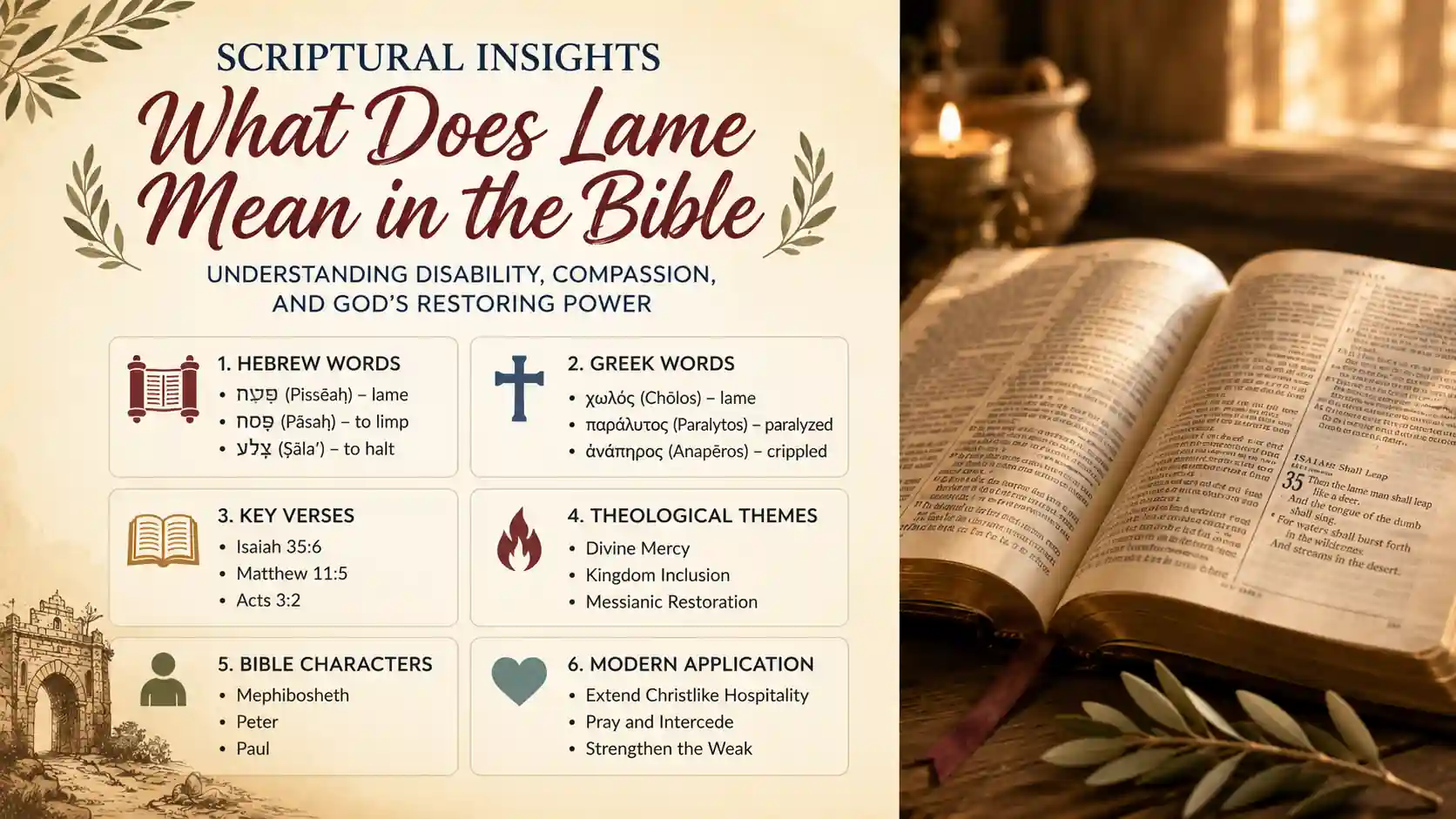
The principal Hebrew adjective translated “lame” is פִּסֵּחַ, pissēaḥ, Strong’s H6455. It describes a genuine impairment affecting a person’s feet or manner of walking. Its related verb פָּסַח, pāsaḥ, can describe limping or moving irregularly, though it is also associated with passing over in the Passover account.
In Leviticus 21:18, a priest who was lame could not approach the altar to present offerings. This restriction concerned ceremonial representation and priestly duty, not personal worth or covenant rejection. The same passage allowed the priest to eat the holy food, confirming that he still belonged to the priestly household.
What Does Lame Mean in the Bible’S Story of Mephibosheth?
Mephibosheth became lame when his nurse fled after the deaths of Saul and Jonathan. He was five years old, and the injury left him impaired in both feet. In the ancient royal world, his disability intensified his dependence and vulnerability as a surviving descendant of a fallen dynasty.
David did not heal Mephibosheth, but he restored his property and invited him to eat continually at the king’s table. The account therefore presents another form of restoration. Mephibosheth remained lame, yet covenant kindness gave him security, provision, fellowship, and honor within the royal household.
Χωλός ChōLos and the Messianic Healings of Jesus
The primary New Testament word is χωλός, chōlos, Strong’s G5560. It refers to someone lame, crippled, or unable to walk normally. Matthew uses the term when crowds bring suffering people to Jesus, and the Gospel reports that the lame walked and the people glorified the God of Israel.
These healings were compassionate acts toward real individuals, but they were also signs of messianic fulfillment. Isaiah 35 had pictured the lame leaping when God came to save his people. Jesus pointed to the fact that “the lame walk” as evidence that God’s promised kingdom was breaking into history through his ministry.
From the Beautiful Gate to the Straight Paths of Hebrews
Acts 3 records a man who had been lame from birth and was carried daily to the temple. Peter offered him neither silver nor gold, but commanded him in the name of Jesus Christ of Nazareth to walk. His strengthened feet and ankles led to public praise and an apostolic proclamation about Jesus.
Hebrews 12:13 uses lameness pastorally and figuratively. Believers are commanded to make straight paths so that what is lame will not be put out of joint but healed. The church must create faithful paths that strengthen struggling people rather than making their discipleship more painful or unstable.
Frequently Asked Questions About Lame in the Bible
Does the Hebrew word פִּסֵּחַ, pissēaḥ, always describe a physical disability?
It ordinarily describes literal lameness, though related words can provide figurative images of wavering or irregular movement.
Why could a lame priest not serve at the altar in Leviticus 21:18?
The restriction concerned the symbolic wholeness required for priestly altar service, not the priest’s value, salvation, or membership in Israel.
Why do some translations say “disabled” or “crippled” instead of “lame”?
Translators choose different English terms to communicate the same underlying condition clearly and respectfully to contemporary readers.
Is Hebrews 12:13 speaking about physical healing?
Its immediate purpose is pastoral, urging the community to strengthen spiritually vulnerable believers and lead them toward healing rather than collapse.
What should Christians learn from Jesus healing the lame?
You should see Christ’s compassion, recognize the arrival of his kingdom, honor people with disabilities, and hope for God’s complete restoration.