
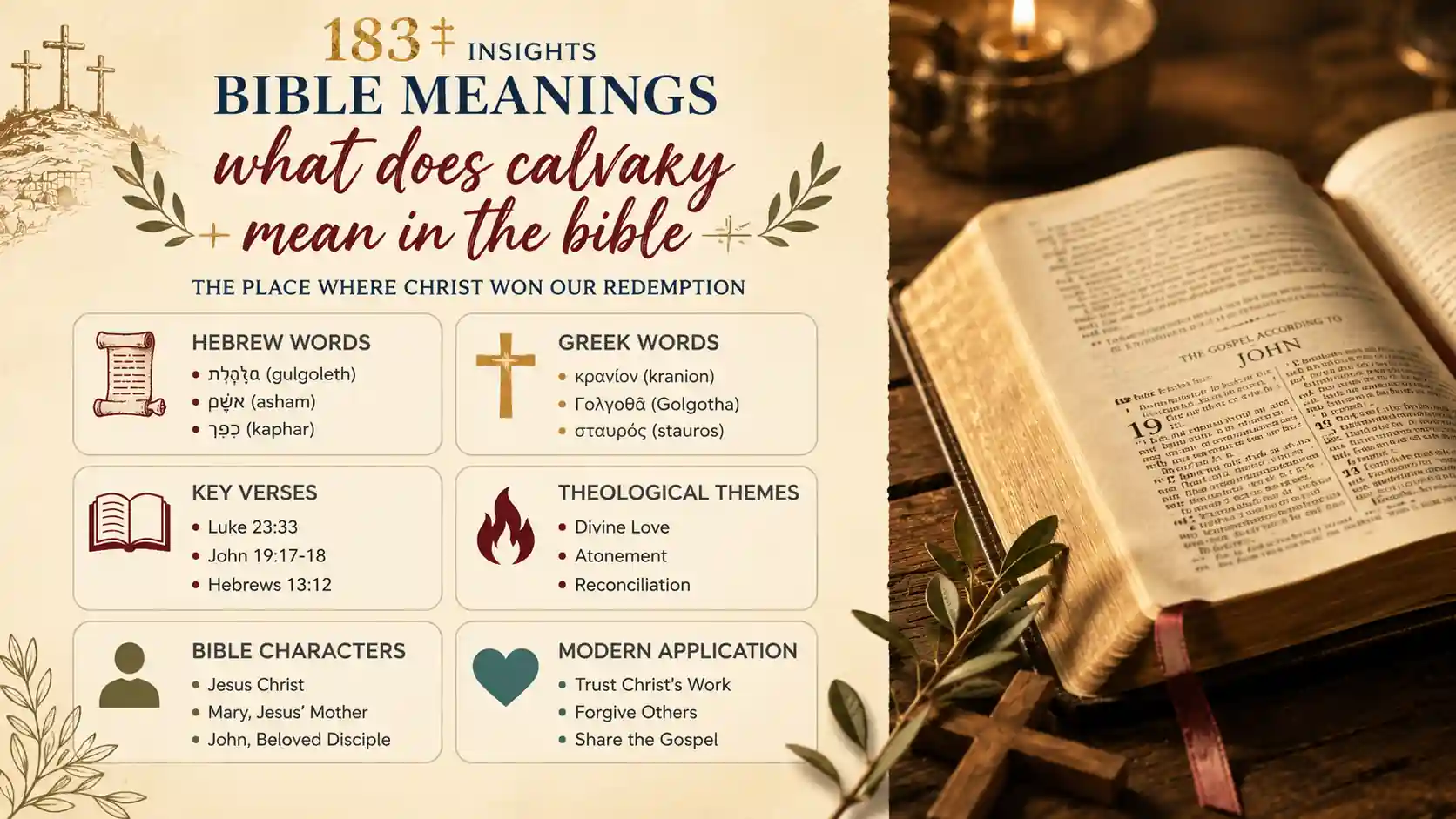
What does Calvary mean in the Bible? Calvary is the place where Jesus Christ was crucified outside Jerusalem. The English name comes through Latin from a Greek word meaning “skull.” Scripture also calls the location Golgotha, an Aramaic name carrying the same meaning.
Yet Calvary signifies far more than geography. In your study of Scripture, it becomes the setting where Christ bears sin, fulfills prophecy, reveals divine love, establishes the new covenant, and opens the way of reconciliation between God and humanity.
Calvary Key Scripture References
| Verse | Passage Snippet | Context |
|---|---|---|
| Matthew 27:33 | “A place called Golgotha” | Matthew identifies the crucifixion site |
| Mark 15:22 | “Place of a skull” | Jesus is led outside for execution |
| Luke 23:33 | “The place, which is called Calvary” | The KJV uses the Latin-derived name |
| John 19:17 | “Called in the Hebrew Golgotha” | Jesus carries the cross toward the site |
| John 19:18 | “There they crucified him” | Two others are crucified beside Jesus |
| John 19:20 | “Nigh to the city” | The execution site was near Jerusalem |
| Hebrews 13:12 | “Suffered without the gate” | Christ’s location carries theological meaning |
| Isaiah 53:5 | “Wounded for our transgressions” | The Servant suffers for human sin |
| 1 Peter 2:24 | “Bare our sins” | Christ’s death brings righteousness and healing |
Calvary Bible Translation Comparison
| Verse | KJV | NIV | ESV | NASB |
|---|---|---|---|---|
| Luke 23:33 | “Called Calvary” | “Called the Skull” | “Called The Skull” | “Called The Skull” |
| Matthew 27:33 | “Golgotha” | “Golgotha” | “Golgotha” | “Golgotha” |
| Mark 15:22 | “Golgotha” | “Golgotha” | “Golgotha” | “Golgotha” |
| John 19:17 | “Golgotha” | “Golgotha” | “Golgotha” | “Golgotha” |
| Luke 23:34 | “Father, forgive them” | “Father, forgive them” | “Father, forgive them” | “Father, forgive them” |
| Luke 23:46 | “Into thy hands” | “Into your hands” | “Into your hands” | “Into Your hands” |
| John 19:30 | “It is finished” | “It is finished” | “It is finished” | “It is finished” |
| Hebrews 13:12 | “Without the gate” | “Outside the city gate” | “Outside the gate” | “Outside the gate” |
Calvary People and Characters Associated
| Person | Role | Connection |
|---|---|---|
| Jesus Christ | Crucified Messiah | Gives His life at Calvary |
| Simon of Cyrene | Cross-bearer | Compelled to carry Jesus’ cross |
| Mary, Jesus’ mother | Faithful witness | Stands near the cross |
| John | Beloved disciple | Receives care of Mary |
| Mary Magdalene | Disciple and witness | Watches the crucifixion |
| Pontius Pilate | Roman governor | Authorizes the execution |
| Roman centurion | Execution officer | Confesses Jesus’ righteousness |
| Two criminals | Condemned men | Crucified beside Jesus |
| Joseph of Arimathea | Council member | Buries Jesus after His death |
Calvary Original Hebrew and Greek Words
| Original Word | Transliteration | Strong’s # | Literal Meaning |
|---|---|---|---|
| κρανίον | kranion | G2898 | Skull |
| Γολγοθᾶ | Golgotha | G1115 | Golgotha, skull-place |
| σταυρός | stauros | G4716 | Cross, execution stake |
| σταυρόω | stauroō | G4717 | To crucify |
| ξύλον | xylon | G3586 | Wood, tree |
| ἀπολύτρωσις | apolytrōsis | G629 | Redemption, release |
| גֻּלְגֹּלֶת | gulgoleth | H1538 | Skull, head |
| מָשִׁיחַ | mashiach | H4899 | Anointed one |
| אָשָׁם | asham | H817 | Guilt offering |
| כָּפַר | kaphar | H3722 | To cover, make atonement |
Calvary Related Biblical Concepts
| Concept | Connection | Supporting Verse |
|---|---|---|
| Crucifixion | Jesus dies by Roman execution | Mark 15:24 |
| Atonement | Christ bears sin on behalf of others | Isaiah 53:6 |
| Redemption | His blood purchases freedom | Ephesians 1:7 |
| Reconciliation | Enemies are brought near to God | Romans 5:10 |
| Forgiveness | Jesus prays for His executioners | Luke 23:34 |
| Sacrifice | Christ offers Himself once for all | Hebrews 10:10 |
| New covenant | His blood establishes covenant blessing | Luke 22:20 |
| Substitution | The righteous suffers for the unrighteous | 1 Peter 3:18 |
| Victory | Christ triumphs over hostile powers | Colossians 2:15 |
Calvary Historical and Cultural Context
| Aspect | Detail | Biblical Source |
|---|---|---|
| Location | Outside Jerusalem’s gate | Hebrews 13:12 |
| Proximity | Near the city | John 19:20 |
| Local name | Golgotha | John 19:17 |
| Name meaning | Place of the Skull | Matthew 27:33 |
| Government | Roman authority controlled execution | John 19:10 |
| Method | Crucifixion displayed public shame | Hebrews 12:2 |
| Cross-bearing | Condemned persons carried the cross | John 19:17 |
| Public notice | Charge written in three languages | John 19:19-20 |
| Burial area | A garden and tomb were nearby | John 19:41 |
Calvary Theological Themes
| Theme | Explanation | Scripture |
|---|---|---|
| Divine love | God gives His Son for sinners | John 3:16 |
| Human sin | The cross exposes sin’s seriousness | Romans 3:23-25 |
| Penal suffering | Christ bears judgment connected with sin | Isaiah 53:5 |
| Covenant fulfillment | Jesus’ blood seals the new covenant | 1 Corinthians 11:25 |
| Righteousness | God remains just while justifying believers | Romans 3:26 |
| Reconciliation | Christ makes peace through His blood | Colossians 1:20 |
| Kingship | Jesus reigns through sacrificial obedience | John 19:19 |
| Forgiveness | Repentant sinners receive mercy | Luke 23:42-43 |
| Victory | Death and spiritual powers are defeated | Hebrews 2:14 |
Calvary Modern Application for Believers
| Area | Practice | Scripture |
|---|---|---|
| Faith | Trust Christ’s completed work | John 19:30 |
| Repentance | Turn from sin to the crucified Savior | Acts 3:19 |
| Gratitude | Thank God for redemption | Colossians 1:12-14 |
| Forgiveness | Forgive as Christ forgave | Ephesians 4:32 |
| Humility | Follow Christ’s self-giving pattern | Philippians 2:5-8 |
| Worship | Praise the Lamb who was slain | Revelation 5:12 |
| Holiness | Die to sin and live righteously | 1 Peter 2:24 |
| Endurance | Look to Jesus amid suffering | Hebrews 12:2-3 |
| Witness | Proclaim Christ crucified | 1 Corinthians 1:23 |
What Does Calvary Mean in the Bible and in Luke 23:33?
The word “Calvary” appears in the King James Version of Luke 23:33. It comes from the Latin calvaria, meaning “skull.” Latin-speaking Christians used calvaria to translate the Greek noun κρανίον, kranion, also meaning “skull.” English inherited “Calvary” from that Latin tradition.
Most modern English translations render Luke’s expression as “the Skull” rather than “Calvary.” This difference does not indicate competing locations. Calvary, the Skull, and Golgotha refer to the same crucifixion site. The translations simply preserve different stages in the word’s movement from a Semitic name into Greek, Latin, and English.
From גֻּלְגֹּלֶת to Γολγοθᾶ And κρανίον
The Greek Gospels preserve the place-name Γολγοθᾶ, Golgotha, listed as Strong’s G1115. It represents a Semitic name related to גֻּלְגֹּלֶת, gulgoleth, Strong’s H1538, the Hebrew word for a skull, head, or counted individual. Matthew, Mark, and John explain the unfamiliar name for their readers.
Luke does not use Γολγοθᾶ in Luke 23:33. He gives the Greek translation κρανίον, kranion, Strong’s G2898. The wording helps a Greek-reading audience understand the name immediately. Calvary is therefore not an additional biblical place. It is the traditional English name for the place the Gospel writers call Golgotha or the Skull.
Scripture does not explain why the site carried this name. It may have referred to the shape of the terrain, its association with death, or a familiar local designation. Claims that Adam’s skull lay there or that executions routinely left skulls scattered there come from later traditions, not explicit biblical testimony.
Calvary Outside the Gate and the Fulfillment of Sacrifice
Hebrews 13:12 says Jesus suffered “outside the gate.” Historically, this agrees with the Gospel picture of a site outside Jerusalem yet close enough for many people to read Pilate’s inscription. Theologically, Hebrews connects Christ’s suffering with sacrificial bodies taken outside Israel’s camp.
Under the old covenant, certain sin-offering remains were burned outside the camp, as described in Leviticus 16:27. Jesus fulfills and surpasses that pattern. He bears rejection and uncleanness outside the sacred boundary so that His people may be sanctified through His blood.
This does not mean every detail of Roman crucifixion directly copied Israel’s sacrifices. Rome crucified Jesus as a condemned man. Yet God’s providence placed that historical death within the scriptural pattern of substitution, shame, cleansing, and access to His presence.
At Calvary the Cross Becomes God’S Message of Redemption
Calvary reveals both the depth of human rebellion and the depth of divine mercy. Religious leaders accuse Jesus, political authority sentences Him, soldiers mock Him, and spectators watch Him suffer. Yet Jesus prays, “Father, forgive them,” showing that His mercy reaches toward the guilty.
The cross also displays substitution. Jesus is innocent, but He dies among criminals. Barabbas, a guilty prisoner, is released while Jesus is condemned. This exchange provides a vivid historical picture of the gospel, though Christ’s atoning work extends far beyond Barabbas to all who trust Him.
Calvary cannot be separated from the resurrection. The cross is not merely a tragedy or an inspiring example of courage. The crucified Jesus is raised from the dead, confirming His identity and the saving significance of His death. Your hope rests not in a sacred location, but in the living Lord who finished His sacrificial work there.
Questions About Calvary
Are Calvary and Golgotha the same place?
Yes. Calvary is the Latin-derived English name, while Golgotha is the Semitic place-name preserved in the Gospels.
Why does the KJV say “Calvary” while the NIV and ESV say “the Skull”?
The KJV follows the traditional Latin-derived term, while modern versions translate the Greek κρανίον, kranion, directly.
Is Γολγοθᾶ, Golgotha, a Greek word?
It appears in Greek manuscripts as Strong’s G1115, but it transliterates a Semitic name related to a word meaning “skull.”
Does the Bible actually call Calvary a hill?
No. Scripture identifies the place but never explicitly calls it “Mount Calvary” or states that it was a hill.
How should Calvary shape your Christian life?
It calls you to trust Christ, reject sin, forgive others, endure suffering faithfully, and live in gratitude for His completed redemption.