
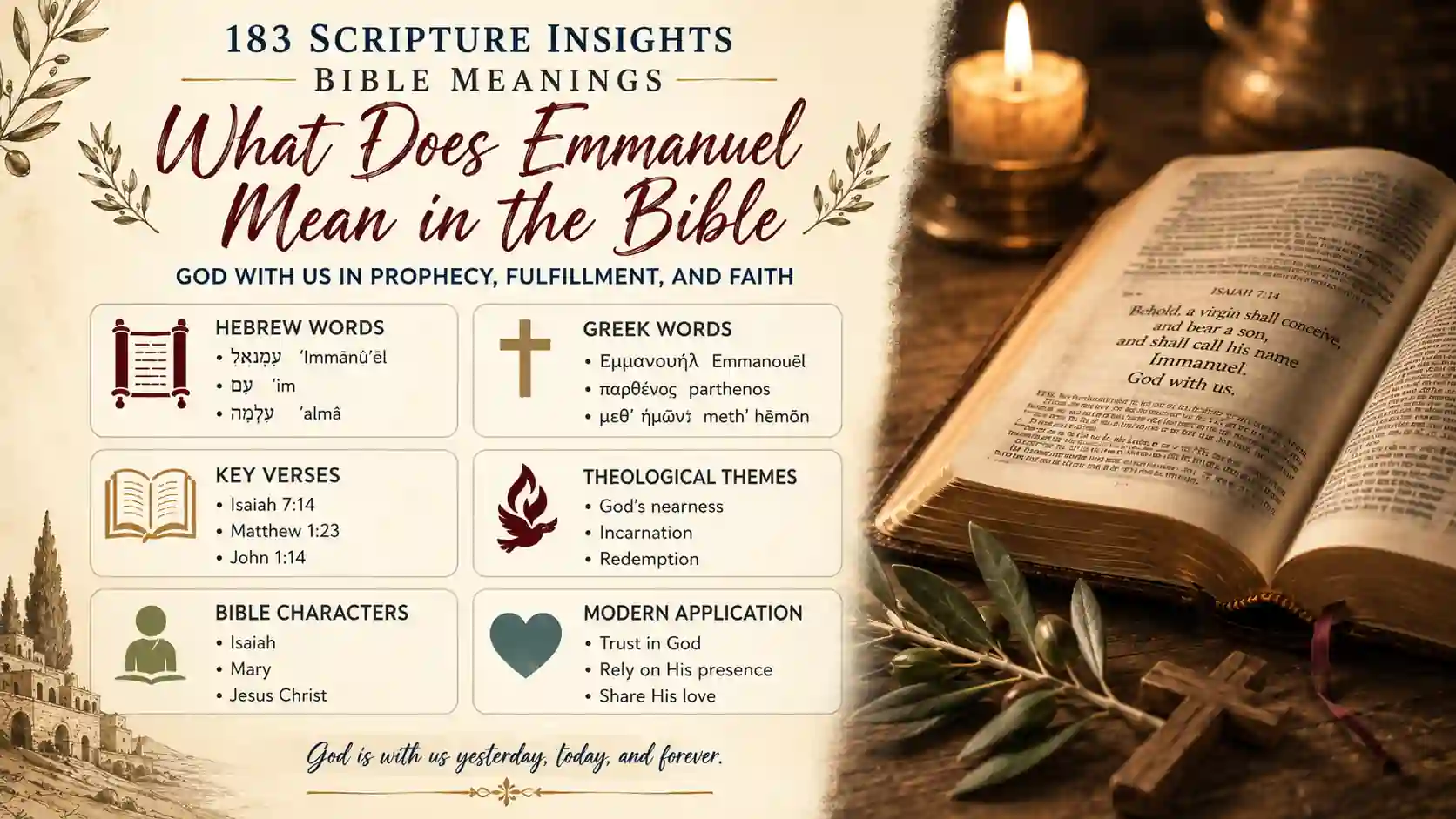
What does emmanuel mean in the bible? Emmanuel means “God with us.” The name comes from the Hebrew עִמָּנוּאֵל, transliterated ʿImmānûʾēl, and appears in Isaiah’s prophecy during a national crisis. Matthew later applies that prophecy to the birth of Jesus Christ.
The name is more than a comforting religious expression. It announces God’s presence among His people, His faithfulness to His promises, and His saving action in history. As you study Emmanuel, you encounter a theme stretching from Isaiah’s sign to Christ’s incarnation and His continuing presence with believers.
Emmanuel Key Scripture References
| Verse | Passage Snippet | Context |
|---|---|---|
| Isaiah 7:14 | “Call his name Immanuel” | A sign given during the Syro-Ephraimite crisis |
| Isaiah 8:8 | “O Immanuel” | Judah belongs to the God who is with His people |
| Isaiah 8:10 | “God is with us” | Enemy plans cannot overturn God’s purpose |
| Matthew 1:18 | Mary was found with child | The conception of Jesus is attributed to the Holy Spirit |
| Matthew 1:21 | “He shall save his people” | Jesus’ name identifies His saving mission |
| Matthew 1:22 | The prophecy was fulfilled | Matthew connects Jesus’ birth with Isaiah |
| Matthew 1:23 | “God with us” | The Gospel explains the meaning of Emmanuel |
| John 1:14 | “The Word was made flesh” | God’s eternal Word dwells among humanity |
| Matthew 18:20 | “There am I” | Christ promises presence among gathered disciples |
| Matthew 28:20 | “I am with you always” | The risen Jesus remains with His people |
Emmanuel Bible Translation Comparison
| Verse | KJV | NIV | ESV | NASB |
|---|---|---|---|---|
| Isaiah 7:14 | “a virgin” | “the virgin” | “the virgin” | “a virgin” |
| Isaiah 7:14 | “Immanuel” | “Immanuel” | “Immanuel” | “Immanuel” |
| Isaiah 8:8 | “O Immanuel” | “Immanuel” | “O Immanuel” | “Immanuel” |
| Isaiah 8:10 | “God is with us” | “God is with us” | “God is with us” | “God is with us” |
| Matthew 1:21 | “save his people” | “save his people” | “save his people” | “save His people” |
| Matthew 1:22 | “spoken of the Lord” | “spoken through the prophet” | “spoken by the Lord” | “spoken by the Lord” |
| Matthew 1:23 | “a virgin” | “the virgin” | “the virgin” | “the virgin” |
| Matthew 1:23 | “Emmanuel” | “Immanuel” | “Immanuel” | “Immanuel” |
| John 1:14 | “dwelt among us” | “made his dwelling among us” | “dwelt among us” | “dwelt among us” |
| Matthew 28:20 | “with you alway” | “with you always” | “with you always” | “with you always” |
Emmanuel People and Characters Associated
| Person | Role | Connection |
|---|---|---|
| Isaiah | Prophet in Judah | Announced the sign of Immanuel |
| Ahaz | King of Judah | Received the sign during political danger |
| Rezin | King of Aram | Joined the threat against Jerusalem |
| Pekah | King of Israel | Allied with Rezin against Judah |
| Shear-jashub | Isaiah’s son | Accompanied Isaiah when he confronted Ahaz |
| The young woman | Mother in Isaiah’s sign | Would bear the child called Immanuel |
| Joseph | Legal father of Jesus | Obeyed the angel and received Mary |
| Mary | Mother of Jesus | Conceived by the Holy Spirit |
| Jesus Christ | Son and Savior | Personally fulfills “God with us” |
| Matthew | Gospel writer | Interpreted Jesus’ birth through Isaiah 7:14 |
Emmanuel Original Hebrew and Greek Words
| Original Word | Transliteration | Strong’s # | Literal Meaning |
|---|---|---|---|
| עִמָּנוּאֵל | ʿImmānûʾēl | H6005 | God with us |
| עִם | ʿim | H5973 | With |
| עִמָּנוּ | ʿimmānû | H5973 | With us |
| אֵל | ʾēl | H410 | God, mighty one |
| עַלְמָה | ʿalmâ | H5959 | Young woman, maiden |
| אוֹת | ʾôt | H226 | Sign |
| Ἐμμανουήλ | Emmanouēl | G1694 | God with us |
| παρθένος | parthenos | G3933 | Virgin |
| θεός | theos | G2316 | God |
| μεθ᾽ ἡμῶν | meth’ hēmōn | G3326, G1473 | With us |
Emmanuel Related Biblical Concepts
| Concept | Connection | Supporting Verse |
|---|---|---|
| Divine presence | Emmanuel declares that God is with His people | Isaiah 8:10 |
| Incarnation | The eternal Word became human | John 1:14 |
| Virgin conception | Jesus was conceived by the Holy Spirit | Matthew 1:18 |
| Salvation from sin | Emmanuel comes as the saving Messiah | Matthew 1:21 |
| Prophetic fulfillment | Matthew reads Isaiah through Christ’s birth | Matthew 1:22 |
| Covenant faithfulness | God preserves His promise despite human fear | Isaiah 7:9 |
| Davidic kingship | The sign concerns the house of David | Isaiah 7:13 |
| Divine protection | Nations cannot defeat God’s final purpose | Isaiah 8:10 |
| Temple presence | God desires to dwell among His people | Exodus 25:8 |
| Mission | Christ remains present with His disciples | Matthew 28:20 |
Emmanuel Historical and Cultural Context
| Aspect | Detail | Biblical Source |
|---|---|---|
| Historical period | Eighth century BC | Isaiah 7:1 |
| Southern kingdom | Judah was ruled from Jerusalem | Isaiah 7:1 |
| Judah’s king | Ahaz faced invasion | Isaiah 7:2 |
| Enemy alliance | Aram and Israel joined forces | Isaiah 7:1 |
| Political objective | The allies sought to replace Judah’s king | Isaiah 7:6 |
| Assyrian pressure | A growing empire dominated the region | 2 Kings 16:7 |
| Isaiah’s counsel | Ahaz was commanded to trust God | Isaiah 7:4 |
| Offered sign | Ahaz could ask for confirmation | Isaiah 7:11 |
| Ahaz’s refusal | He concealed unbelief beneath pious words | Isaiah 7:12 |
| House of David | The prophecy addressed the royal dynasty | Isaiah 7:13 |
Emmanuel Theological Themes
| Theme | Explanation | Scripture |
|---|---|---|
| God’s nearness | God enters the experience of His people | Matthew 1:23 |
| Christ’s deity | Jesus embodies God’s presence among humanity | John 1:1, 14 |
| Christ’s humanity | The Son truly shares human nature | Hebrews 2:14 |
| Fulfillment | God directs history toward His promised Messiah | Matthew 1:22 |
| Redemption | Jesus saves His people from their sins | Matthew 1:21 |
| Judgment | God’s presence also exposes unbelief | Isaiah 8:14 |
| Assurance | Hostile plans cannot cancel God’s word | Isaiah 8:10 |
| Kingship | Emmanuel is linked to David’s royal house | Isaiah 7:13 |
| Revelation | Jesus makes the Father known | John 1:18 |
| Perseverance | Christ remains with disciples in mission | Matthew 28:20 |
Emmanuel Modern Application for Believers
| Area | Practice | Scripture |
|---|---|---|
| Fear | Remember God’s presence during uncertainty | Isaiah 7:4 |
| Faith | Trust God rather than human alliances | Isaiah 7:9 |
| Prayer | Approach God through Christ confidently | Hebrews 4:16 |
| Worship | Honor Jesus as God who came near | Matthew 2:11 |
| Repentance | Receive the Savior who delivers from sin | Matthew 1:21 |
| Loneliness | Rest in Christ’s continuing presence | Matthew 28:20 |
| Church life | Gather with awareness of Jesus among His people | Matthew 18:20 |
| Mission | Make disciples under Christ’s authority | Matthew 28:18-20 |
| Suffering | Believe that God has not abandoned you | Romans 8:35 |
| Hope | Await complete fellowship with God | Revelation 21:3 |
עִמָּנוּאֵל Reveals God’S Presence in a Time of Fear
Isaiah first spoke the name Immanuel when Judah was trembling. Rezin of Aram and Pekah of Israel had formed an alliance against Jerusalem. Isaiah 7:2 says that Ahaz and his people shook like forest trees moved by the wind. The prophecy therefore arose from a real military and spiritual crisis.
God sent Isaiah to tell Ahaz not to fear. The king’s security did not ultimately depend on diplomacy, military strength, or an alliance with Assyria. It depended on the word of the Lord. The name עִמָּנוּאֵל, ʿImmānûʾēl, confronted fear with the reality that God had not abandoned His covenant purpose.
Ahaz was invited to ask for an אוֹת, ʾôt, or sign. His refusal sounded humble, but the context reveals resistance to trusting God. Isaiah then addressed the “house of David,” showing that the sign extended beyond one king’s private circumstances and concerned the future of the Davidic line.
The child’s name declared that political enemies would not destroy God’s promise. Yet divine presence did not mean the absence of discipline. Assyria would become an instrument of judgment against unbelieving Judah. Emmanuel could signify comfort for the faithful and warning for those who rejected God’s word.
What Does Emmanuel Mean in the Bible’S Gospel Fulfillment?
Matthew 1:23 quotes Isaiah 7:14 and translates Ἐμμανουήλ, Emmanouēl, as “God with us.” Matthew does not present Jesus as merely another child with a symbolic name. He identifies the conception and birth of Jesus as the climactic realization of Isaiah’s promise.
The Gospel carefully joins two names. “Jesus,” from the Hebrew name יֵשׁוּעַ, Yēshûaʿ, emphasizes His mission to save His people from their sins. “Emmanuel” emphasizes His identity and presence. The Savior is not a distant agent. In Jesus, God personally draws near to rescue His people.
Matthew’s use of Isaiah also highlights the virgin conception. Isaiah uses עַלְמָה, ʿalmâ, a term for a young woman of marriageable age. The Greek Septuagint renders it παρθένος, parthenos, meaning virgin, and Matthew uses that Greek wording while describing Mary’s conception by the Holy Spirit.
The immediate setting in Isaiah and the ultimate fulfillment in Jesus do not need to be treated as competitors. Biblical prophecy can address an unfolding historical situation while reaching its fullest meaning in God’s later redemptive work. Matthew presents Christ as the decisive fulfillment toward which the Immanuel sign pointed.
Emmanuel and the Mystery of the Incarnation
The doctrine of the incarnation gives theological depth to Emmanuel. John 1:14 says that the Word became flesh and dwelt among us. The verb translated “dwelt” evokes the idea of pitching a tent or tabernacling. God’s presence, once associated with the tabernacle and temple, is revealed personally in Jesus.
“God with us” does not mean that the Father became the Son or that Jesus merely appeared human. The New Testament presents the eternal Son as truly divine and truly human. He entered human history, experienced weakness and suffering, and remained without sin.
This nearness makes salvation personal. Jesus does not save from a protected distance. He shares flesh and blood, bears sin, dies, rises, and brings His people to God. Hebrews 2 connects His genuine humanity with His ability to call the redeemed His brothers and sisters.
Emmanuel also points toward the cross. God’s presence is not proved by a life without sorrow. It is displayed when the Son enters the deepest consequences of human rebellion and accomplishes redemption. The child of Matthew 1 is the crucified and risen Lord of Matthew 28.
From Isaiah’S Sign to Christ’S Continuing Presence
Matthew’s Gospel begins with “God with us” and ends with Jesus saying, “I am with you always, to the end of the age.” This literary pattern shows that Emmanuel is not limited to Bethlehem. The risen Christ remains present as His disciples worship, gather, suffer, and make disciples.
You should not interpret this promise as freedom from every hardship. Isaiah’s audience still faced invasion, judgment, and upheaval. The apostles also faced persecution. God’s presence means that suffering cannot separate His people from His covenant love or prevent His saving purpose from being completed.
Emmanuel therefore shapes your worship and obedience. You gather with other believers knowing Christ is among His people. You pray knowing that the Son has opened access to the Father. You serve knowing that Christian mission proceeds under Christ’s authority and with His promised presence.
The theme reaches its final horizon in Revelation 21:3, where God’s dwelling is with humanity. Scripture moves from God walking in Eden, to the tabernacle, to the temple, to Christ’s incarnation, to the Spirit-filled church, and finally to unbroken fellowship in the new creation.
Frequently Asked Questions About Emmanuel
Are Emmanuel and Immanuel different biblical names?
No. They are English spelling variations of the same Hebrew name, עִמָּנוּאֵל, meaning “God with us.”
Does עַלְמָה, ʿalmâ, in Isaiah 7:14 necessarily mean virgin?
The word describes a young woman, while Matthew follows the Greek παρθένος and identifies Mary explicitly as a virgin.
Was Isaiah 7:14 fulfilled in Isaiah’s lifetime or only in Jesus?
The sign addressed Isaiah’s historical crisis, but Matthew presents Jesus as its fullest and climactic fulfillment.
Why is Jesus called Emmanuel when people usually called Him Jesus?
Jesus identifies His saving mission, while Emmanuel reveals the divine presence embodied in His person and work.
How should “God with us” affect your life during suffering?
It assures you that Christ remains present and faithful even when obedience does not remove pain or danger.