
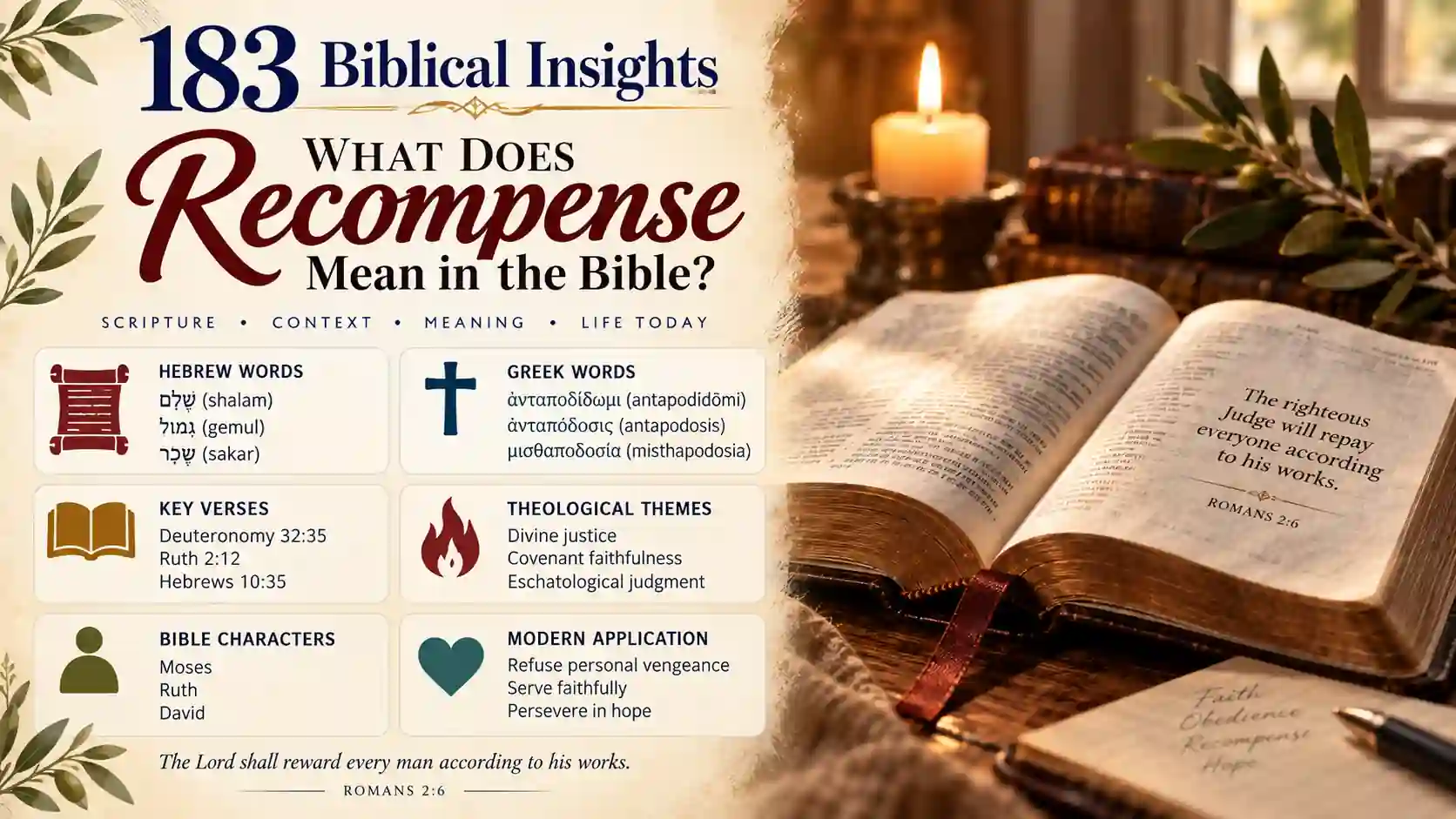
What does recompense mean in the Bible? In Scripture, recompense refers to repayment, requital, compensation, reward, or judgment given in response to a person’s actions. The idea can be positive, as when God rewards faithfulness, or negative, as when wrongdoing receives just consequences.
Biblical recompense is therefore closely connected with God’s justice, covenant faithfulness, restitution, judgment, and gracious reward. As you study the Hebrew and Greek vocabulary, you discover that Scripture presents God as the righteous Judge who repays evil rightly while faithfully rewarding those who trust and obey Him.
Recompense in Key Scripture References
| Verse | Passage Snippet | Context |
|---|---|---|
| Deuteronomy 32:35 | “Vengeance is mine, and recompense” | God declares judgment against His enemies |
| Ruth 2:12 | “The LORD recompense thy work” | Boaz blesses Ruth for her faithfulness |
| 2 Samuel 3:39 | “The LORD shall reward the doer of evil” | David entrusts Joab’s guilt to God |
| Psalm 18:20 | “The LORD rewarded me” | David celebrates God’s righteous deliverance |
| Psalm 62:12 | “Thou renderest to every man” | God repays according to deeds |
| Isaiah 35:4 | “God will come with recompence” | Divine judgment accompanies salvation |
| Isaiah 40:10 | “His reward is with him” | God comes as victorious Shepherd-King |
| Isaiah 59:18 | “According to their deeds” | The divine Warrior executes justice |
| Romans 12:19 | “I will repay, saith the Lord” | Christians surrender personal vengeance |
| Hebrews 10:35 | “Great recompence of reward” | Persevering believers are urged toward confidence |
Recompense Across Major Bible Translations
| Verse | KJV | NIV | ESV | NASB |
|---|---|---|---|---|
| Deuteronomy 32:35 | “vengeance, and recompence” | “avenge; I will repay” | “vengeance is mine, and recompense” | “vengeance is Mine, and retribution” |
| Ruth 2:12 | “recompense thy work” | “repay you” | “repay you” | “reward your work” |
| Psalm 62:12 | “renderest to every man” | “reward everyone” | “repay a man” | “recompense a person” |
| Isaiah 35:4 | “with recompence” | “with divine retribution” | “with recompense” | “with recompense” |
| Isaiah 40:10 | “his reward is with him” | “his reward is with him” | “his reward is with him” | “His reward is with Him” |
| Isaiah 59:18 | “according to their deeds” | “according to what they have done” | “according to their deeds” | “according to their deeds” |
| Romans 12:19 | “I will repay” | “I will repay” | “I will repay” | “I will repay” |
| Hebrews 2:2 | “just recompence of reward” | “just punishment” | “just retribution” | “just punishment” |
| Hebrews 10:35 | “great recompence of reward” | “richly rewarded” | “great reward” | “great reward” |
People and Characters Connected with Biblical Recompense
| Person | Role | Connection |
|---|---|---|
| Moses | Covenant mediator | Announces God’s vengeance and recompense |
| Ruth | Faithful Moabite widow | Receives Boaz’s prayer for divine reward |
| Boaz | Kinsman and landowner | Asks God to repay Ruth’s faithfulness |
| David | King and psalmist | Trusts God to reward righteousness and judge evil |
| Joab | David’s military commander | David leaves recompense for his violence to God |
| Isaiah | Prophet | Describes God coming with recompense |
| Jeremiah | Prophet | Announces repayment for persistent rebellion |
| Paul | Apostle | Commands believers to leave vengeance to God |
| Moses in Hebrews | Example of faith | Looks ahead to divine reward |
| Jesus Christ | Lord and Judge | Repays each person according to his works |
Hebrew and Greek Words Behind Recompense
| Original Word | Transliteration | Strong’s # | Literal Meaning |
|---|---|---|---|
| שָׁלַם | shalam | H7999 | repay, make whole, recompense |
| גְּמוּל | gemul | H1576 | dealing, benefit, recompense |
| שָׂכָר | sakar | H7939 | wages, reward, payment |
| שִׁלּוּם | shillum | H7966 | requital, recompense |
| שִׁלֻּמָה | shillumah | H8011 | requital, retribution |
| ἀνταποδίδωμι | antapodidōmi | G467 | repay, give back in return |
| ἀνταπόδοσις | antapodosis | G469 | repayment, recompense |
| ἀντιμισθία | antimisthia | G489 | corresponding reward or requital |
| μισθαποδοσία | misthapodosia | G3405 | payment of wages, recompense |
Biblical Concepts Closely Related to Recompense
| Concept | Connection | Supporting Verse |
|---|---|---|
| Justice | God gives what righteousness requires | Deuteronomy 32:35 |
| Reward | Faithfulness receives divine recognition | Ruth 2:12 |
| Judgment | Evil receives righteous consequences | Isaiah 59:18 |
| Restitution | Wrongdoing may require repayment | Exodus 21:34 |
| Vengeance | Final retaliation belongs to God | Romans 12:19 |
| Grace | God’s reward exceeds mere human merit | Hebrews 11:6 |
| Perseverance | Confidence has promised reward | Hebrews 10:35 |
| Accountability | Human actions matter before God | Psalm 62:12 |
| Faith | Moses valued God’s reward above Egypt | Hebrews 11:26 |
Historical and Cultural Setting of Recompense
| Aspect | Detail | Biblical Source |
|---|---|---|
| Covenant law | Israelite law required compensation for losses | Exodus 21:33-36 |
| Property damage | Owners could be required to make restitution | Exodus 22:1-6 |
| Sacred offenses | Certain trespasses required added repayment | Leviticus 5:15-16 |
| Ancient wages | Payment language supplied imagery for reward | Leviticus 19:13 |
| Covenant sanctions | Disobedience brought divinely announced consequences | Deuteronomy 28 |
| Wisdom tradition | Conduct was linked with fitting consequences | Proverbs 11:31 |
| Royal justice | Kings were expected to punish wrongdoing | 2 Samuel 3:39 |
| Prophetic judgment | Prophets portrayed God repaying nations | Isaiah 59:18 |
| Roman society | Retaliation and honor shaped social relationships | Romans 12:17-21 |
| Early Christians | Persecution made future reward especially meaningful | Hebrews 10:32-36 |
Theological Themes within Biblical Recompense
| Theme | Explanation | Scripture |
|---|---|---|
| Divine justice | God judges without corruption or partiality | Romans 2:6 |
| Divine sovereignty | Ultimate repayment belongs to God | Deuteronomy 32:35 |
| Moral accountability | Deeds have genuine significance before God | Psalm 62:12 |
| Covenant faithfulness | God fulfills both warnings and promises | Deuteronomy 7:9-10 |
| Mercy | Believers surrender retaliation rather than seeking revenge | Romans 12:19-21 |
| Perseverance | Future recompense encourages endurance | Hebrews 10:35-36 |
| Faith | God is the rewarder of those who seek Him | Hebrews 11:6 |
| Eschatological judgment | Final recompense reaches beyond present life | Revelation 22:12 |
| Restoration | God can restore what suffering has consumed | Joel 2:25 |
Modern Application of Recompense for Believers
| Area | Practice | Scripture |
|---|---|---|
| Personal conflict | Refuse private vengeance | Romans 12:19 |
| Forgiveness | Respond to hostility with good | Romans 12:20-21 |
| Work | Serve sincerely as serving Christ | Colossians 3:23-24 |
| Perseverance | Do not abandon confidence under pressure | Hebrews 10:35 |
| Generosity | Give without demanding repayment | Luke 14:12-14 |
| Integrity | Remember that God sees hidden conduct | Psalm 62:12 |
| Suffering | Entrust unjust treatment to God | 1 Peter 2:23 |
| Faith | Seek God believing that He rewards | Hebrews 11:6 |
| Hope | Look toward Christ’s final righteous judgment | Revelation 22:12 |
What Does Recompense Mean in the Bible Through שָׁלַם Shalam?
The Hebrew verb שָׁלַם, shalam, Strong’s H7999, gives you one of the clearest Old Testament foundations for understanding recompense. Its range includes making something complete, making restitution, repaying a debt, rewarding good, and requiting evil. The word belongs to the same broad Hebrew word family associated with completeness and peace.
That range matters because biblical recompense is more than retaliation. In passages such as Exodus 21, shalam can describe making good a material loss. In Ruth 2:12, it describes the LORD repaying Ruth for faithful action. Elsewhere, the same verb can describe God repaying wickedness. The context determines whether the repayment is restorative, rewarding, or judicial.
Ruth, David, and Isaiah Show Both Sides of Divine Recompense
Ruth 2:12 offers one of Scripture’s warmest uses of the concept. Boaz asks the LORD to recompense Ruth’s work and grant her a full reward because she has sought refuge under the wings of Israel’s God. Recompense here is blessing rather than punishment. Ruth’s story portrays God’s providential generosity toward faithful trust.
David and Isaiah emphasize the judicial side. David can leave an evildoer’s recompense to the LORD rather than making himself the final judge. Isaiah 35:4 likewise joins recompense with God’s saving arrival. God comes to judge what oppresses His people and to save them, showing that judgment and deliverance can be two aspects of the same righteous intervention.
μισθαποδοσία Misthapodosia and the Recompense of Hebrews
Hebrews uses the striking Greek noun μισθαποδοσία, misthapodosia, Strong’s G3405. Built around the idea of payment or wages due, it can describe either positive reward or deserved punishment. Hebrews 2:2 speaks of transgression receiving just recompense, while Hebrews 10:35 associates persevering confidence with great reward.
Hebrews 11:26 applies the word to Moses. He accepted reproach associated with God’s people rather than treating Egypt’s treasures as his highest good because he looked toward the reward. The point is not that Moses purchased salvation by suffering. His choices revealed faith in God’s promises and confidence that God’s final evaluation was more valuable than immediate earthly advantage.
God’S Recompense Changes How You Respond to Wrongdoing
Romans 12:19 draws directly on the Old Testament conviction that vengeance belongs to God. Because God says that He will repay, you do not need to become the ultimate judge of people who wrong you. Paul therefore connects belief in divine justice with a radically different Christian response to enemies.
That does not mean Scripture denies civil justice, accountability, restitution, or appropriate boundaries. It means personal vengeance is surrendered to the righteous Judge. You can pursue truth and justice without cultivating revenge because biblical recompense assures you that evil is neither invisible nor beyond God’s judgment.
Frequently Asked Questions About Biblical Recompense
Does שָׁלַם, shalam, always mean punishment or vengeance?
No. H7999 can describe repayment, restitution, reward, or requital, so its meaning depends on the context.
Why does Hebrews 2:2 call punishment a μισθαποδοσία, misthapodosia?
The word pictures a fitting repayment, emphasizing that the consequence corresponds justly to the offense.
Why do some translations say “recompense” while others say “reward,” “repay,” or “retribution”?
The underlying Hebrew and Greek terms can describe several kinds of repayment, so translators choose English words that best express each context.
How can Hebrews 10:35 promise reward without teaching salvation by works?
Hebrews presents persevering faith as the response of those who trust God, while the promised reward rests on God’s faithfulness rather than human merit independently earning salvation.
How should Romans 12:19 affect you when someone seriously wrongs you?
You may seek legitimate justice and establish wise boundaries while refusing personal vengeance and entrusting final recompense to God.