
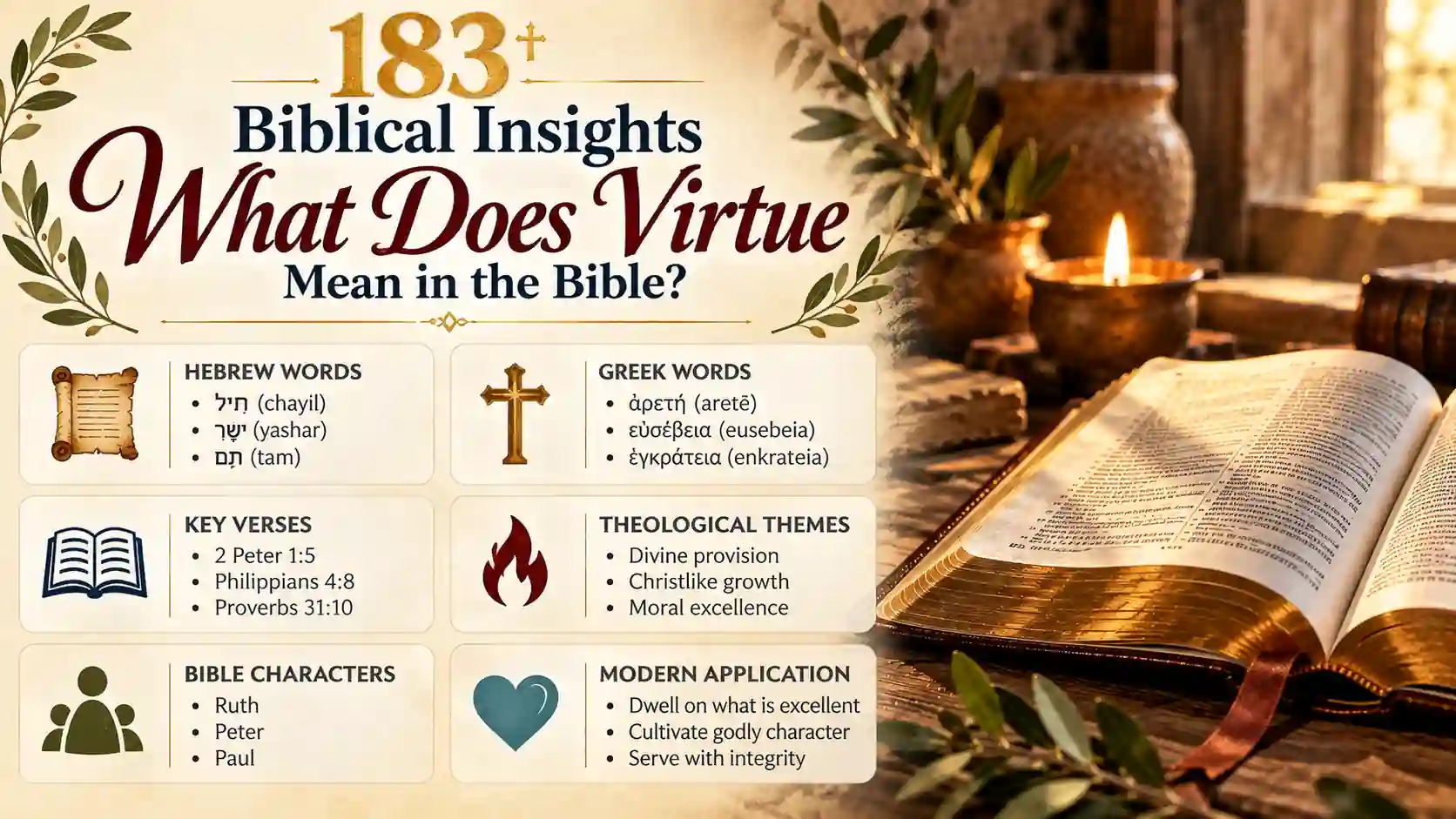
What does virtue mean in the Bible? Scripture presents virtue as moral excellence shaped by the character and calling of God. In the New Testament, the key Greek word ἀρετή (aretē) can describe excellence, goodness, or praiseworthy moral character. Peter especially connects it with a growing, fruitful Christian life.
The Old Testament develops the same theme through words such as חַיִל (chayil), often conveying strength, capability, valor, or noble character. Biblical virtue, therefore, is not merely respectable behavior. It is character expressed through faithful, courageous, righteous living before God.
Key Scripture References for Virtue
| Verse | Passage Snippet | Context |
|---|---|---|
| 2 Peter 1:3 | Called by glory and virtue | God’s power supplies godly life |
| 2 Peter 1:5 | Add to faith virtue | Believers pursue moral excellence |
| 2 Peter 1:8 | Qualities increasing | Virtue belongs to fruitful discipleship |
| Philippians 4:8 | If there be any virtue | Christians consider morally excellent things |
| 1 Peter 2:9 | Show forth his praises | ἀρετή can describe God’s excellencies |
| Proverbs 31:10 | A virtuous woman | חַיִל portrays capable, noble strength |
| Proverbs 12:4 | A virtuous woman | Noble character blesses a household |
| Ruth 3:11 | A virtuous woman | Ruth is publicly known as worthy |
Bible Translation Comparison for Virtue
| Verse | KJV | NIV | ESV | NASB |
|---|---|---|---|---|
| 2 Peter 1:3 | virtue | goodness | excellence | excellence |
| 2 Peter 1:5 | virtue | goodness | virtue | moral excellence |
| Philippians 4:8 | virtue | excellent | excellence | excellence |
| 1 Peter 2:9 | praises | praises | excellencies | excellencies |
| Proverbs 31:10 | virtuous | noble character | excellent | excellent |
| Proverbs 12:4 | virtuous | noble character | excellent | excellent |
| Ruth 3:11 | virtuous | noble character | worthy | excellent |
| Proverbs 31:29 | virtuously | noble things | excellently | nobly |
People and Characters Associated with Virtue
| Person | Role | Connection |
|---|---|---|
| Ruth | Moabite widow | Called אֵשֶׁת חַיִל, a worthy woman |
| Proverbs 31 woman | Wisdom figure | Embodies strength, wisdom, diligence |
| Peter | Apostle | Commands growth in ἀρετή |
| Paul | Apostle | Calls believers to consider ἀρετή |
| Jesus Christ | Lord and Savior | Christian character is formed around him |
| Boaz | Kinsman-redeemer | Recognizes Ruth’s noble character |
| Timothy | Christian minister | Called to exemplary godly conduct |
| Daniel | Exile and prophet | Models integrity under pagan rule |
Original Hebrew and Greek Words for Virtue
| Original Word | Transliteration | Strong’s # | Literal Meaning |
|---|---|---|---|
| ἀρετή | aretē | G703 | excellence, virtue |
| εὐσέβεια | eusebeia | G2150 | godliness, reverence |
| ἐγκράτεια | enkrateia | G1466 | self-control |
| ἀγαθωσύνη | agathōsynē | G19 | goodness |
| δικαιοσύνη | dikaiosynē | G1343 | righteousness |
| חַיִל | chayil | H2428 | strength, valor, capability |
| יָשָׁר | yashar | H3477 | upright, straight |
| תָּם | tam | H8535 | complete, blameless |
Related Biblical Concepts of Virtue
| Concept | Connection | Supporting Verse |
|---|---|---|
| Faith | Starting point for Peter’s growth sequence | 2 Peter 1:5 |
| Knowledge | Virtue is joined with spiritual understanding | 2 Peter 1:5 |
| Self-control | Governs desires and conduct | 2 Peter 1:6 |
| Perseverance | Sustains faithful character | 2 Peter 1:6 |
| Godliness | Directs life toward God | 2 Peter 1:6 |
| Brotherly affection | Virtue becomes relational | 2 Peter 1:7 |
| Love | Climactic quality in Peter’s sequence | 2 Peter 1:7 |
| Righteousness | Expresses conformity to God’s ways | Philippians 1:11 |
Historical and Cultural Context of Virtue
| Aspect | Detail | Biblical Source |
|---|---|---|
| Greek moral language | ἀρετή commonly denoted excellence | 2 Peter 1:5 |
| Apostolic usage | Peter places excellence under Christ’s lordship | 2 Peter 1:3-8 |
| Roman Philippi | Christians lived amid Greco-Roman values | Philippians 4:8 |
| Israelite wisdom | Character appears in practical daily life | Proverbs 31 |
| Household life | חַיִל includes competence and strength | Proverbs 31:10-31 |
| Bethlehem community | Ruth’s character gains public recognition | Ruth 3:11 |
| Christian witness | God’s excellencies are publicly proclaimed | 1 Peter 2:9 |
| False teaching | Growth protects against barren knowledge | 2 Peter 1:8-9 |
Theological Themes of Virtue
| Theme | Explanation | Scripture |
|---|---|---|
| Divine provision | God supplies what believers need for godliness | 2 Peter 1:3 |
| Human diligence | Grace produces active obedience, not passivity | 2 Peter 1:5 |
| Christlike growth | Character should continually increase | 2 Peter 1:8 |
| Moral excellence | Faith produces observable qualities | 2 Peter 1:5 |
| Renewed thinking | Worthy conduct begins with disciplined thought | Philippians 4:8 |
| God’s excellence | Virtue ultimately reflects God’s character | 1 Peter 2:9 |
| Wisdom | Noble character appears in ordinary responsibilities | Proverbs 31:26 |
| Fruitfulness | Mature qualities accompany useful discipleship | 2 Peter 1:8 |
Modern Application of Virtue for Believers
| Area | Practice | Scripture |
|---|---|---|
| Thought life | Dwell on what is morally excellent | Philippians 4:8 |
| Spiritual growth | Cultivate virtue alongside faith | 2 Peter 1:5 |
| Self-discipline | Practice Spirit-shaped self-control | Galatians 5:23 |
| Work | Serve diligently and responsibly | Proverbs 31:13-19 |
| Speech | Speak with wisdom and kindness | Proverbs 31:26 |
| Relationships | Grow in affection and love | 2 Peter 1:7 |
| Reputation | Build character others can recognize | Ruth 3:11 |
| Witness | Display God’s excellencies before others | 1 Peter 2:9 |
What Does Virtue Mean in the Bible Through ἀρετή, Aretē?
The Greek noun ἀρετή (aretē, Strong’s G703) is central to answering what does virtue mean in the Bible. Its basic semantic territory includes excellence and commendable quality. In 2 Peter 1:5, it describes a quality believers are diligently to supply alongside their faith. English translations consequently use terms such as “virtue,” “goodness,” and “moral excellence.”
Peter’s wording must be read from its immediate context. Before commanding believers to make every effort, he declares that God’s divine power has granted what pertains to life and godliness. Christian virtue therefore does not purchase divine grace. Rather, God’s provision becomes the foundation for serious, active spiritual growth.
From חַיִל, Chayil, to the Virtuous Woman of Proverbs and Ruth
The familiar phrase “virtuous woman” comes from a different linguistic setting. חַיִל (chayil, Strong’s H2428) possesses a broader range than the modern English word “virtue.” Depending on context, it can communicate strength, ability, wealth, efficiency, or valor. When applied to a woman, it can portray substantial strength of character and capability.
That richness helps you read Proverbs 31 more carefully. The woman described there is not praised merely because she possesses inward moral sentiments. She fears the Lord, works wisely, provides for her household, speaks wisdom, helps the needy, and acts with foresight. Ruth likewise receives recognition as an אֵשֶׁת חַיִל (eshet chayil), a woman of worthy or noble strength, in Ruth 3:11.
Virtue in 2 Peter Joins Divine Grace with Human Diligence
Second Peter 1 gives one of Scripture’s clearest portraits of progressive Christian character. Peter moves from faith through ἀρετή (aretē), knowledge, self-control, perseverance, godliness, brotherly affection, and love. These qualities are not presented as disconnected achievements. They form an integrated portrait of increasingly fruitful discipleship.
This guards your study against two opposite errors. Virtue is not self-salvation through moral effort, because Peter begins with God’s gracious provision. Yet grace does not make effort unnecessary, because Peter explicitly commands diligence. Biblical spiritual formation holds divine provision and responsible obedience together without confusing them.
Philippians 4:8 Shows Why Virtue Reaches the Mind
Paul gives ἀρετή (aretē) another significant place in Philippians 4:8. He directs believers toward what is true, honorable, just, pure, lovely, commendable, excellent, and worthy of praise. The KJV uses “virtue,” while several contemporary translations use “excellence.” The difference reflects translation choices surrounding the semantic range of ἀρετή.
This means virtue concerns more than outward behavior. What repeatedly occupies your attention helps shape your desires, judgments, words, and actions. Paul calls you to disciplined contemplation of what accords with moral excellence. Christian virtue therefore reaches from the mind into conduct, relationships, worship, work, and witness.
Questions About Biblical Virtue
Why does the NIV translate ἀρετή (aretē) as “goodness” in 2 Peter 1:5 while the KJV and ESV use “virtue”?
The translations reflect the word’s range of moral excellence, goodness, and commendable character rather than fundamentally different Greek texts.
Does חַיִל (chayil) in Proverbs 31:10 simply mean morally virtuous?
No. Its broader sense includes strength, capability, valor, and worth, which helps explain the active and competent character portrayed throughout Proverbs 31.
Is ἀρετή (aretē) something believers produce without God’s help?
No. Second Peter 1:3-5 grounds diligent moral growth in God’s prior provision and calling, then summons believers to active participation.
Why can ἀρετή refer to believers in 2 Peter 1:5 but to God’s excellencies in 1 Peter 2:9?
The word can denote excellence generally, while its precise force depends upon whether the context describes divine excellence or commendable human character.
How can you practice biblical virtue without turning Christianity into moralism?
Begin with God’s grace in Christ, then pursue excellent character as the obedient fruit of faith, growing in knowledge, self-control, perseverance, godliness, affection, and love.