
When you meet a beast in Scripture, you are not reading a simple animal story. You are reading a vivid picture of power that can bless or crush, protect or devour. The image appears in dreams, visions, and warnings about kings and empires that forget God.
This study traces what does the beast mean in the bible from Daniel to Revelation, so you can tell a symbol from a statement and see why the Lamb, not the beast, has the last word.
Key Scripture References for the Beast
| Verse | Passage Snippet | Context |
|---|---|---|
| Daniel 7:3 | Four great beasts came up from the sea | Daniel sees four kingdoms in a night vision |
| Daniel 7:7 | A fourth beast dreadful and strong | The fourth kingdom crushes and breaks others |
| Daniel 7:17 | These great beasts are four kings | An angel explains the vision to Daniel plainly |
| Revelation 13:1 | A beast rising out of the sea | John sees a beast with ten horns and seven heads |
| Revelation 13:2 | The dragon gave the beast power | The beast acts with borrowed satanic authority |
| Revelation 13:11 | Another beast coming out of the earth | A second beast promotes worship of the first |
| Revelation 13:18 | The number of the beast is 666 | Readers are called to wisdom, not to panic |
| Revelation 19:20 | The beast was captured with the false prophet | The beast meets final judgment at Christ’s return |
Bible Translation Comparison for the Beast
| Verse | KJV | NIV | ESV | NASB |
|---|---|---|---|---|
| Daniel 7:3 | Four great beasts came up from the sea | Four great beasts came up out of the sea | Four great beasts came up out of the sea | Four great beasts were coming up from the sea |
| Daniel 7:7 | A fourth beast dreadful and terrible | A fourth beast terrifying and frightening | A fourth beast terrifying and dreadful | A fourth beast dreadful and terrifying |
| Daniel 7:17 | These great beasts are four kings | The four great beasts are four kings | These four great beasts are four kings | These great beasts are four kings |
| Revelation 13:1 | A beast rise up out of the sea | A beast coming out of the sea | A beast rising out of the sea | A beast coming up out of the sea |
| Revelation 13:2 | The dragon gave him his power | The dragon gave the beast his power | The dragon gave his power to the beast | The dragon gave him his power |
| Revelation 13:11 | Another beast coming up out of the earth | Another beast coming out of the earth | Another beast rising out of the earth | Another beast coming up out of the earth |
| Revelation 13:18 | The number of the beast | The number of the beast | The number of the beast | The number of the beast |
| Revelation 19:20 | The beast was taken | The beast was captured | The beast was captured | The beast was seized |
People and Characters Associated with the Beast
| Person | Role | Connection |
|---|---|---|
| Daniel | Prophet in exile | He receives the beast vision in Daniel 7 |
| Nebuchadnezzar | King of Babylon | His empire stands behind the first beast image |
| John | Apostle and seer | He records the beast visions in Revelation |
| The dragon | Satan in symbol | He gives the beast power, throne, and authority |
| The false prophet | Second beast figure | He leads people to worship the first beast |
| The Lamb | Christ in symbol | He defeats the beast and shares his victory |
| The saints | Faithful witnesses | They refuse the mark and endure under pressure |
| The ten kings | Rulers with the beast | They share power with the beast for a time |
Original Hebrew and Greek Words for the Beast
| Original Word | Transliteration | Strong’s # | Literal Meaning |
|---|---|---|---|
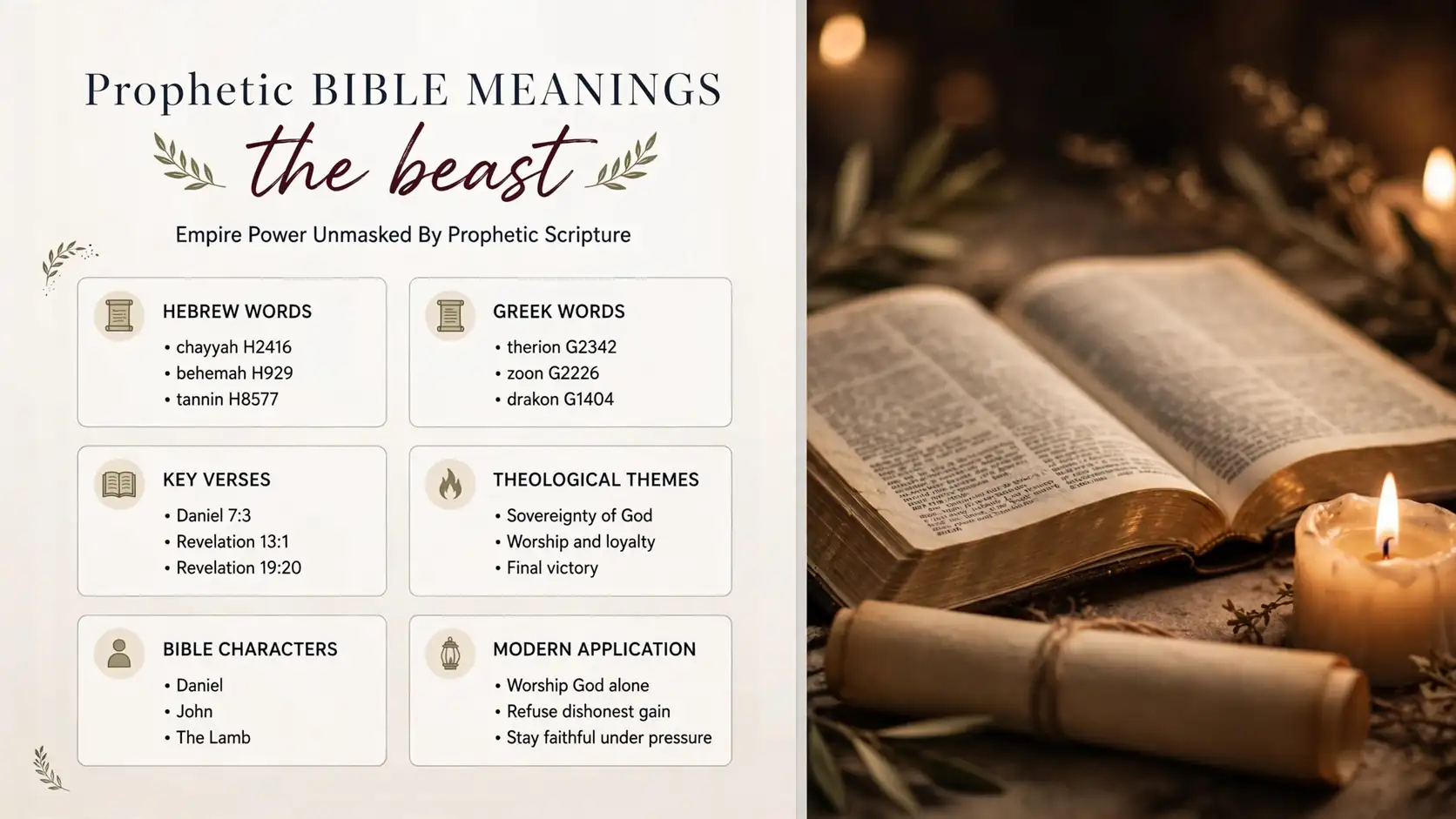
| חַיָּה | chayyah | H2416 | Living creature or beast |
| בְּהֵמָה | behemah | H929 | Beast or cattle |
| חֵיוָה | chevah | H2423 | Beast in Aramaic |
| תַּנִּין | tannin | H8577 | Sea monster or dragon |
| θηρίον | therion | G2342 | Wild beast |
| ζῷον | zoon | G2226 | Living creature |
| δράκων | drakon | G1404 | Dragon or serpent |
| χάραγμα | charagma | G5480 | Mark or stamp |
Related Biblical Concepts for the Beast
| Concept | Connection | Supporting Verse |
|---|---|---|
| Empire | Beasts picture kingdoms that rise and fall | Daniel 7:17 |
| Idolatry | Beast worship replaces worship of God | Revelation 13:15 |
| Persecution | The beast makes war on the saints | Revelation 13:7 |
| Deception | Signs and wonders mislead the unwary | Revelation 13:14 |
| The number 666 | A human number invites wise reading | Revelation 13:18 |
| The dragon | Satan stands behind beastly power | Revelation 12:9 |
| The Lamb | Christ conquers by sacrifice, not by force | Revelation 5:6 |
| Judgment | The beast faces fire at the end | Revelation 19:20 |
Historical and Cultural Context for the Beast
| Aspect | Detail | Biblical Source |
|---|---|---|
| Babylonian exile | Daniel writes under foreign imperial rule | Daniel 1:1 |
| Greek conquest | Alexander spreads Greek rule swiftly | Daniel 8:21 |
| Roman power | Rome ruled when John wrote Revelation | Revelation 1:9 |
| Emperor worship | Rome pressed loyalty through cult and coin | Revelation 13:16 |
| Sea imagery | The sea stood for chaos and hostile nations | Daniel 7:2 |
| Horn imagery | Horns stood for kings and their power | Daniel 7:24 |
| Apocalyptic genre | Visions use symbols to unmask real powers | Daniel 7:1 |
| Jewish hope | Exiles longed for God to judge oppressors | Daniel 7:27 |
Theological Themes for the Beast
| Theme | Explanation | Scripture |
|---|---|---|
| Sovereignty of God | God sets limits on every beastly kingdom | Daniel 7:27 |
| Evil as parody | The beast mimics the Lamb yet kills and lies | Revelation 13:3 |
| Worship and loyalty | Worship shows whom you truly trust | Revelation 14:9 |
| Suffering faithfulness | Saints conquer by endurance and witness | Revelation 12:11 |
| Judgment with mercy | God judges oppressors and frees the oppressed | Revelation 19:2 |
| Power redefined | True power serves and sacrifices like the Lamb | Mark 10:45 |
| Hope beyond empire | No empire lasts, but God’s kingdom endures | Daniel 2:44 |
| Final victory | The beast falls and the Lamb reigns | Revelation 19:20 |
Modern Application for Believers for the Beast
| Area | Practice | Scripture |
|---|---|---|
| Worship | Keep worship for God alone in every season | Exodus 20:3 |
| Work | Refuse dishonest gain even when it costs you | Proverbs 11:1 |
| Money | Spend and trade in ways that honor neighbors | Micah 6:8 |
| Politics | Pray for rulers without making them idols | 1 Timothy 2:1 |
| Courage | Stay faithful when faith brings social cost | Revelation 2:10 |
| Discernment | Test impressive claims against Scripture | 1 John 4:1 |
| Hope | Remember that empires pass and Christ remains | Hebrews 13:8 |
| Witness | Answer hostility with truth and grace | 1 Peter 3:15 |
Therion and the Wild Beast in Greek
The Greek word therion gives you a sharper picture than a tame animal. It points to a wild creature that hunts, tears, and terrifies. When John calls the sea creature a therion, he is warning you that this power is not neutral. It feeds on fear, rewards loyalty, and punishes dissent.
That wildness helps you read Revelation without reducing it to a puzzle. The beast is dangerous because it looks strong and useful. It offers order, wealth, and belonging, yet it asks for the worship that belongs to God alone. Your task is to see the trade clearly and refuse it with calm courage.
Chayyah and the Beasts of Daniel
The Hebrew word chayyah, a living creature, frames Daniel’s vision in a different key. Daniel sees four chayyah rise from a troubled sea, and each one pictures a kingdom with its own strength and cruelty. The lion, the bear, the leopard, and the dreadful fourth beast are not random monsters. They are history told in symbol, so exiles could name their rulers without naming them aloud.
Daniel’s angel then turns the symbol into plain speech. The beasts are kings and kingdoms, and their time is limited. That limit matters for your reading. Beastly power can look permanent, yet Daniel insists that God appoints its end and gives the kingdom to his holy people.
What Does the Beast Mean in the Bible for Empire and Worship
Empire and worship meet at the heart of the beast image. In Daniel, beasts are kingdoms. In Revelation, the beast demands the worship that only God deserves. Put those together and you get a warning that still fits. Any system that asks you to trade conscience for security, truth for profit, or worship for approval is asking for more than it should.
This does not mean every government is the beast. It means you should watch where loyalty is demanded and what it costs. When a power claims ultimate allegiance, promises safety for silence, or punishes those who will not bow, the beast image gives you language for that pressure. The Lamb answers it with a different kind of power, one that lays life down rather than taking it.
Reading Revelation 13 without Fear or Speculation
Revelation 13 rewards patient reading more than clever guessing. The chapter gives you symbols, then invites wisdom, not a hunt for secret codes. The number 666 has drawn endless theories, yet the text itself calls it a human number and asks readers to calculate with care. Scholars differ on the exact referent, and honest readers can admit that difference without losing the main point.
The main point is loyalty under pressure. The first beast rises from the sea, the second beast from the land, and together they build a world where worship, trade, and speech all serve one power. Your response is not panic or withdrawal, but steady faithfulness, honest work, truthful speech, and worship that refuses to bow to anything less than God.
Frequently Asked Questions About the Beast
What does therion mean in Revelation 13?
Therion means a wild beast, and in Revelation 13 it pictures a hostile power that demands worship and persecutes the saints.
Why does Daniel call kingdoms beasts?
Daniel uses beasts because kingdoms act like wild creatures when they conquer, devour, and boast, and the symbol unmasks their cruelty.
Is the beast a single person or a system?
The beast works as both a symbol of empire and a figure within it, so readers should hold the system and the ruler together rather than forcing one choice.
What is the mark of the beast in Revelation 13:16?
The mark pictures public loyalty to the beast shown in hand and forehead, that is, in actions and allegiance, and scholars differ on its literal form.
How should believers respond to beastly pressure today?
Believers respond with faithful worship, honest work, truthful speech, and patient endurance, trusting that the Lamb defeats the beast in the end.