
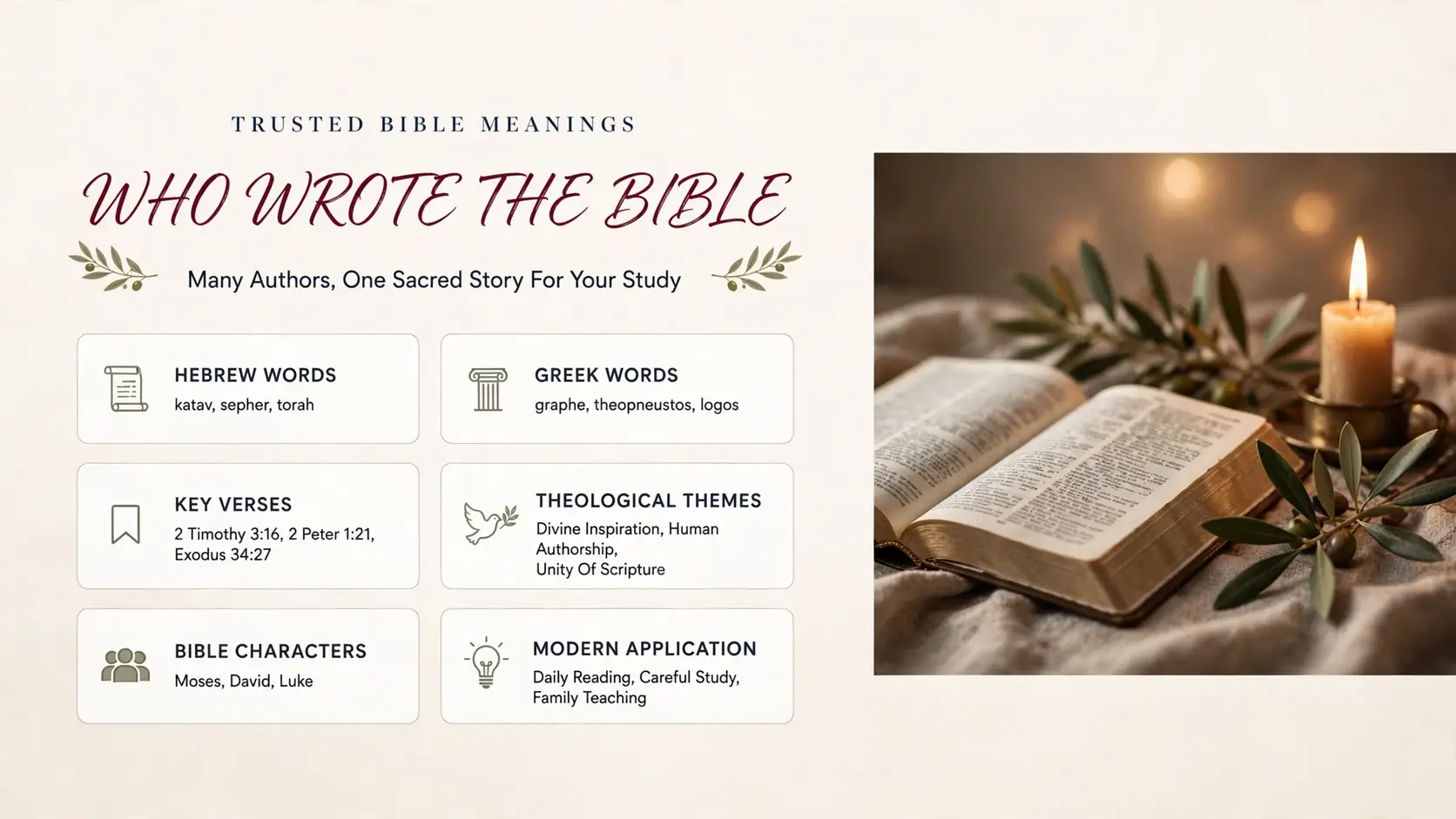
You may have opened your Bible and wondered who wrote the bible, and how one book can carry so many voices across so many centuries. The short answer is that about forty human authors wrote it, guided by God, over fifteen hundred years, and their work forms one library of sixty six books.
In this study you will meet Moses and David, prophets and apostles, scribes and editors, and you will see how their stories fit together. You will also learn the Hebrew and Greek words behind authorship, so you can read each book with fresh confidence and care.
Key Scripture References for Who Wrote the Bible
| Verse | Passage Snippet | Context |
|---|---|---|
| 2 Timothy 3:16 | All Scripture is God breathed for teaching | Paul explains why Scripture trains believers |
| 2 Peter 1:21 | Men spoke from God by the Holy Spirit | Peter roots prophecy in God alone |
| Exodus 34:27 | Write these words, said the Lord | God directs Moses to record covenant words |
| Jeremiah 30:2 | Write all my words in a book | God orders Jeremiah to preserve his message |
| Deuteronomy 31:24 | Moses finished writing this law in a book | Moses leaves a written record for Israel |
| Luke 1:3 | I decided to write an orderly account | Luke notes careful research before writing |
| John 21:24 | This disciple testifies and wrote these things | The Gospel names its eyewitness author |
| Romans 3:2 | Israel was entrusted with God’s words | Paul notes Israel guarded sacred writings |
| Revelation 1:1 | Revelation from Jesus Christ, given by God | John writes a message received from Christ |
Bible Translation Comparison for Who Wrote the Bible
| Verse | KJV | NIV | ESV | NASB |
|---|---|---|---|---|
| 2 Timothy 3:16 | Given by inspiration of God | God breathed | Breathed out by God | Inspired by God |
| 2 Peter 1:21 | Moved by the Holy Ghost | Carried along by the Holy Spirit | Carried along by the Holy Spirit | Moved by the Holy Spirit |
| Exodus 34:27 | Write thou these words | Write down these words | Write these words | Write down these words |
| Jeremiah 30:2 | Write thee all the words | Write all the words | Write all the words | Write all the words |
| Luke 1:3 | Write unto thee in order | Write an orderly account | Write an orderly account | Write an orderly account |
| Deuteronomy 31:24 | Writing this law in a book | Writing this law in a book | Writing this law in a book | Writing this law in a book |
| John 21:24 | Wrote these things | Wrote them down | Has written these things | Wrote these things |
| Revelation 1:1 | Revelation which God gave him | Revelation which God gave him | Revelation which God gave him | Revelation which God gave Him |
People and Characters Associated with Who Wrote the Bible
| Person | Role | Connection |
|---|---|---|
| Moses | Lawgiver and prophet | First five books and covenant at Sinai |
| David | King and psalmist | Many psalms and worship songs for Israel |
| Isaiah | Prophet | Judgment, comfort and hope for Judah |
| Jeremiah | Prophet | Warnings and promises in national crisis |
| Ezra | Scribe and priest | Teaching the law after return from exile |
| Luke | Physician and historian | Gospel and Acts from eyewitness research |
| Paul | Apostle and letter writer | Letters shaping early church teaching |
| Peter | Apostle and eyewitness | Letters and preaching recorded in Acts |
| John | Apostle and witness | Gospel, three letters and Revelation |
| Solomon | King and sage | Proverbs, Ecclesiastes and Song of Songs |
Original Hebrew and Greek Words for Who Wrote the Bible
| Original Word | Transliteration | Strong’s # | Literal Meaning |
|---|---|---|---|
| כָּתַב | katav | H3789 | To write or inscribe |
| סֵפֶר | sepher | H5612 | Book, scroll or document |
| דָּבָר | davar | H1697 | Word, matter or thing spoken |
| תּוֹרָה | torah | H8451 | Instruction, teaching or law |
| נָבִיא | navi | H5030 | Prophet or spokesperson for God |
| γραφή | graphe | G1124 | Writing or Scripture |
| θεόπνευστος | theopneustos | G2315 | God breathed or inspired by God |
| γράφω | grapho | G1125 | To write or record |
| λόγος | logos | G3056 | Word, message or reason |
| προφήτης | prophetes | G4396 | Prophet or one who speaks forth |
Related Biblical Concepts for Who Wrote the Bible
| Concept | Connection | Supporting Verse |
|---|---|---|
| Inspiration | God guided authors without erasing their voices | 2 Timothy 3:16 |
| Canon | Church recognized books with prophetic roots | Romans 3:2 |
| Covenant | Writings record promises God made | Exodus 34:27 |
| Prophecy | Prophets wrote messages received from God | Jeremiah 30:2 |
| Oral tradition | Teachings were shared aloud before writing | Luke 1:3 |
| Scribal care | Scribes copied texts with great attention | Ezra 7:10 |
| Eyewitness testimony | Gospels rest on people who saw Jesus | John 21:24 |
| Apostolic witness | Apostles passed on teaching rooted in Christ | 2 Peter 1:21 |
| Unity of Scripture | Many books point to one rescue story | Hebrews 1:1 |
Historical and Cultural Context for Who Wrote the Bible
| Aspect | Detail | Biblical Source |
|---|---|---|
| Ancient scribes | Trained writers copied sacred texts by hand | Ezra 7:6 |
| Covenant tablets | Laws were kept on stone, then in scrolls | Exodus 34:27 |
| Royal court | Court scribes preserved royal history | 1 Kings 11:41 |
| Exile and return | Loss of land pushed Israel to guard writings | Jeremiah 30:2 |
| Temple reading | Law was read aloud to the community | Deuteronomy 31:11 |
| Greek world | Jewish Scripture was translated into Greek | Acts 8:30 |
| Roman roads | Travel and letters spread apostolic teaching | Romans 1:7 |
| Early churches | Letters were copied and shared among churches | Colossians 4:16 |
| Scroll to codex | Bound books made carrying writings easier | Luke 4:17 |
Theological Themes for Who Wrote the Bible
| Theme | Explanation | Scripture |
|---|---|---|
| Divine inspiration | God breathed life into human words | 2 Timothy 3:16 |
| Human authorship | Real people wrote in their own styles | Luke 1:3 |
| Unity of Scripture | Diverse books tell one unfolding story | Hebrews 1:1 |
| Authority of Scripture | Scripture guides faith and life | Psalm 119:105 |
| Faithful transmission | Scribes and churches preserved God’s word | Romans 3:2 |
| Christ at the center | Both Testaments point toward Jesus | John 5:39 |
| Wisdom for living | Laws and letters teach godly choices | Proverbs 1:7 |
| Hope and promise | Prophecy keeps hope alive in hardship | Jeremiah 29:11 |
| Grace and mercy | The story shows God who rescues | Ephesians 2:8 |
Modern Application for Believers in Who Wrote the Bible
| Area | Practice | Scripture |
|---|---|---|
| Daily reading | Read a short passage and note author and setting | Psalm 119:105 |
| Careful study | Compare translations when a verse feels hard | 2 Timothy 2:15 |
| Family teaching | Share one Bible story each week at home | Deuteronomy 6:7 |
| Church learning | Join a group reading whole books in order | Acts 17:11 |
| Personal prayer | Turn a psalm into a prayer of trust | Psalm 19:14 |
| Wise decisions | Test advice against Scripture before acting | Proverbs 3:5 |
| Honest questions | Bring hard passages to trusted teachers | Luke 24:27 |
| Sharing faith | Explain the Bible story in simple words | 1 Peter 3:15 |
| Steady hope | Return to God’s promises when life feels uncertain | Romans 15:4 |
How Moses, Prophets and Apostles Shared One Story in Who Wrote the Bible
Moses gave Israel law and covenant memory, and later prophets called the nation back to that covenant when it drifted. Their writings were not private journals, because they were read aloud, copied, and kept for the whole community to hear and obey.
Apostles and their companions later wrote Gospels and letters that showed how Jesus fulfilled those older promises. When you read their work beside Moses and the prophets, you can trace one story of creation, rescue, and new life, even though the authors lived centuries apart.
What Theopneustos Reveals About God Breathed Scripture
The Greek word theopneustos in 2 Timothy 3:16 pictures Scripture as breathed out by God, much like breath gives life to a body. That picture helps you hold two truths together, because God is the source, and human writers still used their own words, memories, and styles.
You do not need to choose between a divine book and a human book, since Scripture claims both at once. This view also explains why the Bible sounds different in a psalm, a law, a parable, and a letter, while still speaking with one steady voice.
Why Scribes, Editors and Translators Still Matter for Your Study
Scribes copied texts by hand, editors arranged material into books, and translators carried meaning into new languages for new readers. Their careful work means you can open a modern Bible and still hear ancient voices, even though you live far from their world.
When translations differ in a small phrase, you can compare versions and check the setting instead of guessing. That patient habit builds trust, because it shows how much care went into keeping the words clear, honest, and open to study.
How to Read the Bible as One Library with Many Voices
Think of the Bible as a library rather than a single flat book, with history, poetry, law, prophecy, Gospel, and letters on different shelves. Each shelf has its own style, and each style asks you to read with fitting care and patience.
Start with whole books when you can, and note who is speaking, who is listening, and what problem the writer addresses. That simple habit will help you avoid pulling one verse out of place, and it will let the many authors speak in their own rightful voices.
Questions Readers Ask About Who Wrote the Bible
Did Moses write every word of the first five books himself?
Tradition links Moses with the Torah, while later scribes likely shaped some notes and lists as Israel preserved his teaching.
What does theopneustos in 2 Timothy 3:16 mean for human authors?
It means God breathed out Scripture through real writers, so divine guidance and human style work together rather than cancel each other.
Why do translations differ in 2 Peter 1:21?
Translators choose different English words for carried along and moved, yet all versions stress that prophets spoke from God rather than from private ideas.
Who wrote Psalms if David is named in many headings?
David is linked with many psalms, but other writers such as Asaph, the sons of Korah, and Solomon also contributed songs to the collection.
How can one Bible have about forty authors and still speak with one voice?
Its books share one unfolding story of God, covenant, and rescue, so varied voices point toward the same hope and the same Lord.