
To ask what does it mean to bear fruit in the Bible is to ask how visible life grows from hidden faith. Scripture uses fruit for harvest, children, repentance, wisdom, righteousness, gospel mission, and Spirit-shaped character.
Fruit is never merely religious busyness. In your study, bearing fruit means that God’s life produces recognizable results in a person, a people, or a covenant relationship. The root is grace, the growth is obedience, and the harvest belongs to God.
Fruit Key Scripture References
| Verse | Passage Snippet | Context |
|---|---|---|
| Genesis 1:28 | “Be fruitful” | Creation blessing |
| Psalm 1:3 | “yields its fruit” | Righteous life |
| Proverbs 11:30 | “fruit of the righteous” | Wisdom teaching |
| Isaiah 5:2 | “yielded wild grapes” | Vineyard judgment |
| Jeremiah 17:8 | “does not cease to bear fruit” | Trust in the Lord |
| Matthew 3:8 | “fruit in keeping with repentance” | John the Baptist |
| Matthew 7:17 | “good tree bears good fruit” | Discernment |
| John 15:5 | “bears much fruit” | Abiding in Christ |
| Galatians 5:22 | “fruit of the Spirit” | Spirit-filled life |
| Colossians 1:10 | “bearing fruit in every good work” | Christian growth |
Fruit Bible Translation Comparison
| Verse | KJV | NIV | ESV | NASB |
|---|---|---|---|---|
| Psalm 1:3 | “bringeth forth” | “yields” | “yields” | “yields” |
| Isaiah 5:4 | “brought forth wild grapes” | “yielded only bad fruit” | “yielded wild grapes” | “produced worthless ones” |
| Matthew 3:8 | “fruits meet for repentance” | “fruit in keeping” | “fruit in keeping” | “fruit consistent” |
| Matthew 7:20 | “by their fruits” | “by their fruit” | “by their fruits” | “by their fruits” |
| John 15:2 | “beareth fruit” | “does bear fruit” | “does bear fruit” | “bears fruit” |
| John 15:5 | “much fruit” | “much fruit” | “much fruit” | “much fruit” |
| Romans 7:4 | “bring forth fruit” | “bear fruit for God” | “bear fruit for God” | “bear fruit for God” |
| Galatians 5:22 | “fruit of the Spirit” | “fruit of the Spirit” | “fruit of the Spirit” | “fruit of the Spirit” |
Fruit People & Characters Associated
| Person | Role | Connection |
|---|---|---|
| Adam and Eve | First humans | Called to be fruitful |
| Noah | Covenant survivor | Renewed creation blessing |
| Abraham | Covenant father | Seed promised by God |
| Joseph | Son of Jacob | Ephraim linked with fruitfulness |
| Israel | Covenant nation | Vineyard expected to yield justice |
| John the Baptist | Prophet | Demanded repentance fruit |
| Jesus | True vine | Source of lasting fruit |
| Judas | False disciple | Cut off from the vine |
| Paul | Apostle | Desired gospel fruit among nations |
| Galatian believers | Churches | Taught Spirit’s fruit |
Fruit Original Hebrew & Greek Words
| Original Word | Transliteration | Strong’s # | Literal Meaning |
|---|---|---|---|
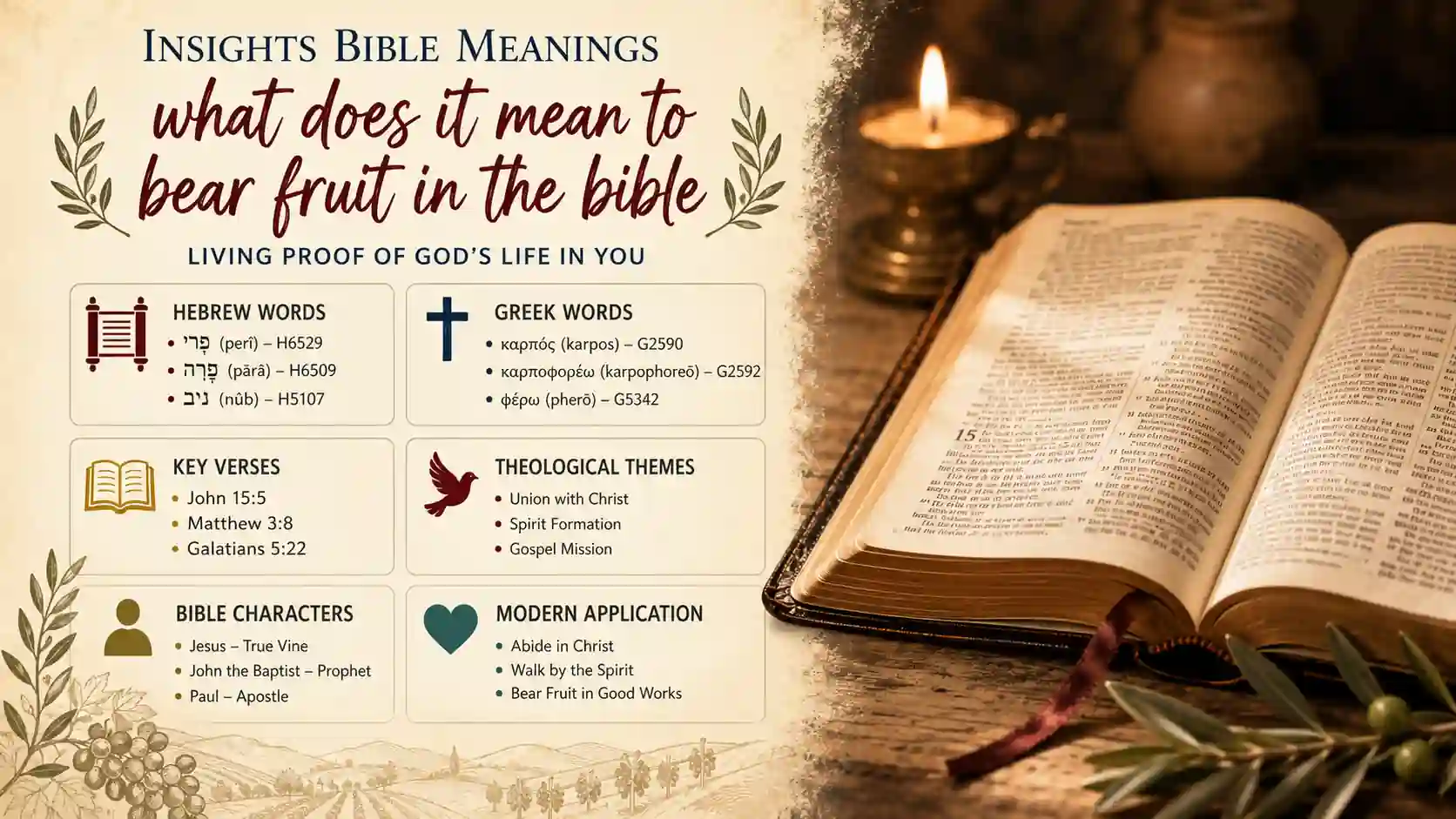
| פְּרִי | perî | H6529 | fruit, produce |
| פָּרָה | pārâ | H6509 | be fruitful |
| נוּב | nûb | H5107 | bear fruit, flourish |
| צֶמַח | tsemaḥ | H6780 | sprout, growth |
| עֵנָב | ʿēnāb | H6025 | grape |
| כֶּרֶם | kerem | H3754 | vineyard |
| καρπός | karpos | G2590 | fruit, harvest |
| καρποφορέω | karpophoreō | G2592 | bear fruit |
| φέρω | pherō | G5342 | bear, carry |
| ἄμπελος | ampelos | G288 | vine |
Fruit Related Biblical Concepts
| Concept | Connection | Supporting Verse |
|---|---|---|
| Abiding | Fruit comes through union with Christ | John 15:4 |
| Repentance | True turning becomes visible | Matthew 3:8 |
| Wisdom | Righteous life blesses others | Proverbs 11:30 |
| Judgment | Bad fruit exposes corruption | Matthew 7:19 |
| Holiness | New life serves God | Romans 7:4 |
| Mission | Gospel grows among nations | Colossians 1:6 |
| Spirit | Character is Spirit-made | Galatians 5:22 |
| Pruning | Discipline increases fruit | John 15:2 |
| Perseverance | Fruit ripens with endurance | Luke 8:15 |
Fruit Historical & Cultural Context
| Aspect | Detail | Biblical Source |
|---|---|---|
| Orchards | Fruit trees showed settled blessing | Deuteronomy 8:8 |
| Vineyards | Required years of labor | Leviticus 19:23 |
| Firstfruits | Harvest belonged first to God | Exodus 23:19 |
| Grafting | Olive imagery explained Gentile inclusion | Romans 11:17 |
| Pruning | Vines were cut for better yield | John 15:2 |
| Wild grapes | Failed covenant justice | Isaiah 5:2 |
| Fig trees | Fruit signaled readiness | Mark 11:13 |
| Harvest | Image of judgment and mission | Matthew 9:37 |
| Seedtime | Growth depended on God’s order | Genesis 8:22 |
Fruit Theological Themes
| Theme | Explanation | Scripture |
|---|---|---|
| Creation blessing | Life multiplies by God’s word | Genesis 1:28 |
| Covenant faithfulness | God expects holy yield | Isaiah 5:7 |
| Union with Christ | The branch lives from the vine | John 15:5 |
| Sanctification | Grace produces obedience | Romans 6:22 |
| Spirit formation | Love leads the list | Galatians 5:22 |
| Perseverance | Good soil bears with patience | Luke 8:15 |
| Judgment | Fruit reveals the tree | Matthew 7:20 |
| Mission | The gospel bears fruit worldwide | Colossians 1:6 |
| Worship | Lips offer fruit of praise | Hebrews 13:15 |
Fruit Modern Application for Believers
| Area | Practice | Scripture |
|---|---|---|
| Prayer | Ask to abide in Christ | John 15:7 |
| Character | Walk by the Spirit | Galatians 5:16 |
| Repentance | Turn visibly from sin | Matthew 3:8 |
| Speech | Offer praise and truth | Hebrews 13:15 |
| Work | Serve with good works | Colossians 1:10 |
| Trials | Receive pruning humbly | John 15:2 |
| Witness | Sow the gospel faithfully | Mark 4:20 |
| Generosity | Share as spiritual fruit | Philippians 4:17 |
| Endurance | Bear fruit with patience | Luke 8:15 |
פְּרִי And καρπός Show That Fruit Is Visible Life
The Hebrew פְּרִי, perî, speaks of produce, harvest, or outcome. It can describe literal fruit on trees, children from the womb, or the moral results of human choices. Scripture joins physical fruitfulness and spiritual fruitfulness because both reveal life that has been given by God.
The Greek καρπός, karpos, carries the same rich range. In the New Testament, it can mean deeds, converts, praise, holiness, or Spirit-shaped character. Fruit is not the root of salvation, but it is the visible evidence that grace has taken root.
What Does It Mean to Bear Fruit in the Bible Through the True Vine?
Jesus’ teaching in John 15 is the center of the Christian answer. He is the ἄμπελος, ampelos, the vine, and his disciples are branches. A branch does not create life by effort. It receives life by remaining joined to the vine.
That is why Jesus says, “apart from me you can do nothing.” Bearing fruit begins with abiding, not achieving. Prayer, obedience, love, and witness grow from communion with Christ. The Father’s pruning may feel severe, yet its aim is not destruction. It is greater fruitfulness.
Israel’S Vineyard Teaches the Seriousness of Fruit
Isaiah 5 presents Israel as the Lord’s vineyard. God planted, protected, and cultivated his people, yet the vineyard yielded wild grapes. The prophet explains the image. God looked for justice and righteousness, but found bloodshed and a cry of distress.
This background matters when John the Baptist and Jesus speak of fruit. They are not inventing a new metaphor. They are standing in Israel’s prophetic tradition. Fruit means covenant response, not religious appearance. Leaves without fruit become a warning sign.
The Fruit of the Spirit Is One Harvest with Many Flavors
Galatians 5 names the fruit of the Spirit as love, joy, peace, patience, kindness, goodness, faithfulness, gentleness, and self-control. Paul says “fruit,” not “fruits,” because these virtues belong together as one Spirit-produced life.
This fruit is different from self-improvement. It grows as the Spirit opposes the flesh and forms Christ’s character in believers. You do not manufacture this harvest by personality or discipline alone. You walk by the Spirit, and God grows what pleases him.
Good Works, Gospel Witness, and the Harvest God Receives
Paul prays that believers would bear fruit in every good work. He also says the gospel bears fruit and increases in the world. This means biblical fruit includes both inner transformation and outward service. Character and mission belong together.
Still, Scripture protects you from pride. The sower scatters, the soil receives, the branch abides, and God gives the growth. Faithful fruit may look small for a season, but the Lord knows what he is cultivating. Lasting fruit is measured by God’s purpose, not applause.
Frequently Asked Questions About Fruit in the Bible
Is καρπός, karpos, always about moral character?
No. It can mean literal fruit, deeds, converts, praise, holiness, or Spirit-produced character.
Why does John 15 say the Father prunes fruitful branches?
Because pruning removes what hinders life so the branch may bear more fruit in Christ.
Does Matthew 3:8 teach salvation by works?
No. John calls for fruit that proves repentance is real, not works that purchase mercy.
Why do translations differ in Isaiah 5:4 about wild grapes or bad fruit?
They are explaining the same vineyard image of corrupt yield instead of covenant justice.
How can you bear fruit without becoming proud of your growth?
Abide in Christ, remember the vine gives life, and offer every harvest back to God.