
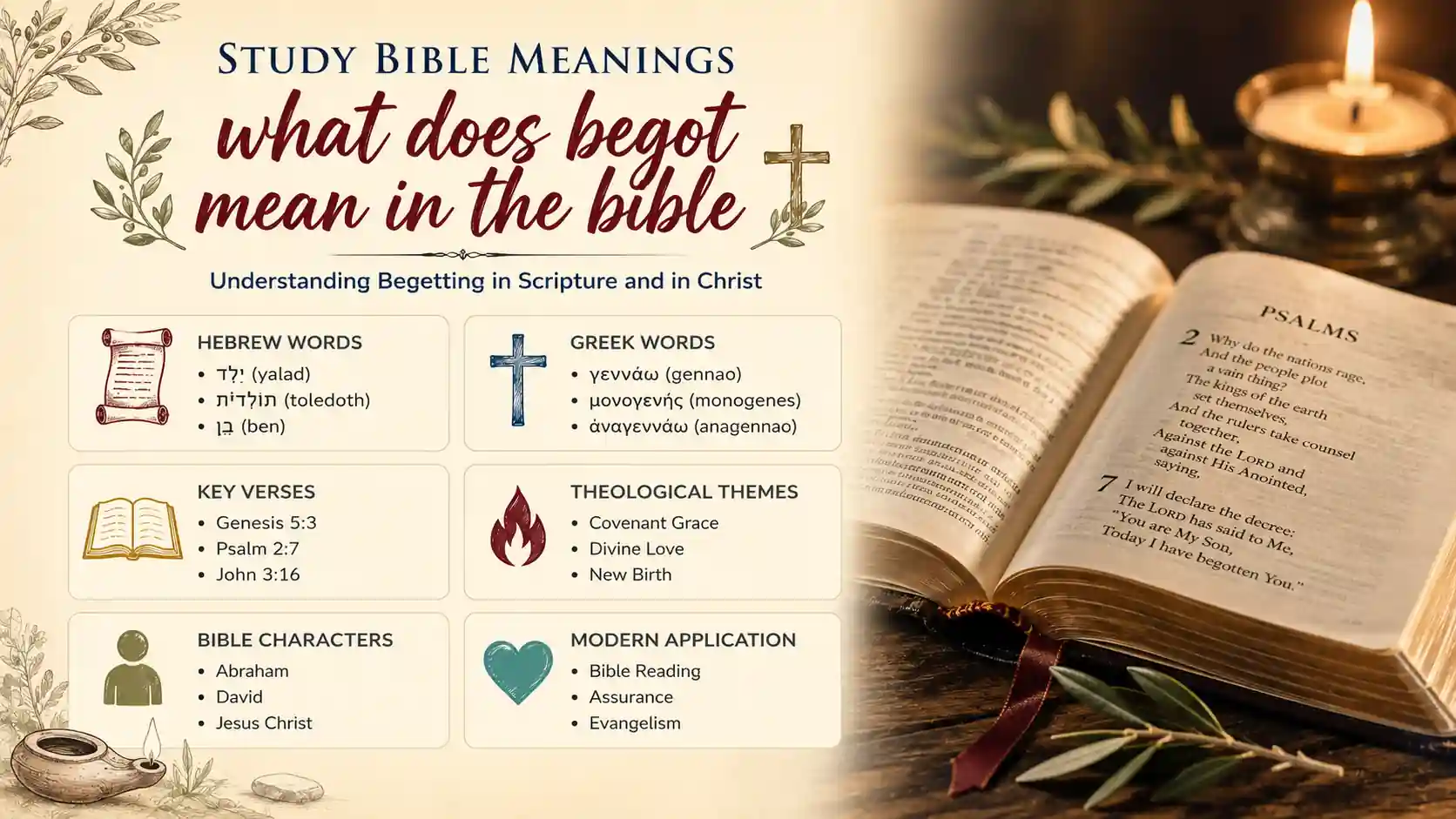
What does begot mean in the Bible? In its simplest sense, “begot” means “fathered,” “brought forth,” or “became the ancestor of.” Older English Bibles often use “begat” or “begot” where modern translations say “fathered” or “became the father of.”
Yet the word carries more than biology. In Scripture, begetting can mark covenant lineage, royal promise, messianic identity, spiritual birth, and the unique Sonship of Christ. Your study should follow the word through genealogies, psalms, Gospels, epistles, and the great story of redemption.
Begot Scripture References
| Verse | Passage Snippet | Context |
|---|---|---|
| Genesis 4:18 | “Irad begat Mehujael” | Cain’s family line |
| Genesis 5:3 | “Adam… begat a son” | Seth in Adam’s likeness |
| Genesis 10:8 | “Cush begat Nimrod” | Nations after the flood |
| Genesis 11:10 | “Shem… begat Arphaxad” | Line toward Abraham |
| Genesis 21:3 | “Isaac… born unto him” | Covenant son of Abraham |
| Ruth 4:18 | “Pharez begat Hezron” | Line toward David |
| Matthew 1:2 | “Abraham begat Isaac” | Messiah’s genealogy |
| Psalm 2:7 | “This day have I begotten thee” | Royal Son enthroned |
| John 3:16 | “only begotten Son” | God’s saving love |
| 1 Peter 1:3 | “begotten us again” | New birth in Christ |
Begot Bible Translation Comparison
| Verse | KJV | NIV | ESV | NASB |
|---|---|---|---|---|
| Genesis 5:3 | begat a son | had a son | fathered a son | became father |
| Genesis 10:8 | begat Nimrod | was father of | fathered Nimrod | became father |
| Genesis 11:12 | begat Salah | became father | fathered Shelah | fathered Shelah |
| Ruth 4:18 | begat Hezron | was father of | fathered Hezron | fathered Hezron |
| Matthew 1:2 | begat Isaac | father of Isaac | father of Isaac | father of Isaac |
| Matthew 1:16 | begat Joseph | father of Joseph | father of Joseph | father of Joseph |
| Psalm 2:7 | begotten thee | become your father | begotten you | fathered You |
| John 1:14 | only begotten | one and only Son | only Son | only Son |
| John 3:16 | only begotten Son | one and only Son | only Son | only Son |
| Hebrews 1:5 | begotten thee | become your Father | begotten you | fathered You |
Begot People and Characters Associated
| Person | Role | Connection |
|---|---|---|
| Adam | First man | Begot Seth in his likeness |
| Seth | Appointed son | Preserved godly line |
| Noah | Flood patriarch | Begot Shem, Ham, Japheth |
| Shem | Covenant line | Ancestor of Abraham |
| Abraham | Covenant father | Begot Isaac by promise |
| Isaac | Promised son | Heir of Abrahamic covenant |
| Jacob | Israel’s father | Begot twelve tribes |
| Judah | Tribal ancestor | Royal line continued |
| David | King of Israel | Messianic line focused |
| Jesus Christ | Son of God | Only begotten Son |
Begot Original Hebrew and Greek Words
| Original Word | Transliteration | Strong’s # | Literal Meaning |
|---|---|---|---|
| יָלַד | yalad | H3205 | bear, beget |
| תּוֹלְדוֹת | toledoth | H8435 | generations |
| בֵּן | ben | H1121 | son |
| אָב | av | H1 | father |
| זֶרַע | zera | H2233 | seed, offspring |
| γεννάω | gennao | G1080 | beget, give birth |
| μονογενής | monogenes | G3439 | only, unique |
| ἀναγεννάω | anagennao | G313 | beget again |
| υἱός | huios | G5207 | son |
| πατήρ | pater | G3962 | father |
Begot Related Biblical Concepts
| Concept | Connection | Supporting Verse |
|---|---|---|
| Genealogy | Begetting traces descent | Matthew 1:1 |
| Covenant | Promise moves through heirs | Genesis 17:19 |
| Seed | Offspring bears promise | Genesis 22:18 |
| Firstborn | Rank and inheritance | Exodus 13:2 |
| Sonship | Family identity | Romans 8:15 |
| New birth | God begets believers | 1 Peter 1:3 |
| Resurrection | Son publicly declared | Acts 13:33 |
| Kingship | Royal Son enthroned | Psalm 2:7 |
| Incarnation | Unique Son revealed | John 1:14 |
| Inheritance | Children receive promise | Galatians 4:7 |
Begot Historical and Cultural Context
| Aspect | Detail | Biblical Source |
|---|---|---|
| Patriarchal records | Fathers named heirs | Genesis 5 |
| Tribal memory | Families guarded lineage | Numbers 1 |
| Covenant descent | Promise tied to seed | Genesis 17 |
| Levirate duty | Name preserved by kin | Ruth 4 |
| Royal succession | Sons inherited thrones | 2 Samuel 7 |
| Temple records | Priests proved descent | Ezra 2 |
| Matthew’s list | Legal messianic claim | Matthew 1 |
| Luke’s list | Human descent traced | Luke 3 |
| Greco-Roman setting | Fatherhood shaped status | Galatians 4 |
| Early church preaching | Psalm 2 applied to Christ | Acts 13 |
Begot Theological Themes
| Theme | Explanation | Scripture |
|---|---|---|
| Creation life | God fills earth by offspring | Genesis 1:28 |
| Fallen likeness | Adam begets after the fall | Genesis 5:3 |
| Covenant grace | Isaac comes by promise | Genesis 21:12 |
| Chosen line | Judah carries royal hope | Genesis 49:10 |
| Messianic kingship | Son receives nations | Psalm 2:7 |
| Divine love | Father gives the Son | John 3:16 |
| Eternal Sonship | Son shares divine glory | John 1:18 |
| Regeneration | Believers are born of God | John 1:13 |
| Living hope | God begets through resurrection | 1 Peter 1:3 |
| Family of God | Faith brings adoption | Galatians 4:5 |
Begot Modern Application for Believers
| Area | Practice | Scripture |
|---|---|---|
| Bible reading | Notice genealogies | Matthew 1:1 |
| Worship | Honor the Son | Psalm 2:12 |
| Assurance | Trust God’s fatherly work | John 1:13 |
| Evangelism | Speak of new birth | John 3:3 |
| Identity | Live as God’s child | 1 John 3:1 |
| Hope | Rest in resurrection life | 1 Peter 1:3 |
| Family | Value spiritual legacy | 2 Timothy 1:5 |
| Doctrine | Distinguish terms carefully | John 3:16 |
| Prayer | Approach the Father | Romans 8:15 |
| Discipleship | Bear gospel fruit | Philemon 10 |
יָלַד Yalad and the Genealogies That Carry Promise
The Hebrew verb יָלַד, yalad, often stands behind the older English “begat.” It can describe a mother bearing a child, a father begetting a son, or a genealogy declaring descent. In Genesis 5, the word is not decoration. It tells you that life continues east of Eden under both judgment and mercy.
The repeated pattern of father and son also teaches patience. God’s promises move through real families, real years, and real graves. When Adam begets Seth, and when Shem’s line moves toward Abraham, Scripture is showing that redemption does not appear from nowhere. It comes through the faithful hand of God in history.
What Does Begot Mean in the Bible When Matthew Names Abraham, David, and Christ
Matthew 1 uses begetting language to present Jesus as the promised Son of Abraham and Son of David. The genealogy is selective, arranged, and theological. It shows legal descent through Joseph, but it also prepares you for the miracle that Jesus is conceived by the Holy Spirit, not by ordinary human begetting.
That matters for your reading of “begot.” In Matthew, the word points backward to covenant history and forward to Christ’s unique birth. Abraham begot Isaac, David’s line continued through kings, and Joseph stands in the royal line. Yet Jesus is more than another descendant. He is the promised King entering the family story to save His people.
γεννάω Gennao and the New Birth Jesus Taught Nicodemus
The Greek verb γεννάω, gennao, can mean to beget, to father, to give birth, or to be born. In John 3, Jesus uses birth language when He tells Nicodemus that a person must be born again, or born from above. The point is not physical ancestry, but spiritual life from God.
This is why “begot” becomes pastoral. You cannot give yourself spiritual birth any more than you gave yourself physical birth. The Father brings life by the Spirit, through the Son. In 1 Peter 1:3, believers are “begotten again” to a living hope through the resurrection of Jesus Christ from the dead.
μονογενής Monogenes and the Only Begotten Son
The word μονογενής, monogenes, is often translated “only begotten” in older English versions and “only,” “one and only,” or “unique” in many modern versions. In John’s writings, it points to the Son’s unmatched relationship with the Father. Jesus is not one child among many divine children. He is the unique Son who reveals God.
This does not mean the Son began to exist at Bethlehem. Historic Christian theology has used “begotten” carefully to confess the Son’s eternal relation to the Father, not a created origin. John 1:18 and John 3:16 call you to worship the Son as the One who comes from the Father and makes the Father known.
Begot Questions Bible Students Often Ask
Does יָלַד, yalad, always mean a father physically produced a child?
No. It often means physical begetting, but it can also mark lineage, birth, or descent in a genealogy.
Why does Psalm 2:7 say, “This day have I begotten thee”?
It speaks of the king’s enthronement and is applied in the New Testament to Christ’s messianic sonship and resurrection declaration.
Why do translations differ on μονογενής, monogenes, in John 3:16?
Because the word can stress unique sonship, which older versions rendered “only begotten” and many newer versions render “one and only” or “only Son.”
Is “begotten” in John 3:16 saying Jesus was created?
No. John presents the Son as divine, preexistent, and uniquely from the Father, not as a creature.
How should “begot” affect my daily Bible study?
Read genealogies as testimony that God keeps His promises through real people, real history, and ultimately through Christ.