
What does born again mean in the Bible? Jesus used this striking expression while speaking with Nicodemus, a respected Jewish teacher who knew Scripture but did not yet understand the transforming work of God’s Spirit. To be born again is not merely to adopt better habits, change religious communities, or become more sincere.
It means receiving spiritual life from God. Scripture describes this miracle as birth from above, regeneration, renewal, a new heart, and new creation. Your study of these passages reveals salvation as God’s gracious work that produces faith, repentance, obedience, and lasting hope.
Key Born Again Scripture References
| Verse | Passage Snippet | Context |
|---|---|---|
| John 1:12-13 | Born of God, not human will | John introduces divine sonship through faith in Christ |
| John 3:3 | Unless one is born again | Jesus explains entrance into God’s kingdom |
| John 3:5 | Born of water and Spirit | Jesus connects cleansing, renewal, and the Spirit |
| John 3:6 | Spirit gives birth to spirit | Spiritual life requires a spiritual source |
| John 3:7-8 | You must be born again | The Spirit works sovereignly like the wind |
| 2 Corinthians 5:17 | A new creation in Christ | Union with Christ produces a transformed identity |
| Titus 3:5 | Washing of regeneration and renewal | Salvation rests on mercy, not righteous works |
| 1 Peter 1:3 | Born again to a living hope | Christ’s resurrection grounds the believer’s new life |
| 1 Peter 1:23 | Born again through God’s word | The enduring gospel is the means of new birth |
| 1 John 5:1 | Everyone believing is born of God | New birth is shown through faith in Jesus |
Born Again Bible Translation Comparison
| Verse | KJV | NIV | ESV | NASB |
|---|---|---|---|---|
| John 3:3 | born again | born again | born again | born again |
| John 3:3 footnote sense | from above | from above | from above | from above |
| John 3:5 | water and Spirit | water and the Spirit | water and the Spirit | water and the Spirit |
| John 3:7 | Ye must be born again | You must be born again | You must be born again | You must be born again |
| Titus 3:5 | washing of regeneration | washing of rebirth | washing of regeneration | washing of regeneration |
| 1 Peter 1:3 | begotten us again | given us new birth | caused us to be born again | caused us to be born again |
| 1 Peter 1:23 | being born again | born again | born again | born again |
| James 1:18 | begat he us | chose to give us birth | brought us forth | brought us forth |
| 1 John 3:9 | born of God | born of God | born of God | born of God |
| Matthew 19:28 | regeneration | renewal of all things | new world | regeneration |
People and Characters Associated with Being Born Again
| Person | Role | Connection |
|---|---|---|
| Jesus Christ | Son of God and teacher | Reveals the necessity and source of new birth |
| Nicodemus | Pharisee and ruler | Misunderstands spiritual birth as physical rebirth |
| John the Baptist | Prophetic witness | Announces the One who baptizes with the Holy Spirit |
| Ezekiel | Exilic prophet | Foretells cleansing, a new heart, and a new spirit |
| Peter | Apostle and pastor | Connects new birth with resurrection and living hope |
| Paul | Apostle to the Gentiles | Describes regeneration, renewal, and new creation |
| James | Jerusalem church leader | Says God brings believers forth through truth |
| John the Apostle | Evangelist and elder | Identifies faith, love, and righteousness as birthmarks |
| Cornelius | Gentile God-fearer | Receives the Spirit after hearing the gospel |
| Lydia | Philippian believer | Has her heart opened to respond to Paul’s message |
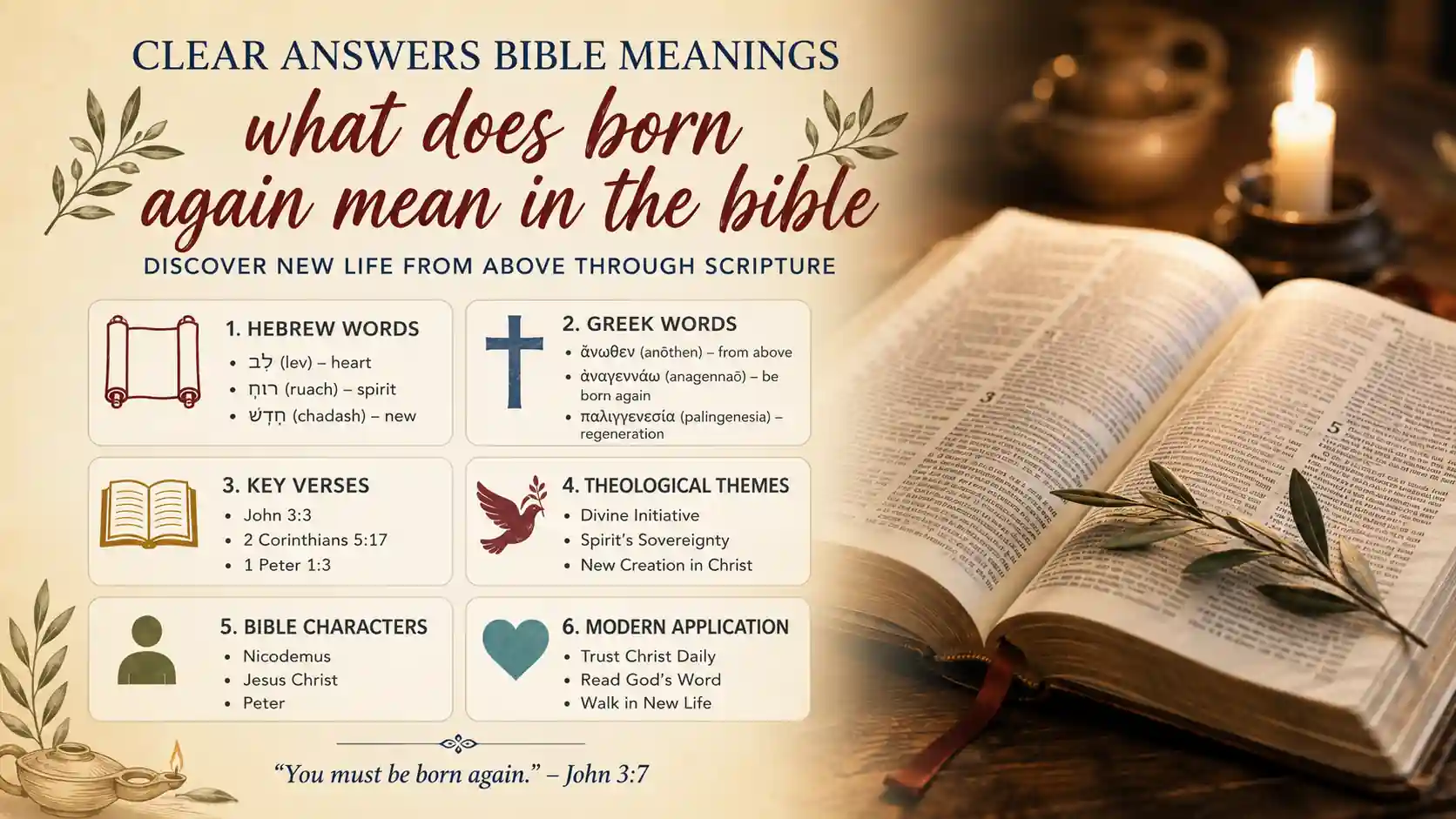
Original Hebrew and Greek Words for Born Again
| Original Word | Transliteration | Strong’s # | Literal Meaning |
|---|---|---|---|
| ἄνωθεν | anōthen | G509 | From above, again, from the beginning |
| γεννάω | gennaō | G1080 | To beget, give birth, produce |
| ἀναγεννάω | anagennaō | G313 | To beget again, cause new birth |
| παλιγγενεσία | palingenesia | G3824 | Rebirth, regeneration, renewed existence |
| καινός | kainos | G2537 | New in quality or character |
| κτίσις | ktisis | G2937 | Creation, created order, creature |
| πνεῦμα | pneuma | G4151 | Spirit, breath, wind |
| לֵב | lev | H3820 | Heart, inner person, understanding |
| רוּחַ | ruach | H7307 | Spirit, breath, wind |
| חָדָשׁ | chadash | H2319 | New, fresh, renewed |
Related Biblical Concepts of Being Born Again
| Concept | Connection | Supporting Verse |
|---|---|---|
| Regeneration | God imparts spiritual life to the spiritually dead | Titus 3:5 |
| Conversion | The renewed person turns to God in faith | Acts 3:19 |
| Repentance | New life produces a changed mind and direction | Acts 11:18 |
| Faith | Trust in Christ marks those born of God | 1 John 5:1 |
| New creation | The believer receives a new identity in Christ | 2 Corinthians 5:17 |
| New heart | God replaces stubborn resistance with responsiveness | Ezekiel 36:26 |
| Adoption | Those receiving Christ become God’s children | John 1:12-13 |
| Sanctification | The Spirit progressively forms holy character | 2 Thessalonians 2:13 |
| Resurrection life | Christ’s resurrection secures living hope | 1 Peter 1:3 |
| Eternal life | The believer possesses life through God’s Son | 1 John 5:11-12 |
Historical and Cultural Context of Born Again Teaching
| Aspect | Detail | Biblical Source |
|---|---|---|
| Pharisaic identity | Nicodemus belonged to a strict religious movement | John 3:1 |
| Jewish leadership | He served as a ruler among the Jews | John 3:1 |
| Nighttime visit | He approached Jesus under cover of darkness | John 3:2 |
| Rabbi language | Nicodemus acknowledged Jesus as a God-sent teacher | John 3:2 |
| Kingdom expectation | Many Jews awaited God’s promised reign | John 3:3 |
| Physical misunderstanding | Nicodemus interpreted birth in biological terms | John 3:4 |
| Ritual cleansing | Water commonly represented purification | Ezekiel 36:25 |
| Prophetic renewal | Israel expected God to give a new heart and spirit | Ezekiel 36:26-27 |
| Wind imagery | Wind illustrated the Spirit’s invisible freedom | John 3:8 |
| Wilderness sign | The bronze serpent foreshadowed faith in Christ | John 3:14-15 |
Theological Themes within Born Again Teaching
| Theme | Explanation | Scripture |
|---|---|---|
| Divine initiative | New birth begins with God’s will and mercy | John 1:13 |
| Human inability | Flesh cannot generate spiritual life | John 3:6 |
| Spirit’s sovereignty | The Spirit acts freely and powerfully | John 3:8 |
| Christ-centered faith | Eternal life comes through believing in the Son | John 3:15-16 |
| Cleansing from sin | God washes and renews the guilty person | Titus 3:5 |
| Union with Christ | Life in Christ creates a new identity | 2 Corinthians 5:17 |
| Trinitarian salvation | Father, Son, and Spirit act in redemption | Titus 3:4-6 |
| Gospel instrumentality | God uses his living word to bring new birth | 1 Peter 1:23 |
| Transforming grace | New birth produces righteousness and love | 1 John 2:29 |
| Persevering hope | Regenerated believers await an imperishable inheritance | 1 Peter 1:3-5 |
Modern Application of Born Again Truth for Believers
| Area | Practice | Scripture |
|---|---|---|
| Self-examination | Test whether your faith produces spiritual fruit | 2 Corinthians 13:5 |
| Dependence | Ask God for mercy rather than trusting morality | Titus 3:5 |
| Faith | Rest in Christ’s saving work and promise | John 3:16 |
| Repentance | Turn from cherished sin toward obedience | Acts 2:38 |
| Scripture | Receive God’s word as living and enduring | 1 Peter 1:23 |
| Prayer | Depend upon the Spirit for inward renewal | Ephesians 3:16 |
| Love | Treat fellow believers as God’s family | 1 John 4:7 |
| Holiness | Reject patterns that oppose your new identity | 1 John 3:9 |
| Witness | Explain that Christianity requires new life | John 3:7 |
| Hope | Anchor your future in Christ’s resurrection | 1 Peter 1:3 |
Ἄνωθεν And the Meaning of Birth from Above
The Greek adverb ἄνωθεν, transliterated anōthen, can mean “again,” “from above,” or “from the beginning.” John often uses words with more than one meaningful sense. Nicodemus hears Jesus speaking about a second physical birth, while Jesus is describing life that comes from above.
Both ideas belong together. You must be born anew because your natural birth cannot give you spiritual life. You must be born from above because only God can produce this life. The phrase points beyond moral improvement to a divine act that changes your spiritual origin, identity, and destiny.
Jesus reinforces this meaning by contrasting flesh and Spirit. “Flesh” in John 3 refers to human life according to natural generation. Human beings can reproduce human life, but they cannot produce the life of God’s kingdom. Only the Holy Spirit can give birth to spirit.
The wind illustration emphasizes mystery without implying irrationality. You cannot see the wind itself, but you observe its effects. Likewise, you cannot control or manufacture regeneration, yet its results become visible through faith, love, confession of Christ, growing obedience, and a new desire for holiness.
What Does Born Again Mean in the Bible’S New Covenant Story?
Nicodemus should have recognized the foundations of Jesus’ teaching because Israel’s prophets had already promised inward renewal. Ezekiel 36 speaks of clean water, a new heart, a new spirit, and God’s Spirit dwelling within his people. Jesus is not inventing an unrelated spiritual experience.
The “water and Spirit” language in John 3:5 most naturally echoes this prophetic promise. Ezekiel joins cleansing from impurity with the gift of a responsive heart and the indwelling Spirit. Jesus announces that the promised new covenant renewal is necessary for anyone who would enter God’s kingdom.
Jeremiah also anticipates a covenant in which God writes his law upon the heart. Deuteronomy speaks of God circumcising the heart so that his people may love him. These promises show that Scripture’s concern is not merely external membership, ritual observance, or inherited privilege.
Physical descent from Abraham did not remove the need for inward transformation. Nicodemus possessed learning, status, morality, and covenant heritage, yet Jesus still told him, “You must be born again.” Religious knowledge is valuable, but knowledge alone cannot replace the Spirit’s life-giving work.
Regeneration, Faith, and the Living Word
Titus 3:5 uses παλιγγενεσία, palingenesia, for regeneration. Paul explains that God saves according to mercy through the washing of regeneration and renewal by the Holy Spirit. New birth is therefore not a reward for good works but the gracious source of a changed life.
This does not make faith unnecessary. Scripture presents faith as the proper response to Christ and as evidence of God’s life-giving work. John writes that everyone who believes Jesus is the Christ has been born of God. Regeneration and faith are inseparable in Christian experience.
Peter uses ἀναγεννάω, anagennaō, when he says God has caused believers to be born again. He connects this birth both to Christ’s resurrection and to God’s imperishable word. The risen Jesus supplies the life, while the proclaimed gospel announces the truth through which you believe.
James gives a similar picture when he says that God brought believers forth by the word of truth. The Spirit does not ordinarily regenerate people apart from Christ’s gospel. This is why Scripture reading, preaching, teaching, and personal witness matter deeply, even though the saving power belongs to God.
New Birth Produces a New Creation
Being born again does not mean that a believer immediately reaches sinless perfection. John’s letters acknowledge that Christians still need confession, cleansing, and Christ’s advocacy. Yet John also insists that birth from God creates a decisive break with a life ruled by unrepentant sin.
The new birth establishes a new direction. You begin to love God, trust Christ, practice righteousness, resist sin, and love other believers. These qualities do not purchase regeneration. They reveal that God’s life is actively reshaping your desires and conduct.
Paul’s expression “new creation” describes the same transforming reality from another angle. In union with Christ, the old order of guilt, alienation, and self-rule loses its governing claim. You receive reconciliation with God and begin living under Christ’s lordship.
This inward renewal also points toward the future renewal of creation. Matthew 19:28 uses παλιγγενεσία for the coming restoration when the Son of Man reigns in glory. Your personal regeneration is therefore a foretaste of God’s purpose to make all things new through Christ.
Questions About What Born Again Means in the Bible
Does ἄνωθεν mean “born again” or “born from above”?
It can mean both, and John’s wording presents new birth as a fresh beginning whose source is God above.
Does “born of water and Spirit” in John 3:5 refer directly to baptism?
Christians differ, but the immediate prophetic background strongly echoes Ezekiel’s promise of spiritual cleansing and renewal.
Can a moral or religious person still need to be born again?
Yes, Nicodemus shows that learning, sincerity, status, and religious heritage cannot substitute for spiritual life.
How can you know whether you have been born of God?
Scripture points to faith in Christ, love for God’s people, repentance, obedience, and an ongoing struggle against sin.
Is παλιγγενεσία the same as complete Christian maturity?
No, regeneration begins new spiritual life, while sanctification describes the Spirit’s continuing work of making you more like Christ.