
What does famine mean in the Bible? Scripture presents famine as a severe shortage of food that brings hunger, economic distress, migration, disease, and death. Yet biblical famine is never merely a background disaster. It becomes a setting in which human weakness is exposed, divine warnings are heard, faith is tested, and God’s preserving mercy becomes visible.
As you study famine across Scripture, you will encounter patriarchs seeking food, prophets announcing covenant judgment, faithful people serving the hungry, and Jesus revealing himself as the Bread of Life.
Key Famine Scripture References
| Verse | Passage Snippet | Context |
|---|---|---|
| Genesis 12:10 | Severe famine in the land | Abram travels to Egypt |
| Genesis 26:1 | Another famine arose | Isaac remains under God’s direction |
| Genesis 41:30 | Seven years of famine | Joseph interprets Pharaoh’s dreams |
| Ruth 1:1 | Famine in Bethlehem | Elimelech’s family moves to Moab |
| 2 Samuel 21:1 | Famine for three years | David seeks the Lord |
| 1 Kings 17:1 | Neither dew nor rain | Elijah announces drought |
| 2 Kings 6:25 | Great famine in Samaria | Arameans besiege the city |
| Amos 8:11 | Famine of hearing God’s words | Spiritual deprivation is foretold |
| Luke 15:14 | Severe famine in that country | The prodigal son becomes desperate |
| Acts 11:28 | Great famine over the world | The church prepares relief |
Famine Bible Translation Comparison
| Verse | KJV | NIV | ESV | NASB |
|---|---|---|---|---|
| Genesis 12:10 | Grievous famine | Severe famine | Famine was severe | Famine was severe |
| Genesis 41:30 | Seven years of famine | Seven years of famine | Seven years of famine | Seven years of famine |
| Ruth 1:1 | Famine in the land | Famine in the land | Famine in the land | Famine in the land |
| 1 Kings 17:12 | Dress it for me and my son | Make a meal for myself and my son | Prepare it for myself and my son | Prepare it for me and my son |
| 2 Kings 6:25 | Great famine | Great famine | Great famine | Great famine |
| Amos 8:11 | Hearing the words of the Lord | Hearing the words of the Lord | Hearing the words of the Lord | Hearing the words of the Lord |
| Luke 4:25 | Great famine throughout all the land | Severe famine throughout the land | Great famine over all the land | Great famine over all the land |
| Luke 15:14 | Mighty famine | Severe famine | Severe famine | Severe famine |
| Acts 11:28 | Great dearth | Severe famine | Great famine | Great famine |
| Revelation 6:8 | Hunger | Famine | Famine | Famine |
People and Characters Associated with Famine
| Person | Role | Connection |
|---|---|---|
| Abram | Patriarch | Entered Egypt during famine |
| Isaac | Covenant heir | Faced famine in Canaan |
| Joseph | Egyptian administrator | Stored grain before famine |
| Jacob | Father of Israel | Sent his sons to Egypt |
| Naomi | Israelite widow | Left Bethlehem during famine |
| Ruth | Moabite convert | Returned after the famine ended |
| David | King of Israel | Sought God during prolonged famine |
| Elijah | Prophet | Announced drought and received provision |
| Widow of Zarephath | Faithful Gentile | Shared her last food with Elijah |
| Agabus | Christian prophet | Predicted famine in Claudius’s reign |
Original Hebrew and Greek Famine Words
| Original Word | Transliteration | Strong’s # | Literal Meaning |
|---|---|---|---|
| רָעָב | raʿav | H7458 | Famine, hunger |
| רָעֵב | raʿev | H7456 | To hunger, be hungry |
| רָעֵב | raʿev | H7457 | Hungry, famished |
| רְעָבוֹן | reʿavon | H7459 | Hunger, household famine |
| כָּפָן | kafan | H3720 | Painful hunger, famine |
| λιμός | limos | G3042 | Famine, hunger |
| πεινάω | peinaō | G3983 | To hunger |
| ἄσιτος | asitos | G777 | Without food |
| σῖτος | sitos | G4621 | Wheat, grain |
| χοῖνιξ | choinix | G5518 | Daily grain measure |
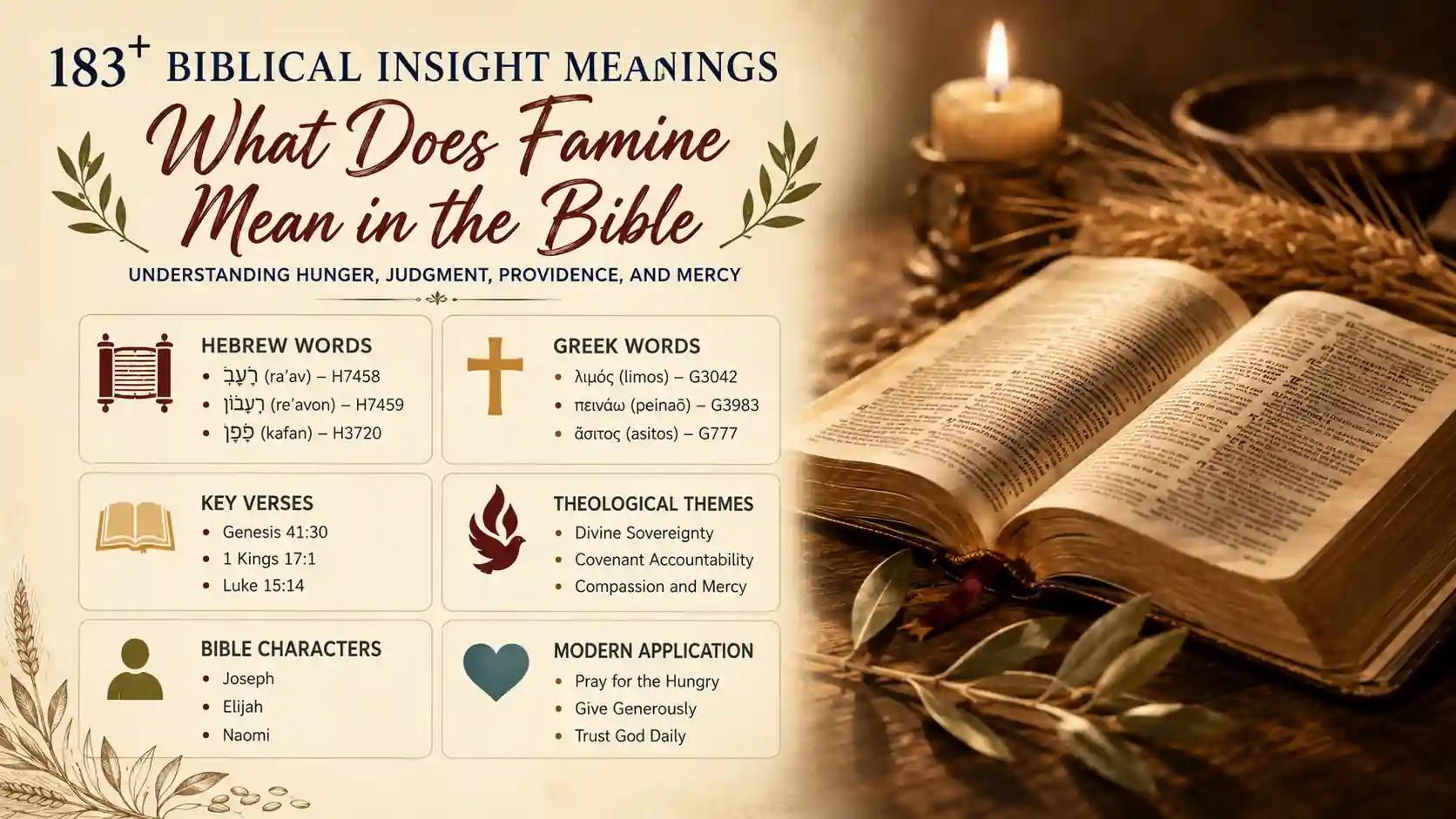
The principal Old Testament noun is רָעָב, raʿav, Strong’s H7458. It can describe national famine or personal hunger. The related רְעָבוֹן, reʿavon, occurs less often and emphasizes pressing hunger within households. The New Testament normally uses λιμός, limos, Strong’s G3042, for both famine and severe hunger.
The rare Hebrew noun כָּפָן, kafan, Strong’s H3720, appears in Job and conveys painful hunger that bends or weakens the body. These terms show that biblical famine includes both widespread agricultural collapse and the bodily suffering experienced by individuals.
Related Biblical Famine Concepts
| Concept | Connection | Supporting Verse |
|---|---|---|
| Drought | Lack of rain destroys crops | 1 Kings 17:1 |
| Covenant curse | Rebellion brings agricultural judgment | Deuteronomy 28:23–24 |
| Siege | Enemies prevent food supplies | 2 Kings 6:24–25 |
| Migration | Families relocate to survive | Ruth 1:1–2 |
| Providence | God prepares deliverance beforehand | Genesis 50:20 |
| Repentance | Calamity calls people back to God | 2 Chronicles 7:13–14 |
| Generosity | God’s people support the suffering | Acts 11:29 |
| Spiritual hunger | People lack access to God’s word | Amos 8:11 |
| End-time judgment | Famine accompanies the seals | Revelation 6:5–8 |
| Messianic provision | Jesus satisfies deepest hunger | John 6:35 |
Historical and Cultural Context of Famine
| Aspect | Detail | Biblical Source |
|---|---|---|
| Rainfall | Farming depended on seasonal rains | Deuteronomy 11:13–17 |
| Grain crops | Wheat and barley were staple foods | Ruth 2:23 |
| Food storage | Granaries preserved surplus harvests | Genesis 41:48 |
| Regional trade | Egypt supplied grain during shortages | Genesis 42:1–3 |
| Migration | Famine displaced households | Genesis 12:10 |
| Food prices | Scarcity produced extreme inflation | Revelation 6:6 |
| Siege warfare | Armies cut off city supplies | 2 Kings 6:24–25 |
| Debt and land | Families sold property for food | Genesis 47:18–20 |
| Relief gifts | Churches sent aid through trusted leaders | Acts 11:29–30 |
| Vulnerable people | Widows and children faced special danger | 1 Kings 17:12 |
Theological Themes within Biblical Famine
| Theme | Explanation | Scripture |
|---|---|---|
| Divine sovereignty | God rules over seasons and nations | Psalm 105:16 |
| Covenant accountability | Israel’s disobedience had consequences | Leviticus 26:18–20 |
| Human dependence | Bread ultimately comes from God | Deuteronomy 8:3 |
| Providential preparation | God raised Joseph before the crisis | Genesis 41:39–40 |
| Testing of faith | Scarcity revealed trust or fear | 1 Kings 17:13–16 |
| Compassion | God commands care for hungry people | Isaiah 58:7 |
| Judgment with warning | Prophets called sinners to repent | Jeremiah 14:11–12 |
| Preservation of promise | God protected the covenant family | Genesis 45:7 |
| Spiritual deprivation | Rejecting truth leads to darkness | Amos 8:11–12 |
| Christ’s sufficiency | Jesus gives enduring life | John 6:35 |
Modern Famine Application for Believers
| Area | Practice | Scripture |
|---|---|---|
| Prayer | Intercede for affected communities | 1 Timothy 2:1 |
| Giving | Share according to your ability | Acts 11:29 |
| Hospitality | Feed those lacking daily food | Matthew 25:35 |
| Stewardship | Prepare wisely without hoarding | Proverbs 21:20 |
| Trust | Depend on God rather than possessions | Matthew 6:31–33 |
| Justice | Refuse to exploit scarcity | Amos 8:4–6 |
| Church ministry | Organize accountable relief | Acts 6:1–4 |
| Gratitude | Receive food with thanksgiving | 1 Timothy 4:4 |
| Scripture | Treasure God’s word as necessary food | Matthew 4:4 |
| Hope | Await the end of hunger and sorrow | Revelation 7:16–17 |
What Does Famine Mean in the Bible’S Covenant Story?
In the ancient world, famine usually followed drought, crop disease, locust destruction, war, or siege. Israel’s covenant law warned that persistent rebellion could result in failed harvests and empty storehouses. Famine could therefore function as divine discipline, calling the covenant people to recognize their dependence on the Lord.
This does not mean every hungry person was being punished for personal sin. Scripture often portrays famine sufferers as vulnerable people needing compassion. Ruth and Naomi experienced loss during a famine, while the widow of Zarephath faced death with her son. The proper response was not accusation, but mercy, generosity, and trust.
רָעָב, RaʿAv, and God’S Providence in Genesis
Genesis repeatedly places famine at crucial moments in the patriarchal story. Abram entered Egypt because food was scarce. Isaac encountered famine but received specific instruction from God. Jacob’s household later faced a regional crisis that forced his sons to seek grain in Egypt.
Joseph’s story gives the fullest picture of providence. God revealed that seven abundant years would be followed by seven years of רָעָב, raʿav. Joseph organized grain storage so that countless lives would be preserved. What his brothers intended for evil became part of God’s means for saving the covenant family.
Famine did not overturn God’s promise to Abraham. Instead, God worked through scarcity, migration, political authority, and stored grain to keep that promise moving forward. Your study should therefore distinguish between the pain of famine and the unseen providence of God operating within the crisis.
The narrative does not excuse Joseph’s brothers or romanticize suffering. It teaches that human evil and natural disaster cannot defeat God’s redemptive purpose. The Lord may prepare an answer years before his people understand why the preparation was necessary.
λιμός, Limos, from Jesus’ Teaching to Revelation
The Greek noun λιμός, limos, appears in Gospel teachings, historical narratives, Paul’s list of hardships, and Revelation’s judgments. Jesus referred to famines as part of a troubled age, while warning his disciples not to treat every disaster as proof that the end had immediately arrived.
In Luke 15, a severe λιμός reduces the prodigal son to desperation. The famine does not save him by itself, but it exposes the emptiness of life far from his father. Physical hunger becomes the setting in which he remembers home, confesses his sin, and returns.
Acts 11 presents a different response. When Agabus predicted famine, believers in Antioch did not speculate about dates or blame distant sufferers. They determined to send assistance, each according to ability. Biblical prophecy produced practical love, responsible planning, and unity across regional and ethnic boundaries.
Revelation 6 uses famine imagery in the vision of the black horse. A day’s wage purchases only a small amount of grain, portraying rationing, inflation, and economic anguish. The vision warns that human systems are fragile and that final security cannot be found in wealth or markets.
The Famine of Hearing the Lord in Amos 8
Amos 8:11 contains Scripture’s most striking figurative use of famine. God announces neither a lack of bread nor a thirst for water, but a famine of hearing the words of the Lord. The people had repeatedly resisted prophetic truth, so the judgment involved losing access to the word they had despised.
This spiritual famine should not be reduced to insufficient religious information. Israel possessed religious ceremonies, yet justice was corrupted and the poor were exploited. The scarcity concerned a true, authoritative word from God that could guide, correct, and restore them.
You should receive this warning with humility. Familiarity with sermons, books, and religious language does not guarantee attentiveness to Scripture. A person may be surrounded by biblical material while remaining resistant to what God has actually spoken about holiness, mercy, repentance, and justice.
The answer to spiritual hunger is not novelty. It is a renewed reception of God’s revealed word and faith in Christ, who calls himself the Bread of Life. Physical bread sustains mortal life, but Christ gives eternal life and satisfies the deepest hunger of those who come to him.
Questions Bible Students Ask About Famine
Does רָעָב, raʿav, always mean a national famine?
No. It can refer to widespread food scarcity or to the experience of personal hunger.
Why did God use famine as a covenant judgment?
Famine exposed Israel’s dependence on the God who gave rain, land, harvests, and daily bread.
Does Amos 8:11 predict a literal shortage of Bibles?
The verse primarily describes the withdrawal of an accessible, authoritative word from God after persistent rejection.
Is every biblical famine a punishment for someone’s sin?
No. Some famines are identified as judgments, while many sufferers are portrayed as people deserving mercy rather than blame.
How should Christians respond to modern famine?
You should pray, give generously, support wise relief, resist exploitation, and serve hungry people as an expression of love for Christ.