
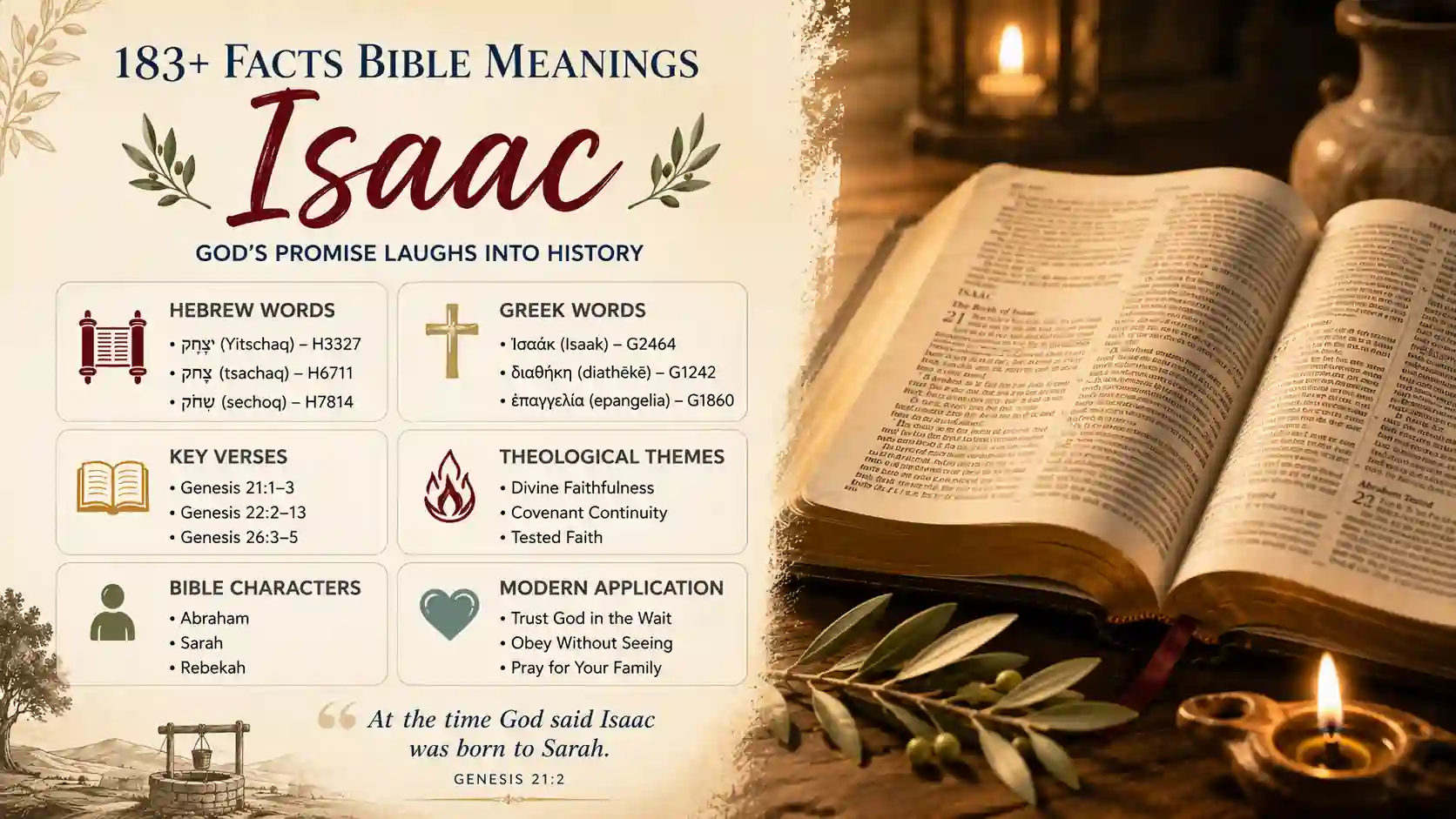
What does Isaac mean in the Bible? The name Isaac comes from the Hebrew יִצְחָק, Yitschaq, commonly understood as “he laughs” or “laughter.” God chose this name before Isaac’s birth, turning Abraham and Sarah’s astonished laughter into a lasting testimony of divine faithfulness.
Isaac was not merely a long-awaited child. He was the promised son through whom God confirmed the Abrahamic covenant. His life connects miraculous birth, covenant inheritance, sacrificial obedience, answered prayer, family conflict, and God’s sovereign purpose.
Isaac Key Scripture References
| Verse | Passage Snippet | Context |
|---|---|---|
| Genesis 17:17 | Abraham laughed | Abraham reacts to the promised birth |
| Genesis 17:19 | Call his name Isaac | God names the promised son |
| Genesis 18:12 | Sarah laughed within herself | Sarah doubts because of old age |
| Genesis 21:2 | At the set time | God fulfills His precise promise |
| Genesis 21:3 | Abraham called him Isaac | Abraham obeys God’s naming command |
| Genesis 21:6 | God has made me laugh | Sarah’s disbelief becomes joy |
| Genesis 22:2 | Your son, your only son | Abraham’s faith is severely tested |
| Genesis 24:67 | Isaac took Rebekah | God provides Isaac with a wife |
| Genesis 26:3 | I will be with you | God personally confirms the covenant |
| Hebrews 11:20 | By faith Isaac blessed | Isaac participates in covenant hope |
Isaac Bible Translation Comparison
| Verse | KJV | NIV | ESV | NASB |
|---|---|---|---|---|
| Genesis 17:19 | Call his name Isaac | Call him Isaac | Call his name Isaac | Call his name Isaac |
| Genesis 18:12 | Sarah laughed within herself | Sarah laughed to herself | Sarah laughed to herself | Sarah laughed to herself |
| Genesis 21:2 | At the set time | At the very time | At the time | At the appointed time |
| Genesis 21:3 | Called the name Isaac | Gave the name Isaac | Called his name Isaac | Named him Isaac |
| Genesis 21:6 | Made me to laugh | Brought me laughter | Made laughter for me | Made laughter for me |
| Genesis 22:2 | Thine only son Isaac | Your only son, Isaac | Your only son Isaac | Your only son, Isaac |
| Genesis 26:24 | Fear not, for I am with thee | Do not be afraid | Fear not | Do not fear |
| Hebrews 11:20 | By faith Isaac blessed | By faith Isaac blessed | By faith Isaac invoked | By faith Isaac blessed |
Isaac People and Characters Associated
| Person | Role | Connection |
|---|---|---|
| Abraham | Father | Receives God’s promise concerning Isaac |
| Sarah | Mother | Bears Isaac miraculously in old age |
| Ishmael | Half brother | Separated from Isaac after family conflict |
| Hagar | Ishmael’s mother | Her household affects Isaac’s early life |
| Rebekah | Wife | Chosen through providential guidance |
| Esau | Older son | Receives a lesser paternal blessing |
| Jacob | Younger son | Inherits the covenant blessing |
| Abimelech | Philistine ruler | Makes a treaty with Isaac |
| Eliezer’s mission | Servant’s assignment | Secures Rebekah for Isaac |
| God | Covenant Lord | Names, preserves, guides, and blesses Isaac |
Isaac Original Hebrew and Greek Words
| Original Word | Transliteration | Strong’s # | Literal Meaning |
|---|---|---|---|
| יִצְחָק | Yitschaq | H3327 | He laughs |
| צָחַק | tsachaq | H6711 | To laugh |
| שְׂחוֹק | sechoq | H7814 | Laughter or amusement |
| בְּרִית | berit | H1285 | Covenant |
| זֶרַע | zera | H2233 | Seed or offspring |
| בְּרָכָה | berakhah | H1293 | Blessing |
| עֹלָה | olah | H5930 | Whole burnt offering |
| Ἰσαάκ | Isaak | G2464 | Isaac |
| διαθήκη | diathēkē | G1242 | Covenant or testament |
| ἐπαγγελία | epangelia | G1860 | Promise |
The Hebrew name יִצְחָק, Yitschaq, is derived from the verb צָחַק, tsachaq. The name’s verbal form is often expressed as “he laughs,” while “laughter” communicates its broader sense. The New Testament Greek Ἰσαάκ, Isaak, is a transliteration of the Hebrew name rather than a separate Greek name with a new meaning.
Isaac Related Biblical Concepts
| Concept | Connection | Supporting Verse |
|---|---|---|
| Promise | Isaac’s birth fulfills God’s word | Genesis 21:1–2 |
| Laughter | His name recalls doubt and joy | Genesis 21:6 |
| Covenant | God establishes Abraham’s covenant through him | Genesis 17:19 |
| Election | God chooses Isaac’s line | Romans 9:7 |
| Sacrifice | Isaac is placed upon the altar | Genesis 22:9 |
| Provision | God supplies a ram in his place | Genesis 22:13 |
| Marriage | God guides the search for Rebekah | Genesis 24:50–51 |
| Prayer | Isaac intercedes for his barren wife | Genesis 25:21 |
| Blessing | Isaac blesses Jacob and Esau | Genesis 27:27–40 |
| Resurrection faith | Abraham expects God’s power over death | Hebrews 11:17–19 |
Isaac Historical and Cultural Context
| Aspect | Detail | Biblical Source |
|---|---|---|
| Patriarchal era | Isaac belongs to Israel’s founding family | Exodus 3:6 |
| Nomadic life | His household moves among grazing regions | Genesis 26:17–23 |
| Tents | Isaac’s family lives as resident foreigners | Genesis 24:67 |
| Wells | Water rights determine survival and stability | Genesis 26:18–22 |
| Marriage customs | A family representative arranges his marriage | Genesis 24:1–9 |
| Bride gifts | Valuable gifts accompany the marriage agreement | Genesis 24:53 |
| Primogeniture | The older son normally holds special status | Genesis 25:31–34 |
| Paternal blessing | Spoken blessings carry family authority | Genesis 27:27–29 |
| Covenant sign | Isaac is circumcised on the eighth day | Genesis 21:4 |
| Burial property | Isaac is buried in the family cave | Genesis 35:29; 49:31 |
Isaac Theological Themes
| Theme | Explanation | Scripture |
|---|---|---|
| Divine faithfulness | God does what human strength cannot accomplish | Genesis 21:1 |
| Grace | Isaac is received through promise, not achievement | Galatians 4:28 |
| Covenant continuity | God renews Abraham’s promises with Isaac | Genesis 26:3–5 |
| Sovereign choice | The covenant line proceeds through Isaac | Romans 9:7–9 |
| Tested faith | Abraham must entrust Isaac back to God | Genesis 22:1–12 |
| Substitution | A ram dies in Isaac’s place | Genesis 22:13 |
| Providence | God directs Rebekah into Isaac’s household | Genesis 24:14 |
| Prayer | God responds to Isaac’s intercession | Genesis 25:21 |
| Peace | Isaac withdraws rather than escalating disputes | Genesis 26:20–22 |
| Future hope | Isaac blesses his sons concerning coming things | Hebrews 11:20 |
Isaac Modern Application for Believers
| Area | Practice | Scripture |
|---|---|---|
| Waiting | Trust God when fulfillment appears impossible | Genesis 21:1–2 |
| Joy | Receive fulfilled promises with gratitude | Genesis 21:6 |
| Obedience | Follow God even without complete understanding | Genesis 22:9 |
| Worship | Surrender treasured gifts to God | Genesis 22:12 |
| Prayer | Intercede patiently for your family | Genesis 25:21 |
| Marriage | Seek God’s guidance in lifelong commitments | Genesis 24:63–67 |
| Conflict | Pursue peace without surrendering faith | Genesis 26:20–22 |
| Work | Reopen faithful wells left by earlier generations | Genesis 26:18 |
| Parenting | Reject favoritism within the family | Genesis 25:28 |
| Legacy | Speak faith and blessing into the future | Hebrews 11:20 |
יִצְחָק Yitschaq Turns Human Laughter into a Memorial
The meaning of Isaac begins with laughter, but Genesis presents more than one kind of laughter. Abraham laughs after hearing that Sarah will bear a son, and Sarah laughs privately when she hears the same promise. Their reactions reveal the tension between God’s word and the visible limitations of age, barrenness, and human weakness.
When Isaac is born, Sarah declares that God has made laughter for her. The sound once associated with incredulity now expresses wonder and shared joy. Every time the family speaks Isaac’s name, they remember that God’s promise proved stronger than their doubts.
Isaac’s name can be rendered “he laughs,” though some study notes summarize it as “laughter.” These renderings complement one another. “He laughs” reflects the grammatical force of the Hebrew form, while “laughter” captures the narrative wordplay surrounding his birth.
What Does Isaac Mean in the Bible’S Abrahamic Covenant?
Isaac means more than personal happiness because God joins his name to the covenant. In Genesis 17:19, God announces both the child’s name and his covenant role. Ishmael also receives divine blessing, but the particular covenant promise involving the chosen offspring is established through Isaac.
This distinction becomes significant throughout Scripture. God repeatedly identifies Himself as the God of Abraham, Isaac, and Jacob. Isaac forms the essential middle link between the promise given to Abraham and the nation that develops through Jacob’s sons.
Paul later refers to Isaac when explaining that God’s saving purpose rests upon promise rather than natural privilege or human effort. Believers are compared to Isaac as “children of promise,” not because they replace his historical family, but because their spiritual life also depends upon God’s gracious action.
Moriah Reveals Isaac as the Beloved Son of Promise
Genesis 22 identifies Isaac as Abraham’s beloved and unique covenant son. God’s command to offer him creates a profound tension. The same God who promised descendants through Isaac now commands Abraham to place Isaac upon the altar. The passage tests whether Abraham trusts the Giver above the gift.
Isaac carries the wood and asks where the offering is, showing that he understands the normal requirements of sacrifice. Abraham answers that God will provide. A ram is eventually offered in Isaac’s place, preserving the promised son and establishing a powerful pattern of divine provision.
Christian readers have long recognized correspondences between Isaac and Jesus, including beloved sonship, sacrificial imagery, and willing submission. Yet Isaac is not Jesus. Isaac needs a substitute, while Christ gives Himself for sinners. The comparison reaches its clearest meaning when the differences remain visible.
Isaac’S Quiet Life Displays Prayer, Peace, and Perseverance
Isaac receives less narrative space than Abraham or Jacob, yet his quieter life carries spiritual weight. He meditates in the field, loves Rebekah, prays during her barrenness, reopens his father’s wells, builds altars, and calls upon the Lord. His story shows that covenant faithfulness is not always dramatic.
His handling of disputed wells is especially instructive. Rather than answering every conflict with force, Isaac repeatedly moves until God grants room. His peace is not weakness. God prospers him, confirms the covenant, and causes former opponents to recognize that the Lord is with him.
Isaac also displays human frailty. He repeats Abraham’s fearful deception concerning his wife and contributes to family division by favoring Esau. Scripture neither idealizes nor discards him. God’s faithfulness continues through an imperfect man who remains dependent upon grace.
Frequently Asked Questions About Isaac
Does יִצְחָק, Yitschaq, mean “laughter” or “he laughs”?
Its grammatical sense is commonly given as “he laughs,” while “laughter” summarizes the name’s wordplay in Genesis.
Why did God name Isaac before he was born?
God named him to connect his miraculous birth permanently with divine promise, human laughter, and covenant faithfulness.
Does Genesis 22 teach that God approved human sacrifice?
No. God stops Abraham, provides a ram, and uses the event to test faith and reveal substitutionary provision.
Why was the covenant established through Isaac rather than Ishmael?
God freely chose Isaac as the promised covenant heir while still hearing, preserving, and blessing Ishmael.
How can Isaac’s meaning shape your faith during long seasons of waiting?
His name reminds you that God can transform doubtful laughter into joyful testimony when His appointed time arrives.