
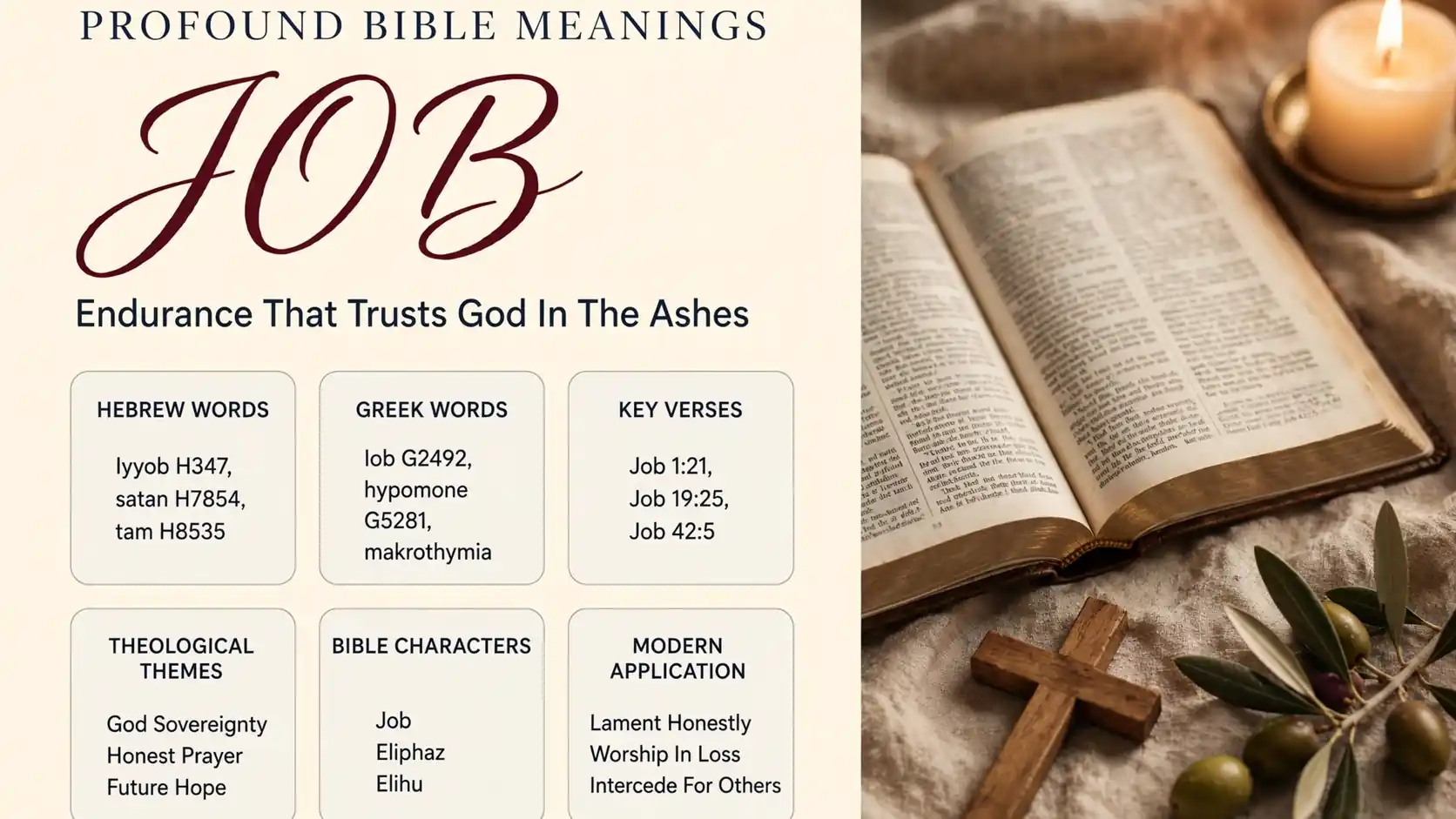
When you ask what does job mean in the bible, you meet Iyyob, a blameless man from Uz who lost wealth, children, and health yet refused to curse God. His name is often linked with being persecuted or treated as an enemy. His book is not mainly about employment or a career. It is a wisdom story about innocent suffering, honest lament, patient endurance, and restoration by a sovereign God who finally speaks from the whirlwind and calls every hurting believer to trust Him today.
Job Key Scripture References
| Verse | Passage Snippet | Context |
|---|---|---|
| Job 1:1 | Blameless and upright, fearing God | Job introduced in Uz |
| Job 1:21 | The Lord gave, the Lord has taken away | Job worships after loss |
| Job 2:10 | Shall we accept good and not trouble | Job answers his wife |
| Job 9:32 | He is not a man like me | Job longs for a mediator |
| Job 13:15 | Though he slay me, yet will I hope | Defiant trust in pain |
| Job 19:25 | I know my Redeemer lives | Hope beyond the grave |
| Job 23:10 | When he has tested me, I come forth gold | Refining through trial |
| Job 38:4 | Where were you when I laid foundations | God speaks from whirlwind |
| Job 42:5 | My eyes have seen you | Job repents in dust and ashes |
Job Bible Translation Comparison
| Verse | KJV | NIV | ESV | NASB |
|---|---|---|---|---|
| Job 1:21 | The LORD gave, the LORD hath taken away | The LORD gave and the LORD has taken away | The LORD gave, the LORD has taken away | The LORD gave, the LORD has taken away |
| Job 2:10 | Shall we receive good, and not evil | Shall we accept good, and not trouble | Shall we receive good, and not evil | Shall we accept good, and not adversity |
| Job 13:15 | Though he slay me, yet will I trust | Though he slay me, yet will I hope | Though he slay me, I will hope in him | Though He slay me, I will hope in Him |
| Job 19:25 | I know that my redeemer liveth | I know that my redeemer lives | I know that my Redeemer lives | I know that my Redeemer lives |
| Job 23:10 | He knoweth the way that I take | He knows the way that I take | He knows the way that I take | He knows the way I take |
| Job 28:28 | Fear of the Lord, that is wisdom | Fear of the Lord, that is wisdom | Fear of the Lord, that is wisdom | Fear of the Lord, that is wisdom |
| Job 38:4 | Where wast thou when I laid foundations | Where were you when I laid foundations | Where were you when I laid foundations | Where were you when I laid foundations |
| Job 42:10 | The LORD turned the captivity of Job | The LORD restored his fortunes | The LORD restored the fortunes of Job | The LORD restored the fortunes of Job |
Job People and Characters Associated
| Person | Role | Connection |
|---|---|---|
| Job | Righteous sufferer | Central figure of the book |
| Yahweh | Sovereign Creator | Permits testing, then answers Job |
| Satan | The adversary | Accuses Job in the heavenly court |
| Job wife | Grieving spouse | Urges Job to curse God and die |
| Eliphaz | Friend from Teman | Argues suffering proves hidden sin |
| Bildad | Friend from Shuah | Defends retribution theology |
| Zophar | Friend from Naamah | Speaks harshly and briefly |
| Elihu | Young speaker | Claims suffering can teach and refine |
| Jemimah, Keziah, Keren Happuch | Daughters after restoration | Named in the closing chapter |
Job Original Hebrew and Greek Words
| Original Word | Transliteration | Strong’s # | Literal Meaning |
|---|---|---|---|
| אִיּוֹב | Iyyob | H347 | Persecuted one, object of hostility |
| אָיַב | ayab | H340 | To be hostile, treat as enemy |
| שָׂטָן | satan | H7854 | Adversary, accuser |
| תָּם | tam | H8535 | Blameless, complete, upright |
| צַדִּיק | tsaddiq | H6662 | Righteous, just |
| חִנָּם | chinnam | H2600 | Without cause, for nothing |
| נָחַם | nacham | H5162 | To comfort, to relent |
| עָפָר | aphar | H6083 | Dust, earth |
| Ἰώβ | Iob | G2492 | Job, the persecuted patriarch |
| ὑπομονή | hypomone | G5281 | Endurance, steadfast patience |
Job Related Biblical Concepts
| Concept | Connection | Supporting Verse |
|---|---|---|
| Innocent suffering | Righteous people can suffer greatly | Job 1:1 |
| Lament | Honest grief poured out to God | Job 3:25 |
| Sovereignty | God rules creation and limits evil | Job 38:11 |
| Retribution debate | Friends link all pain to sin | Job 4:7 |
| Mediator longing | Job wishes for an arbiter | Job 9:33 |
| Redeemer hope | Faith looks beyond death | Job 19:25 |
| Wisdom | True wisdom belongs to God | Job 28:23 |
| Repentance | Seeing God changes self view | Job 42:6 |
| Restoration | God gives back after loss | Job 42:10 |
Job Historical and Cultural Context
| Aspect | Detail | Biblical Source |
|---|---|---|
| Land of Uz | Job home, east of Israel | Job 1:1 |
| Patriarchal setting | Wealth counted in livestock and servants | Job 1:3 |
| Family priest role | Job offers sacrifices for his children | Job 1:5 |
| Mourning customs | Torn robes, shaved heads, dust | Job 1:20 |
| Ash heap suffering | Job sits among ashes in grief | Job 2:8 |
| Comforter visits | Friends sit silent seven days | Job 2:13 |
| Poetry form | Most of the book is Hebrew poetry | Job 3:1 |
| Ancient cosmology | Storehouses of snow and hail | Job 38:22 |
| Inheritance note | Daughters receive an inheritance | Job 42:15 |
Job Theological Themes
| Theme | Explanation | Scripture |
|---|---|---|
| God sovereignty | God is free and never on trial | Job 38:2 |
| Satan limits | The adversary acts only by permission | Job 1:12 |
| Human limits | Mortals cannot see the full picture | Job 28:13 |
| Honest prayer | God honors truthful lament over slogans | Job 42:7 |
| Creation wisdom | Nature reveals divine order and care | Job 39:27 |
| Intercession | Job prays for the friends who hurt him | Job 42:8 |
| Grace after pain | Restoration is gift, not payment | Job 42:12 |
| Future hope | The Redeemer will stand on the earth | Job 19:25 |
| Fear of the Lord | Reverence is the heart of wisdom | Job 28:28 |
Job Modern Application for Believers
| Area | Practice | Scripture |
|---|---|---|
| Grief | Lament honestly instead of hiding pain | Job 3:25 |
| Loss | Worship God when outcomes confuse you | Job 1:21 |
| Friendship | Sit with sufferers before offering answers | Job 2:13 |
| Speech | Refuse easy blame for another pain | Job 42:7 |
| Endurance | Hold hope during long unexplained trials | James 5:11 |
| Prayer | Intercede for people who wounded you | Job 42:8 |
| Repentance | Let a fresh sight of God humble you | Job 42:5 |
| Work integrity | Stay blameless when no one applauds you | Job 31:6 |
| Hope | Trust your Redeemer beyond present loss | Job 19:25 |
Iyyob and the Root Behind the Name Job
Scholars debate the exact origin of Iyyob, yet many connect it with ayab, the Hebrew verb for acting with hostility. That link fits a man treated like an enemy by loss, disease, and accusation. The name therefore carries the weight of persecution rather than a job description or trade.
The Greek form Iob appears in the Septuagint and in James, where Job becomes a pattern of endurance. When James praises the patience of Job, he uses hypomone, a word for staying under pressure without surrender, paired in Scripture with makrothymia, longsuffering patience. Your study of the name should hold both ideas together, a persecuted man who endured.
What Does Job Mean in the Bible When Life Feels Unfair
The book refuses the simple claim that every wound is a direct payment for a specific sin. Job friends repeat that formula with confidence, yet God rebukes them at the end. Their error warns you against turning a suffering friend into a courtroom case.
At the same time, the book never calls suffering meaningless or random. God remains sovereign, Satan remains limited, and Job questions receive a vision of creation rather than a full explanation. Faith in this book is not denial. It is reverent trust when the reasons stay hidden from human sight.
The Whirlwind Speeches and the Wisdom of Job 28
Chapter 28 interrupts the debate with a poem about mining, searching deep places where silver and iron hide. Humans can tunnel through rock, yet they cannot purchase wisdom with gold or find its path by skill. The poem answers human pride with a quiet line about the fear of the Lord.
The whirlwind speeches in chapters 38 to 41 expand that answer through wild animals, stars, sea, Behemoth, and Leviathan. God does not hand Job a ledger of causes. He shows a world ordered, wild, and cared for beyond human management, inviting humility instead of control.
Restoration in Job 42 and the Redeemer Hope of Job 19
Job restoration is generous, yet it does not erase the children and servants who died earlier in the story. Scripture presents the ending as grace, not as proof that loss never leaves a scar. Job prays for his friends, receives family and flocks again, and lives to see four generations.
His boldest hope rises long before that ending, when he declares that his Redeemer lives and will stand on the earth. Christians read that hope in light of Christ, while the original scene still matters on its own terms. A suffering believer longs for a living defender who will vindicate him beyond the grave.
Frequently Asked Questions About Job
Does the name Job mean persecuted in Hebrew?
Yes, Iyyob, Strong’s H347, is commonly linked with ayab and understood as a persecuted or hated one.
Is Job about employment or a career in the Bible?
No, the book centers on the patriarch Job, his suffering and endurance, not on work in general.
Why does James call Job patient in James 5:11?
James uses Job as an example of hypomone, steadfast endurance that stayed faithful through severe loss.
Did God say Job friends were wrong about his suffering?
Yes, in Job 42:7 God says Eliphaz and his friends did not speak rightly about Him as Job had.
What is the main message of the Book of Job?
God is sovereign and worthy of trust even when righteous people suffer without a visible explanation.