
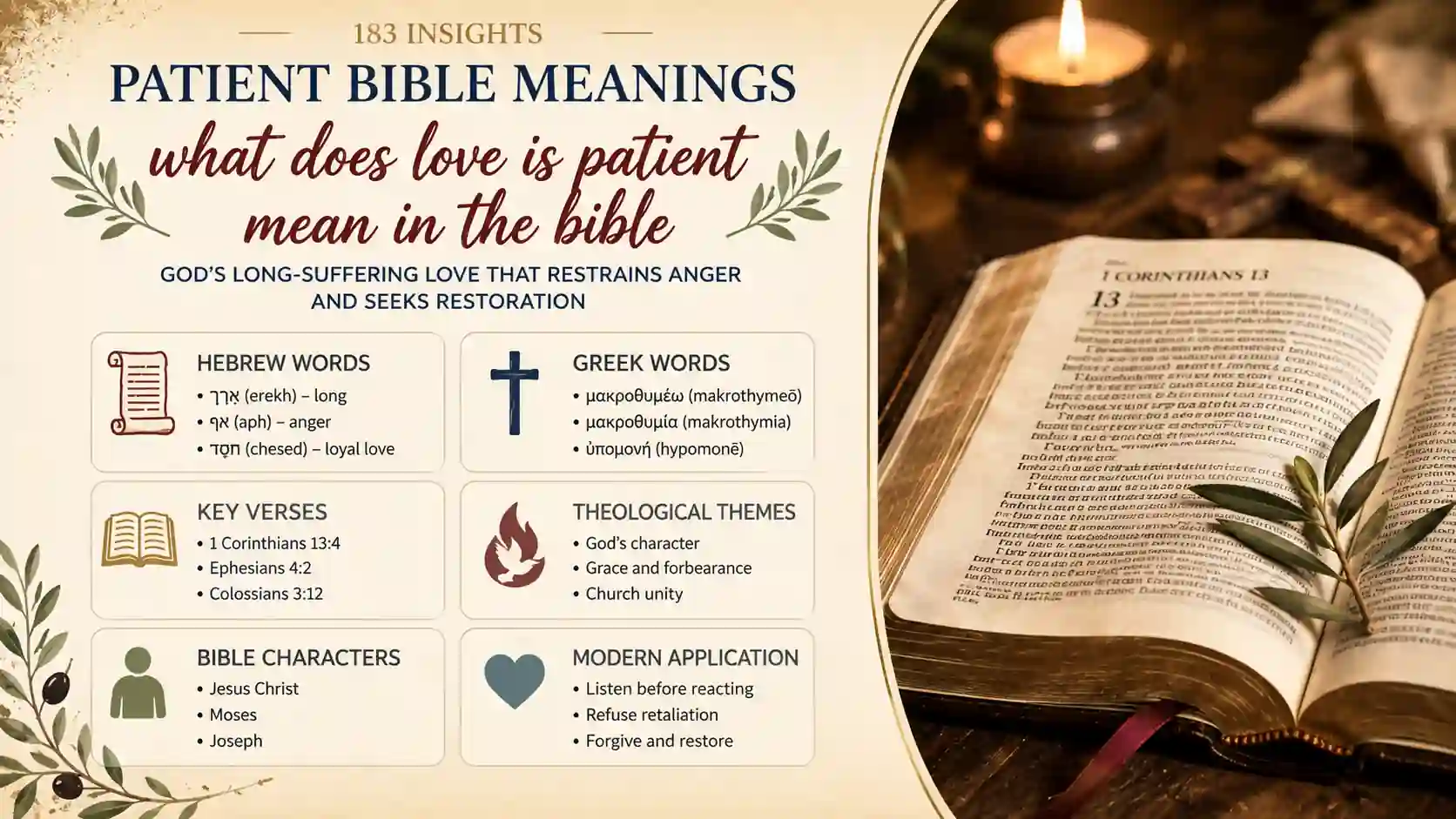
What does love is patient mean in the Bible? In 1 Corinthians 13:4, Paul describes love as choosing long-suffering restraint toward imperfect people. Biblical patience is not passive resignation or sentimental tolerance. It is a Spirit-formed willingness to endure injury, delay, weakness, and inconvenience without retaliating or abandoning another person.
The Greek verb μακροθυμέω, makrothymeō, pictures being “long-tempered” rather than quick-tempered. As you study this teaching, you discover that patient love reflects God’s own character, governs Christian fellowship, and seeks another person’s restoration without excusing destructive behavior.
Key Scripture References About Patient Love
| Verse | Passage Snippet | Context |
|---|---|---|
| 1 Corinthians 13:4 | “Love is patient” | Love governs spiritual gifts |
| Exodus 34:6 | “Slow to anger” | God reveals His character |
| Numbers 14:18 | “Longsuffering” | Moses appeals to God’s mercy |
| Proverbs 19:11 | “Slow to anger” | Wisdom overlooks an offense |
| Ephesians 4:2 | “Bearing with one another” | Patience preserves church unity |
| Colossians 3:12-13 | “Patience, bearing with” | Forgiven people forgive others |
| 1 Thessalonians 5:14 | “Patient with them all” | Different needs require patient care |
| James 5:7-8 | “Be patient” | Believers await Christ’s return |
| 2 Peter 3:9 | “Patient toward you” | God delays judgment for repentance |
| Galatians 5:22 | “Patience” | The Spirit produces Christlike character |
Patient Love in Bible Translation Comparison
| Verse | KJV | NIV | ESV | NASB |
|---|---|---|---|---|
| 1 Corinthians 13:4 | “Charity suffereth long” | “Love is patient” | “Love is patient” | “Love is patient” |
| Ephesians 4:2 | “With longsuffering” | “Be patient” | “With patience” | “With patience” |
| Colossians 3:12 | “Longsuffering” | “Patience” | “Patience” | “Patience” |
| 1 Thessalonians 5:14 | “Patient toward all” | “Patient with everyone” | “Patient with them all” | “Patient with everyone” |
| 2 Timothy 4:2 | “All longsuffering” | “Great patience” | “Complete patience” | “Great patience” |
| James 5:7 | “Be patient” | “Be patient” | “Be patient” | “Be patient” |
| 2 Peter 3:9 | “Longsuffering to us-ward” | “Patient with you” | “Patient toward you” | “Patient toward you” |
| Galatians 5:22 | “Longsuffering” | “Forbearance” | “Patience” | “Patience” |
People and Characters Associated with Patient Love
| Person | Role | Connection |
|---|---|---|
| God | Covenant Lord | Slow to anger and rich in mercy |
| Jesus Christ | Suffering Messiah | Patiently endured hostility and rejection |
| Paul | Apostle | Taught and practiced patient ministry |
| Moses | Covenant mediator | Endured Israel’s repeated complaints |
| David | King of Israel | Refused to kill Saul |
| Joseph | Son of Jacob | Waited through injustice and forgave |
| Job | Righteous sufferer | Persevered through severe affliction |
| Stephen | First Christian martyr | Prayed for his killers |
| James | Church leader | Compared patience to farming |
| Corinthian believers | Divided congregation | Needed patience to practice love |
Original Hebrew and Greek Words for Patient Love
| Original Word | Transliteration | Strong’s # | Literal Meaning |
|---|---|---|---|
| μακροθυμέω | makrothymeō | G3114 | To be long-tempered |
| μακροθυμία | makrothymia | G3115 | Patience, long-suffering |
| ἀγάπη | agapē | G26 | Self-giving love |
| χρηστεύομαι | chrēsteuomai | G5541 | To act kindly |
| ὑπομένω | hypomenō | G5278 | To remain under pressure |
| ὑπομονή | hypomonē | G5281 | Steadfast endurance |
| ἀνέχομαι | anechomai | G430 | To bear with |
| אֶרֶךְ | erekh | H750 | Long, slow |
| אַף | aph | H639 | Nose, anger |
| חֶסֶד | chesed | H2617 | Loyal covenant love |
Related Biblical Concepts of Patient Love
| Concept | Connection | Supporting Verse |
|---|---|---|
| Kindness | Patience seeks another’s good | 1 Corinthians 13:4 |
| Forgiveness | Patience releases personal vengeance | Colossians 3:13 |
| Humility | Patience does not demand superiority | Ephesians 4:2 |
| Mercy | Patience restrains deserved judgment | Exodus 34:6 |
| Forbearance | Patience bears ordinary weaknesses | Romans 15:1 |
| Self-control | Patience governs anger and speech | Proverbs 16:32 |
| Perseverance | Patience continues under suffering | James 5:10-11 |
| Hope | Patience waits for God’s fulfillment | Romans 8:25 |
| Repentance | Divine patience allows time to turn | 2 Peter 3:9 |
| Unity | Patience protects communal peace | Ephesians 4:3 |
Historical and Cultural Context of Patient Love
| Aspect | Detail | Biblical Source |
|---|---|---|
| Corinthian rivalry | Believers competed for honor | 1 Corinthians 3:3-4 |
| Spiritual gifts | Gifts became sources of pride | 1 Corinthians 12:4-31 |
| Social divisions | Rich and poor ate separately | 1 Corinthians 11:20-22 |
| Lawsuits | Christians sued one another | 1 Corinthians 6:1-8 |
| Honor culture | Status shaped public relationships | 1 Corinthians 1:26-29 |
| Household churches | Diverse believers met closely | Romans 16:5 |
| Apostolic correction | Paul corrected without abandoning them | 2 Corinthians 1:23-24 |
| Agricultural waiting | Farmers depended on seasonal rains | James 5:7 |
| Roman persecution | Churches endured social hostility | Romans 12:12-14 |
| Covenant language | God was known as slow to anger | Exodus 34:6 |
Theological Themes within Patient Love
| Theme | Explanation | Scripture |
|---|---|---|
| God’s character | Human patience reflects divine mercy | Numbers 14:18 |
| Christ’s example | Jesus endured sinners without retaliation | 1 Peter 2:23 |
| Spirit-produced virtue | Patience grows through the Holy Spirit | Galatians 5:22 |
| Sanctification | Patient relationships expose selfishness | Colossians 3:12 |
| Grace | God bears with sinners before judgment | Romans 2:4 |
| Church unity | Patience protects the body of Christ | Ephesians 4:2-3 |
| Redemptive discipline | Love corrects without cruelty | 2 Timothy 4:2 |
| Christian hope | Believers wait for Christ faithfully | James 5:7-8 |
| Forgiveness | The forgiven become patient forgivers | Colossians 3:13 |
| Final judgment | Patience does not eliminate accountability | Romans 12:19 |
Modern Application of Patient Love for Believers
| Area | Practice | Scripture |
|---|---|---|
| Marriage | Listen before reacting | James 1:19 |
| Parenting | Correct without provoking | Ephesians 6:4 |
| Church | Bear with differing personalities | Colossians 3:13 |
| Conflict | Refuse immediate retaliation | Romans 12:17 |
| Speech | Answer gently rather than harshly | Proverbs 15:1 |
| Discipleship | Teach with repeated encouragement | 2 Timothy 4:2 |
| Suffering | Wait faithfully for God’s help | Romans 12:12 |
| Forgiveness | Release personal revenge | Romans 12:19 |
| Leadership | Restore people gently | Galatians 6:1 |
| Boundaries | Confront sin truthfully and lovingly | Matthew 18:15 |
Μακροθυμέω Shows That Love Has a Long Temper
Paul begins his description of love with the verb μακροθυμέω, makrothymeō. The word combines the ideas of being “long” and having passion, anger, or temper. Patient love therefore possesses a long emotional fuse. It does not erupt quickly when another person disappoints, irritates, misunderstands, or wounds you.
The verb is active, not passive. Paul does not merely say that love possesses patience as an abstract quality. He portrays love as repeatedly choosing restraint. You may feel anger, grief, or frustration, yet love refuses to let those feelings become cruelty, revenge, humiliation, or contempt.
What Does Love Is Patient Mean in the Bible’S Corinthian Setting?
First Corinthians 13 stands between Paul’s teaching about spiritual gifts in chapters 12 and 14. The chapter is not an interruption designed mainly for weddings. It corrects a congregation whose members possessed impressive gifts but often used them competitively. Their impatience appeared through factions, public disputes, class divisions, and struggles over status.
When Paul says love is patient, he confronts the desire to force others to recognize your importance. Patient love does not demand that every believer mature at your preferred pace. It serves weaker members, listens to correction, makes room for repentance, and values the whole body above personal recognition.
The surrounding descriptions clarify this patience. Love is kind, does not envy, does not boast, and is not arrogant. Biblical patience is not cold endurance while secretly despising someone. It is restraint joined to active goodwill. You do not merely avoid harming the difficult person. You continue seeking that person’s true good.
אֶרֶךְ אַפַּיִם Reveals the Patience of the Covenant God
The Old Testament background appears in the Hebrew expression אֶרֶךְ אַפַּיִם, erekh appayim, commonly translated “slow to anger.” Its imagery is vivid. The Hebrew word אַף, aph, can refer to the nose or anger, while אֶרֶךְ, erekh, means long. God is not short-breathed with rage. He is long before anger is expressed.
God announces this character in Exodus 34:6 after Israel’s golden-calf rebellion. His patience is therefore not indifference toward sin. He has already identified Israel’s actions as covenant-breaking wickedness. Yet He renews His covenant, remains present with His people, and continues His redemptive purpose.
This pattern guards you from two errors. Patience is not permissiveness, because God still judges evil and calls people to repentance. Patience is also not reluctant tolerance, because His restraint flows from חֶסֶד, chesed, His loyal covenant love. Mature patience can name sin honestly while still desiring restoration.
Christlike Patience Joins Mercy, Truth, and Holy Boundaries
Jesus embodies patient love throughout His ministry. He bears with slow-learning disciples, answers repeated misunderstandings, restores Peter after denial, and endures hostile accusations. During His suffering, He does not answer abuse with threats. His restraint reveals strength submitted to the Father, not helplessness before His enemies.
Yet Jesus also rebukes hypocrisy, confronts exploitation, and withdraws from those seeking to kill Him before the appointed hour. Patient love does not require you to remain exposed to violence, manipulation, or unrepentant abuse. Scripture never defines love as enabling another person’s sin.
You can establish boundaries without hatred, seek justice without vengeance, and correct someone without contempt. Biblical patience governs the spirit in which you act. It keeps suffering from turning into retaliation and correction from becoming humiliation. Its goal is faithfulness to God and genuine good for your neighbor.
Because patience is a fruit of the Spirit, it cannot be reduced to personality. Naturally calm people may still harbor resentment, while naturally intense people can learn holy restraint. The Spirit forms patience as you remember God’s mercy, surrender your demand for control, and entrust judgment to Him.
Questions About What Love Is Patient Means
Does μακροθυμέω mean that Christians must tolerate every kind of mistreatment?
No. It calls you to restrain retaliation, but it does not forbid truthful confrontation, protective boundaries, lawful justice, or escape from danger.
Why does the KJV say “charity suffereth long” instead of “love is patient”?
“Charity” once carried the sense of Christian self-giving love, while “suffereth long” reflects the older English meaning of enduring patiently.
Is μακροθυμία different from ὑπομονή?
Generally, μακροθυμία emphasizes patience toward people or delayed action, while ὑπομονή emphasizes steadfast endurance under difficult circumstances.
How can God be patient and still judge sin?
God’s patience delays judgment and invites repentance, but His holiness ensures that unrepentant evil will not be ignored forever.
How can you practice patient love when anger is justified?
Acknowledge the wrong, slow your response, seek wisdom, speak truth without contempt, and entrust personal vengeance to God.