
What does travail mean in the Bible? Scripture uses travail for intense labor, distress, exhaustion, and especially the pains of childbirth. The word may describe a woman giving birth, a nation facing judgment, creation longing for renewal, or a servant laboring for another person’s spiritual growth.
Biblical travail is never merely ordinary discomfort. It is severe pressure that exposes weakness and often precedes judgment, deliverance, birth, or transformation. Your study must therefore consider each passage carefully, since the English word represents several Hebrew and Greek terms with distinct shades of meaning.
Key Travail Scripture References
| Verse | Passage Snippet | Context |
|---|---|---|
| Genesis 38:27 | “In the time of her travail” | Tamar gives birth to twins |
| Psalm 48:6 | “Pain, as of a woman in travail” | Kings tremble before Zion |
| Isaiah 26:17 | “Crieth out in her pangs” | Israel confesses helplessness |
| Isaiah 53:11 | “Travail of his soul” | The Servant suffers for sinners |
| Jeremiah 4:31 | “Voice as of a woman in travail” | Jerusalem faces invasion |
| Micah 4:10 | “Be in pain, and labour” | Zion enters exile before restoration |
| John 16:21 | “A woman when she is in travail” | Jesus explains sorrow becoming joy |
| Galatians 4:19 | “Travail in birth again” | Paul labors for Christlike maturity |
| Romans 8:22 | “Travaileth in pain together” | Creation awaits final renewal |
| 1 Thessalonians 5:3 | “Travail upon a woman with child” | Judgment arrives unexpectedly |
Travail Bible Translation Comparison
| Verse | KJV | NIV | ESV | NASB |
|---|---|---|---|---|
| Psalm 48:6 | Woman in travail | Woman in labor | Woman in labor | Woman in childbirth |
| Isaiah 26:17 | Crieth in her pangs | Cries out in pain | Cries out in pangs | Cries in labor pains |
| Isaiah 53:11 | Travail of his soul | Suffering of his soul | Anguish of his soul | Anguish of His soul |
| Jeremiah 4:31 | Woman in travail | Woman in labor | Woman in labor | Woman in childbirth |
| Micah 4:10 | Labour to bring forth | Groan in labor | Groan and give birth | Labor to give birth |
| John 16:21 | In travail | Giving birth | Giving birth | In labor |
| Galatians 4:19 | Travail in birth | Pains of childbirth | Anguish of childbirth | Labor again |
| Romans 8:22 | Travaileth in pain | Pains of childbirth | Pains of childbirth | Pains of childbirth |
| 1 Thessalonians 5:3 | Travail upon a woman | Labor pains | Labor pains | Labor pains |
| Revelation 12:2 | Travailed in birth | Pains of childbirth | Birth pains | Pain to give birth |
People and Characters Associated with Travail
| Person | Role | Connection |
|---|---|---|
| Eve | Mother of humanity | Childbearing pain follows the fall |
| Rachel | Wife of Jacob | Dies during difficult childbirth |
| Tamar | Mother of Perez and Zerah | Experiences travail with twins |
| Hannah | Mother of Samuel | Her anguish precedes answered prayer |
| Isaiah | Prophet | Uses labor pains for judgment and hope |
| Jeremiah | Prophet | Portrays Jerusalem crying in travail |
| Micah | Prophet | Connects Zion’s labor with exile |
| Jesus Christ | Suffering Servant | Bears the anguish of redemptive suffering |
| Paul | Apostle | Travails for believers’ maturity |
| John | Apostle and seer | Describes a woman laboring in Revelation |
Original Travail Hebrew and Greek Words
| Original Word | Transliteration | Strong’s # | Literal Meaning |
|---|---|---|---|
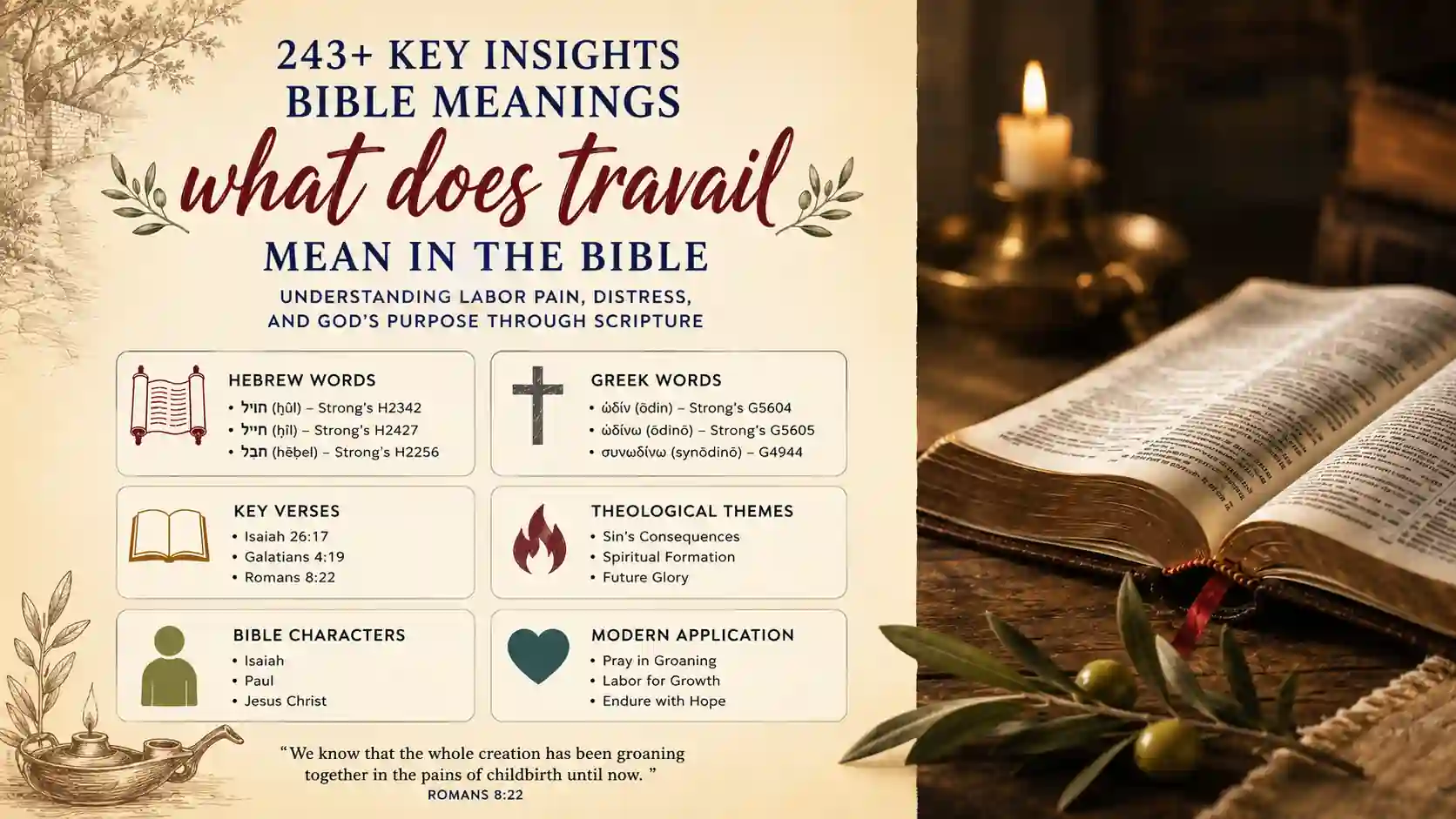
| חוּל | ḥûl | H2342 | To twist, writhe, tremble |
| חִיל | ḥîl | H2427 | Pain, anguish, writhing |
| חֵבֶל | ḥēḇel | H2256 | Cord, pang, birth pain |
| יָלַד | yālad | H3205 | To bear or bring forth |
| עָמָל | ʿāmāl | H5999 | Toil, misery, grievous labor |
| תְּלָאָה | telāʾâ | H8513 | Hardship, weariness, distress |
| ὠδίν | ōdin | G5604 | Birth pang or severe anguish |
| ὠδίνω | ōdinō | G5605 | To suffer birth pains |
| συνωδίνω | synōdinō | G4944 | To travail together |
| μόχθος | mochthos | G3449 | Labor, hardship, exhausting toil |
The Hebrew vocabulary ranges from literal childbirth to twisting fear, exhausting work, and national distress. The Greek ὠδίν family preserves the vivid image of labor pains, while μόχθος emphasizes strenuous toil.
Related Travail Biblical Concepts
| Concept | Connection | Supporting Verse |
|---|---|---|
| Childbirth | Primary physical image | Genesis 38:27 |
| The fall | Pain enters human experience | Genesis 3:16 |
| Judgment | Anguish overtakes the rebellious | Isaiah 13:8 |
| Exile | Zion labors before displacement | Micah 4:10 |
| Redemption | Suffering precedes deliverance | Isaiah 53:11 |
| Intercession | Spiritual concern resembles labor | Galatians 4:19 |
| Discipleship | Travail seeks mature faith | Galatians 4:19 |
| Creation’s groaning | The world awaits liberation | Romans 8:22 |
| End-time distress | Birth pains mark coming judgment | Matthew 24:8 |
| Joy after sorrow | Birth transforms anguish | John 16:21 |
Historical and Cultural Context of Travail
| Aspect | Detail | Biblical Source |
|---|---|---|
| Ancient childbirth | Delivery carried serious danger | Genesis 35:16–19 |
| Midwives | Assisted women during delivery | Exodus 1:15–21 |
| Birthing posture | Women could use birthstools | Exodus 1:16 |
| Maternal mortality | Rachel dies after bearing Benjamin | Genesis 35:18 |
| Twin births | Could involve confusion and danger | Genesis 38:27–30 |
| Warfare imagery | Terror resembles sudden labor | Jeremiah 6:24 |
| Royal humiliation | Warriors lose strength like laboring women | Jeremiah 30:6 |
| Prophetic poetry | Birth pangs dramatize national crisis | Isaiah 13:8 |
| Agricultural toil | Labor reflects life under the curse | Genesis 3:17–19 |
| Messianic expectation | Pain precedes promised restoration | Micah 5:2–4 |
Theological Themes within Travail
| Theme | Explanation | Scripture |
|---|---|---|
| Sin’s consequences | Travail reflects creation’s brokenness | Genesis 3:16–19 |
| Human helplessness | Severe anguish defeats self-reliance | Isaiah 26:17–18 |
| Divine judgment | Rebellion produces unavoidable distress | Jeremiah 4:31 |
| Substitution | Christ bears soul-deep anguish | Isaiah 53:11 |
| Spiritual formation | Paul labors until Christ is formed | Galatians 4:19 |
| Present suffering | Creation remains under corruption | Romans 8:20–22 |
| Future glory | Groaning anticipates liberation | Romans 8:21–23 |
| Sudden accountability | Judgment arrives like labor pains | 1 Thessalonians 5:3 |
| Sorrow transformed | Christ turns grief into lasting joy | John 16:20–22 |
| Kingdom expectation | Distress precedes final restoration | Matthew 24:8 |
Modern Travail Application for Believers
| Area | Practice | Scripture |
|---|---|---|
| Personal suffering | Bring anguish honestly before God | Psalm 6:6–9 |
| Prayer | Persist when words become groaning | Romans 8:26 |
| Discipleship | Labor patiently for spiritual growth | Galatians 4:19 |
| Ministry | Serve despite weariness and hardship | 1 Thessalonians 2:9 |
| Compassion | Support those enduring painful seasons | Romans 12:15 |
| Endurance | View suffering beside promised glory | Romans 8:18 |
| Hope | Expect God to redeem present sorrow | John 16:21–22 |
| Watchfulness | Remain spiritually awake | 1 Thessalonians 5:4–6 |
| Creation care | Recognize the world’s present groaning | Romans 8:22 |
| Worship | Trust God during helplessness | Isaiah 26:16–18 |
What Does Travail Mean in the Bible Through חוּל And חִיל?
The Hebrew verb חוּל, ḥûl, can describe twisting, trembling, writhing, or bringing forth. Its related noun חִיל, ḥîl, identifies the pain or anguish produced by that convulsive movement. Together they communicate distress that affects the entire person, not a mild or passing inconvenience.
Prophets employ this vocabulary when nations encounter divine judgment. In Jeremiah 4:31, Jerusalem gasps like a woman giving birth as enemies close in. The comparison emphasizes vulnerability, inevitability, and urgency. Once true labor begins, it cannot be dismissed through positive thinking or political confidence.
The noun חֵבֶל, ḥēḇel, adds another striking image. It ordinarily may refer to a cord or rope, but it can also signify a birth pang. The connection suggests pain that grips or binds its sufferer. Isaiah 26:17 pictures Israel writhing before God yet unable to produce deliverance by its own strength.
This confession corrects a common misunderstanding. Travail itself does not automatically create spiritual fruit. Israel experienced anguish but admitted, “We have not wrought any deliverance.” Pain can expose your need, yet only God can grant the salvation, holiness, or restoration for which you long.
Isaiah’S Travail from Judgment to the Suffering Servant
Isaiah uses childbirth imagery to portray both terror and hope. In Isaiah 13:8, the inhabitants of Babylon experience pangs as divine judgment approaches. In Isaiah 26:17, faithful Israel feels powerless. In Isaiah 66:7–9, however, Zion’s astonishing birth announces God’s ability to restore his people.
Isaiah 53:11 uses different vocabulary. The “travail” of the Servant’s soul translates עָמָל, ʿāmāl, a term for grievous toil, misery, or trouble. The verse does not describe literal childbirth. It describes the profound suffering through which the Servant justifies many and bears their iniquities.
This gives biblical travail a redemptive dimension without teaching that all suffering is redemptive. Christ’s suffering is unique because he acts as the righteous, sin-bearing Servant. Your suffering does not atone for sin, but it can deepen dependence, strengthen endurance, and conform you to Christ.
The resurrection pattern also prevents despair. Isaiah’s Servant sees the fruit of his anguish and is satisfied. Biblical hope does not pretend that travail is painless. It declares that God can bring his saving purpose through circumstances that appear barren, defeated, or beyond recovery.
Ὠδίν And the New Testament Birth-Pain Pattern
The Greek noun ὠδίν, ōdin, means a birth pang or acute anguish. Jesus uses its plural form in Matthew 24:8 when he calls wars, famines, and earthquakes “the beginning of birth pains.” These events indicate real distress, but Jesus does not give his disciples permission to calculate dates from every disaster.
Paul uses the same image in 1 Thessalonians 5:3. Sudden destruction comes like labor pains upon a pregnant woman. His emphasis is moral and pastoral. Because the day of the Lord will not submit to human schedules, you should live awake, sober, faithful, and prepared.
Romans 8:22 intensifies the picture through συνωδίνω, synōdinō, meaning to suffer birth pains together. Creation is personified as sharing one vast labor. The world’s decay, frustration, and mortality are neither natural ideals nor permanent realities. They point toward the liberation God has promised.
Yet Romans 8 does not say every earthly crisis signals immediate deliverance. Creation has groaned across generations. Paul’s argument centers on assured hope, patient endurance, and the Spirit’s help. Travail is therefore an honest description of present brokenness joined to confidence in future renewal.
Paul’S Travail Until Christ Is Formed in You
In Galatians 4:19, Paul addresses his converts as “my little children” and says he is again in ὠδίνω, ōdinō, until Christ is formed in them. He is not describing physical labor. He is expressing the costly pastoral anguish caused by their movement toward a distorted gospel.
His travail is purposeful rather than dramatic. Paul wants Christlike character, doctrinal stability, and freedom from spiritual bondage. The passage does not support manipulating others by displaying emotional pain. Genuine spiritual travail serves another person’s growth and remains governed by the truth of the gospel.
Paul also describes ministry through μόχθος, mochthos, meaning exhausting labor or hardship. He worked night and day so that he would not burden young congregations. Biblical ministry may require sacrifice, lost sleep, patient teaching, correction, and prayer that receives little public recognition.
You should not romanticize exhaustion or neglect wise rest. Still, Scripture challenges a faith built entirely around comfort. Travail teaches you to care deeply, pray persistently, endure faithfully, and trust God for results that human effort cannot manufacture.
Questions About Travail in Scripture
Does חוּל, ḥûl, always refer to literal childbirth?
No. It may describe childbirth, trembling, writhing, fear, or national anguish according to the passage.
Why does Isaiah 53:11 say “travail” in the KJV but “anguish” in newer translations?
The Hebrew עָמָל, ʿāmāl, means grievous toil or suffering, so “anguish” communicates the sense more directly.
Is Paul teaching a special prayer method when he uses ὠδίνω in Galatians 4:19?
No. He uses childbirth metaphorically for his costly pastoral concern until Christlike maturity develops in believers.
Do the birth pains in Matthew 24:8 provide a timetable for Christ’s return?
No. Jesus identifies them as the beginning of distress and calls his followers to endurance rather than date setting.
How should Romans 8:22 shape your response to suffering?
It permits honest groaning while grounding your endurance in God’s promised liberation of creation.