
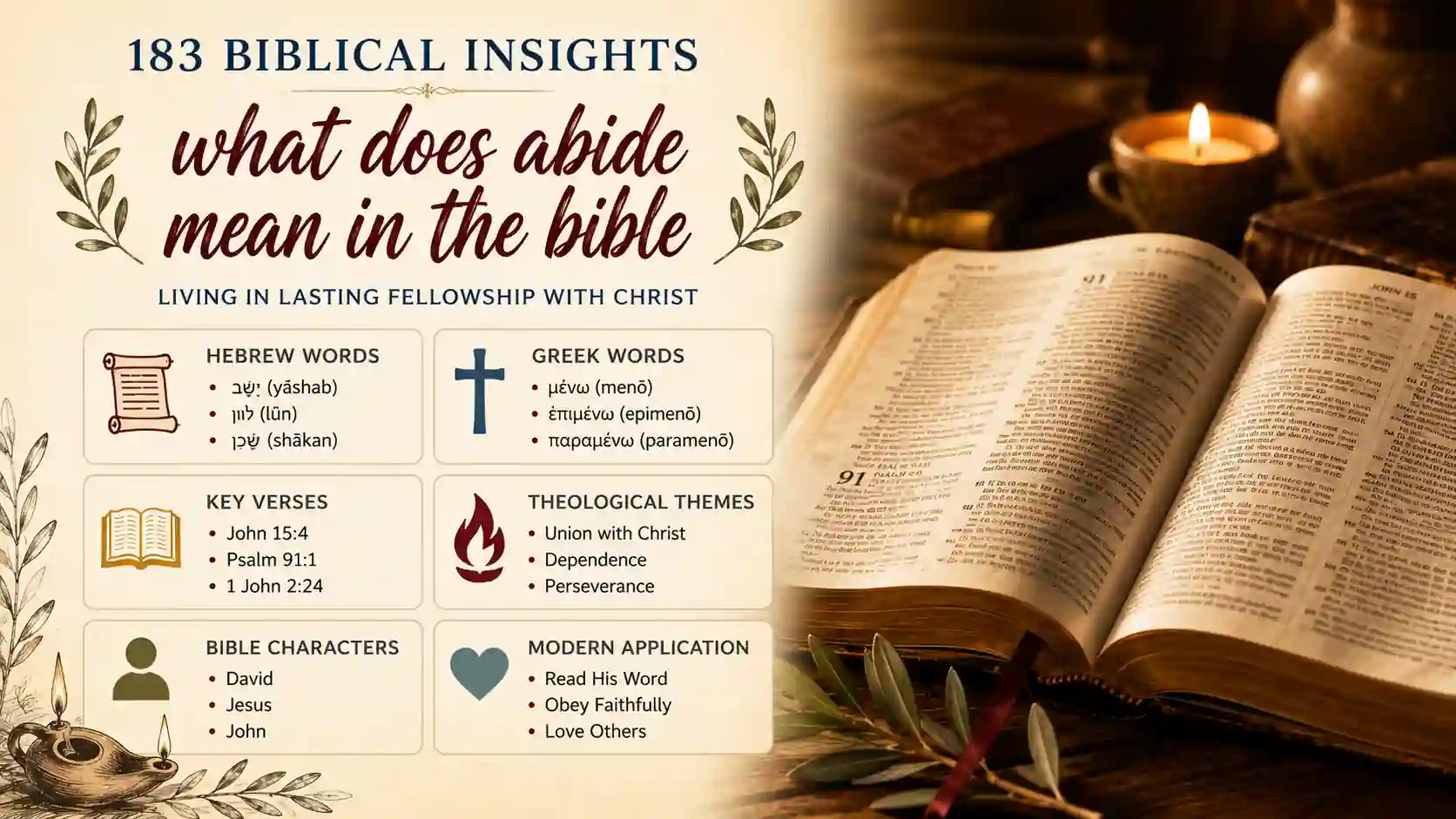
What does abide mean in the Bible? The word describes far more than occupying a place. To abide is to remain, continue, dwell, endure, or maintain a faithful relationship. Scripture uses it for living under God’s protection, continuing in Christ’s teaching, remaining in divine love, and persevering in faith.
In your study, you will encounter several Hebrew and Greek words translated as “abide.” Their contexts vary, but they share an emphasis on settled presence rather than temporary contact. Biblical abiding is the enduring life of trust, obedience, fellowship, and dependence that God desires for his people.
Key Abide Scripture References
| Verse | Passage Snippet | Context |
|---|---|---|
| Psalm 15:1 | “Abide in thy tabernacle” | David asks who may live near God |
| Psalm 61:4 | “Abide in thy tabernacle for ever” | A prayer for lasting refuge |
| Psalm 91:1 | “Abide under the shadow” | Security beneath God’s protection |
| John 6:56 | “Dwelleth in me” | Union through receiving Christ |
| John 8:31 | “Continue in my word” | Evidence of genuine discipleship |
| John 15:4 | “Abide in me” | Branches must remain in the vine |
| John 15:7 | “My words abide in you” | Communion shapes fruitful prayer |
| 1 Corinthians 13:13 | “Abideth faith, hope, charity” | Enduring Christian virtues |
| 1 John 2:24 | “Abide in you” | Continuing in the apostolic message |
| 1 John 4:16 | “Dwelleth in God” | Living within God’s love |
John 15 presents the Bible’s best-known picture of abiding. Jesus spoke shortly before his arrest, using the familiar image of a cultivated vine to explain the disciples’ complete dependence upon him. The branch bears fruit only while it remains joined to the vine.
Abide Bible Translation Comparison
| Verse | KJV | NIV | ESV | NASB |
|---|---|---|---|---|
| Psalm 15:1 | abide | dwell | dwell | dwell |
| Psalm 61:4 | abide | dwell | dwell | dwell |
| Psalm 91:1 | abide | rest | abide | lodge |
| John 8:31 | continue | hold to | abide | continue |
| John 15:4 | abide | remain | abide | remain |
| John 15:5 | abideth | remain | abides | remains |
| John 15:7 | abide | remain | abide | remain |
| 1 John 2:6 | abideth | lives | abides | remains |
| 1 John 2:24 | abide | remain | abide | remain |
| 1 John 4:16 | dwelleth | lives | abides | remains |
The differences are usually matters of English style rather than conflicting interpretations. “Abide,” “remain,” “continue,” “dwell,” and “live” may represent the same underlying verb. The KJV and ESV often preserve “abide,” while the NIV and NASB frequently use more contemporary equivalents.
People and Characters Associated with Abide
| Person | Role | Connection |
|---|---|---|
| David | King and psalmist | Longed to abide in God’s tent |
| Moses | Covenant mediator | Desired God’s presence with Israel |
| Ruth | Faithful Moabite | Remained with Naomi and her God |
| Samuel | Prophet | God’s word remained authoritative |
| Jesus | True vine | Commands disciples to abide in him |
| John | Apostle and evangelist | Develops abiding as a major theme |
| Peter | Apostle | Calls God’s word enduring |
| Paul | Apostle to the Gentiles | Teaches that faith, hope, and love abide |
| Timothy | Christian minister | Told to continue in learned truth |
| Beloved disciple | Witness to Christ | Models sustained fellowship with Jesus |
David’s prayers give the Old Testament background for this theme. To abide in God’s tent meant enjoying accepted fellowship with the covenant Lord. It did not describe merely entering a physical sanctuary. It pictured a life welcomed into God’s holy presence.
Original Hebrew and Greek Words for Abide
| Original Word | Transliteration | Strong’s # | Literal Meaning |
|---|---|---|---|
| יָשַׁב | yāshab | H3427 | sit, dwell, remain |
| לוּן | lûn | H3885 | lodge, stay overnight |
| גּוּר | gûr | H1481 | sojourn, reside |
| שָׁכַן | shākan | H7931 | settle, dwell |
| עָמַד | ʿāmad | H5975 | stand, remain |
| μένω | menō | G3306 | remain, stay, abide |
| ἐπιμένω | epimenō | G1961 | continue, persist |
| παραμένω | paramenō | G3887 | remain beside, continue |
| διαμένω | diamenō | G1265 | continue throughout |
| κατοικέω | katoikeō | G2730 | inhabit, dwell |
The central New Testament word is μένω, menō, Strong’s G3306. It can describe staying in a house, continuing in a condition, enduring through time, or remaining within a relationship. John gives the word special theological depth by applying it to the mutual fellowship of Christ and his people.
No single Hebrew verb corresponds to every biblical occurrence of “abide.” English translations use the term for several roots involving dwelling, lodging, standing, or sojourning. You must therefore examine each verse rather than assuming that every occurrence carries precisely the same nuance.
Related Biblical Concepts of Abide
| Concept | Connection | Supporting Verse |
|---|---|---|
| Fellowship | Abiding includes communion with God | 1 John 1:3 |
| Union with Christ | The branch receives life from the vine | John 15:5 |
| Discipleship | True disciples remain in Jesus’ word | John 8:31 |
| Obedience | Keeping commands expresses abiding love | John 15:10 |
| Fruitfulness | Remaining in Christ produces fruit | John 15:4 |
| Prayer | Christ’s words shape faithful requests | John 15:7 |
| Assurance | Abiding confirms confident relationship | 1 John 2:28 |
| Perseverance | Believers continue in received truth | 1 John 2:24 |
| Divine presence | God makes his dwelling with his people | John 14:23 |
| Eternal life | Christ’s life remains in believers | 1 John 3:15 |
Abiding must not be reduced to a private feeling of spiritual closeness. In John’s writings, it is tied to revealed truth, confession of the Son, obedience to Christ’s commands, love for fellow believers, and dependence upon the Holy Spirit.
Historical and Cultural Context of Abide
| Aspect | Detail | Biblical Source |
|---|---|---|
| Ancient tents | Tents represented residence and hospitality | Psalm 15:1 |
| Temple worship | Dwelling near God signified accepted access | Psalm 27:4 |
| Covenant land | Israel was called to remain faithful there | Deuteronomy 30:20 |
| Hospitality | Travelers lodged in homes overnight | Luke 24:29 |
| Rabbinic discipleship | Students continued in a teacher’s instruction | John 8:31 |
| Vine cultivation | Branches required living attachment | John 15:1–5 |
| Pruning | Growers cut branches to increase fruit | John 15:2 |
| Farewell discourse | Jesus prepared disciples for his departure | John 13–17 |
| House churches | Believers practiced sustained fellowship | Acts 2:46 |
| Johannine conflict | Christians faced teachers denying Christ | 1 John 2:18–27 |
Vineyards were common throughout ancient Israel, and Scripture regularly used vines as symbols for God’s covenant people. In John 15, Jesus identifies himself as the true vine. Life and fruitfulness now center upon relationship with him, not ancestry or outward membership alone.
Jesus delivered this teaching during his farewell discourse. His disciples were about to lose his visible, bodily presence. The command to remain assured them that his departure would not end their fellowship with him. His words and Spirit would sustain them.
Theological Themes of Abide
| Theme | Explanation | Scripture |
|---|---|---|
| Divine initiative | Christ first receives and sustains his people | John 15:16 |
| Dependence | Spiritual fruit cannot arise apart from Christ | John 15:5 |
| Mutual indwelling | Christ abides in those who abide in him | John 15:4 |
| Sanctification | Abiding produces increasing fruitfulness | John 15:2 |
| Revelation | Christ’s teaching remains in disciples | John 15:7 |
| Covenant love | Obedience continues within divine love | John 15:9–10 |
| Perseverance | Genuine faith continues with Christ | 1 John 2:19 |
| Assurance | The Spirit testifies to God’s indwelling | 1 John 4:13 |
| Judgment | Fruitless separation ends in destruction | John 15:6 |
| Glory | Fruitful lives honor the Father | John 15:8 |
The command to abide does not mean that you create spiritual life through effort. A branch does not manufacture the vine’s life. It receives life by remaining connected. Yet this dependence is active, because Jesus joins abiding with hearing, believing, obeying, praying, and loving.
John 15:6 also gives the image a sober edge. A branch that does not remain withers and is burned. Christians differ over every implication of that warning, but its pastoral force is clear. Mere outward association with Jesus must never replace living, fruitful dependence upon him.
Modern Application of Abide for Believers
| Area | Practice | Scripture |
|---|---|---|
| Scripture | Read and retain Christ’s words | John 8:31 |
| Prayer | Let Scripture guide your requests | John 15:7 |
| Obedience | Respond concretely to Jesus’ commands | John 15:10 |
| Worship | Seek fellowship with God, not ritual alone | Psalm 27:4 |
| Relationships | Practice patient, sacrificial love | 1 John 4:12 |
| Temptation | Remain grounded in received truth | 1 John 2:24 |
| Suffering | Continue trusting when feelings change | Romans 12:12 |
| Work | Serve from dependence upon Christ | Colossians 3:23 |
| Church | Stay committed to Christian fellowship | Hebrews 10:24–25 |
| Witness | Bear fruit that glorifies the Father | John 15:8 |
Abiding may include quiet prayer and meditation, but it extends through your entire life. You abide when Christ’s teaching governs your decisions, his love shapes your relationships, and dependence upon him replaces self-sufficiency.
This practice is steady rather than spectacular. You return to Scripture, confess sin, receive grace, obey what Christ has made clear, and remain among his people. Such habits do not earn union with Christ. They express and nourish a relationship grounded in his life.
What Does Abide Mean in the Bible’S Johannine Writings?
John uses μένω, menō, more extensively than any other New Testament writer. The word appears in ordinary settings, such as staying at a house, but it also describes enduring spiritual realities. The Father’s word, Christ’s love, eternal life, truth, and the Holy Spirit are all said to remain.
This vocabulary connects the Gospel of John with 1 and 2 John. To abide in Christ is to continue in the apostolic testimony about Jesus. Anyone claiming spiritual intimacy while rejecting the incarnate Son or refusing his command to love has misunderstood biblical abiding.
Μένω And the Vine’S Life in John 15
The vine metaphor explains why abiding is necessary. A detached branch may retain its shape briefly, but it possesses no independent source of life. In the same way, talent, religious activity, and moral determination cannot produce the fruit that comes from communion with Christ.
Fruit includes obedience, love, witness, answered prayer, and conduct that glorifies the Father. The passage does not call you to anxious self-production. It calls you to sustained reliance upon Jesus, whose life supplies everything the branch needs.
Covenant Dwelling from the Psalms to Christ
The Psalms associate abiding with God’s tent, holy hill, shelter, and shadow. These images express security and accepted access. The worshiper does not treat God as a temporary refuge while continuing in rebellion. Psalm 15 connects dwelling with integrity, truthfulness, justice, and covenant faithfulness.
The New Testament carries this hope forward through Christ. Jesus does not merely provide a place where God may be visited. Through him, God dwells with his people, and they dwell in God. The sanctuary theme becomes personal, communal, and ultimately eternal.
Abiding, Obedience, and Grace
Some readers fear that commands to abide make salvation depend upon flawless performance. Others speak of abiding so passively that obedience becomes unnecessary. Scripture avoids both errors. Christ is the source of life, while obedience is the fitting expression of living fellowship with him.
You do not obey to persuade Christ to become your vine. You obey because his word and life are working within you. When you fail, abiding directs you back to confession, cleansing, faith, and renewed obedience rather than despair or careless presumption.
Frequently Asked Questions About Abide
Does μένω, menō, always mean spiritual union with Christ?
No. It can mean simply staying or remaining, so each occurrence must be interpreted from its context.
Why does the NIV say “remain” where the KJV says “abide” in John 15?
Both translate μένω accurately, with “remain” using more familiar contemporary English.
Does John 15:6 teach that a true believer can lose salvation?
The verse gives a real warning against fruitless separation from Christ, though Christian traditions differ on how it relates to apostasy and assurance.
How is יָשַׁב, yāshab, different from μένω, menō?
Yāshab commonly emphasizes sitting or dwelling in a place, while John often uses menō for continuing personal and spiritual fellowship.
How can you abide in Christ during an ordinary workday?
Carry his word into your decisions, pray dependently, obey faithfully, love others, and recognize that every good fruit comes from him.