
You may have met this phrase in Daniel and again in the words of Jesus, and you may have wondered why it sounds both ancient and urgent at the same time. The full phrase what is the abomination of desolation in the bible points to a defiling act in a holy place, an act that shocks worshippers and signals deep trouble for the people of God.
This study walks through the verses, the Hebrew and Greek words, the history behind them, and the hope that runs through them. You will see how Daniel, Jesus, and Paul each use the image, and you will find steady practices for discernment when sacred things are twisted or misused.
Key Scripture References for the Abomination of Desolation
| Verse | Passage Snippet | Context |
|---|---|---|
| Daniel 9:27 | An abomination that causes desolation | A covenant broken in a final week |
| Daniel 11:31 | Forces desecrate the sanctuary | Daily sacrifice abolished by a ruler |
| Daniel 12:11 | The abomination is set up | A counted period of distress follows |
| Daniel 8:13 | The sanctuary is trampled | A question about rebellion and desecration |
| Matthew 24:15 | The abomination stands in the holy place | Jesus warns hearers in Judea to flee |
| Mark 13:14 | The abomination stands where it does not belong | Mark adds a note to understand |
| Luke 21:20 | Jerusalem surrounded by armies | Its desolation is near, Luke says |
| 2 Thessalonians 2:3-4 | The man of lawlessness in the temple | A proud figure claims divine honor |
Bible Translation Comparison for the Abomination of Desolation
| Verse | KJV | NIV | ESV | NASB |
|---|---|---|---|---|
| Daniel 9:27 | abomination of desolation | abomination that causes desolation | abomination of desolation | abomination of desolation |
| Daniel 11:31 | abomination that maketh desolate | abomination that causes desolation | abomination that makes desolate | abomination of desolation |
| Daniel 12:11 | abomination that maketh desolate | abomination that causes desolation | abomination that makes desolate | abomination of desolation |
| Matthew 24:15 | abomination of desolation | abomination that causes desolation | abomination of desolation | abomination of desolation |
| Mark 13:14 | abomination of desolation | abomination that causes desolation | abomination of desolation | abomination of desolation |
| Luke 21:20 | desolation thereof is nigh | its desolation is near | its desolation has come near | her desolation is near |
| 2 Thessalonians 2:4 | man of sin exalteth himself | man of lawlessness in the temple | man of lawlessness in the temple | man of lawlessness in the temple |
| Revelation 13:15 | image of the beast should speak | image of the beast to speak | image of the beast to speak | image of the beast would speak |
People and Characters Associated with the Abomination of Desolation
| Person | Role | Connection |
|---|---|---|
| Daniel | Prophet in exile | He receives visions naming the defiling act |
| Antiochus IV Epiphanes | Seleucid king | He bans worship and pollutes the temple |
| Judas Maccabeus | Leader of revolt | He leads resistance and cleanses the temple |
| Jesus | Teacher and Messiah | He cites Daniel and warns disciples to flee |
| Paul | Apostle to Gentiles | He warns of a lawless figure to come |
| John | Seer of Patmos | He pictures a beast image demanding worship |
| Titus | Roman general | He commands the army that destroys Jerusalem |
| Disciples in Judea | First hearers | Jesus speaks to them about flight to mountains |
Original Hebrew and Greek Words for the Abomination of Desolation
| Original Word | Transliteration | Strong’s # | Literal Meaning |
|---|---|---|---|
| שִׁקּוּץ | shiqquts | H8251 | A detestable idol that provokes disgust |
| שֹׁמֵם | shomem | H8074 | One who appalls and lays waste |
| תּוֹעֵבָה | toevah | H8441 | An abhorrent practice God rejects |
| מִקְדָּשׁ | miqdash | H4720 | A sacred sanctuary for worship |
| קֹדֶשׁ | qodesh | H6944 | A place set apart for God |
| βδέλυγμα | bdelygma | G946 | A foul abomination causing revulsion |
| ἐρήμωσις | eremosis | G2050 | A laying waste leaving desolation |
| ἱερόν | hieron | G2411 | The temple and its courts |
Related Biblical Concepts for the Abomination of Desolation
| Concept | Connection | Supporting Verse |
|---|---|---|
| Idolatry | An idol replaces true worship | Exodus 20:4-5 |
| Temple defilement | A holy place is polluted | Daniel 11:31 |
| Covenant faithfulness | God keeps promises under attack | Daniel 9:27 |
| Daily sacrifice | Regular worship is stopped | Daniel 12:11 |
| Day of the Lord | Judgment and rescue follow rebellion | 2 Thessalonians 2:2-3 |
| Man of lawlessness | A proud figure claims worship | 2 Thessalonians 2:4 |
| False worship | Pressure to bow tests loyalty | Revelation 13:15 |
| Restoration | God restores worship after defilement | Daniel 8:14 |
Historical and Cultural Context for the Abomination of Desolation
| Aspect | Detail | Biblical Source |
|---|---|---|
| Seleucid rule | A Greek empire controls Judea | Daniel 11:21-31 |
| Antiochus altar | A pagan altar is set up in 167 BC | Daniel 11:31 |
| Maccabean revolt | Jewish families resist the worship ban | Daniel 11:32-34 |
| Temple cleansing | The temple is rededicated after defilement | Daniel 8:14 |
| Roman standards | Roman armies carry idolatrous images | Luke 21:20 |
| Siege of Jerusalem | Rome destroys the temple in AD 70 | Luke 21:20-24 |
| Apocalyptic writing | Visions comfort people under foreign power | Daniel 12:1-4 |
| Temple worship | Priests offer daily sacrifices in the sanctuary | Daniel 12:11 |
Theological Themes for the Abomination of Desolation
| Theme | Explanation | Scripture |
|---|---|---|
| Holiness of God | God is set apart and must be honored | Leviticus 19:2 |
| Judgment on idolatry | False worship brings ruin to a sanctuary | Daniel 11:31 |
| Sovereignty in distress | God limits the time of trouble | Daniel 12:11 |
| Faithfulness under pressure | Believers stay loyal at great cost | Daniel 11:32 |
| Discernment of signs | Jesus calls people to act wisely | Matthew 24:15 |
| Hope beyond desolation | Desolation is not the final word | Daniel 12:1 |
| Warning and mercy | A warning gives time to flee | Matthew 24:16 |
| Endurance to the end | Those who wait find blessing | Daniel 12:12 |
Modern Application for Believers for the Abomination of Desolation
| Area | Practice | Scripture |
|---|---|---|
| Worship purity | Keep worship centered on God alone | Exodus 20:3 |
| Discernment | Test teachings against Scripture first | Matthew 24:15 |
| Courage | Stand firm when crowds pressure compromise | Daniel 11:32 |
| Prayer | Pray for wisdom when news frightens you | Luke 21:28 |
| Community | Stay close to a faithful church | Hebrews 10:25 |
| Teaching children | Explain hard passages with honesty and hope | Deuteronomy 6:6-7 |
| Media habits | Refuse images demanding worship like loyalty | Revelation 13:15 |
| Hope in hardship | Remember trouble has limits from God | Daniel 12:1 |
Shiqquts and Bdelygma Reveal Defilement in a Holy Place
The Hebrew word shiqquts points to something foul and hateful in the eyes of God, often an idol placed where only God should be honored. The Greek word bdelygma carries the same shock in the New Testament, and it helps you feel why Jesus and his hearers would recoil at the image. When such a thing stands in a holy place, the offense is not only political, it is spiritual, because worship itself has been invaded.
You can use these words as a lens for reading Daniel and the Gospels slowly. Notice how each passage pairs the defiling object with desolation, a word that speaks of emptiness, ruin, and a sanctuary stripped of its purpose. That pairing teaches you to watch for both parts, the false worship and the waste that follows, rather than treating the phrase as a vague symbol.
What Is the Abomination of Desolation in the Bible for Readers in Judea
Jesus speaks to people who could see Jerusalem and its temple with their own eyes, and he tells them to flee to the mountains when they see the sign. That concrete advice matters, because it shows that prophecy in this passage is meant to protect life and not only to satisfy curiosity. The first readers would have heard a call to act quickly, to leave homes and fields behind, and to trust God more than property or routine.
For you today, the passage still asks for readiness and clear judgment rather than panic or speculation. You are not told to decode every headline, and you are not told to set dates for events that Scripture leaves open. You are told to know the words of Daniel, to listen to Jesus, and to hold fast to worship that belongs to God alone.
From Antiochus to Rome and Toward the End of the Age
Many readers see a first fulfillment in Antiochus, who banned Jewish worship and polluted the temple in the second century BC. Others see a later fulfillment in the Roman destruction of Jerusalem, when armies surrounded the city and the temple fell. Both readings share a pattern, a sacred place is seized, true worship is stopped, and faithful people must choose loyalty under threat.
Some readers also look ahead to a final figure who will claim divine honor and demand worship in the last days. You do not need to settle every debate about timing to learn the main lesson of the pattern. God warns his people in advance, God limits the reach of evil, and God keeps a remnant who will not bow to an image.
Discernment and Courage When Sacred Things Are Misused
Discernment begins with Scripture and with a community that will test bold claims rather than repeat them. When a teacher, a movement, or a cultural pressure asks for loyalty that belongs to God, you can pause and ask whether true worship is being replaced by something smaller. That pause is not doubt for its own sake, it is wisdom that protects your heart and your household.
Courage follows discernment, and it often looks quiet rather than dramatic in daily life. You may refuse a compromise at work, you may keep worship central in a busy week, or you may speak gently when others mock faith. Each small act of loyalty rehearses the larger faithfulness that Daniel and the Maccabees modeled under far greater pressure.
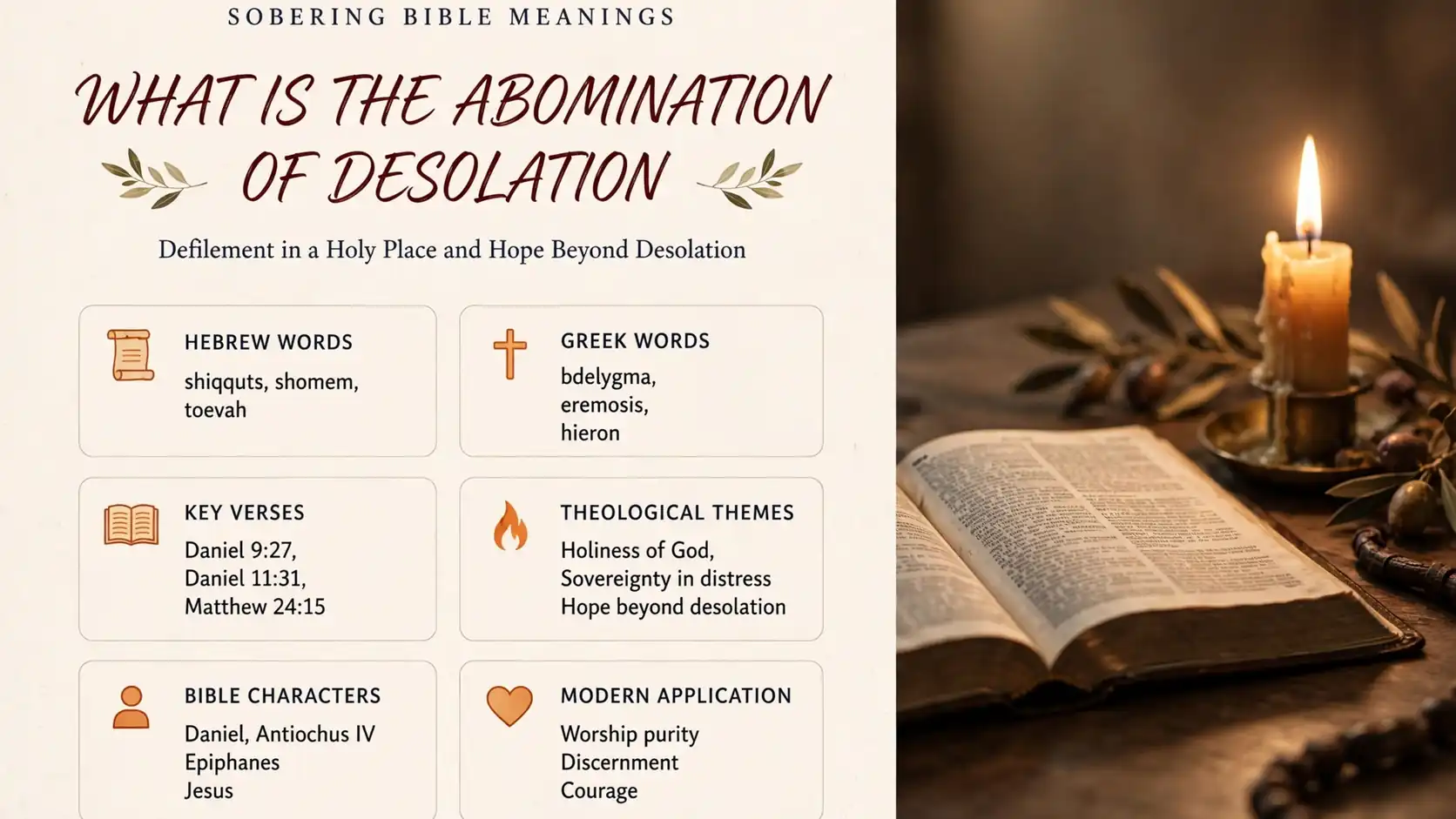
Questions About the Abomination of Desolation
What does shiqquts teach about the abomination of desolation in the bible?
Shiqquts teaches that the act is a detestable idol or practice placed where God alone should be honored.
Why does Matthew 24:15 tell readers to understand the words of Daniel?
Jesus tells readers to understand Daniel because the sign must be recognized quickly so that people in Judea can flee.
How do translations differ on the phrase that causes desolation?
Translations differ mainly in wording, with some saying abomination of desolation and others saying abomination that causes desolation.
Does the phrase point only to Antiochus, only to Rome, or also to the end of the age?
Readers disagree on timing, yet many see a pattern that includes Antiochus and Rome and may also point toward a final fulfillment.
How can you practice discernment when a cultural image demands loyalty like worship?
You can test the claim against Scripture, stay rooted in a faithful church, and refuse loyalty that belongs to God alone.