
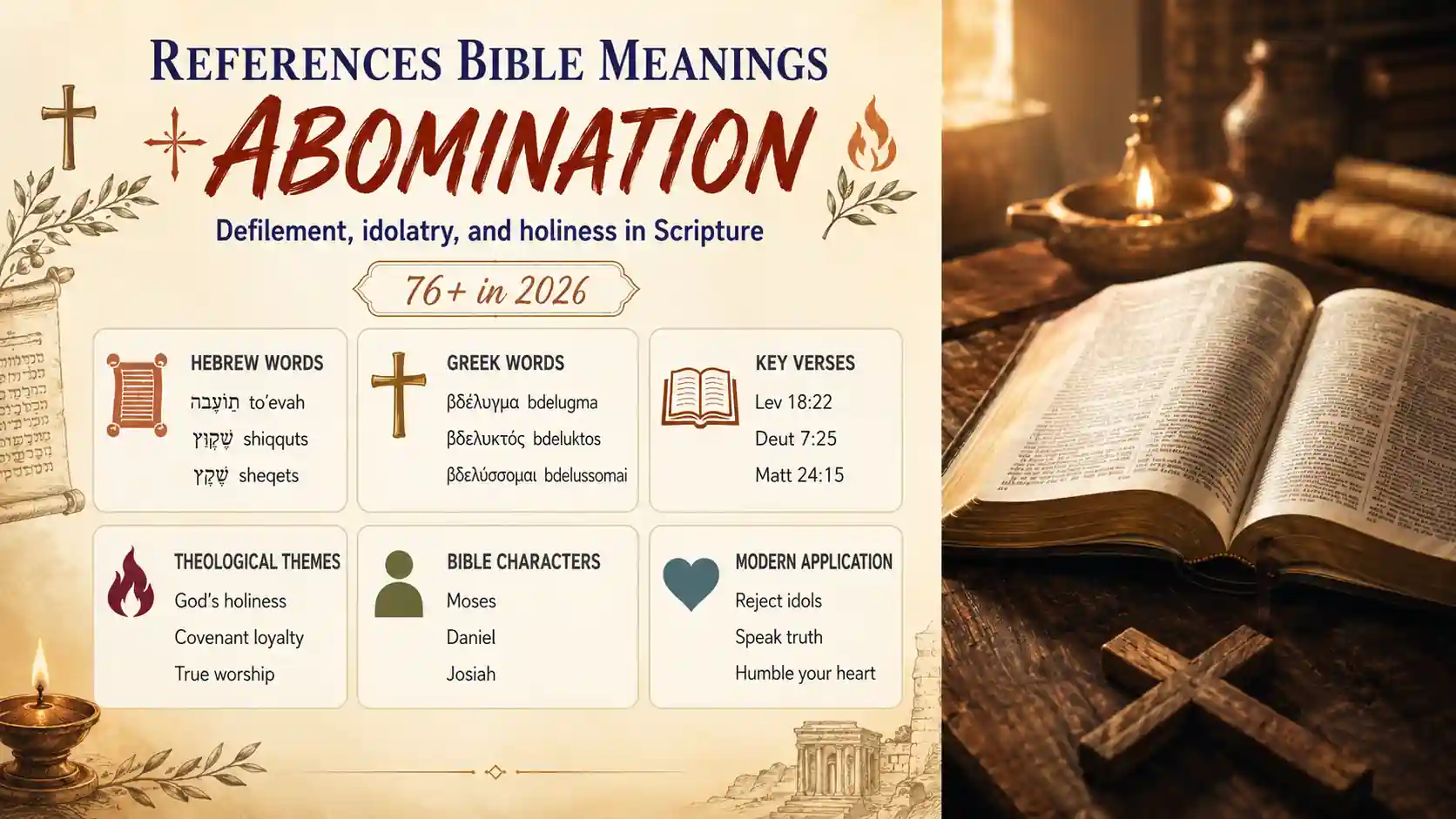
What does abomination mean in the Bible? In Scripture, an abomination is not merely something unpleasant or culturally offensive. It is something detestable before the Lord because it violates His holiness, corrupts worship, harms covenant life, or turns the heart toward idols.
Your study will meet several Hebrew and Greek words, especially תּוֹעֵבָה, toʿevah, and βδέλυγμα, bdelugma. These words appear in legal, prophetic, wisdom, gospel, and apocalyptic settings, showing that God’s people must learn to hate what God calls detestable while still seeking mercy and repentance.
Abomination Key Scripture References
| Verse | Passage Snippet | Context |
|---|---|---|
| Genesis 43:32 | Egyptians could not eat with Hebrews | Social and ritual separation |
| Exodus 8:26 | Sacrifice would be abomination to Egyptians | Moses before Pharaoh |
| Leviticus 18:22 | Same sex intercourse called abomination | Holiness code |
| Deuteronomy 7:25 | Idols are an abomination | Conquest warning |
| Deuteronomy 12:31 | Nations burned children to gods | Canaanite worship |
| Proverbs 6:16 | Six things the Lord hates | Wisdom teaching |
| Isaiah 1:13 | Incense became abomination | Hypocritical worship |
| Daniel 9:27 | Abomination that makes desolate | Temple defilement |
| Matthew 24:15 | Abomination of desolation | Jesus warns disciples |
| Revelation 21:27 | Nothing abominable enters | New Jerusalem purity |
Abomination Bible Translation Comparison
| Verse | KJV | NIV | ESV | NASB |
|---|---|---|---|---|
| Lev 18:22 | abomination | detestable | abomination | abomination |
| Deut 7:25 | abomination | detestable | abominable | abomination |
| Deut 18:12 | abomination | detestable | abomination | detestable |
| Prov 11:1 | abomination | detests | abomination | abomination |
| Prov 16:5 | abomination | detests | abomination | abomination |
| Isa 1:13 | abomination | detestable | abomination | abomination |
| Jer 7:10 | abominations | detestable things | abominations | abominations |
| Dan 11:31 | abomination | abomination | abomination | abomination |
| Matt 24:15 | abomination | abomination | abomination | abomination |
Abomination People and Characters Associated
| Person | Role | Connection |
|---|---|---|
| Moses | Lawgiver | Taught Israel what God detests |
| Pharaoh | Egyptian king | Opposed Israel’s worship |
| Aaron | High priest | Guarded holy worship |
| Solomon | Israel’s king | Later tolerated detestable idols |
| Manasseh | Judah’s king | Filled Jerusalem with abominations |
| Josiah | Reforming king | Removed idolatrous practices |
| Daniel | Prophet in exile | Saw temple desecration foretold |
| Antiochus IV | Seleucid ruler | Historical temple profaner |
| Jesus | Messiah | Warned of desolating abomination |
Abomination Original Hebrew and Greek Words
| Original Word | Transliteration | Strong’s # | Literal Meaning |
|---|---|---|---|
| תּוֹעֵבָה | toʿevah | H8441 | Detestable thing |
| שֶׁקֶץ | sheqets | H8263 | Loathsome thing |
| שִׁקּוּץ | shiqquts | H8251 | Detestable idol |
| פִּגּוּל | piggul | H6292 | Foul sacrificial thing |
| נִדָּה | niddah | H5079 | Impurity, separation |
| זָעַם | zaʿam | H2194 | To abhor, denounce |
| βδέλυγμα | bdelugma | G946 | Detestable thing |
| βδελυκτός | bdeluktos | G947 | Abominable |
| βδελύσσομαι | bdelussomai | G948 | To detest |
Abomination Related Biblical Concepts
| Concept | Connection | Supporting Verse |
|---|---|---|
| Idolatry | False worship is detestable | Deut 7:25 |
| Holiness | God separates clean from unclean | Lev 20:26 |
| Justice | Dishonest scales offend God | Prov 11:1 |
| Hypocrisy | Ritual without obedience disgusts God | Isa 1:13 |
| Sexual sin | Some acts violate covenant holiness | Lev 18:22 |
| Child sacrifice | Canaanite worship condemned | Deut 12:31 |
| Pride | Arrogant heart is detestable | Prov 16:5 |
| Temple defilement | Desecration brings judgment | Dan 11:31 |
| Final purity | Evil excluded from God’s city | Rev 21:27 |
Abomination Historical and Cultural Context
| Aspect | Detail | Biblical Source |
|---|---|---|
| Egypt | Hebrews were socially offensive | Gen 43:32 |
| Exodus | Israel’s sacrifice offended Egypt | Exod 8:26 |
| Canaan | Idols shaped forbidden worship | Deut 7:25 |
| Molech | Children were sacrificed | Deut 12:31 |
| Temple | Holy space could be polluted | Ezek 5:11 |
| Exile | Abominations brought judgment | Jer 7:30 |
| Second Temple | Foreign altar desecrated worship | Dan 11:31 |
| Rome | Jerusalem faced later desolation | Matt 24:15 |
| Apocalypse | Evil excluded from the city | Rev 21:27 |
Abomination Theological Themes
| Theme | Explanation | Scripture |
|---|---|---|
| God’s holiness | Evil is measured by God’s nature | Lev 11:44 |
| Covenant loyalty | Israel must reject rival gods | Deut 7:26 |
| True worship | Sacrifice without obedience is rejected | Isa 1:13 |
| Moral order | Sin corrupts personal and public life | Lev 18:24 |
| Justice | God hates dishonest gain | Prov 11:1 |
| Judgment | Abominations invite discipline | Ezek 8:17 |
| Mercy | Defilement can be cleansed | Ezek 36:25 |
| Messiah’s warning | Jesus alerts His disciples | Matt 24:15 |
| New creation | Nothing unclean enters glory | Rev 21:27 |
| Repentance | God calls sinners back | Ezek 18:30 |
Abomination Modern Application for Believers
| Area | Practice | Scripture |
|---|---|---|
| Worship | Bring obedience with praise | Isa 1:16 |
| Money | Reject dishonest measures | Prov 11:1 |
| Speech | Refuse lying lips | Prov 12:22 |
| Pride | Humble the heart before God | Prov 16:5 |
| Discernment | Do not cherish idols | 1 John 5:21 |
| Sexuality | Honor God with the body | 1 Cor 6:20 |
| Justice | Protect the vulnerable | Mic 6:8 |
| Repentance | Turn from detestable things | Ezek 14:6 |
| Hope | Long for the pure city | Rev 21:27 |
| Witness | Speak truth with mercy | Eph 4:15 |
תּוֹעֵבָה And the Covenant Weight of What God Detests
The main Hebrew word behind “abomination” is תּוֹעֵבָה, toʿevah. It describes something detestable, especially when it violates worship, covenant faithfulness, moral order, or justice. In Deuteronomy, the word often stands close to idolatry because false worship attacks Israel’s relationship with the Lord.
This does not mean every use carries the same exact setting. Egyptians found eating with Hebrews offensive in Genesis 43:32, while God calls idols detestable in Deuteronomy 7:25. Context matters, yet the word consistently marks a serious boundary between what may be embraced and what must be rejected.
What Does Abomination Mean in the Bible When Worship Becomes Corrupt?
The prophets show that abomination is not only about pagan idols outside Israel. Isaiah says incense itself became an abomination when offered by people whose hands were full of injustice. The problem was not incense as God had commanded worship, but worship divorced from repentance.
Jeremiah and Ezekiel intensify the warning. Detestable practices were brought into the land, the city, and even the temple. Scripture therefore teaches you to examine not only what is done in worship, but whether the heart, ethics, and allegiance beneath worship honor the Holy One.
שִׁקּוּץ And βδέλυγμα in Daniel and the Words of Jesus
Daniel uses שִׁקּוּץ, shiqquts, for a detestable thing connected with temple desecration. This language becomes central in the phrase often called the “abomination of desolation.” Historically, many readers connect Daniel’s language with the profaning of the temple under Antiochus IV, while also seeing a later horizon in Jesus’ teaching.
In Matthew 24:15 and Mark 13:14, Jesus refers to the abomination of desolation spoken of by Daniel. The Greek word βδέλυγμα, bdelugma, carries the idea of something abhorrent before God. Jesus uses prophetic language to warn His disciples that sacred space would again face terrible defilement and judgment.
Wisdom, Justice, and the Everyday Face of Abomination
Proverbs may surprise you because it applies abomination language to ordinary life. Dishonest scales are an abomination to the Lord, lying lips are an abomination, and pride of heart is an abomination. God’s hatred of evil reaches markets, conversations, motives, and decisions.
This widens your study beyond ritual impurity. The Bible’s concern is not merely whether something looks religiously offensive. The Lord weighs whether a life aligns with truth, humility, justice, purity, and covenant love. What God detests, His people must learn to refuse.
Questions Bible Students Ask About Abomination
Does תּוֹעֵבָה, toʿevah, always mean the same thing?
No. It always signals something detestable, but the precise issue depends on context, such as idolatry, injustice, impurity, or social revulsion.
Why do some translations use “abomination” while others use “detestable”?
“Abomination” preserves traditional biblical language, while “detestable” gives modern readers the sense of something strongly rejected.
What is the abomination of desolation in Daniel and Matthew?
It refers to a dreadful desecration connected with holy space, first rooted in Daniel’s temple language and later used by Jesus as a warning.
Are all abominations ritual sins rather than moral sins?
No. Proverbs calls lying lips, dishonest scales, and pride abominations, showing that moral evil is central to the theme.
How should believers apply abomination language without becoming harsh?
Receive God’s moral seriousness with humility, reject what He calls evil, and speak truth as people who also need mercy.