
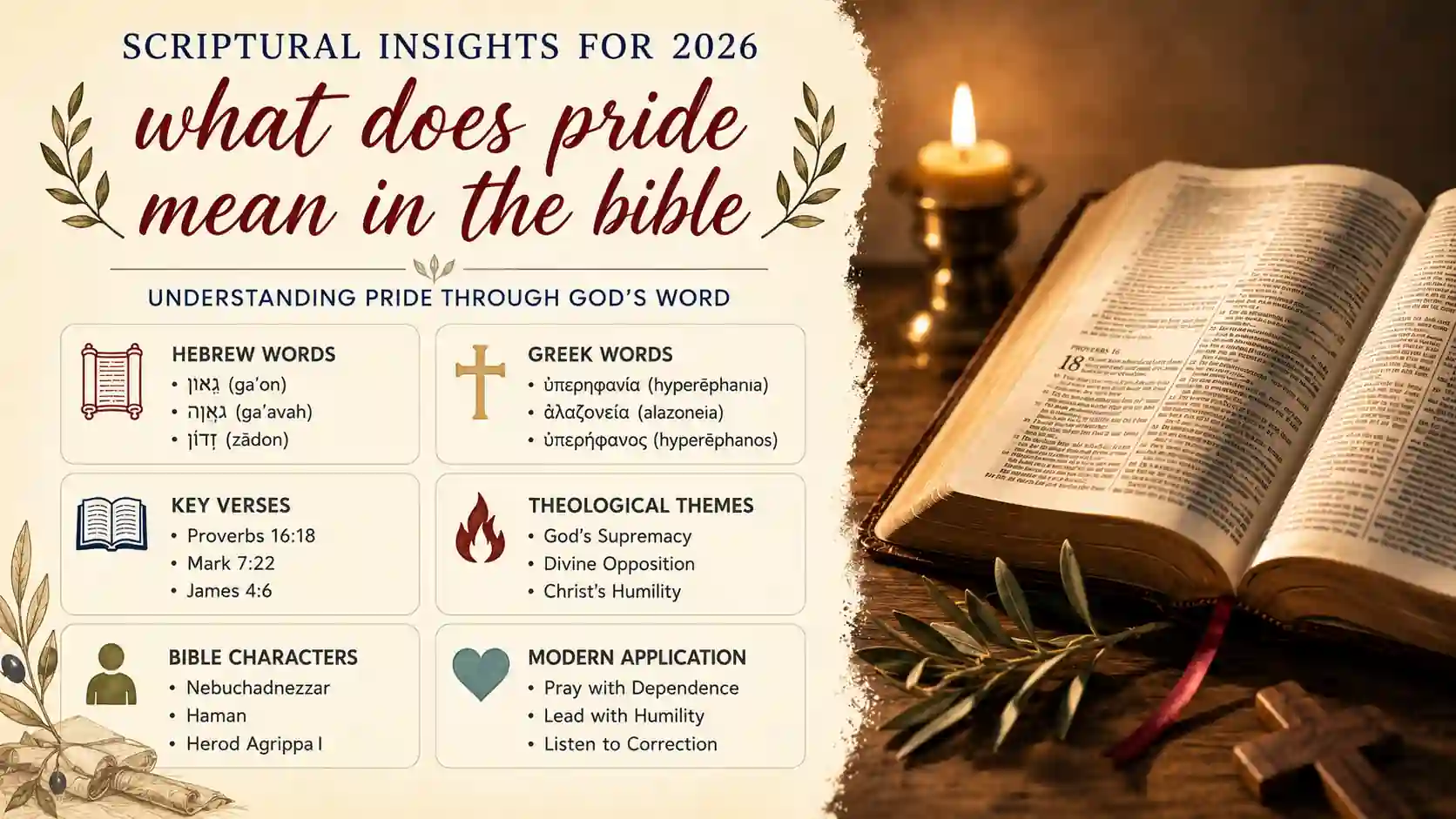
What does pride mean in the Bible? Scripture presents pride as a distorted elevation of self that refuses proper dependence on God, seeks honor apart from Him, and often looks down on others. Biblical pride may appear as boasting, arrogance, stubbornness, self-sufficiency, or resistance to correction.
Yet the Bible also distinguishes sinful self-exaltation from grateful confidence in God’s work. As you study its Hebrew and Greek vocabulary, historical settings, warnings, and personal examples, you discover that humility is not self-hatred. It is living truthfully before the God who gives every good gift.
Pride in Key Scripture References
| Verse | Passage Snippet | Context |
|---|---|---|
| Proverbs 8:13 | “Pride, and arrogancy” | Wisdom’s fear of the Lord rejects evil |
| Proverbs 11:2 | Pride brings shame | Humility receives wisdom |
| Proverbs 16:5 | Proud hearts offend God | Inner arrogance faces judgment |
| Proverbs 16:18 | Pride precedes destruction | Wisdom warns of a coming fall |
| Isaiah 2:11 | Human loftiness is humbled | The Lord alone will be exalted |
| Daniel 4:37 | God humbles the proud | Nebuchadnezzar confesses God’s rule |
| Mark 7:22 | Pride comes from within | Jesus identifies heart-born defilement |
| James 4:6 | God opposes the proud | Grace is given to the humble |
| 1 Peter 5:5 | Clothe yourselves with humility | Believers submit and serve one another |
| 1 John 2:16 | “Pride of life” | Worldly boasting opposes the Father |
Pride Across Major Bible Translations
| Verse | KJV | NIV | ESV | NASB |
|---|---|---|---|---|
| Proverbs 11:2 | Pride brings shame | Pride brings disgrace | Pride brings disgrace | Pride brings dishonor |
| Proverbs 16:18 | Pride before destruction | Pride before destruction | Pride before destruction | Pride before destruction |
| Proverbs 21:4 | High look and proud heart | Haughty eyes and proud heart | Haughty eyes and proud heart | Haughty eyes and proud heart |
| Isaiah 2:11 | Lofty looks humbled | Arrogant eyes humbled | Haughty looks brought low | Proud look made low |
| Jeremiah 13:17 | Weep for your pride | Weep because of pride | Weep because of pride | Weep because of pride |
| Mark 7:22 | Pride | Arrogance | Pride | Pride |
| James 4:6 | Resists the proud | Opposes the proud | Opposes the proud | Opposed to the proud |
| 1 Peter 5:5 | Resists the proud | Opposes the proud | Opposes the proud | Opposed to the proud |
| 1 John 2:16 | Pride of life | Pride of life | Pride of life | Boastful pride of life |
These translations largely agree on pride’s moral danger. Differences such as “pride,” “arrogance,” “haughty,” and “boastful pride” reveal overlapping dimensions of the biblical idea rather than competing definitions.
People and Characters Associated with Pride
| Person | Role | Connection |
|---|---|---|
| Pharaoh | King of Egypt | Refused God’s command and hardened himself |
| Miriam | Sister of Moses | Challenged Moses’ unique calling |
| Korah | Levitical leader | Sought priestly status God had not assigned |
| Uzziah | King of Judah | Became proud after gaining strength |
| Hezekiah | King of Judah | Failed to respond humbly after blessing |
| Haman | Persian official | Craved public honor and hated Mordecai |
| Nebuchadnezzar | Babylonian emperor | Boasted in his power and was humbled |
| Belshazzar | Babylonian king | Knew prior judgment but remained proud |
| Herod Agrippa I | Judean ruler | Accepted divine praise and was judged |
| Diotrephes | Church leader | Loved to have first place among believers |
Original Hebrew and Greek Words for Pride
| Original Word | Transliteration | Strong’s # | Literal Meaning |
|---|---|---|---|
| גָּאוֹן | gaʾon | H1347 | Exaltation, majesty, pride |
| גַּאֲוָה | gaʾavah | H1346 | Height, arrogance, pride |
| גֵּוָה | gevah | H1466 | Pride, loftiness |
| זָדוֹן | zādon | H2087 | Presumption, insolence |
| גָּבַהּ | gābah | H1361 | To be high or exalted |
| רוּם | rūm | H7311 | To rise, lift oneself |
| ὑπερηφανία | hyperēphania | G5243 | Pride, haughtiness |
| ὑπερήφανος | hyperēphanos | G5244 | Proud, arrogant |
| ἀλαζονεία | alazoneia | G212 | Boasting, pretension |
| τυφόω | typhoō | G5187 | To become conceited |
The Hebrew words often draw upon the image of height. Something elevated may properly describe God’s majesty, but it becomes sinful when a human being claims an independent greatness or status that belongs to God.
The Greek noun ὑπερηφανία, hyperēphania, describes an elevated opinion of oneself that can include contempt for others. The noun ἀλαζονεία, alazoneia, emphasizes empty boasting and confidence in possessions, achievements, or plans apart from God.
Concepts Closely Related to Pride
| Concept | Connection | Supporting Verse |
|---|---|---|
| Humility | Pride’s direct moral opposite | Proverbs 11:2 |
| Fear of the Lord | Teaches hatred of arrogance | Proverbs 8:13 |
| Boasting | Public expression of self-exaltation | Jeremiah 9:23 |
| Presumption | Acting without submission to God | Deuteronomy 17:12 |
| Self-deception | Pride hides personal weakness | Obadiah 3 |
| Hardness of heart | Pride resists God’s commands | Exodus 10:3 |
| Envy | Pride resents another’s honor | Esther 5:13 |
| Worldliness | Status and possessions become identity | 1 John 2:16 |
| Humiliation | God may bring the proud low | Daniel 4:37 |
| Grace | God gives help to the humble | James 4:6 |
Historical and Cultural Context of Pride
| Aspect | Detail | Biblical Source |
|---|---|---|
| Ancient kingship | Kings claimed extraordinary authority | Daniel 4:30 |
| Monumental building | Royal projects displayed power and glory | Daniel 4:30 |
| Honor culture | Public rank shaped social relationships | Esther 3:2 |
| Court promotion | Officials competed for royal favor | Esther 5:11 |
| Military success | Victory could produce self-reliance | 2 Chronicles 26:16 |
| Temple boundaries | Priestly service followed divine appointment | 2 Chronicles 26:18 |
| Prophetic judgment | Proud nations were brought low | Isaiah 13:11 |
| Wealth and trade | Prosperity encouraged false security | Ezekiel 28:5 |
| Banquet seating | Places of honor revealed social ambition | Luke 14:7 |
| Patronage | Leaders could demand flattering praise | Acts 12:22 |
In ancient societies, honor was public and socially powerful. Titles, clothing, banquet positions, military victories, monuments, and royal favor could visibly establish a person’s rank. Scripture does not condemn every position of honor, but it repeatedly exposes the desire to seize glory, misuse authority, or forget that power is received from God.
Theological Themes within Biblical Pride
| Theme | Explanation | Scripture |
|---|---|---|
| God’s supremacy | Pride disputes God’s rightful rule | Isaiah 2:17 |
| Creaturely dependence | Human strength remains God-given | Deuteronomy 8:17–18 |
| Divine opposition | God actively resists proud rebellion | James 4:6 |
| Moral blindness | Pride distorts self-knowledge | Obadiah 3 |
| Judgment | Self-exaltation leads toward humiliation | Proverbs 16:18 |
| Grace | Humility receives undeserved help | 1 Peter 5:5 |
| Christ’s humility | Jesus chose obedient self-lowering | Philippians 2:5–8 |
| Cross-centered boasting | Believers boast only in Christ | Galatians 6:14 |
| Community unity | Humility values the interests of others | Philippians 2:3–4 |
| Final exaltation | God exalts the humble in His time | 1 Peter 5:6 |
Modern Application of Pride for Believers
| Area | Practice | Scripture |
|---|---|---|
| Prayer | Confess dependence before making plans | James 4:13–16 |
| Work | Give God credit for ability and success | Deuteronomy 8:18 |
| Leadership | Serve rather than seek superiority | Mark 10:43–45 |
| Correction | Listen before defending yourself | Proverbs 12:15 |
| Relationships | Consider others above selfish ambition | Philippians 2:3 |
| Possessions | Reject status based on material abundance | 1 John 2:16 |
| Spiritual gifts | Remember every gift is received | 1 Corinthians 4:7 |
| Speech | Avoid exaggerating your importance | Proverbs 27:2 |
| Repentance | Humble yourself and draw near to God | James 4:8–10 |
| Success | Boast in knowing the Lord | Jeremiah 9:23–24 |
What Does Pride Mean in the Bible Through גָּאוֹן, GaʾOn?
The Hebrew noun גָּאוֹן, gaʾon, can refer to majesty, excellence, exaltation, or pride. Its moral meaning depends upon its subject and context. God’s exalted majesty is entirely righteous because His greatness is real, eternal, and independent. Human pride is corrupt when people claim greatness as though they were self-created or sovereign.
This distinction protects your study from defining all honor or confidence as sinful. Scripture can celebrate God-given dignity, faithful labor, and righteous achievement. The problem begins when gratitude becomes self-glory, authority becomes domination, or confidence becomes independence from the Lord.
זָדוֹן, ZāDon, and the Presumptuous Heart in Israel’S Wisdom Tradition
The Hebrew word זָדוֹן, zādon, connects pride with presumption and insolence. Proverbs 13:10 teaches that contention arises through pride, showing that arrogance is not merely a private feeling. It enters conversations, rejects counsel, intensifies quarrels, and makes reconciliation difficult.
In the covenant life of Israel, presumption was especially serious because the nation lived under God’s revealed instruction. A proud person did not simply possess high self-esteem. That person knowingly crossed moral boundaries, rejected correction, or acted as though God’s command could be ignored without consequence.
Ὑπερηφανία, HyperēPhania, Begins within the Human Heart
In Mark 7, Jesus places ὑπερηφανία, hyperēphania, among the evils that proceed from within and defile a person. Pride is therefore deeper than posture, clothing, vocabulary, or social class. It is an inward disposition that elevates self, diminishes others, and resists the truth about God.
This diagnosis also explains why outward modesty cannot cure pride. A person may speak humbly while secretly craving recognition. Another may take pride in appearing spiritually disciplined. Christ directs you toward heart-level repentance, where motives, imagined status, and hidden desires are exposed before God.
The Cross Replaces Ἀλαζονεία, Alazoneia, with Boasting in Christ
In 1 John 2:16, ἀλαζονεία τοῦ βίου, alazoneia tou biou, refers to boastful confidence connected with one’s life, livelihood, resources, or social standing. James 4 uses related language when confronting merchants who confidently announce future plans without acknowledging the Lord’s will.
Christian humility does not forbid every plan or accomplishment. It changes the ground of confidence. Paul refuses boasting based on ancestry, religious achievement, or human approval, yet he gladly boasts in the Lord and in the cross. You may rejoice in God’s work while confessing that grace, not self-sufficiency, is your foundation.
Questions About Pride in the Bible
Does גָּאוֹן, gaʾon, always describe sinful pride?
No. It can describe genuine majesty, including God’s exalted greatness, while context determines whether human elevation is condemned.
Why does Proverbs 16:18 connect pride with destruction?
Pride rejects correction and produces false security, so it prepares the moral conditions that lead toward ruin.
What is the difference between ὑπερηφανία and ἀλαζονεία?
Ὑπερηφανία emphasizes arrogant self-elevation, while ἀλαζονεία stresses boastful pretension about status, resources, or plans.
Does humility require you to deny your abilities?
No. Biblical humility recognizes your abilities truthfully while receiving them as gifts and using them for God’s glory.
How can you recognize spiritual pride in your own life?
Look for defensiveness, contempt, hunger for recognition, resistance to correction, and confidence that rarely acknowledges dependence on God.