
If you have ever wondered what does rejoice mean in the Bible, you are asking a question that reaches far beyond simple happiness. Scripture presents rejoicing as a deep response to God’s character, His saving work, His promises, and His presence.
Whether you are studying the Old Testament or the New Testament, you discover that biblical rejoicing remains steady even during hardship. Your study will reveal that true joy is rooted in faith rather than circumstances, making rejoicing both a command and a gift from God.
Key Scripture References for Rejoice
| Verse | Passage Snippet | Context |
|---|---|---|
| Psalm 32:11 | Rejoice in the Lord | Joy after forgiveness |
| Psalm 68:3 | Let the righteous rejoice | Celebration before God |
| Psalm 118:24 | This is the day | Gratitude for God’s works |
| Isaiah 61:10 | I greatly rejoice | Salvation and righteousness |
| Habakkuk 3:18 | Yet I will rejoice | Faith during crisis |
| Luke 10:20 | Rejoice your names are written | Eternal security |
| Philippians 4:4 | Rejoice in the Lord always | Christian perseverance |
| 1 Peter 1:8 | Rejoice with glorious joy | Faith without seeing Christ |
| Revelation 19:7 | Let us rejoice | Celebration of the Lamb |
Bible Translation Comparison for Rejoice
| Verse | KJV | NIV | ESV | NASB |
|---|---|---|---|---|
| Psalm 32:11 | Be glad and rejoice | Rejoice in the Lord | Be glad in the Lord | Be glad in the Lord |
| Psalm 118:24 | We will rejoice | Let us rejoice | Let us rejoice | Let us rejoice |
| Isaiah 61:10 | I will greatly rejoice | I delight greatly | I will greatly rejoice | I will rejoice greatly |
| Luke 10:20 | Rather rejoice | Rejoice that | Rejoice that | Rejoice that |
| Romans 12:12 | Rejoicing in hope | Be joyful in hope | Rejoice in hope | Rejoicing in hope |
| Philippians 4:4 | Rejoice always | Rejoice always | Rejoice always | Rejoice always |
| James 1:2 | Count it all joy | Consider it pure joy | Count it all joy | Consider it all joy |
| 1 Peter 4:13 | Rejoice | Rejoice | Rejoice | Keep on rejoicing |
People and Characters Associated with Rejoice
| Person | Role | Connection |
|---|---|---|
| David | King | Rejoiced in God’s salvation |
| Moses | Prophet | Sang after the Red Sea crossing |
| Hannah | Mother of Samuel | Rejoiced in answered prayer |
| Mary | Mother of Jesus | Magnified God with joy |
| Paul | Apostle | Commanded continual rejoicing |
| Silas | Missionary | Sang while imprisoned |
| Habakkuk | Prophet | Rejoiced despite hardship |
| The Shepherds | Witnesses | Rejoiced at Christ’s birth |
| The Early Church | Believers | Rejoiced despite persecution |
Original Hebrew and Greek Words for Rejoice
| Original Word | Transliteration | Strong’s # | Literal Meaning |
|---|---|---|---|
| שָׂמַח | samach | H8055 | To rejoice, be glad |
| גִּיל | gil | H1523 | To exult with joy |
| עָלַז | alaz | H5937 | To triumph joyfully |
| רָנַן | ranan | H7442 | To shout for joy |
| שׂוּשׂ | sus | H7797 | To delight greatly |
| χαίρω | chairō | G5463 | To rejoice |
| χαρά | chara | G5479 | Joy |
| ἀγαλλιάω | agalliaō | G21 | To exult greatly |
| εὐφραίνω | euphrainō | G2165 | To make joyful |
Related Biblical Concepts for Rejoice
| Concept | Connection | Supporting Verse |
|---|---|---|
| Joy | Fruit of God’s work | Galatians 5:22 |
| Thanksgiving | Joy expressed in praise | Psalm 100:4 |
| Worship | Celebration before God | Psalm 95:1 |
| Hope | Future confidence | Romans 12:12 |
| Salvation | Source of rejoicing | Isaiah 61:10 |
| Peace | Companion of joy | Philippians 4:7 |
| Faith | Trust produces joy | 1 Peter 1:8 |
| Grace | Gift received with gladness | Ephesians 2:8 |
| Resurrection | Ultimate reason for joy | Matthew 28:8 |
Historical and Cultural Context for Rejoice
| Aspect | Detail | Biblical Source |
|---|---|---|
| Harvest Festivals | Community celebration | Deuteronomy 16 |
| Temple Worship | Singing and praise | Psalm 95 |
| Victory Songs | Joy after deliverance | Exodus 15 |
| Pilgrimage Feasts | National rejoicing | Psalm 122 |
| Wedding Celebrations | Covenant joy | John 2 |
| Coronations | National gladness | 1 Kings 1 |
| Exile Return | Joy after restoration | Ezra 3 |
| Synagogue Worship | Public praise | Luke 4 |
| Early Church Gatherings | Shared joyful fellowship | Acts 2 |
Theological Themes for Rejoice
| Theme | Explanation | Scripture |
|---|---|---|
| God’s Presence | Joy flows from knowing God | Psalm 16:11 |
| Covenant Faithfulness | God keeps His promises | Deuteronomy 30:9 |
| Redemption | Salvation creates joy | Isaiah 12:2 |
| Kingdom Hope | Future glory inspires joy | Romans 14:17 |
| Christian Endurance | Joy amid suffering | James 1:2 |
| Resurrection | Death is defeated | 1 Corinthians 15:57 |
| Worship | Joy honors God | Psalm 100:2 |
| Eternal Life | Lasting reason to rejoice | Luke 10:20 |
| New Creation | Final celebration | Revelation 21:4 |
Modern Application for Believers About Rejoice
| Area | Practice | Scripture |
|---|---|---|
| Prayer | Thank God daily | Philippians 4:6 |
| Worship | Sing with gratitude | Colossians 3:16 |
| Trials | Trust God’s purpose | James 1:2 |
| Family | Celebrate God’s blessings | Psalm 128 |
| Church | Encourage one another | Hebrews 10:24 |
| Evangelism | Rejoice over repentance | Luke 15:7 |
| Service | Give cheerfully | 2 Corinthians 9:7 |
| Hope | Focus on eternity | Romans 5:2 |
| Daily Life | Delight in the Lord | Psalm 37:4 |
The Hebrew Root Samach and Covenant Joy
When you ask what does rejoice mean in the Bible, the Old Testament often answers with the Hebrew word שָׂמַח (samach). This verb describes gladness that springs from experiencing God’s goodness. It appears in celebrations, worship, covenant festivals, victories, and family milestones.
Another important word is גִּיל (gil), which pictures overflowing delight. Rather than quiet contentment alone, it often describes visible celebration before the Lord. Israel rejoiced because God had chosen, protected, forgiven, and restored His covenant people.
Biblical joy was never meant to ignore reality. Habakkuk declared that even if crops failed and flocks disappeared, he would still rejoice in God. His confidence rested in the Lord rather than changing circumstances.
The covenant explains why rejoicing appears so frequently in the Psalms. God’s people celebrated because His steadfast love remained faithful across generations. Joy became an act of trust that acknowledged God’s promises even before every prayer had been answered.
Chairō in the Pauline Epistles and What Does Rejoice Mean in the Bible
The New Testament commonly uses the Greek verb χαίρω (chairō), meaning “to rejoice,” and the noun χαρά (chara), meaning “joy.” These words appear throughout the Gospels, Acts, and especially Paul’s letters.
Paul’s command in Philippians 4:4, “Rejoice in the Lord always,” gains remarkable depth when you remember he wrote from prison. His circumstances were difficult, yet his confidence rested in Christ’s unchanging rule rather than personal comfort.
The Greek language also includes ἀγαλλιάω (agalliaō), expressing intense joy or exultation. This word appears when Mary praises God, when believers rejoice in salvation, and when the hope of eternal inheritance fills Christians with confidence.
For Paul, rejoicing was not emotional denial. Christians still grieved, suffered, and struggled. Yet they possessed an enduring joy because Christ’s resurrection guaranteed that suffering would never have the final word.
Rejoicing in Worship Suffering and Salvation
One striking feature of Scripture is that rejoicing appears in both celebration and suffering. At first this seems contradictory. Yet the Bible teaches that joy is rooted in who God is rather than in what happens each day.
James encourages believers to count trials as joy because God uses hardship to produce spiritual maturity. Peter likewise tells Christians to rejoice even while facing grief because genuine faith becomes refined like gold through testing.
Rejoicing also accompanies salvation. Isaiah celebrates God’s gift of righteousness. Mary rejoices that God has remembered His promises. The shepherds return praising God after seeing the Messiah. The angels themselves rejoice when sinners repent.
These passages show that rejoicing is deeply theological. It grows from remembering God’s faithfulness, celebrating His redemption, and anticipating His coming kingdom. Worship becomes the natural expression of a heart transformed by grace.
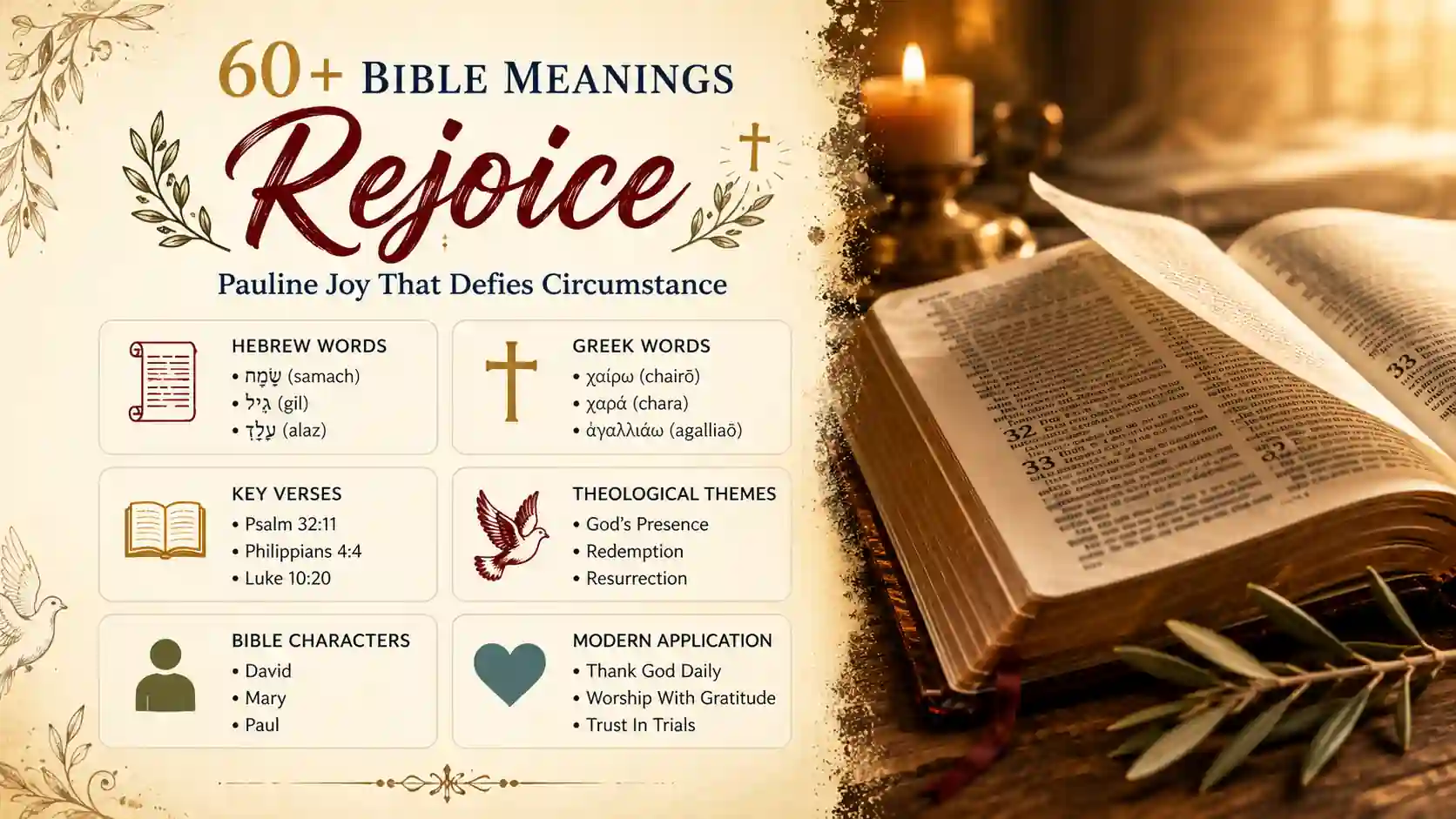
The Kingdom Hope Behind Biblical Rejoicing
Biblical rejoicing always points beyond the present moment. The prophets anticipated a future day when sorrow would disappear and God’s people would sing with everlasting joy. This expectation reaches its fulfillment through Jesus Christ.
The New Testament repeatedly connects joy with the resurrection. Because Christ conquered death, believers possess hope that cannot be destroyed by persecution, illness, disappointment, or death itself. Christian rejoicing is therefore both present and future.
The final chapters of Revelation portray heaven rejoicing as God completes His plan of redemption. The marriage supper of the Lamb celebrates the fulfillment of every covenant promise. Rejoicing reaches its highest expression when God dwells forever with His redeemed people.
As you continue your Bible study, you discover that rejoicing is much more than smiling or feeling optimistic. It is an act of worship rooted in faith, strengthened by hope, sustained by grace, and centered completely on the Lord. Whether you stand in seasons of abundance or hardship, Scripture invites you to rejoice because God’s character never changes.
Does samach always describe happiness in the Old Testament?
No. Samach often expresses covenant joy rooted in God’s faithfulness rather than temporary emotion.
Why does Paul command believers to rejoice while suffering in Philippians 4:4?
Because Christian joy is grounded in Christ’s presence and promises, not comfortable circumstances.
What is the difference between chairō and agalliaō in Greek?
Chairō refers to rejoicing generally, while agalliaō emphasizes overflowing or exuberant joy.
Is rejoicing in the Bible a command or a feeling?
It is both a command and a Spirit-shaped response that grows from trusting God.
Can believers rejoice even when prayers seem unanswered?
Yes. Scripture teaches that you can rejoice in God’s unchanging character while continuing to wait faithfully for His timing.