
The question what does messiah mean in the bible leads you to one of Scripture’s most important themes. From the promises given to Israel to the fulfillment revealed in Jesus Christ, the title “Messiah” ties together the entire biblical story. As you study both the Hebrew Scriptures and the New Testament, you discover that Messiah is far more than a royal title.
It points to God’s Anointed One who would reign, rescue, suffer, and establish His everlasting kingdom. Understanding this biblical theme enriches your reading of every part of God’s Word.
Key Scripture References for Messiah
| Verse | Passage Snippet | Context |
|---|---|---|
| Genesis 3:15 | Seed crushes serpent | First promise of redemption |
| Genesis 49:10 | Scepter from Judah | Royal expectation |
| Deuteronomy 18:15 | Prophet like Moses | Future deliverer |
| Psalm 2:2 | Against the LORD’s Anointed | Messianic kingship |
| Psalm 22:16 to 18 | Pierced hands and feet | Suffering Messiah |
| Isaiah 9:6 to 7 | Child born to us | Divine King promised |
| Isaiah 53:5 | Wounded for sins | Suffering Servant |
| Daniel 9:25 | Messiah the Prince | Prophetic timeline |
| Micah 5:2 | Bethlehem birthplace | Davidic ruler |
| John 1:41 | We have found the Messiah | Jesus identified |
Bible Translation Comparison for Messiah
| Verse | KJV | NIV | ESV | NASB |
|---|---|---|---|---|
| John 1:41 | Messias | Messiah | Messiah | Messiah |
| Daniel 9:25 | Messiah | Anointed One | Anointed One | Messiah |
| Psalm 2:2 | Anointed | Anointed | Anointed | Anointed |
| Isaiah 61:1 | Anointed me | Anointed me | Anointed me | Anointed me |
| Luke 4:18 | Anointed me | Anointed me | Anointed me | Anointed me |
| John 4:25 | Messias | Messiah | Messiah | Messiah |
| Acts 4:26 | Christ | Anointed One | Anointed | Christ |
| Hebrews 1:9 | Anointed thee | Anointed you | Anointed you | Anointed You |
People & Characters Associated with Messiah
| Person | Role | Connection |
|---|---|---|
| Adam | First man | Promise after the fall |
| Abraham | Patriarch | Covenant blessing |
| Moses | Prophet | Foreshadowed greater Prophet |
| David | King | Royal covenant line |
| Isaiah | Prophet | Predicted suffering Servant |
| Daniel | Prophet | Foretold Messiah’s coming |
| John the Baptist | Forerunner | Prepared Messiah’s way |
| Peter | Apostle | Confessed Jesus as Messiah |
| Mary | Mother of Jesus | Bore the promised Messiah |
Original Hebrew & Greek Words for Messiah
| Original Word | Transliteration | Strong’s # | Literal Meaning |
|---|---|---|---|
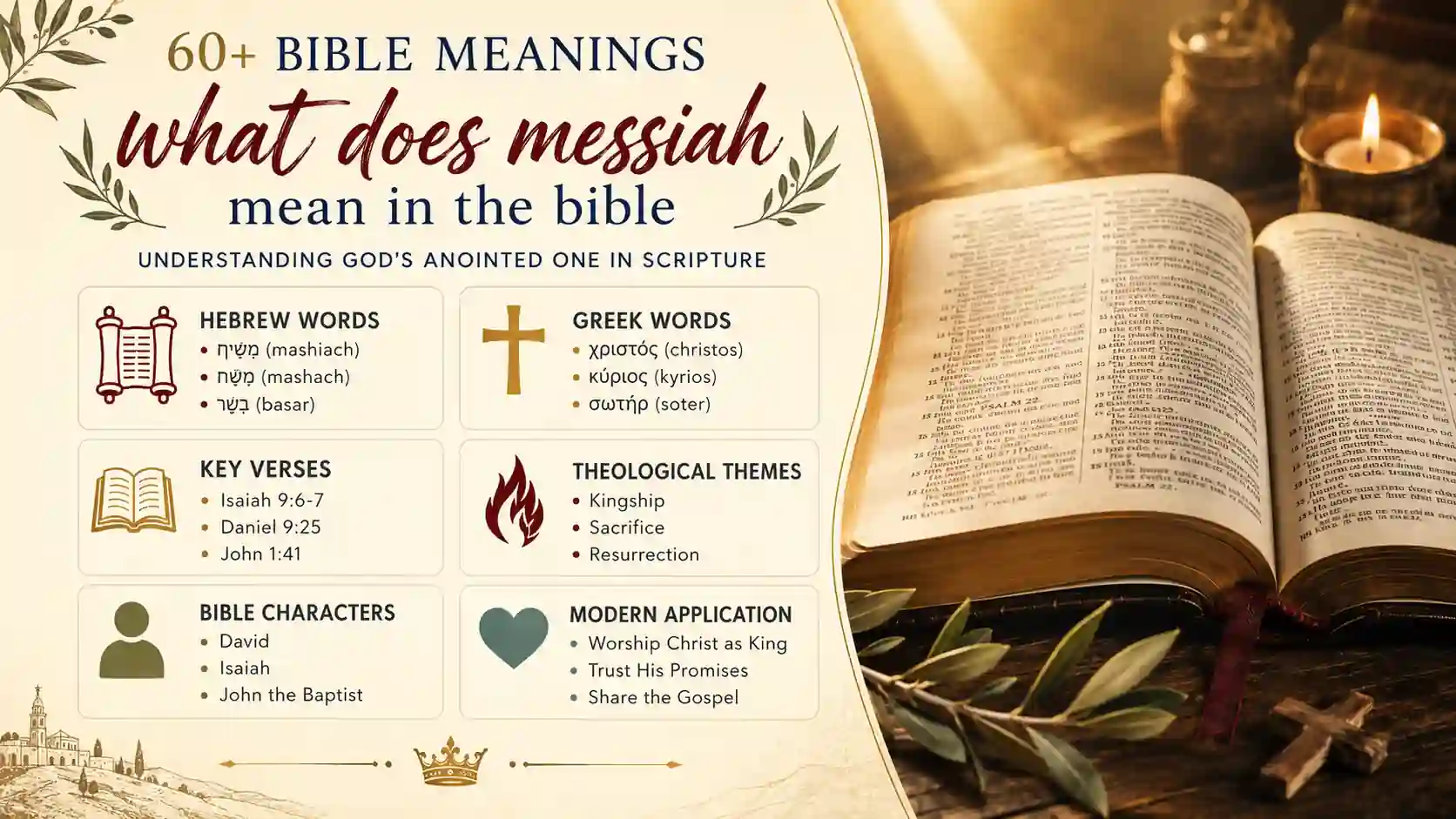
| מָשִׁיחַ | mashiach | H4899 | Anointed one |
| מָשַׁח | mashach | H4886 | To anoint |
| χριστός | christos | G5547 | Anointed One |
| χρίω | chriō | G5548 | To anoint |
| βασιλεύς | basileus | G935 | King |
| σωτήρ | sōtēr | G4990 | Savior |
| κύριος | kyrios | G2962 | Lord |
| υἱός | huios | G5207 | Son |
| βασιλεία | basileia | G932 | Kingdom |
Related Biblical Concepts for Messiah
| Concept | Connection | Supporting Verse |
|---|---|---|
| Covenant | Promise through David | 2 Samuel 7:16 |
| Kingdom | Eternal reign | Daniel 7:14 |
| Redemption | Saves sinners | Isaiah 53:5 |
| Priesthood | Mediator | Psalm 110:4 |
| Prophecy | Fulfilled promises | Luke 24:44 |
| Shepherd | Cares for flock | Ezekiel 34:23 |
| Servant | Suffers willingly | Isaiah 52:13 |
| Resurrection | Victory over death | Psalm 16:10 |
| New Covenant | Forgiveness | Jeremiah 31:31 |
Historical & Cultural Context for Messiah
| Aspect | Detail | Biblical Source |
|---|---|---|
| Anointing oil | Set apart leaders | Exodus 30:30 |
| Kings | Public anointing | 1 Samuel 10:1 |
| Priests | Consecrated for service | Leviticus 8:12 |
| Prophets | Spirit empowered | 1 Kings 19:16 |
| Davidic throne | Covenant promise | 2 Samuel 7 |
| Exile | Hope for restoration | Ezekiel 37 |
| Second Temple era | Growing expectation | Daniel 9 |
| Roman rule | Desire for deliverer | John 6:15 |
| Early church | Jesus proclaimed Messiah | Acts 2 |
Theological Themes for Messiah
| Theme | Explanation | Scripture |
|---|---|---|
| Divine promise | God keeps His word | Genesis 12:3 |
| Kingship | Rules forever | Isaiah 9:7 |
| Sacrifice | Bears sin | Isaiah 53:6 |
| Resurrection | Defeats death | Acts 2:31 |
| Lordship | Worthy of worship | Philippians 2:11 |
| Mediation | Brings people to God | 1 Timothy 2:5 |
| Justice | Righteous judgment | Isaiah 11:4 |
| Peace | Reconciles humanity | Ephesians 2:14 |
| Hope | Future restoration | Revelation 22:20 |
Modern Application for Believers About Messiah
| Area | Practice | Scripture |
|---|---|---|
| Worship | Honor Christ as King | Hebrews 1:8 |
| Prayer | Pray in His name | John 14:13 |
| Trust | Depend on His promises | Romans 15:13 |
| Obedience | Follow His commands | John 14:15 |
| Evangelism | Share the gospel | Matthew 28:19 |
| Hope | Await His return | Titus 2:13 |
| Humility | Follow His example | Philippians 2:5 |
| Service | Love others | Mark 10:45 |
| Endurance | Persevere in faith | Hebrews 12:2 |
The Hebrew Root Mashiach and What Does Messiah Mean in the Bible
The Hebrew word מָשִׁיחַ (mashiach) comes from the verb מָשַׁח (mashach), meaning “to anoint.” In ancient Israel, anointing with oil publicly marked someone as chosen by God for a special office. Kings, priests, and at times prophets were anointed as visible signs that the Lord had set them apart for His purposes.
When you ask what does messiah mean in the bible, the simplest answer is “God’s Anointed One.” Yet Scripture gradually expands this title. At first, many individuals were called anointed because they served God’s covenant people. Over time, the prophets began pointing toward one perfect Messiah who would fulfill every promise given to Israel. This coming King would possess complete righteousness, perfect wisdom, and everlasting authority.
Christos in the New Testament and the Fulfillment of God’s Promise
The Greek New Testament uses the word χριστός (christos), which translates the Hebrew idea of mashiach. Rather than functioning merely as a surname, “Christ” is a title declaring that Jesus is the promised Messiah. Whenever you read “Jesus Christ,” you are reading “Jesus the Messiah.”
The Gospels repeatedly emphasize this truth. Andrew joyfully announces that he has found the Messiah. Peter boldly confesses Jesus as the Christ. Even the Samaritan woman speaks about the coming Messiah, and Jesus plainly tells her that He is the One she expected. The apostles continue this message throughout Acts, proclaiming that Jesus fulfills the Law, the Prophets, and the Psalms exactly as God intended.
The Davidic Covenant and the Messianic Kingdom
God’s covenant with David forms the foundation of biblical messianic hope. In 2 Samuel 7, the Lord promises that one of David’s descendants will establish an everlasting kingdom. Although Solomon fulfilled part of that promise, his kingdom did not last forever. The prophets therefore looked beyond Solomon to a greater Son of David.
Isaiah, Jeremiah, Ezekiel, Micah, and Zechariah each describe this coming King in remarkable detail. He would rule with justice, gather God’s people, shepherd the flock, defeat evil, and bring peace to the nations. Daniel even speaks of the Messiah receiving an eternal kingdom from the Ancient of Days. These promises create a unified expectation that reaches its fulfillment in Jesus.
The New Testament opens by presenting Jesus as “the Son of David.” His genealogy, birth in Bethlehem, ministry, miracles, death, resurrection, and ascension all demonstrate that He fulfills the covenant promises made centuries earlier. The kingdom He inaugurates is already present through His reign while awaiting its complete fulfillment at His return.
Isaiah 53 the Suffering Servant and the Glory of the Messiah
Many people in Jesus’ day expected the Messiah to defeat Rome through military power. Yet Isaiah revealed another essential truth. The Messiah would first suffer for the sins of His people. Isaiah 53 describes One who bears grief, carries sorrows, is pierced for transgressions, and brings healing through His sacrifice.
This portrait finds its fulfillment in Jesus’ crucifixion. Rather than abandoning His mission through suffering, He completed it. His death satisfied God’s justice while displaying God’s mercy. His resurrection confirmed that death could not hold the Holy One and that His kingdom would never end.
As you study Scripture, you see that Messiah is simultaneously King, Priest, Prophet, Shepherd, Servant, Savior, and Lord. These roles do not compete with one another. Instead, they reveal the fullness of God’s redemptive plan. Jesus teaches God’s truth as the perfect Prophet, offers Himself as the perfect Priest and sacrifice, reigns forever as the perfect King, and lovingly shepherds His people until He returns.
Recognizing Jesus as the Messiah also shapes your daily walk with God. You trust His authority because He reigns over every circumstance. You rest in His forgiveness because His sacrifice is complete. You follow His example because He combines humility with perfect obedience. You live with hope because the promised King who came once in grace will come again in glory.
Throughout the Bible, every major covenant, prophecy, sacrifice, and promise ultimately points toward the Messiah. The earliest chapters of Genesis plant the seed of expectation. The historical books preserve the royal line. The Psalms celebrate the coming King. The Prophets describe His person and work. The Gospels announce His arrival. The Epistles explain His saving work. Revelation presents His final victory over sin, death, and evil.
When you read the Bible through this lens, its unity becomes clear. The Messiah is not simply one topic among many. He is the central figure around whom the entire story of redemption revolves. God’s faithfulness shines through every fulfilled promise, inviting you to place your confidence in the One whom Scripture consistently proclaims.
FAQs
Does מָשִׁיחַ (mashiach) always refer to Jesus?
No. The Hebrew word can describe other anointed leaders, but the ultimate Messiah is Jesus Christ.
Why do some translations say “Anointed One” instead of “Messiah”?
Both express the same meaning, with “Messiah” reflecting the Hebrew title and “Anointed One” translating its literal sense.
Why is Isaiah 53 so important for understanding the Messiah?
It reveals that the promised Messiah would suffer for sin before entering His glory.
Is Christ a name or a title based on χριστός (christos)?
It is primarily a title meaning “Anointed One,” identifying Jesus as the promised Messiah.
How should knowing what does messiah mean in the bible affect your faith?
It strengthens your confidence that Jesus fulfills God’s promises and reigns as Savior, Lord, and eternal King.