
The question what does shalom mean in the Bible reaches far beyond the simple idea of peace. Throughout Scripture, shalom describes wholeness, well being, harmony, covenant faithfulness, security, and restored relationships with God and others. As you study the Bible, you discover that shalom is not merely the absence of conflict but the presence of God’s complete blessing.
From the Garden of Eden to the New Jerusalem, the biblical story reveals God’s desire to bring true שָׁלוֹם (shalom) to His creation through His covenant promises and ultimately through Jesus Christ.
Key Scripture References for Shalom
| Verse | Passage Snippet | Context |
|---|---|---|
| Genesis 15:15 | Go to your fathers in peace | Peaceful death promised to Abraham |
| Numbers 6:24 to 26 | The Lord give you peace | Priestly blessing over Israel |
| Deuteronomy 20:10 | Offer terms of peace | Warfare and covenant ethics |
| Judges 6:24 | The Lord is Peace | Gideon builds an altar |
| Psalm 29:11 | The Lord blesses with peace | Divine strength and blessing |
| Psalm 85:10 | Peace and righteousness kiss | Restoration after exile |
| Isaiah 9:6 | Prince of Peace | Messianic prophecy |
| Isaiah 26:3 | Perfect peace | Trusting the Lord |
| Jeremiah 29:11 | Plans for welfare | Hope during exile |
| John 14:27 | My peace I give | Christ’s farewell promise |
Bible Translation Comparison for Shalom
| Verse | KJV | NIV | ESV | NASB |
|---|---|---|---|---|
| Numbers 6:26 | Peace | Peace | Peace | Peace |
| Judges 6:24 | Peace | Peace | Peace | Peace |
| Psalm 29:11 | Peace | Peace | Peace | Peace |
| Psalm 85:8 | Peace | Peace | Peace | Peace |
| Isaiah 9:6 | Prince of Peace | Prince of Peace | Prince of Peace | Prince of Peace |
| Isaiah 26:3 | Perfect peace | Perfect peace | Perfect peace | Perfect peace |
| Jeremiah 29:11 | Peace | Prosper | Welfare | Welfare |
| Ezekiel 37:26 | Covenant of peace | Covenant of peace | Covenant of peace | Covenant of peace |
| John 14:27 | Peace | Peace | Peace | Peace |
| Romans 5:1 | Peace with God | Peace with God | Peace with God | Peace with God |
People & Characters Associated with Shalom
| Person | Role | Connection |
|---|---|---|
| Abraham | Patriarch | Promised peaceful end |
| Moses | Covenant mediator | Declared God’s blessing |
| Aaron | High priest | Spoke priestly blessing |
| Gideon | Judge | Built altar called The Lord Is Peace |
| David | King | Prayed for Jerusalem’s peace |
| Solomon | King | Name reflects peace and completeness |
| Isaiah | Prophet | Foretold Prince of Peace |
| Jeremiah | Prophet | Spoke of true welfare in exile |
| Jesus | Messiah | Gives lasting peace |
| Paul | Apostle | Taught peace through Christ |
Original Hebrew & Greek Words for Shalom
| Original Word | Transliteration | Strong’s # | Literal Meaning |
|---|---|---|---|
| שָׁלוֹם | shalom | H7965 | Peace completeness |
| שָׁלֵם | shalem | H8003 | Whole complete |
| שָׁלַם | shalam | H7999 | Complete repay |
| בְּרִית | berith | H1285 | Covenant |
| חֶסֶד | hesed | H2617 | Covenant love |
| εἰρήνη | eirēnē | G1515 | Peace |
| καταλλάσσω | katallassō | G2644 | Reconcile |
| καταλλαγή | katallagē | G2643 | Reconciliation |
| χάρις | charis | G5485 | Grace |
| σωτηρία | sōtēria | G4991 | Salvation |
Related Biblical Concepts for Shalom
| Concept | Connection | Supporting Verse |
|---|---|---|
| Covenant | Peace flows from God’s covenant | Ezekiel 37:26 |
| Justice | Peace joins righteousness | Isaiah 32:17 |
| Mercy | Covenant love sustains peace | Psalm 85:10 |
| Wisdom | Wisdom produces peace | Proverbs 3:17 |
| Salvation | Messiah brings peace | Isaiah 53:5 |
| Reconciliation | Peace with God | Romans 5:1 |
| Unity | Church lives in peace | Ephesians 4:3 |
| Hope | Peace strengthens endurance | Romans 15:13 |
| Kingdom | Peace marks God’s reign | Romans 14:17 |
| New Creation | Eternal peace restored | Revelation 21:4 |
Historical & Cultural Context for Shalom
| Aspect | Detail | Biblical Source |
|---|---|---|
| Greeting | Common blessing of peace | 1 Samuel 25:6 |
| Farewell | Departure with blessing | Judges 18:6 |
| Covenant | Peace treaties affirmed loyalty | Joshua 9 |
| Worship | Priestly blessing included peace | Numbers 6 |
| Temple | Symbol of God’s presence | 1 Kings 8 |
| Kingship | Peace reflected righteous rule | 1 Kings 4:25 |
| Exile | Seek city’s welfare | Jeremiah 29:7 |
| Messiah | Expected bringer of peace | Isaiah 9:6 |
| Family | Household harmony valued | Psalm 128 |
| Restoration | Peace after judgment | Ezekiel 37:26 |
Theological Themes for Shalom
| Theme | Explanation | Scripture |
|---|---|---|
| Creation | God made a harmonious world | Genesis 1 |
| Fall | Sin shattered peace | Genesis 3 |
| Covenant | God restores peace through promises | Genesis 17 |
| Sacrifice | Atonement prepares for peace | Leviticus 3 |
| Messiah | Christ fulfills true peace | Isaiah 9:6 |
| Gospel | Peace proclaimed to nations | Ephesians 2:17 |
| Church | United in one body | Colossians 3:15 |
| Eternity | Peace without end | Isaiah 9:7 |
| Resurrection | Christ greets disciples with peace | John 20:19 |
| New Creation | Perfect shalom restored | Revelation 21:1 to 4 |
Modern Application for Believers About Shalom
| Area | Practice | Scripture |
|---|---|---|
| Prayer | Ask for God’s peace | Philippians 4:6 to 7 |
| Family | Pursue reconciliation | Colossians 3:13 to 15 |
| Church | Preserve unity | Ephesians 4:3 |
| Work | Act with integrity | Proverbs 3:1 to 2 |
| Community | Seek neighborhood welfare | Jeremiah 29:7 |
| Evangelism | Share gospel of peace | Romans 10:15 |
| Suffering | Trust God’s presence | Isaiah 26:3 |
| Leadership | Promote justice | Isaiah 32:17 |
| Worship | Receive Christ’s peace | John 14:27 |
| Daily Life | Walk in wisdom | James 3:18 |
The Hebrew Root Shalom and God’s Covenant Promise
When asking what does shalom mean in the Bible, the first place to begin is with the Hebrew word שָׁלוֹם (shalom). It comes from the related root שָׁלַם (shalam), meaning to make complete, repay, restore, or bring something to fulfillment. The idea is much richer than emotional calm.
In the Old Testament, shalom describes life as God intended it. A person living in shalom enjoys harmony with God, healthy relationships, justice in society, physical well being, and spiritual security. The word points to completeness rather than merely quiet circumstances.
God often connected shalom with His covenant. When Israel obeyed Him, peace became evidence of His faithful presence. The priestly blessing in Numbers 6 closes with God’s gift of peace because His presence is the source of every blessing.
Even during difficult seasons, God’s people could pray for shalom. Jeremiah instructed the exiles to seek the welfare of Babylon. This surprising command showed that biblical peace includes working for the flourishing of others, even while waiting for God’s ultimate restoration.
What Does Shalom Mean in the Bible Through the Messiah
Isaiah announced that the coming Messiah would be called the Prince of Peace. This title reveals that shalom is not simply something Jesus gives. It is part of His very identity. His kingdom is characterized by righteousness, justice, and everlasting peace.
The New Testament commonly uses the Greek word εἰρήνη (eirēnē) as the equivalent of shalom. Although written in Greek, the apostles continued thinking in the rich Hebrew sense of complete restoration under God’s rule.
Jesus repeatedly greeted His disciples with peace after His resurrection. His words carried profound meaning because His death and resurrection accomplished reconciliation between God and sinners. Through His sacrifice, hostility caused by sin was removed.
Paul explains this beautifully by using καταλλαγή (katallagē) and καταλλάσσω (katallassō), words describing reconciliation. Peace with God is not earned through human effort but received through faith in Christ. Because believers are justified, they stand in restored fellowship with their Creator.
EirēNē in the Apostolic Letters and the Life of the Church
The apostles frequently opened and closed their letters with blessings of grace and peace. This pattern was more than polite correspondence. It reminded churches that every Christian community should reflect God’s shalom in daily relationships.
Paul urged believers to let the peace of Christ rule in their hearts. The image suggests an umpire directing every decision. When the church practices forgiveness, humility, patience, and love, God’s peace governs the body of Christ.
Biblical peace does not mean the absence of hardship. Jesus plainly warned His followers that they would experience trouble in the world. Yet He immediately assured them that they could have peace in Him because He had overcome the world.
This distinction is essential for your study. Scripture never promises a life free from suffering. Instead, it promises God’s presence in suffering. His peace guards the heart even when circumstances remain difficult, allowing believers to trust His sovereign care.
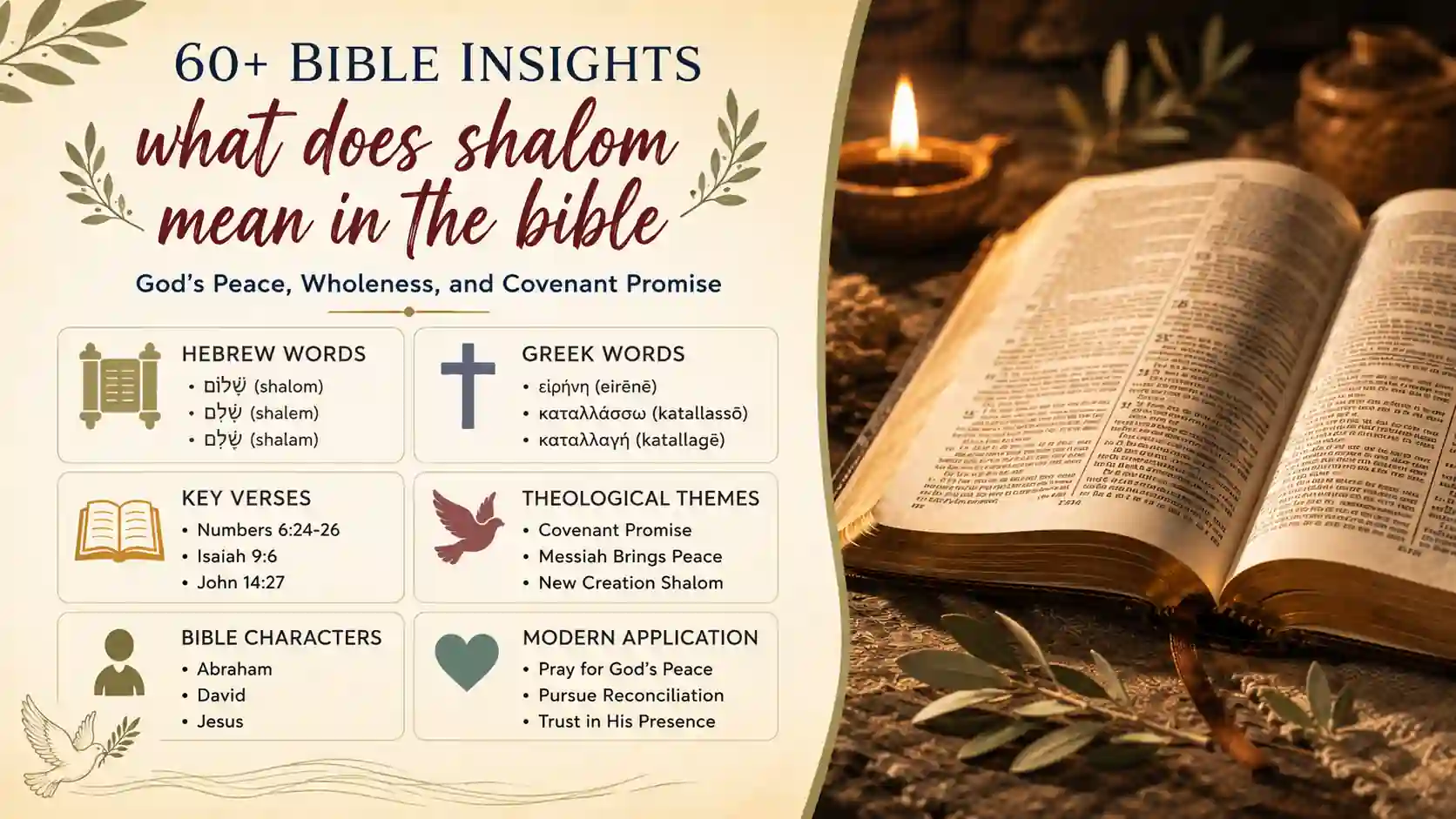
Shalom in the Story of Redemption from Eden to New Creation
The Bible begins with humanity living in perfect fellowship with God. Eden reflects complete shalom. Every relationship functioned according to God’s design until sin entered the world and fractured creation.
After the fall, the biblical story becomes the account of God restoring what was broken. Every covenant, sacrifice, prophecy, and promise points toward the day when complete peace would return through God’s redeeming work.
Jesus fulfilled that hope by bearing humanity’s sin upon the cross. Isaiah declared that the punishment bringing us peace fell upon Him. His resurrection confirms that death itself cannot destroy God’s plan of restoration.
The final chapters of Revelation present the complete fulfillment of shalom. God dwells with His people, sorrow disappears, death is defeated, and creation is renewed. The peace first experienced in Eden becomes eternal reality. Your study of shalom therefore traces one of the Bible’s greatest themes from Genesis to Revelation, revealing God’s unwavering purpose to restore His people into joyful fellowship with Himself.
Does shalom only mean peace or does it also mean wholeness?
It means peace, wholeness, completeness, well being, and restored relationships under God’s blessing.
Why is שָׁלוֹם (shalom) translated differently in Jeremiah 29:11?
The Hebrew includes the idea of welfare and flourishing, so some translations use “welfare” or “prosper” instead of simply “peace.”
How does εἰρήνη (eirēnē) relate to the Hebrew word shalom?
Eirēnē is the primary Greek equivalent, carrying the Old Testament idea of peace fulfilled through Christ.
Does Isaiah 9:6 teach that the Messiah brings spiritual or earthly peace?
It points to both, beginning with reconciliation to God and reaching its complete fulfillment in Christ’s eternal kingdom.
How can you experience biblical shalom in everyday life?
You experience biblical shalom by trusting Christ, walking in obedience, pursuing reconciliation, and resting in God’s faithful presence.