
If you have ever wondered what does refuge mean in the Bible, you are exploring one of Scripture’s richest pictures of God’s character. From the earliest pages of the Old Testament to the hope revealed in Christ, refuge describes far more than physical safety.
It points to God’s faithful protection, covenant love, and enduring presence with His people. As you study the Hebrew and Greek vocabulary, key passages, and historical setting, you will discover that biblical refuge is both a place of security and a relationship of complete trust in the Lord.
Key Scripture References for Refuge
| Verse | Passage Snippet | Context |
|---|---|---|
| Psalm 46:1 | God is our refuge and strength | Confidence during trouble |
| Psalm 91:2 | My refuge and my fortress | Divine protection |
| Psalm 62:8 | Pour out your heart before Him | Trust in God alone |
| Proverbs 14:26 | Children have a refuge | Fear of the Lord |
| Deuteronomy 33:27 | The eternal God is your refuge | Moses blesses Israel |
| Psalm 57:1 | Take refuge under Your wings | David fleeing enemies |
| Isaiah 25:4 | Refuge from the storm | God’s care for the needy |
| Nahum 1:7 | Stronghold in trouble | God’s goodness and justice |
| Hebrews 6:18 | Fled for refuge | Hope anchored in God’s promise |
| Ruth 2:12 | Refuge under His wings | Ruth’s covenant faith |
Bible Translation Comparison for Refuge
| Verse | KJV | NIV | ESV | NASB |
|---|---|---|---|---|
| Psalm 46:1 | Refuge | Refuge | Refuge | Refuge |
| Psalm 91:2 | Refuge | Refuge | Refuge | Refuge |
| Psalm 57:1 | Trust under wings | Refuge in shadow | Refuge in shadow | Refuge in shadow |
| Proverbs 14:26 | Strong confidence | Secure fortress | Refuge | Strong confidence |
| Isaiah 25:4 | Refuge | Refuge | Stronghold | Refuge |
| Nahum 1:7 | Strong hold | Refuge | Stronghold | Stronghold |
| Deuteronomy 33:27 | Refuge | Refuge | Dwelling place | Refuge |
| Hebrews 6:18 | Flee for refuge | Flee to take hold | Flee for refuge | Take refuge |
| Ruth 2:12 | Trust under wings | Refuge | Refuge | Refuge |
People and Characters Associated with Refuge
| Person | Role | Connection |
|---|---|---|
| David | King | Found safety in God during persecution |
| Moses | Prophet | Declared God the eternal refuge |
| Ruth | Moabite believer | Sought refuge under God’s wings |
| Boaz | Redeemer | Recognized Ruth’s faith |
| Elijah | Prophet | Sheltered by God during famine |
| Hezekiah | King | Trusted God against Assyria |
| Jeremiah | Prophet | Called God his refuge |
| Paul | Apostle | Pointed believers to hope in Christ |
| Jesus | Messiah | Ultimate refuge for sinners |
Original Hebrew and Greek Words for Refuge
| Original Word | Transliteration | Strong’s # | Literal Meaning |
|---|---|---|---|
| מַחְסֶה | machseh | H4268 | Shelter, refuge |
| מָעוֹז | maoz | H4581 | Stronghold, fortress |
| חָסָה | chasah | H2620 | To seek refuge |
| מִשְׂגָּב | misgav | H4869 | High place, defense |
| סֵתֶר | sether | H5643 | Secret place, hiding |
| καταφυγή | kataphygē | G2703 | Refuge, place of escape |
| καταφεύγω | katapheugō | G2704 | To flee for refuge |
| ἐλπίς | elpis | G1680 | Hope |
| πέτρα | petra | G4073 | Rock, secure foundation |
Related Biblical Concepts for Refuge
| Concept | Connection | Supporting Verse |
|---|---|---|
| Fortress | God defends His people | Psalm 18:2 |
| Shepherd | God protects His flock | Psalm 23:1 to 4 |
| Covenant | Refuge flows from God’s promises | Genesis 17:7 |
| Mercy | God welcomes the weak | Psalm 57:1 |
| Hope | Refuge produces confidence | Hebrews 6:18 |
| Salvation | Rescue from sin | Isaiah 12:2 |
| Rock | Stability amid trials | Psalm 18:2 |
| Wings | Loving protection | Psalm 91:4 |
| Peace | Security through faith | Isaiah 26:3 |
Historical and Cultural Context for Refuge
| Aspect | Detail | Biblical Source |
|---|---|---|
| Desert travel | Travelers sought safe shelters | Exodus 17 |
| City walls | Fortified protection | Joshua 6 |
| Cities of Refuge | Protected accidental killers | Numbers 35 |
| Mountain strongholds | Defensive locations | 1 Samuel 23 |
| Royal fortresses | Symbols of security | 2 Samuel 5 |
| Temple worship | God’s presence offered hope | Psalm 27 |
| Covenant blessings | God promised protection | Deuteronomy 28 |
| Shepherd life | Sheep depended on secure shelter | John 10 |
| Ancient warfare | Strongholds saved communities | Judges 6 |
Theological Themes for Refuge
| Theme | Explanation | Scripture |
|---|---|---|
| Divine Protection | God guards His people | Psalm 91 |
| Covenant Faithfulness | God keeps His promises | Deuteronomy 33:27 |
| Trust | Refuge requires faith | Psalm 62:8 |
| Grace | God receives sinners | Hebrews 6:18 |
| Presence | God remains near | Psalm 46 |
| Salvation | Refuge fulfilled in Christ | Matthew 11:28 |
| Hope | Future security in God | Romans 15:13 |
| Perseverance | Confidence during suffering | James 1:12 |
| Worship | Refuge inspires praise | Psalm 18 |
Modern Application for Believers
| Area | Practice | Scripture |
|---|---|---|
| Prayer | Run to God first | Psalm 46:1 |
| Anxiety | Rest in God’s care | Philippians 4:6 to 7 |
| Family | Teach children trust | Proverbs 14:26 |
| Suffering | Depend on God’s strength | 2 Corinthians 12:9 |
| Temptation | Seek Christ daily | Hebrews 4:16 |
| Worship | Praise God’s protection | Psalm 18:2 |
| Decision making | Trust God’s guidance | Proverbs 3:5 to 6 |
| Fear | Remember God’s promises | Isaiah 41:10 |
| Hope | Fix your eyes on Christ | Hebrews 6:19 |
The Hebrew Root חָסָה Chasah and What Does Refuge Mean in the Bible
One of the most important Hebrew verbs connected with refuge is חָסָה (chasah), Strong’s H2620. It means “to seek refuge,” “to take shelter,” or “to place your trust in.” Unlike a word that merely describes a building or fortress, chasah pictures a deliberate act of faith. Someone chooses to run toward God because they believe He alone can provide safety.
This idea appears throughout the Psalms, where David repeatedly declares that he has taken refuge in the Lord. David knew military fortresses, caves, and city walls, yet he consistently described God as his true refuge. His confidence rested not in stone defenses but in God’s covenant faithfulness. As you read these passages, you see that biblical refuge begins with trust before it becomes an experience of peace.
Cities of Refuge and the Covenant Pattern
The concept of refuge also appears in Israel’s legal system through the Cities of Refuge described in Numbers 35, Deuteronomy 19, and Joshua 20. These cities offered temporary protection for someone who had accidentally caused another person’s death. The purpose was not to avoid justice but to prevent personal revenge until a fair hearing could take place.
This arrangement reflected God’s concern for both justice and mercy. The cities stood as visible reminders that the Lord values truth, compassion, and orderly judgment. While these places served a legal function, they also pointed beyond themselves. They illustrated that God Himself provides a safe place where those who seek Him may find mercy without ignoring righteousness.
The location of these cities mattered as well. They were distributed across the land so that anyone could reach one without an impossible journey. Roads were maintained, and access remained open. This practical design demonstrated that God’s provision for refuge was never intended to remain distant or hidden from those in genuine need.
The New Testament does not recreate the system of refuge cities, yet it builds upon the same principle. God’s saving work in Christ fulfills what these institutions anticipated by providing lasting security rather than temporary legal protection.
καταφυγή Kataphygē and Refuge in the New Testament
The primary Greek noun for refuge is καταφυγή (kataphygē), Strong’s G2703, while the related verb καταφεύγω (katapheugō), Strong’s G2704, means “to flee for refuge.” These words appear less frequently than their Hebrew counterparts, but their theological significance is profound.
Hebrews 6:18 speaks of believers who have “fled for refuge” to lay hold of the hope set before them. The image combines the urgency of someone escaping danger with the certainty of arriving at complete safety. The writer immediately connects this refuge with God’s unchanging promise and oath, emphasizing that His character guarantees the believer’s hope.
The passage also introduces ἐλπίς (elpis), meaning “hope.” In Scripture, hope is not uncertain optimism. It is confident expectation based on God’s faithfulness. Because Christ has entered the heavenly sanctuary as our High Priest, your refuge rests upon His finished work rather than your own strength or consistency.
This New Testament perspective expands the Old Testament imagery. God is still the refuge of His people, but that refuge is fully revealed through Jesus Christ. The believer’s security is grounded in His death, resurrection, intercession, and eternal kingdom.
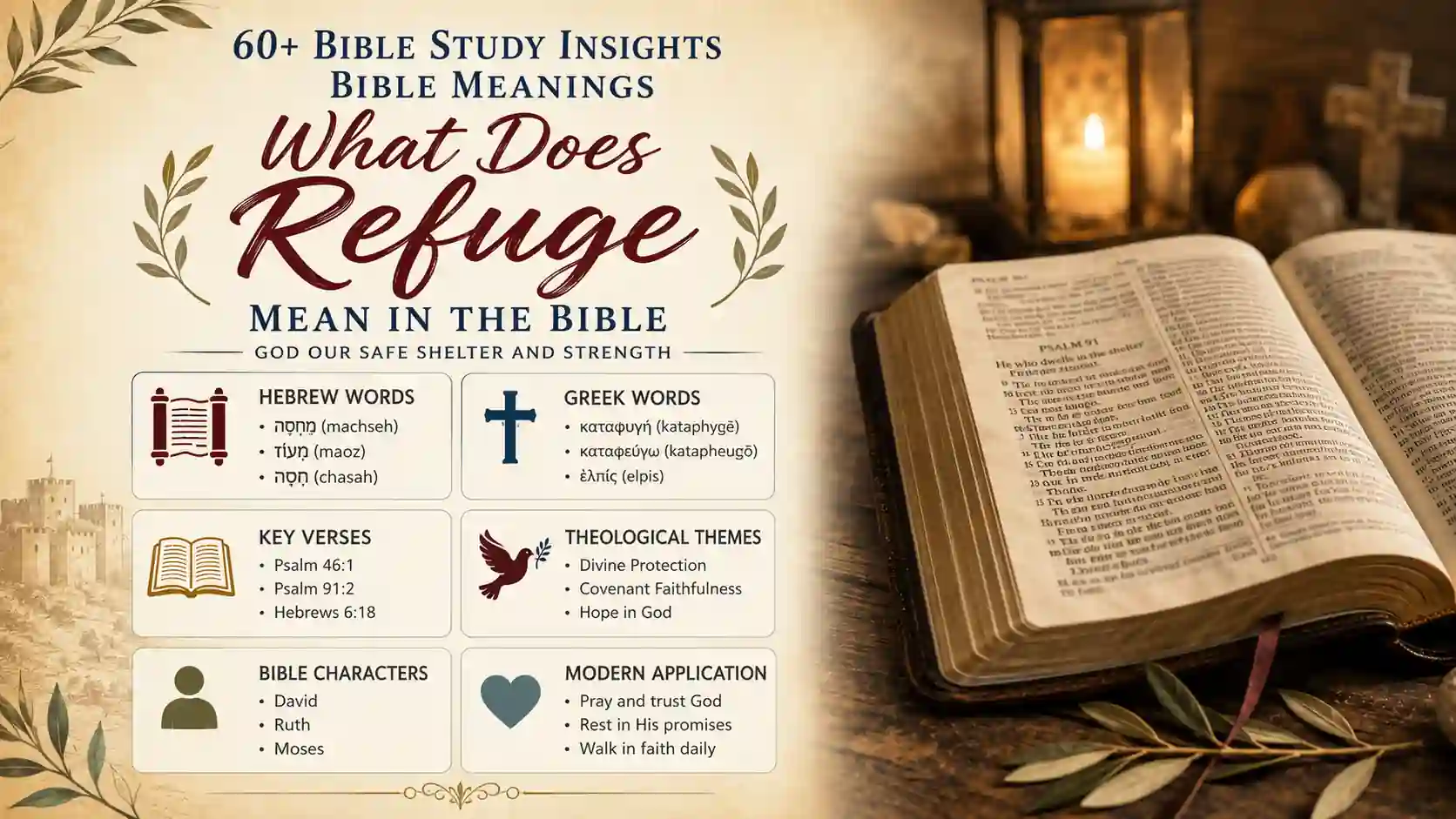
Refuge as a Biblical Theology of Trust and Worship
Throughout Scripture, refuge is never presented as permission to ignore hardship. God’s people still experienced exile, persecution, famine, imprisonment, and death. David fled from Saul, Elijah hid from Jezebel, Jeremiah suffered rejection, and Paul endured repeated trials. Yet each discovered that God’s presence remained constant even when circumstances remained difficult.
That distinction is essential for your Bible study. Refuge means God’s faithful presence within suffering rather than the guarantee of an easy life. Psalm 46 declares that God is “our refuge and strength,” then immediately describes mountains shaking and nations raging. The promise is not that trouble disappears but that God remains sovereign within it.
The imagery of refuge also encourages worship. Many Psalms move naturally from cries for help to songs of praise because the writers remember who God is. Refuge grows from God’s unchanging character. His holiness, mercy, justice, wisdom, and steadfast love become the foundation of confidence. When you pray these passages, you are reminded that biblical faith is rooted in God’s nature instead of changing emotions.
This theme reaches its fullest expression in Jesus. He welcomed the weary, forgave sinners, calmed fearful hearts, and promised eternal life to those who trusted Him. The invitation to come to Him echoes the Old Testament call to seek refuge in the Lord. What began as the image of a fortress ultimately becomes the person of Christ Himself, in whom believers find forgiveness, reconciliation, peace, and everlasting security.
Studying refuge also reshapes your daily life. When fear, uncertainty, temptation, or grief arise, Scripture repeatedly directs your attention away from self reliance and toward God’s steadfast care. Prayer becomes an act of refuge. Worship becomes an act of refuge. Obedience becomes an act of refuge because each expresses confidence that the Lord is trustworthy.
The Bible never portrays refuge as passive escape from responsibility. Instead, it empowers faithful living. Those who know God as their refuge are able to serve others, persevere through hardship, forgive enemies, and remain hopeful because their security rests in Him rather than in changing circumstances. That enduring confidence explains why the biblical writers repeatedly celebrate the Lord as their refuge from Genesis to Revelation.
FAQs
What is the Hebrew word most often translated as refuge?
The primary word is מַחְסֶה (machseh), while חָסָה (chasah) describes the act of seeking refuge in God.
Why are the Cities of Refuge important in understanding biblical refuge?
They illustrate God’s balance of justice and mercy while pointing forward to the complete safety found in Christ.
Does Hebrews 6:18 use a different idea of refuge than the Psalms?
No, it builds upon the Old Testament image and applies it to the believer’s secure hope in Christ.
Why do some translations say “stronghold” instead of “refuge”?
Hebrew words like מָעוֹז (maoz) and מִשְׂגָּב (misgav) can emphasize a fortified place, so translators sometimes choose “stronghold” to reflect that nuance.
How can you practically make God your refuge today?
Trust His promises in prayer, obey His Word, and rely on Christ’s finished work instead of your own strength.