
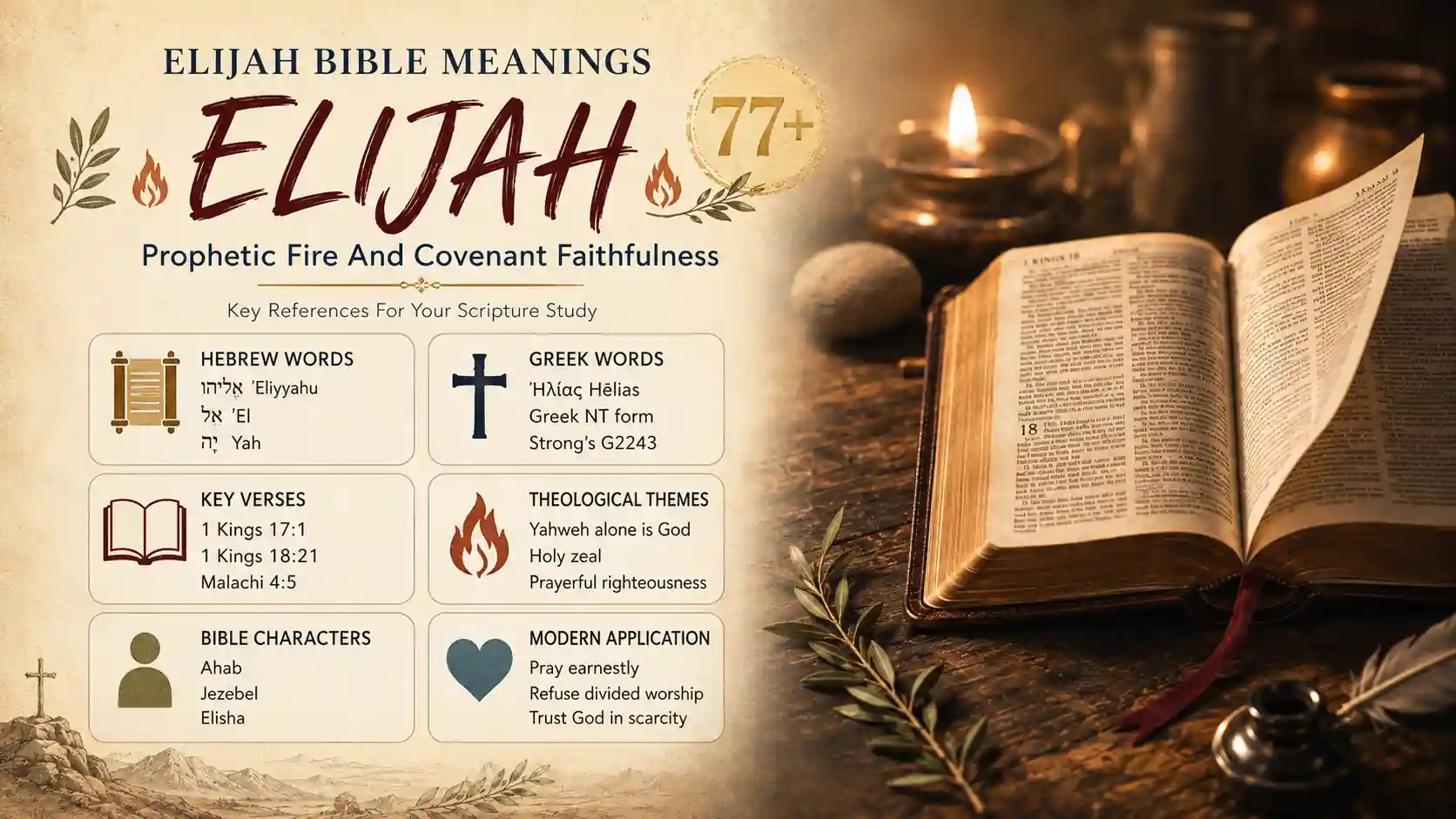
What does Elijah mean in the Bible? The name Elijah means “My God is Yahweh” or “Yahweh is my God,” from Hebrew אֵלִיָּהוּ, ʾEliyyahu. His very name becomes his message.
When you study Elijah, you meet more than a miracle-working prophet. You meet a living summons to covenant faithfulness, holy courage, prayer, repentance, and hope. Elijah stands at the fiery crossroads of Israel’s worship crisis, confronting Baal, calling down fire, hearing God’s low whisper, and pointing forward to John the Baptist and the Messiah.
Elijah Key Scripture References
| Verse | Passage Snippet | Context |
|---|---|---|
| 1 Kings 17:1 | “As the LORD God of Israel liveth” | Elijah announces drought to Ahab |
| 1 Kings 17:4 | “I have commanded the ravens” | God feeds Elijah at Cherith |
| 1 Kings 17:14 | “The barrel of meal shall not waste” | Widow of Zarephath receives provision |
| 1 Kings 17:22 | “The soul of the child came into him again” | Elijah raises the widow’s son |
| 1 Kings 18:21 | “How long halt ye between two opinions?” | Carmel covenant confrontation |
| 1 Kings 18:36 | “LORD God of Abraham, Isaac, and Israel” | Elijah prays before the altar |
| 1 Kings 18:39 | “The LORD, he is the God” | Israel confesses Yahweh |
| 1 Kings 19:12 | “A still small voice” | God meets Elijah at Horeb |
| 2 Kings 2:11 | “Elijah went up by a whirlwind” | Elijah is taken from Elisha |
| Malachi 4:5 | “I will send you Elijah the prophet” | Promise before the day of the LORD |
Elijah Bible Translation Comparison
| Verse | KJV | NIV | ESV | NASB |
|---|---|---|---|---|
| 1 Kings 17:1 | “Elijah the Tishbite” | “Elijah the Tishbite” | “Elijah the Tishbite” | “Elijah the Tishbite” |
| 1 Kings 18:21 | “halt ye” | “waver” | “limping” | “hesitating” |
| 1 Kings 18:24 | “the God that answereth by fire” | “the god who answers by fire” | “the God who answers by fire” | “the God who answers by fire” |
| 1 Kings 18:37 | “thou hast turned their heart” | “you are turning their hearts” | “you have turned their hearts” | “You have turned their heart” |
| 1 Kings 19:12 | “still small voice” | “gentle whisper” | “low whisper” | “sound of a gentle blowing” |
| 2 Kings 1:8 | “an hairy man” | “a garment of hair” | “a garment of hair” | “a hairy man” |
| 2 Kings 2:9 | “double portion” | “double portion” | “double portion” | “double portion” |
| Malachi 4:5 | “Elijah the prophet” | “the prophet Elijah” | “Elijah the prophet” | “Elijah the prophet” |
| Matthew 11:14 | “Elias, which was for to come” | “the Elijah who was to come” | “Elijah who is to come” | “Elijah who was to come” |
| James 5:17 | “Elias was a man” | “Elijah was a human being” | “Elijah was a man” | “Elijah was a man” |
Elijah People and Characters Associated
| Person | Role | Connection |
|---|---|---|
| Ahab | King of Israel | Opposed Elijah’s covenant message |
| Jezebel | Queen of Israel | Promoted Baal and threatened Elijah |
| Widow of Zarephath | Gentile widow | Hosted Elijah during famine |
| Widow’s son | Restored child | Raised through Elijah’s prayer |
| Obadiah | Palace servant | Hid prophets from Jezebel |
| Baal prophets | False prophets | Defeated at Mount Carmel |
| Elisha | Successor prophet | Received Elijah’s mantle |
| Ahaziah | King of Israel | Judged for seeking Baal-zebub |
| John the Baptist | Forerunner | Came in Elijah’s spirit and power |
| Jesus Christ | Messiah | Appeared with Elijah at transfiguration |
Elijah Original Hebrew and Greek Words
| Original Word | Transliteration | Strong’s # | Literal Meaning |
|---|---|---|---|
| אֵלִיָּה | ʾEliyyah | H452 | Elijah, God is Yah |
| אֵלִיָּהוּ | ʾEliyyahu | H452 | My God is Yahweh |
| אֵל | ʾEl | H410 | God, mighty one |
| יָהּ | Yah | H3050 | Short form of Yahweh |
| יְהוָה | YHWH, Yahweh | H3068 | The covenant LORD |
| נָבִיא | naviʾ | H5030 | Prophet, spokesman |
| קַנֹּא | qannoʾ | H7065 | Jealous, zealous |
| בַּעַל | Baʿal | H1168 | Lord, master, Baal |
| תִּשְׁבִּי | Tishbi | H8664 | Tishbite |
| Ἡλίας | Hēlias | G2243 | Elijah, Greek form |
Elijah Related Biblical Concepts
| Concept | Connection | Supporting Verse |
|---|---|---|
| Covenant loyalty | Elijah calls Israel back to Yahweh | 1 Kings 18:21 |
| Prophetic courage | He confronts royal apostasy | 1 Kings 18:17 to 18 |
| Prayer | Drought and rain follow prayer | James 5:17 to 18 |
| Provision | God feeds prophet and widow | 1 Kings 17:6 to 16 |
| Resurrection | Widow’s son is restored | 1 Kings 17:22 |
| Judgment | Fire falls against idolatry | 1 Kings 18:38 |
| Mercy | God preserves a remnant | 1 Kings 19:18 |
| Succession | Elisha receives the mantle | 2 Kings 2:13 |
| Eschatological hope | Elijah expected before the day | Malachi 4:5 |
Elijah Historical and Cultural Context
| Aspect | Detail | Biblical Source |
|---|---|---|
| Kingdom setting | Northern Israel under Ahab | 1 Kings 16:29 |
| Baal worship | Jezebel supported Baal cult | 1 Kings 18:19 |
| Drought sign | Yahweh rules rain, not Baal | 1 Kings 17:1 |
| Mount Carmel | Public contest of worship | 1 Kings 18:20 |
| Broken altar | Restored altar of Yahweh | 1 Kings 18:30 |
| Twelve stones | Symbol of covenant Israel | 1 Kings 18:31 |
| Horeb journey | Return to covenant mountain | 1 Kings 19:8 |
| Mantle | Sign of prophetic office | 2 Kings 2:13 |
| Whirlwind | Divine taking of Elijah | 2 Kings 2:11 |
Elijah Theological Themes
| Theme | Explanation | Scripture |
|---|---|---|
| Yahweh alone is God | Elijah’s name becomes his confession | 1 Kings 18:39 |
| God rules creation | Rain, ravens, fire, and famine obey him | 1 Kings 17:1 |
| True prophecy | Elijah speaks before kings without fear | 1 Kings 18:18 |
| Holy zeal | He grieves Israel’s covenant betrayal | 1 Kings 19:10 |
| Weak servants | Elijah fears, flees, and is restored | 1 Kings 19:3 to 8 |
| Divine presence | God is not confined to spectacle | 1 Kings 19:12 |
| Remnant grace | Seven thousand remain faithful | 1 Kings 19:18 |
| Messianic preparation | Elijah expectation points to John | Luke 1:17 |
| Prayerful righteousness | Elijah’s prayers are effective | James 5:16 to 18 |
| Glory of Christ | Elijah appears with Moses near Jesus | Matthew 17:3 |
Elijah Modern Application for Believers
| Area | Practice | Scripture |
|---|---|---|
| Worship | Refuse divided allegiance | 1 Kings 18:21 |
| Prayer | Pray earnestly and humbly | James 5:17 |
| Courage | Speak truth before power | 1 Kings 18:18 |
| Dependence | Trust God in scarcity | 1 Kings 17:14 |
| Compassion | Serve the vulnerable | 1 Kings 17:10 |
| Discernment | Reject false spiritual claims | 2 Kings 1:3 |
| Renewal | Repair neglected worship | 1 Kings 18:30 |
| Perseverance | Receive God’s care in weakness | 1 Kings 19:7 |
| Mentoring | Pass faith to faithful servants | 2 Kings 2:9 |
| Hope | Live ready for the Lord’s day | Malachi 4:5 |
ʾEliyyahu Means My God Is Yahweh in Israel’S Darkest Worship Crisis
The Hebrew name אֵלִיָּהוּ, ʾEliyyahu, is not decorative. It is a confession packed into a name. אֵל, ʾEl, means God, and יָהּ, Yah, is a shortened form of Yahweh. Elijah’s name announces what Israel had forgotten. The LORD, not Baal, is God.
That meaning matters because Elijah appears when Ahab and Jezebel have normalized Baal worship in the northern kingdom. Baal was associated with storm, fertility, and rain. So when Elijah declares drought, the message is sharp. Yahweh controls the skies. Baal cannot give what only the living God commands.
What Does Elijah Mean in the Bible at Mount Carmel
At Mount Carmel, Elijah presses Israel with a searching question. “How long will you go limping between two different opinions?” The people cannot confess Yahweh and Baal as equals. Elijah’s challenge exposes the spiritual impossibility of divided worship.
The fire from heaven answers the meaning of Elijah’s name. The people cry, “The LORD, he is God.” In Hebrew, that confession echoes the burden of ʾEliyyahu. Elijah’s ministry turns a personal name into a public summons. Your own study should hear the same call to whole-hearted allegiance.
Elijah at Horeb Shows That Zeal Still Needs Mercy
After Carmel, Elijah runs from Jezebel and collapses in fear. Scripture does not flatten him into a hero without weakness. He is zealous, but he is also exhausted. God feeds him, lets him sleep, and leads him to Horeb, the mountain associated with covenant revelation.
There Elijah learns that the LORD is not only present in wind, earthquake, and fire. God also comes in a quiet voice. This does not cancel Carmel’s fire. It completes the picture. The God who judges idolatry also restores tired servants and sends them back with purpose.
HēLias in the New Testament Points from Prophet to Messiah
The Greek New Testament uses Ἡλίας, Hēlias, Strong’s G2243, for Elijah. Jewish expectation remembered Malachi’s promise that Elijah would come before the great day of the LORD. This expectation appears in questions about John the Baptist, Jesus, and the coming kingdom.
Jesus teaches that John came in the promised Elijah pattern, not as Elijah reincarnated, but in prophetic likeness. At the transfiguration, Elijah appears with Moses beside Christ. The Law and the Prophets bear witness, but Jesus stands supreme as the beloved Son.
FAQ About Elijah in the Bible
Does אֵלִיָּהוּ, ʾEliyyahu, mean “Yahweh is my God”?
Yes, the name means “My God is Yahweh” or “Yahweh is my God,” joining ʾEl with Yah.
Why do some Bibles say Elias instead of Elijah?
Elias comes from Ἡλίας, Hēlias, the Greek New Testament form of the Hebrew name Elijah.
Was John the Baptist literally Elijah in Matthew 11:14?
No, John came in Elijah’s prophetic role and spirit, fulfilling Malachi’s expectation as Jesus explained.
Why is 1 Kings 19:12 translated as “still small voice” or “gentle whisper”?
The translations reflect the difficult Hebrew phrase describing God’s quiet, delicate communication at Horeb.
How should Elijah’s meaning shape my prayer life?
Elijah teaches you to pray as one who believes Yahweh is truly God over drought, rain, weakness, and renewal.