
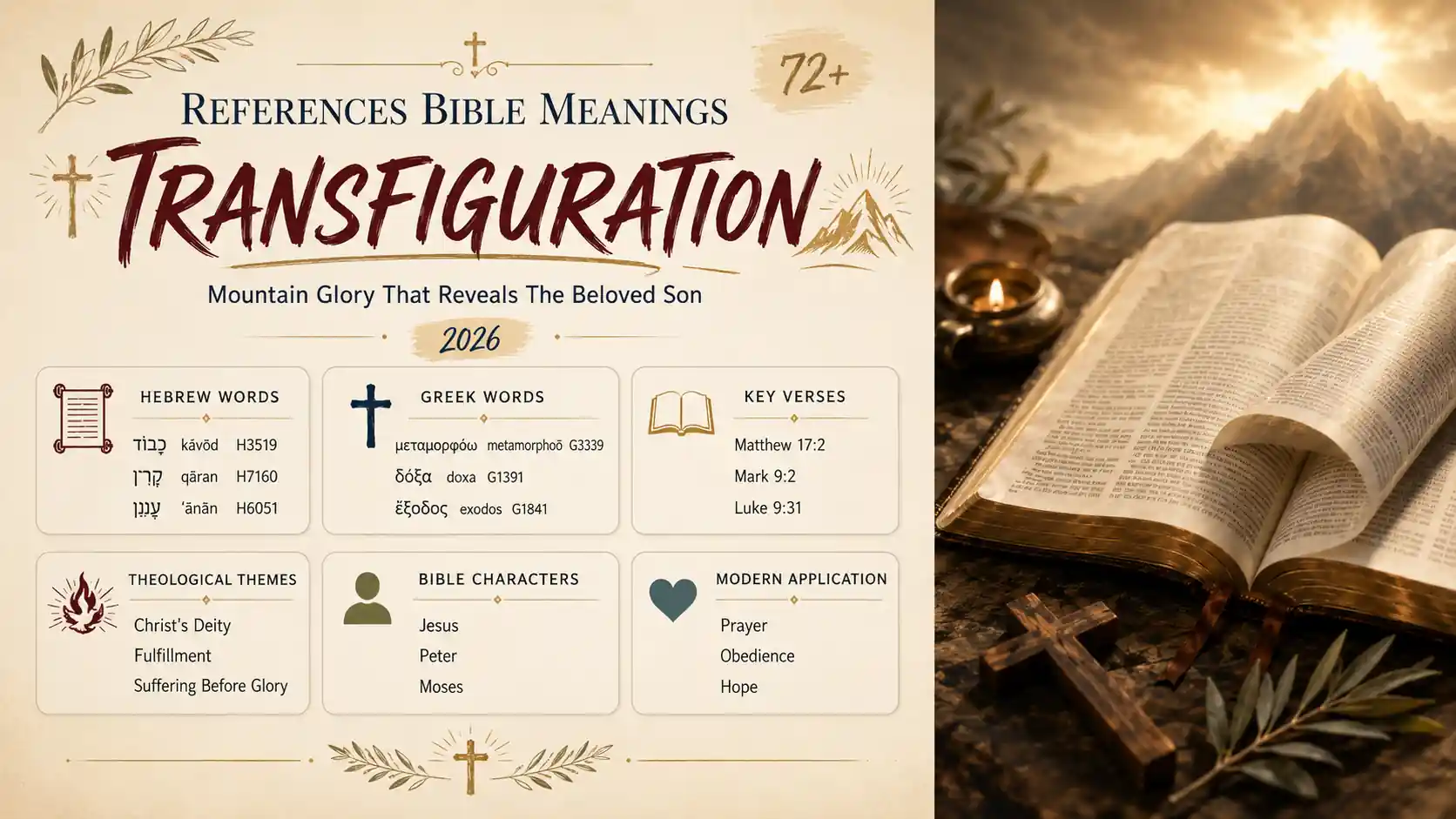
What does transfiguration mean in the Bible? It means the visible unveiling of divine glory, especially in the moment when Jesus’ appearance was changed before Peter, James, and John on a high mountain.
The transfiguration shows that Jesus is not merely a teacher with heavenly approval. He is the beloved Son, the fulfillment of Moses and the prophets, and the Lord whose glory will one day transform his people.
Transfiguration Key Scripture References
| Verse | Passage Snippet | Context |
|---|---|---|
| Matthew 17:1 | Jesus takes three disciples | High mountain setting |
| Matthew 17:2 | His face shines like the sun | Jesus is transfigured |
| Matthew 17:3 | Moses and Elijah appear | Law and prophets witness |
| Matthew 17:5 | “This is my beloved Son” | Father speaks from cloud |
| Mark 9:2 | Jesus is transfigured | Six days after confession |
| Mark 9:3 | Garments become radiant | Heavenly brightness shown |
| Luke 9:29 | Face altered while praying | Glory revealed in prayer |
| Luke 9:31 | They speak of his departure | Cross in view |
| 2 Peter 1:16 | Eyewitnesses of majesty | Apostolic testimony |
Transfiguration Bible Translation Comparison
| Verse | KJV | NIV | ESV | NASB |
|---|---|---|---|---|
| Matthew 17:2 | “transfigured” | “transfigured” | “transfigured” | “transfigured” |
| Mark 9:2 | “transfigured” | “transfigured” | “transfigured” | “transfigured” |
| Luke 9:29 | “altered” | “changed” | “altered” | “became different” |
| Romans 12:2 | “transformed” | “transformed” | “transformed” | “transformed” |
| 2 Corinthians 3:18 | “changed” | “transformed” | “transformed” | “transformed” |
| Exodus 34:29 | “shone” | “radiant” | “shone” | “shone” |
| Daniel 7:13 | “Son of man” | “son of man” | “son of man” | “Son of Man” |
| Psalm 2:7 | “my Son” | “my son” | “my Son” | “My Son” |
| Deuteronomy 18:15 | “hear ye him” | “listen to him” | “listen to him” | “listen to him” |
Transfiguration People & Characters Associated
| Person | Role | Connection |
|---|---|---|
| Jesus | Beloved Son | Revealed in divine glory |
| Peter | Witness | Wants three shelters |
| James | Witness | Present on mountain |
| John | Witness | Later sees glory themes |
| Moses | Lawgiver | Represents Sinai covenant |
| Elijah | Prophet | Represents prophetic witness |
| The Father | Speaker | Identifies the Son |
| Disciples | Learners | Told to listen |
| Son of Man | Messianic title | Glory after suffering |
Transfiguration Original Hebrew & Greek Words
| Original Word | Transliteration | Strong’s # | Literal Meaning |
|---|---|---|---|
| μεταμορφόω | metamorphoō | G3339 | To change form |
| μορφή | morphē | G3444 | Form, outward appearance |
| δόξα | doxa | G1391 | Glory, honor, splendor |
| ἔξοδος | exodos | G1841 | Departure, going out |
| ἐπισκιάζω | episkiazō | G1982 | To overshadow |
| νεφέλη | nephelē | G3507 | Cloud |
| κָרַן | qāran | H7160 | To shine, send rays |
| כָּבוֹד | kāvōd | H3519 | Glory, weight, honor |
| עָנָן | ʿānān | H6051 | Cloud |
Transfiguration Related Biblical Concepts
| Concept | Connection | Supporting Verse |
|---|---|---|
| Divine glory | Jesus’ majesty revealed | Matthew 17:2 |
| Sonship | Father names Jesus Son | Matthew 17:5 |
| Kingdom | Glory previews reign | Mark 9:1 |
| Resurrection | Vision after rising | Matthew 17:9 |
| Sinai | Cloud and voice echo Moses | Exodus 24:15 |
| New covenant | Christ surpasses Moses | 2 Corinthians 3:18 |
| Prophecy | Elijah appears with Moses | Mark 9:4 |
| Cross | Jesus discusses exodus | Luke 9:31 |
| Discipleship | “Listen to him” commands faith | Matthew 17:5 |
Transfiguration Historical & Cultural Context
| Aspect | Detail | Biblical Source |
|---|---|---|
| Mountain setting | Revelation often occurs on mountains | Exodus 19:20 |
| Six days | Echoes Sinai waiting pattern | Exodus 24:16 |
| Bright garments | Symbol of heavenly purity | Daniel 7:9 |
| Radiant face | Recalls Moses after Sinai | Exodus 34:29 |
| Cloud | Sign of divine presence | Exodus 40:34 |
| Shelters | Peter recalls sacred dwelling | Mark 9:5 |
| Fear | Human response to glory | Matthew 17:6 |
| Secrecy | Vision explained after resurrection | Mark 9:9 |
| Departure | Jerusalem suffering is central | Luke 9:31 |
Transfiguration Theological Themes
| Theme | Explanation | Scripture |
|---|---|---|
| Christ’s deity | Glory belongs to the Son | Matthew 17:2 |
| Fulfillment | Moses and Elijah point to Jesus | Luke 9:30 |
| Revelation | Father interprets the event | Matthew 17:5 |
| Suffering before glory | Cross precedes exaltation | Luke 9:31 |
| Resurrection hope | Glory anticipates victory | Matthew 17:9 |
| Apostolic witness | Peter saw majesty | 2 Peter 1:16 |
| Transformation | Believers are changed by glory | 2 Corinthians 3:18 |
| Obedience | Disciples must listen | Mark 9:7 |
| Worship | Fear turns to Jesus alone | Matthew 17:8 |
Transfiguration Modern Application for Believers
| Area | Practice | Scripture |
|---|---|---|
| Prayer | Seek God’s glory humbly | Luke 9:29 |
| Scripture | Read Law and prophets through Christ | Luke 24:27 |
| Worship | Behold Jesus above all | Matthew 17:8 |
| Obedience | Listen to the Son | Matthew 17:5 |
| Hope | Expect glory after suffering | Romans 8:18 |
| Holiness | Be transformed in mind | Romans 12:2 |
| Witness | Speak from apostolic truth | 2 Peter 1:16 |
| Courage | Fear God more than man | Matthew 17:6 |
| Perseverance | Follow Jesus to the cross | Luke 9:23 |
Metamorphoō and What Does Transfiguration Mean in the Bible
The key Greek verb is μεταμορφόω, metamorphoō, meaning to be changed in form. In Matthew and Mark, it describes Jesus’ visible change before the disciples. This was not a costume, mood, or symbolic glow. It was a disclosure of who he truly is.
Luke does not use metamorphoō, but he says Jesus’ face became different and his clothing flashed with brightness. That difference matters for your study. Matthew and Mark emphasize transformation of appearance, while Luke stresses prayer, glory, and the coming “departure” Jesus would accomplish at Jerusalem.
Moses, Elijah, and the Glory of the Covenant Witness
Moses and Elijah are not random heavenly visitors. Moses is tied to Torah, Sinai, covenant, and the radiant face of Exodus 34. Elijah is tied to prophetic power, covenant confrontation, and hope for restoration before the day of the Lord.
Together, they stand beside Jesus and then disappear from view. The point is not that Jesus joins their level. The point is that the Law and the Prophets bear witness to him, while the Father commands the disciples to listen to the beloved Son.
The Cloud, the Voice, and the Beloved Son
The bright cloud recalls the glory cloud that covered Sinai and filled the tabernacle. In Scripture, the cloud is often a sign that God is present, holy, and mercifully hidden. At the transfiguration, that presence surrounds the disciples.
The Father’s words gather several biblical streams. “My beloved Son” echoes Psalm 2 and messianic kingship. “Listen to him” recalls Deuteronomy 18 and the promised prophet like Moses. The mountain becomes a place where Scripture’s promises converge on Jesus.
From Mountain Glory to the Cross and the Believer’S Transformation
The transfiguration does not let you avoid the cross. Luke says Moses and Elijah spoke with Jesus about his ἔξοδος, exodos, his departure. That word points to death, resurrection, ascension, and deliverance. Glory and suffering belong together in the mission of Christ.
For believers, transfiguration also teaches hope. You do not transform yourself by spiritual performance. You behold Christ by faith, listen to his word, follow him through suffering, and trust that the Spirit changes God’s people from glory to glory.
Transfiguration FAQ
Why does Matthew 17:2 use μεταμορφόω, metamorphoō, for Jesus?
Because Jesus’ outward appearance was changed to reveal the divine glory that truly belongs to him.
Why does Luke 9:31 mention ἔξοδος, exodos, instead of simply saying death?
Because Jesus’ death, resurrection, and ascension form a greater deliverance centered in Jerusalem.
Is the transfiguration the same as Moses’ shining face in Exodus 34?
No. Moses reflected God’s glory, but Jesus revealed his own glory as the beloved Son.
Why do some translations say “altered” in Luke 9:29 instead of “transfigured”?
Luke uses different wording, emphasizing the changed appearance of Jesus’ face during prayer.
How should the transfiguration shape my daily discipleship?
It calls you to behold Christ’s glory, listen to his voice, and follow him with hope through suffering.