
What does firmament mean in the Bible? If you have ever paused while reading Genesis and wondered what the biblical writers meant by the “firmament,” you are asking an important question. This word has shaped centuries of Christian interpretation, biblical scholarship, and theological reflection.
As you study Scripture, understanding the Hebrew language, ancient Near Eastern context, and the Bible’s larger message will help you appreciate how the firmament reveals God’s wisdom, creative authority, and orderly design throughout creation.
Key Scripture References for Firmament
| Verse | Passage Snippet | Context |
|---|---|---|
| Genesis 1:6 | Let there be a firmament | God separates the waters |
| Genesis 1:7 | God made the firmament | Division of waters above and below |
| Genesis 1:8 | God called the firmament Heaven | Naming the sky |
| Genesis 1:14 | Lights in the firmament | Sun, moon, and stars appointed |
| Genesis 1:15 | Give light upon the earth | Heavenly bodies serve creation |
| Genesis 1:17 | Set them in the firmament | God places celestial lights |
| Psalm 19:1 | Firmament shows His handiwork | Creation declares God’s glory |
| Psalm 150:1 | Praise in His mighty firmament | Worship of God’s majesty |
| Ezekiel 1:22 | Firmament over living creatures | Vision of God’s throne |
Bible Translation Comparison for Firmament
| Verse | KJV | NIV | ESV | NASB |
|---|---|---|---|---|
| Genesis 1:6 | firmament | vault | expanse | expanse |
| Genesis 1:8 | Heaven | sky | Heaven | Heaven |
| Genesis 1:14 | firmament | vault | expanse | expanse |
| Genesis 1:15 | firmament | vault | expanse | expanse |
| Genesis 1:17 | firmament | vault | expanse | expanse |
| Psalm 19:1 | firmament | skies | sky | expanse |
| Psalm 150:1 | firmament | mighty heavens | mighty heavens | mighty expanse |
| Ezekiel 1:22 | firmament | vault | expanse | expanse |
People & Characters Associated with Firmament
| Person | Role | Connection |
|---|---|---|
| God | Creator | Makes the firmament |
| Adam | First man | Lives beneath it |
| Moses | Lawgiver | Records Genesis creation |
| David | King | Praises God’s heavens |
| Ezekiel | Prophet | Sees heavenly firmament |
| Daniel | Prophet | Speaks of heavenly glory |
| Noah | Righteous man | Flood narrative involves heavens |
| Abraham | Patriarch | Counts the stars above |
| John | Apostle | Describes heavenly visions |
Original Hebrew & Greek Words for Firmament
| Original Word | Transliteration | Strong’s # | Literal Meaning |
|---|---|---|---|
| רָקִיעַ | rāqîaʿ | H7549 | Expanse, spread out |
| רָקַע | rāqaʿ | H7554 | Beat out, hammer thin |
| שָׁמַיִם | shamayim | H8064 | Heavens |
| כָּבוֹד | kavod | H3519 | Glory |
| οὐρανός | ouranos | G3772 | Heaven, sky |
| στερέωμα | stereōma | G4733 | Firm structure |
| κτίσις | ktisis | G2937 | Creation |
| δόξα | doxa | G1391 | Glory |
| κόσμος | kosmos | G2889 | Ordered world |
Related Biblical Concepts for Firmament
| Concept | Connection | Supporting Verse |
|---|---|---|
| Creation | Ordered universe | Genesis 1:1 |
| Separation | Waters divided | Genesis 1:6 |
| Heaven | God’s created sky | Genesis 1:8 |
| Glory | Creation reveals God | Psalm 19:1 |
| Worship | Heavens praise God | Psalm 150:1 |
| Sovereignty | God rules creation | Isaiah 40:22 |
| Wisdom | Ordered design | Proverbs 3:19 |
| Providence | Sustaining creation | Hebrews 1:3 |
| New Creation | Renewed heavens | Revelation 21:1 |
Historical & Cultural Context for Firmament
| Aspect | Detail | Biblical Source |
|---|---|---|
| Ancient cosmology | Ordered heavens | Genesis 1 |
| Creation account | God establishes order | Genesis 1:6 to 8 |
| Temple imagery | Heaven as God’s dwelling | Isaiah 66:1 |
| Flood narrative | Windows of heaven | Genesis 7:11 |
| Israelite worship | Creator praised | Psalm 148 |
| Prophetic visions | Heavenly throne | Ezekiel 1 |
| Wisdom tradition | Created order | Proverbs 8 |
| Exile theology | God’s reign continues | Ezekiel 10 |
| Apocalyptic hope | New heavens promised | Revelation 21 |
Theological Themes for Firmament
| Theme | Explanation | Scripture |
|---|---|---|
| Divine Authority | God alone creates | Genesis 1:6 |
| Order | Chaos becomes structure | Genesis 1:2 to 8 |
| Glory | Heavens display God | Psalm 19:1 |
| Worship | Creation praises God | Psalm 150:1 |
| Sovereignty | God governs nature | Isaiah 40:22 |
| Revelation | Nature teaches truth | Romans 1:20 |
| Holiness | Heaven reflects purity | Ezekiel 1:22 |
| Hope | New heavens promised | Revelation 21:1 |
| Faithfulness | Creator sustains all | Colossians 1:17 |
Modern Application for Believers
| Area | Practice | Scripture |
|---|---|---|
| Worship | Praise the Creator | Psalm 150:1 |
| Bible Study | Read Genesis carefully | Genesis 1 |
| Prayer | Thank God for creation | Psalm 8 |
| Stewardship | Care for creation | Genesis 2:15 |
| Faith | Trust God’s power | Jeremiah 32:17 |
| Wonder | Observe the heavens | Psalm 19:1 |
| Humility | Remember God’s greatness | Isaiah 40:22 |
| Hope | Await new creation | Revelation 21:1 |
| Evangelism | Point others to the Creator | Romans 1:20 |
The Hebrew Root רָקִיעַ RāQîaʿ and the Creation Narrative
The key to understanding what does firmament mean in the Bible begins with the Hebrew word רָקִיעַ (rāqîaʿ). It comes from the verb רָקַע (rāqaʿ), meaning “to spread out,” “to beat out,” or “to hammer thin,” much like a craftsman shaping metal into a broad surface.
In Genesis 1, this word describes the expanse God created between the waters above and the waters below. Rather than focusing on scientific language, Moses presents the world as God’s carefully ordered creation. The emphasis rests on divine purpose, not on explaining the physical mechanics of the universe.
The ancient Israelites understood creation through the language of everyday observation. Looking upward, they saw the vast heavens stretched above them. Scripture uses this familiar perspective to proclaim that God alone established order where there had been chaos.
For your study, it helps to remember that biblical revelation communicates eternal truth through language its first audience could understand. The theological message remains timeless even when the imagery reflects the worldview of the ancient Near East.
Στερέωμα StereōMa in the Septuagint and Early Christian Understanding
When Jewish scholars translated the Hebrew Scriptures into Greek, known as the Septuagint, they rendered rāqîaʿ as στερέωμα (stereōma), meaning something established, firm, or solid. This translation later influenced the Latin word firmamentum, from which English inherited the word “firmament.”
The King James Version follows this traditional wording, while many modern translations prefer “expanse” or “vault.” Neither translation changes the central theological truth. Each attempts to communicate the meaning of the original Hebrew to modern readers.
This translation history explains why Christians sometimes picture the firmament differently. Older readers may imagine a solid heavenly structure, while newer translations encourage readers to think of the vast sky or heavens. Both approaches point to God’s creative work rather than competing scientific models.
As you compare translations, you can appreciate how faithful translators balance linguistic accuracy, historical context, and readability. The differences invite deeper study instead of creating contradiction.
The Firmament in Psalms Prophets and Biblical Worship
Genesis introduces the firmament, but later biblical writers develop its theological significance. Psalm 19 celebrates that “the heavens declare the glory of God” and the firmament proclaims His craftsmanship. The focus shifts from creation itself to the Creator whose wisdom fills every corner of the universe.
Psalm 150 expands this idea by calling all creation to praise God in His mighty firmament. The heavens become a grand sanctuary where God’s majesty is displayed. Every sunrise, star, and season becomes a testimony to His faithfulness.
Ezekiel’s prophetic vision presents the firmament above the living creatures as a brilliant crystal expanse supporting the appearance of God’s throne. Here the imagery communicates holiness, transcendence, and divine kingship rather than geography.
Daniel also uses heavenly imagery to describe God’s everlasting kingdom, while the New Testament directs your attention toward the Creator revealed fully in Christ. Throughout Scripture, the heavens consistently magnify God’s glory instead of drawing attention to themselves.
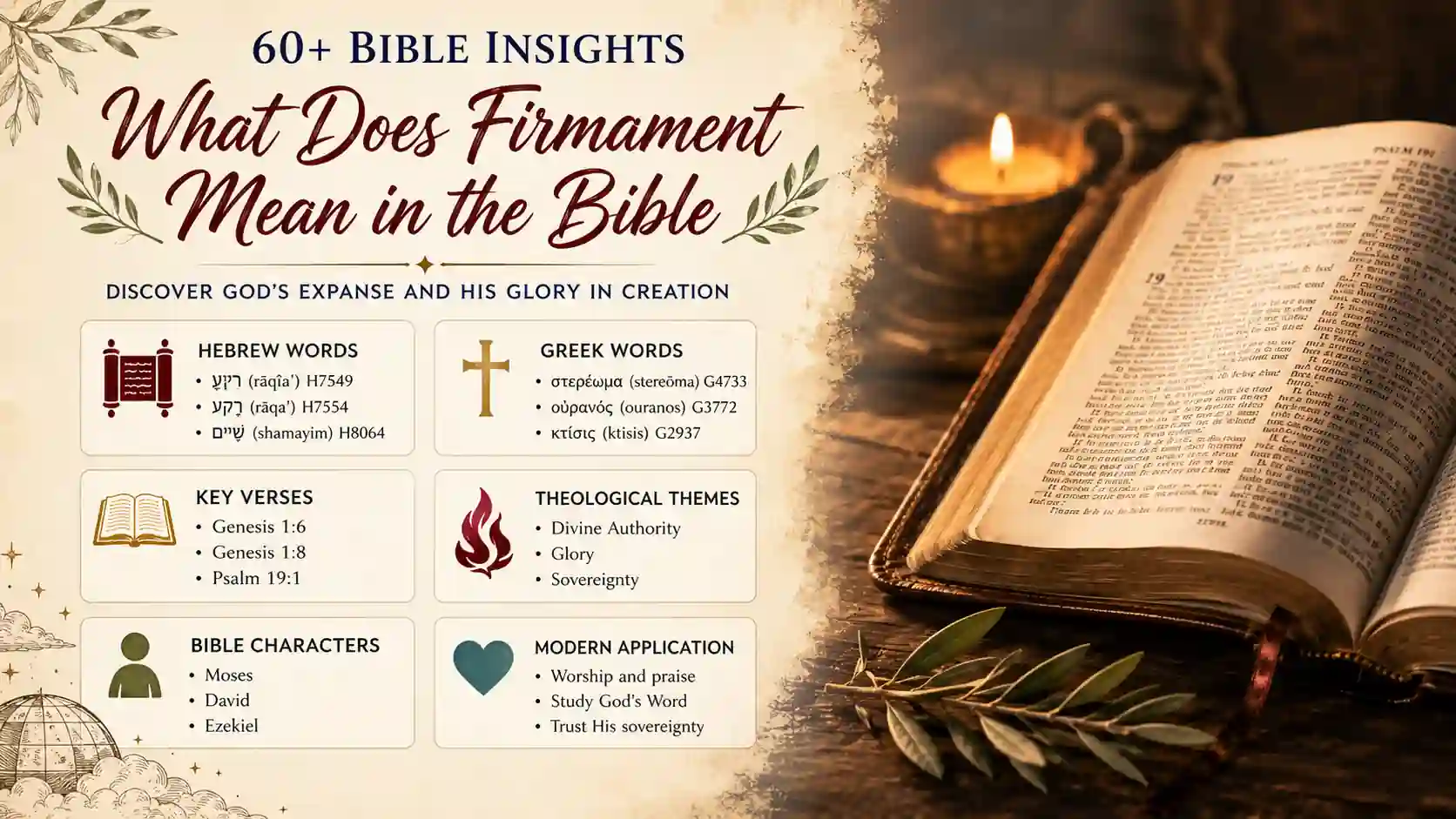
What Does Firmament Mean in the Bible Through the Lens of New Creation
As the biblical story unfolds, the firmament becomes part of a larger theme of God’s rule over creation. The same God who stretched out the heavens in Genesis continues to sustain the universe. The New Testament teaches that all things hold together through Christ, affirming the unity of creation and redemption.
Romans reminds you that creation itself bears witness to God’s eternal power and divine nature. Looking at the heavens should inspire worship, humility, and gratitude rather than fear or speculation. The created order directs your attention to the Creator.
The Bible also points forward to a renewed creation. Revelation describes a new heaven and a new earth where God’s presence dwells perfectly with His people. The hope of Scripture is not escaping creation but seeing it restored under God’s righteous reign.
When you ask what the firmament means in the Bible, the deepest answer is theological. The firmament declares that God is Creator, King, Sustainer, and Redeemer. It invites you to trust His wisdom, marvel at His power, and worship Him with confidence because the One who ordered the heavens also orders the lives of those who belong to Him.
FAQs
Why does Genesis use the Hebrew word רָקִיעַ (rāqîaʿ) instead of simply saying “sky”?
Because rāqîaʿ emphasizes God’s act of spreading out and ordering creation, not merely the visible sky.
Why do the KJV and modern translations disagree about the word “firmament”?
The KJV follows the traditional Latin-influenced term, while modern versions translate the Hebrew more directly as “expanse” or “vault.”
Does στερέωμα (stereōma) teach that the heavens are a solid dome?
The Greek word reflects the Septuagint’s translation choice and should be understood within its literary and historical context rather than as a scientific statement.
How does Psalm 19 help explain the meaning of the firmament?
Psalm 19 teaches that the firmament continually reveals God’s glory and craftsmanship to all people.
What practical lesson should you take from studying the firmament in the Bible?
The firmament reminds you to worship the Creator, trust His sovereign care, and live with hope in His promised new creation.