
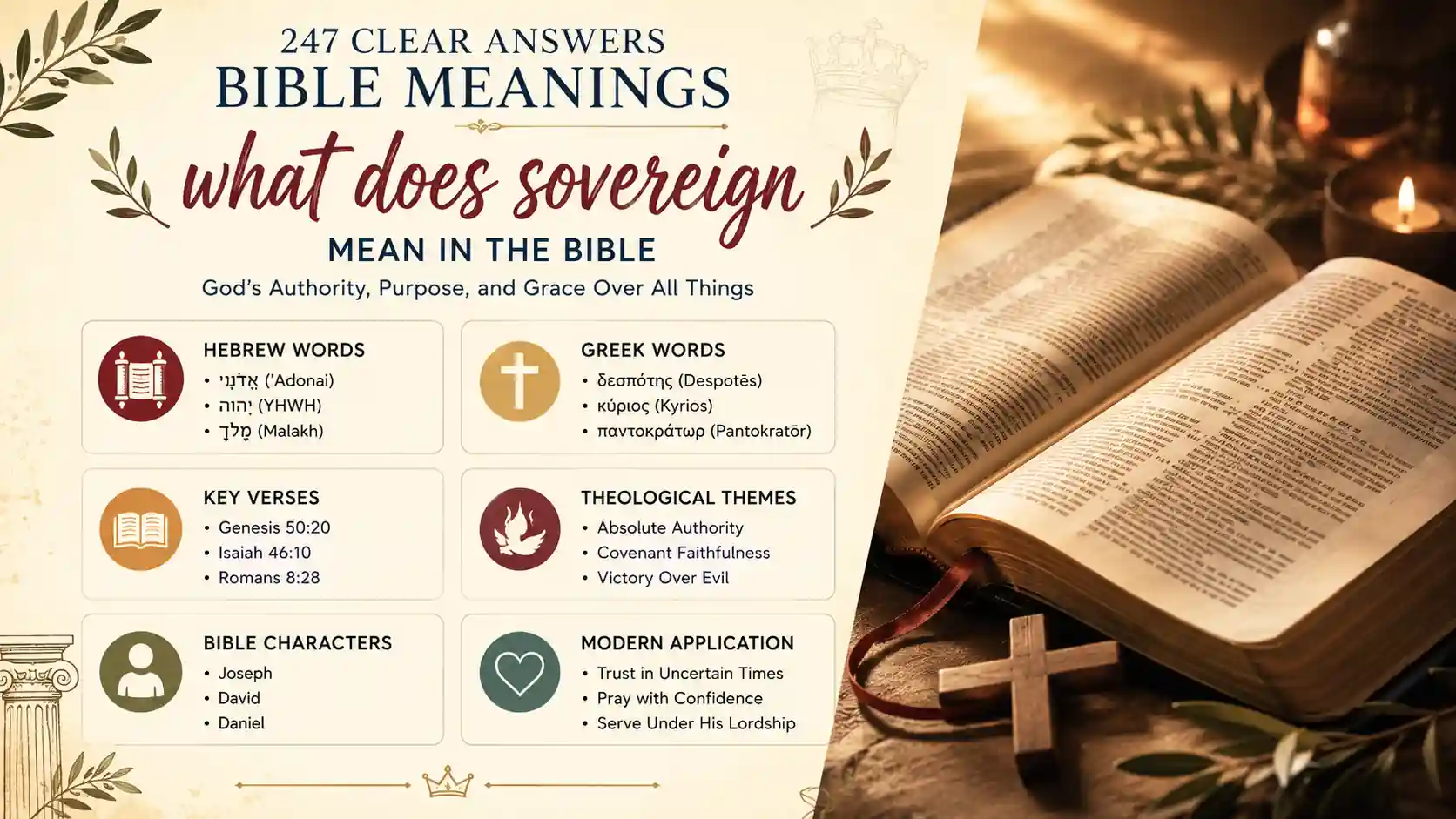
What does sovereign mean in the Bible? In Scripture, sovereignty describes God’s rightful authority, unrestricted power, wise government, and freedom to accomplish His purposes. Although English translations do not always use the word “sovereign,” the concept appears wherever God is revealed as Lord, King, Creator, Judge, Redeemer, and ruler over all.
As you study biblical sovereignty, you encounter several Hebrew and Greek titles rather than one technical term. Together, they show that God rules creation, directs history, judges evil, keeps covenant promises, and lovingly governs His people without acting unjustly or capriciously.
Key Sovereign Scripture References
| Verse | Passage Snippet | Context |
|---|---|---|
| Genesis 50:20 | “God intended it for good” | Joseph interprets suffering providentially |
| 1 Chronicles 29:11 | “Yours is the kingdom” | David praises God’s universal rule |
| Job 42:2 | “No purpose of yours” | Job confesses God’s unstoppable plan |
| Psalm 103:19 | “His kingdom rules over all” | Heaven is God’s royal throne |
| Isaiah 46:10 | “My purpose will stand” | God distinguishes Himself from idols |
| Daniel 4:35 | “None can stay his hand” | Nebuchadnezzar acknowledges divine rule |
| Romans 8:28 | “Works for the good” | Providence serves God’s called people |
| Revelation 19:6 | “The Lord God Almighty reigns” | Heaven celebrates God’s final victory |
Sovereign Bible Translation Comparison
| Verse | KJV | NIV | ESV | NASB |
|---|---|---|---|---|
| Ezekiel 2:4 | “Lord GOD” | “Sovereign LORD” | “Lord GOD” | “Lord GOD” |
| Ezekiel 18:23 | “Lord GOD” | “Sovereign LORD” | “Lord GOD” | “Lord GOD” |
| Amos 3:7 | “Lord GOD” | “Sovereign LORD” | “Lord GOD” | “Lord GOD” |
| Luke 2:29 | “Lord” | “Sovereign Lord” | “Lord” | “Lord” |
| Acts 4:24 | “Lord” | “Sovereign Lord” | “Sovereign Lord” | “Lord” |
| 1 Timothy 6:15 | “only Potentate” | “only Ruler” | “only Sovereign” | “only Sovereign” |
| Revelation 6:10 | “O Lord” | “Sovereign Lord” | “Sovereign Lord” | “O Lord” |
| Revelation 19:6 | “omnipotent reigneth” | “Almighty reigns” | “Almighty reigns” | “Almighty reigns” |
English translations represent sovereignty through words such as “Lord,” “Ruler,” “Almighty,” and “Sovereign.” In Ezekiel and Amos, the NIV’s “Sovereign LORD” usually represents אֲדֹנָי יְהוִה, ʾAdonai YHWH, while many other translations print “Lord GOD.” The difference is stylistic rather than theological. All emphasize the authority of Israel’s covenant God.
People and Characters Associated with Sovereign Rule
| Person | Role | Connection |
|---|---|---|
| Abraham | Covenant patriarch | Trusts God as Judge of all |
| Joseph | Governor in Egypt | Sees God overruling human evil |
| Moses | Covenant mediator | Confronts Pharaoh under God’s authority |
| David | Israelite king | Confesses that God owns the kingdom |
| Job | Righteous sufferer | Learns the limits of human understanding |
| Isaiah | Prophetic messenger | Proclaims God’s purpose over nations |
| Nebuchadnezzar | Babylonian emperor | Humbled by heaven’s King |
| Jesus Christ | Messiah and Lord | Receives authority over all creation |
| Paul | Apostle to Gentiles | Teaches election, providence, and lordship |
| John | Apocalyptic witness | Sees the Almighty’s final reign |
Original Sovereign Hebrew and Greek Words
| Original Word | Transliteration | Strong’s # | Literal Meaning |
|---|---|---|---|
| אָדוֹן | ʾadon | H113 | lord, master, owner |
| אֲדֹנָי | ʾAdonai | H136 | Lord, my Lord |
| יְהוִה | YHWH | H3068 | covenant name of God |
| מָלַךְ | malakh | H4427 | to reign, become king |
| מֶלֶךְ | melekh | H4428 | king, royal ruler |
| מֶמְשָׁלָה | memshalah | H4475 | dominion, government |
| δεσπότης | despotēs | G1203 | master, absolute ruler |
| κύριος | kyrios | G2962 | lord, owner, master |
| παντοκράτωρ | pantokratōr | G3841 | all-ruler, Almighty |
| βασιλεύς | basileus | G935 | king |
No single Hebrew word corresponds perfectly to the English theological term “sovereignty.” אֲדֹנָי, ʾAdonai, identifies God as Lord, while מָלַךְ, malakh, declares that He reigns. In Greek, δεσπότης, despotēs, stresses a master’s authority, and παντοκράτωρ, pantokratōr, portrays God as the One who rules all things.
Related Sovereign Biblical Concepts
| Concept | Connection | Supporting Verse |
|---|---|---|
| Kingship | God rules as supreme King | Psalm 47:7 |
| Providence | God sustains and directs events | Genesis 50:20 |
| Creation | The Maker owns what He made | Psalm 24:1 |
| Omnipotence | Nothing exceeds God’s power | Jeremiah 32:17 |
| Omniscience | His rule includes perfect knowledge | Psalm 139:1–6 |
| Covenant | His authority secures His promises | Deuteronomy 7:9 |
| Judgment | The rightful King judges evil | Psalm 96:10 |
| Election | God graciously calls a people | Ephesians 1:4–5 |
| Human responsibility | People answer for real choices | Romans 2:6 |
| Redemption | God rules by saving His people | Colossians 1:13 |
Historical and Cultural Context of Sovereign Language
| Aspect | Detail | Biblical Source |
|---|---|---|
| Ancient monarchy | Kings exercised political authority | 1 Samuel 8:10–18 |
| Divine kingship | Israel regarded God as ultimate King | 1 Samuel 12:12 |
| Covenant treaties | A great king bound servants by covenant | Exodus 19:3–8 |
| Royal throne | Heaven pictures God’s government | Isaiah 6:1 |
| Imperial Babylon | Emperors claimed vast earthly power | Daniel 3:4–6 |
| Exile | God remained Lord outside Judah | Ezekiel 1:1–28 |
| Persian rule | God used Cyrus for His purpose | Isaiah 44:28 |
| Roman Empire | Caesar’s claims framed New Testament life | Luke 2:1 |
| Early church prayer | Believers addressed God as despotēs | Acts 4:24 |
| Apocalypse | Revelation challenges beastly kingdoms | Revelation 13:1–8 |
Israel’s neighbors often associated gods with particular territories, temples, or peoples. The prophets rejected any suggestion that the Lord’s authority stopped at Israel’s borders. Ezekiel’s visions in Babylon declared that the divine throne was mobile, glorious, and unconstrained by Jerusalem’s destruction.
Daniel makes the same claim within an imperial setting. Babylon’s king could command nations, yet his authority remained temporary and accountable. When Nebuchadnezzar was humbled, he confessed that God acts among heaven’s host and earth’s inhabitants, and no creature can ultimately frustrate His hand.
Theological Themes of Sovereign Scripture
| Theme | Explanation | Scripture |
|---|---|---|
| Absolute authority | God answers to no higher power | Daniel 4:35 |
| Holy government | His rule expresses moral perfection | Psalm 145:17 |
| Wise purpose | God never governs ignorantly | Romans 11:33 |
| Covenant faithfulness | His promises cannot finally fail | Joshua 21:45 |
| Rule over nations | Kingdoms rise under His permission | Daniel 2:21 |
| Rule over nature | Creation responds to His command | Mark 4:39 |
| Rule through Christ | The Son receives universal authority | Matthew 28:18 |
| Victory over evil | Rebellion cannot defeat His kingdom | Revelation 19:11–16 |
| Mercy in salvation | Redemption begins in divine grace | Ephesians 2:4–9 |
| Human accountability | God judges meaningful decisions | Acts 17:30–31 |
Modern Sovereign Application for Believers
| Area | Practice | Scripture |
|---|---|---|
| Anxiety | Entrust uncertain outcomes to God | Matthew 6:31–34 |
| Prayer | Ask boldly while submitting to His will | Matthew 6:10 |
| Suffering | Refuse to call pain meaningless | Romans 8:28 |
| Decisions | Seek wisdom rather than omens | James 1:5 |
| Work | Serve faithfully under Christ’s lordship | Colossians 3:23–24 |
| Politics | Honor rulers without idolizing them | Romans 13:1–7 |
| Injustice | Trust God’s judgment and pursue good | Romans 12:19–21 |
| Humility | Hold plans with open hands | James 4:13–15 |
| Worship | Praise the King who reigns forever | Psalm 146:10 |
| Mission | Go confidently under Christ’s authority | Matthew 28:18–20 |
What Does Sovereign Mean in the Bible’S Story of Creation and Covenant?
Biblical sovereignty begins with creation. Genesis does not picture God struggling against equal rivals. He speaks, and light, land, living creatures, and humanity come into existence. Because He made all things, His authority is not seized, delegated, or temporary. The earth belongs to Him by right.
That authority takes covenant form. The sovereign Creator binds Himself to Abraham, Israel, David, and ultimately the new covenant established through Christ. God’s rule is therefore personal and faithful. He does not merely possess power. He uses power according to His holy character and pledged word.
אֲדֹנָי יְהוִה And the Prophetic Message of Ezekiel
The title אֲדֹנָי יְהוִה, ʾAdonai YHWH, appears repeatedly in Ezekiel. Many English versions render it “Lord GOD,” while the NIV commonly uses “Sovereign LORD.” The title combines lordship with God’s covenant name, presenting the prophet’s message as the authoritative declaration of Israel’s true Master.
This matters because Ezekiel ministered among exiles after Babylon had shattered Judah’s political security. God’s sovereignty meant that exile was neither proof of Babylonian supremacy nor evidence of divine absence. The Lord judged Jerusalem, accompanied His displaced people, confronted false shepherds, and promised restoration.
παντοκράτωρ And the Reign of the Almighty in Revelation
The Greek title παντοκράτωρ, pantokratōr, means “all-ruler” or “Almighty.” It occurs most prominently in Revelation, where persecuted believers face imperial violence, deceptive powers, and apparent chaos. Revelation answers fear by repeatedly directing worship toward “the Lord God Almighty,” whose reign cannot be displaced.
This sovereignty does not excuse cruelty or portray evil as good. Revelation distinguishes sharply between God’s righteous throne and the beast’s oppressive authority. God permits rebellion for a limited time, judges it truthfully, vindicates His witnesses, and brings creation toward the holy city where death and corruption are gone.
Divine Sovereignty, Human Choices, and Trust
Scripture places God’s rule beside genuine human responsibility without treating either as imaginary. Joseph’s brothers intended evil, yet God intended the same event for saving purposes. Their guilt remained real, while God’s providence proved deeper than their malice. Divine purpose can govern an event without sharing the sinner’s corrupt motive.
For your study, humility is wiser than forcing every mystery into a philosophical formula. Biblical writers call you to obey, pray, repent, choose wisdom, and proclaim the gospel. They also call you to rest in the assurance that God’s kingdom, promises, and saving purpose will not collapse through human weakness.
Questions About Sovereign Meaning in Scripture
Why does the NIV say “Sovereign LORD” where the KJV says “Lord GOD”?
Both render אֲדֹנָי יְהוִה, ʾAdonai YHWH, using different English conventions for the same divine title.
Does δεσπότης, despotēs, imply that God is cruel or tyrannical?
No. In biblical Greek it identifies a master with rightful authority, while Scripture consistently describes God’s rule as holy, just, and merciful.
How does Genesis 50:20 hold sovereignty and human responsibility together?
Joseph’s brothers remain responsible for their evil intention, while God sovereignly directs the event toward preservation and good.
Why is παντοκράτωρ, pantokratōr, especially important in Revelation?
It assures suffering believers that God, not emperors, beasts, violence, or death, possesses final and universal rule.
How should belief in God’s sovereignty change your prayers?
It should give you confidence to ask boldly, patience to await God’s wisdom, and humility to submit your desires to His will.