
What does Israel mean in the Bible? The answer begins with Jacob’s mysterious encounter with God beside the Jabbok River. There, Jacob received the Hebrew name יִשְׂרָאֵל, Yisra’el, a name associated with striving, prevailing, and God’s sovereign action.
Yet Scripture uses “Israel” for more than one man. As you follow the biblical story, the name identifies Jacob, his descendants, the covenant nation, the northern kingdom, the promised land, and God’s people within important New Testament discussions. Each use must be understood in its literary and covenant setting.
Israel Key Scripture References
| Verse | Passage Snippet | Context |
|---|---|---|
| Genesis 32:28 | “Your name…shall be Israel” | Jacob receives his new name after wrestling |
| Genesis 35:10 | “Israel shall be your name” | God confirms the renaming at Bethel |
| Genesis 46:1 | “Israel…offered sacrifices” | Jacob personally bears the new name |
| Exodus 4:22 | “Israel is my son” | The nation is identified as God’s firstborn |
| Exodus 19:6 | “A kingdom of priests” | Israel receives a covenant vocation at Sinai |
| Deuteronomy 6:4 | “Hear, O Israel” | Moses calls the covenant people to loyalty |
| 1 Kings 12:20 | “King over all Israel” | Israel becomes the northern kingdom |
| Isaiah 49:3 | “You are my servant, Israel” | Israel’s calling is expressed through servant imagery |
| Matthew 2:6 | “My people Israel” | Bethlehem is linked with Israel’s promised ruler |
| Romans 9:6 | “Not all…Israel” | Paul distinguishes physical descent and covenant identity |
Genesis connects the name with Jacob’s striving with God and human beings, while later books expand its reference to his descendants and their covenant history.
Israel Bible Translation Comparison
| Verse | KJV | NIV | ESV | NASB |
|---|---|---|---|---|
| Genesis 32:28 | “as a prince hast thou power” | “struggled with God” | “striven with God” | “contended with God” |
| Genesis 35:10 | “Israel shall be thy name” | “your name will be Israel” | “Israel shall be your name” | “Israel shall be your name” |
| Exodus 4:22 | “Israel is my son” | “Israel is my firstborn son” | “Israel is my firstborn son” | “Israel is My son” |
| Deuteronomy 6:4 | “Hear, O Israel” | “Hear, O Israel” | “Hear, O Israel” | “Hear, Israel” |
| Psalm 130:7 | “Let Israel hope” | “Israel, put your hope” | “O Israel, hope” | “Israel, wait for” |
| Isaiah 49:3 | “Thou art my servant” | “You are my servant” | “You are my servant” | “You are My Servant” |
| Matthew 15:24 | “lost sheep…Israel” | “lost sheep of Israel” | “lost sheep…Israel” | “lost sheep…Israel” |
| Romans 9:6 | “not all Israel” | “not all…are Israel” | “not all…belong to Israel” | “not all Israel” |
The most noticeable difference appears in Genesis 32:28. The KJV uses royal language about having power “as a prince,” while many modern translations emphasize struggling, striving, or contending. The underlying Hebrew supports the image of persistent conflict rather than an earthly political title.
Israel People and Characters Associated
| Person | Role | Connection |
|---|---|---|
| Jacob | Patriarch | First person explicitly named Israel |
| Abraham | Covenant ancestor | Grandfather of Jacob and recipient of the promises |
| Isaac | Promised son | Father of Jacob and Esau |
| Rebekah | Matriarch | Mother of Jacob, later called Israel |
| Esau | Jacob’s brother | Jacob feared meeting him before the renaming |
| Joseph | Son of Jacob | Preserved Israel’s household in Egypt |
| Moses | Covenant mediator | Led the children of Israel from slavery |
| David | Anointed king | Ruled the united tribes of Israel |
| Solomon | Temple builder | Ruled Israel before the kingdom divided |
| Jesus | Messiah | Presented as Israel’s promised King and representative |
Israel Original Hebrew and Greek Words
| Original Word | Transliteration | Strong’s # | Literal Meaning |
|---|---|---|---|
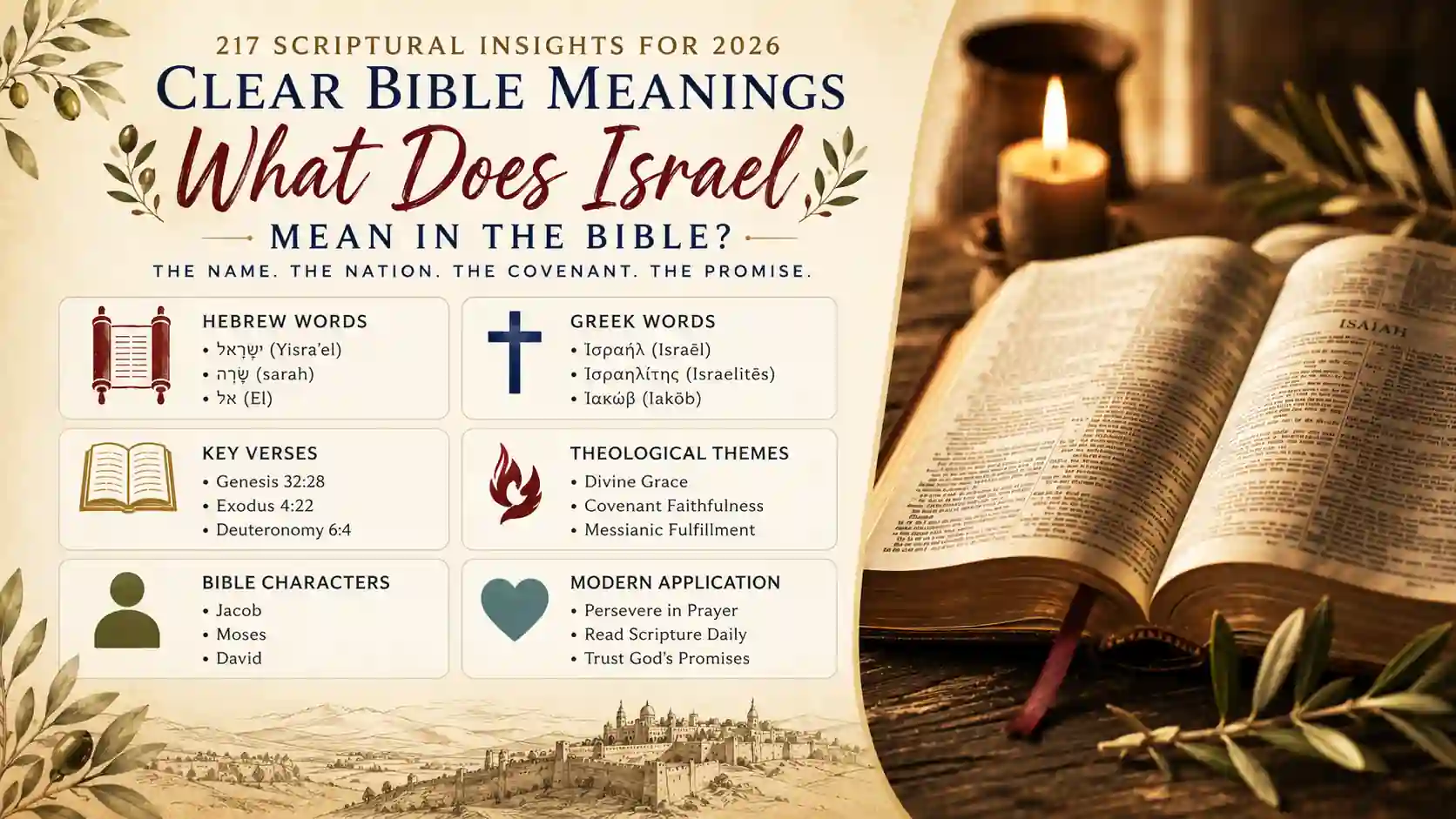
| יִשְׂרָאֵל | Yisra’el | H3478 | God strives, or he strives with God |
| שָׂרָה | sarah | H8280 | To strive, contend, persist |
| אֵל | El | H410 | God, mighty one |
| יַעֲקֹב | Ya‘aqov | H3290 | Jacob, heel holder |
| בְּנֵי־יִשְׂרָאֵל | bene Yisra’el | H1121 + H3478 | Sons or children of Israel |
| יִשְׂרְאֵלִי | Yisre’eli | H3481 | An Israelite |
| Ἰσραήλ | Israēl | G2474 | Israel, from the Hebrew name |
| Ἰσραηλίτης | Israēlitēs | G2475 | An Israelite |
| Ἰακώβ | Iakōb | G2384 | Jacob |
| Ἰουδαῖος | Ioudaios | G2453 | Jew, Judean |
The primary Hebrew term is יִשְׂרָאֵל, Yisra’el, Strong’s H3478. Lexicons connect it with שָׂרָה, sarah, “to strive,” and אֵל, El, “God.” The New Testament form Ἰσραήλ, Israēl, Strong’s G2474, carries the Hebrew name into Greek with little alteration.
The exact grammatical force of the Hebrew name has been discussed. It may be understood as “God strives,” “God rules,” “he strives with God,” or “God contends.” Genesis 32:28 supplies the inspired narrative explanation by linking Israel with Jacob’s striving and prevailing.
Israel Related Biblical Concepts
| Concept | Connection | Supporting Verse |
|---|---|---|
| Covenant | Israel inherits promises given to Abraham | Genesis 17:7 |
| Election | God chooses Israel by grace | Deuteronomy 7:6-8 |
| Sonship | Israel is called God’s firstborn | Exodus 4:22 |
| Kingdom | Israel is called to priestly service | Exodus 19:6 |
| Torah | Israel receives God’s covenant instruction | Deuteronomy 4:8 |
| Land | Canaan is given within the covenant promise | Genesis 35:12 |
| Temple | Worship is centered in Jerusalem | 1 Kings 8:20 |
| Exile | Covenant rebellion brings judgment | 2 Kings 17:18 |
| Remnant | God preserves faithful Israelites | Isaiah 10:20-22 |
| Messiah | Israel awaits David’s promised ruler | Jeremiah 23:5-6 |
Israel Historical and Cultural Context
| Aspect | Detail | Biblical Source |
|---|---|---|
| Jabbok encounter | Jacob wrestles before meeting Esau | Genesis 32:22-32 |
| Bethel confirmation | God formally repeats the new name | Genesis 35:9-15 |
| Twelve tribes | Jacob’s sons become tribal ancestors | Genesis 49 |
| Egyptian slavery | Israel grows into an oppressed people | Exodus 1:7-14 |
| Exodus | God liberates Israel through Moses | Exodus 12:31-42 |
| Sinai covenant | Israel receives law and vocation | Exodus 19–24 |
| United monarchy | Saul, David, and Solomon rule the tribes | 1 Samuel 10 to 1 Kings 11 |
| Divided kingdom | Israel separates from Judah | 1 Kings 12 |
| Assyrian exile | Northern Israel falls in 722 BC | 2 Kings 17 |
| Restoration hope | Prophets promise renewal and return | Ezekiel 36:22-28 |
After Solomon’s death, biblical usage becomes especially sensitive to context. “Israel” may describe all twelve tribes collectively, but in Kings and the Prophets it often refers specifically to the northern kingdom, while “Judah” identifies the southern kingdom.
The northern kingdom retained the name Israel because it contained most of the tribes. Its capital eventually became Samaria. Assyria conquered it, deported many inhabitants, and brought foreign populations into the region, creating lasting historical and religious tensions.
Israel Theological Themes
| Theme | Explanation | Scripture |
|---|---|---|
| Divine grace | God chooses a flawed Jacob | Genesis 32:28 |
| Transformation | Jacob receives a new identity | Genesis 35:10 |
| Covenant faithfulness | God remembers ancestral promises | Exodus 2:24 |
| Holy vocation | Israel serves as a priestly kingdom | Exodus 19:6 |
| God’s presence | The Lord dwells among His people | Exodus 29:45 |
| Human rebellion | Israel repeatedly breaks covenant | Judges 2:17 |
| Righteous judgment | Exile follows persistent disobedience | 2 Kings 17:7-23 |
| Preserved remnant | Grace keeps a faithful people | Romans 11:5 |
| Messianic fulfillment | Jesus fulfills Israel’s story | Matthew 2:15 |
| Worldwide blessing | Abraham’s blessing reaches the nations | Galatians 3:8 |
Israel Modern Application for Believers
| Area | Practice | Scripture |
|---|---|---|
| Identity | Receive your identity from God’s grace | Ephesians 2:10 |
| Prayer | Persevere while submitting to God | Genesis 32:26 |
| Humility | Remember that blessing is not earned | Romans 9:16 |
| Scripture | Read both Testaments as one unfolding story | Luke 24:27 |
| Worship | Love God with your whole being | Deuteronomy 6:4-5 |
| Holiness | Reflect God’s character in daily conduct | Leviticus 19:2 |
| Community | Resist pride toward other covenant participants | Romans 11:18 |
| Witness | Carry God’s light toward the nations | Isaiah 49:6 |
| Hope | Trust God’s faithfulness to His promises | Romans 11:29 |
| Reconciliation | Seek unity in Christ without erasing history | Ephesians 2:14 |
What Does Israel Mean in the Bible at the Jabbok River?
The name Israel first becomes personal before it becomes national. Jacob is alone, afraid of Esau, and unable to control what will happen next. During the night, a mysterious “man” wrestles with him until daybreak. Jacob is injured, yet he clings to his opponent and asks for a blessing.
The stranger declares, “Your name shall no longer be called Jacob, but Israel.” Jacob’s new identity is therefore born in weakness, dependence, and encounter with God. His limp prevents you from reading “prevailing” as human superiority. Jacob overcomes only by refusing to release the One who has already demonstrated power over him.
The name also contrasts with Jacob’s earlier habits. He had obtained advantages through planning, bargaining, and deception. At Jabbok, he cannot manipulate the blessing. He must confess his name, endure God’s touch, and receive what only divine grace can provide.
יִשְׂרָאֵל Yisra’El and the Mystery of Striving with God
The element אֵל, El, clearly refers to God. The first part is related to the Hebrew verb שָׂרָה, sarah, which conveys striving, contending, or persisting. This explains why English resources offer several renderings rather than one universally accepted formula.
Genesis itself is more important than an isolated dictionary gloss. The name is given “because you have striven with God and with men, and have prevailed.” In its first setting, Israel describes a man whose life has involved conflict, but whose deepest victory comes through receiving God’s blessing.
Hosea 12 revisits the episode and says Jacob strove with the angel, wept, and sought favor. That prophetic interpretation keeps striving and supplication together. Biblical Israel is not a picture of humanity overpowering God. It is a picture of desperate dependence meeting divine mercy.
From Jacob’S Household to the Covenant Nation of Israel
As Genesis continues, Israel may still refer directly to Jacob. When “Israel journeyed” or “Israel loved Joseph,” the text is speaking about the patriarch. Gradually, however, “the sons of Israel” becomes a collective expression for his descendants and eventually for the entire covenant nation.
In Exodus, the transition is complete. Pharaoh oppresses the children of Israel, and God identifies the nation as “my son, my firstborn.” The name now carries covenant meaning. Israel is the people whom God redeems, gathers, instructs, disciplines, and appoints to be a kingdom of priests.
Israel’s election never means that God approves everything Israelites do. The prophets repeatedly confront idolatry, injustice, false worship, and covenant betrayal. Election creates responsibility. Israel is chosen to know God, display His holiness, preserve His revelation, and become the historical setting through which the Messiah comes.
Israel, the Messiah, and Paul’S New Testament Argument
The New Testament does not treat Israel as an irrelevant Old Testament label. Jesus is born as Israel’s Messiah, ministers among “the lost sheep of the house of Israel,” appoints twelve apostles, and fulfills patterns drawn from Israel’s exodus, wilderness testing, kingship, and servant calling.
Paul sometimes uses Israel in an ethnic or historical sense. He speaks of his “kinsmen according to the flesh,” identifies himself as an Israelite, and discusses Israel’s privileges, unbelief, remnant, and hoped-for salvation in Romans 9 through 11.
Romans 9:6 states that “not all who are descended from Israel belong to Israel.” Paul is distinguishing outward descent from the faithful people produced by God’s promise. Yet Romans 11 warns Gentile believers against arrogance. They share covenant blessings only through grace and must not boast over the natural branches.
These passages have produced different theological models, but they agree on central truths. God is faithful, salvation comes through Christ, no one is justified by ancestry, and believing Gentiles must respond to Israel’s story with humility rather than contempt.
Frequently Asked Questions About Israel in the Bible
Does יִשְׂרָאֵל, Yisra’el, mean “prince with God” or “one who struggles with God”?
The KJV reflects an older interpretation, while the Hebrew root and Genesis 32 context more directly emphasize striving or contending involving God.
Why does Genesis continue calling the patriarch Jacob after God renames him Israel?
Both names remain in use because Scripture presents continuity between the historical man Jacob and his transformed covenant identity as Israel.
Does “Israel” always refer to the same group in every Bible passage?
No. It may refer to Jacob, all twelve tribes, the northern kingdom, the land, ethnic Israelites, or a covenant community defined by the passage.
What does Paul mean when he says, “Not all Israel is Israel,” in Romans 9:6?
He teaches that physical descent alone does not guarantee participation in the saving promise, which depends on God’s gracious calling.
How should believers apply Jacob’s striving without thinking they can overpower God?
You should persevere in prayer, confess your dependence, and cling to God’s mercy, recognizing that His blessing is received through grace rather than human strength.