
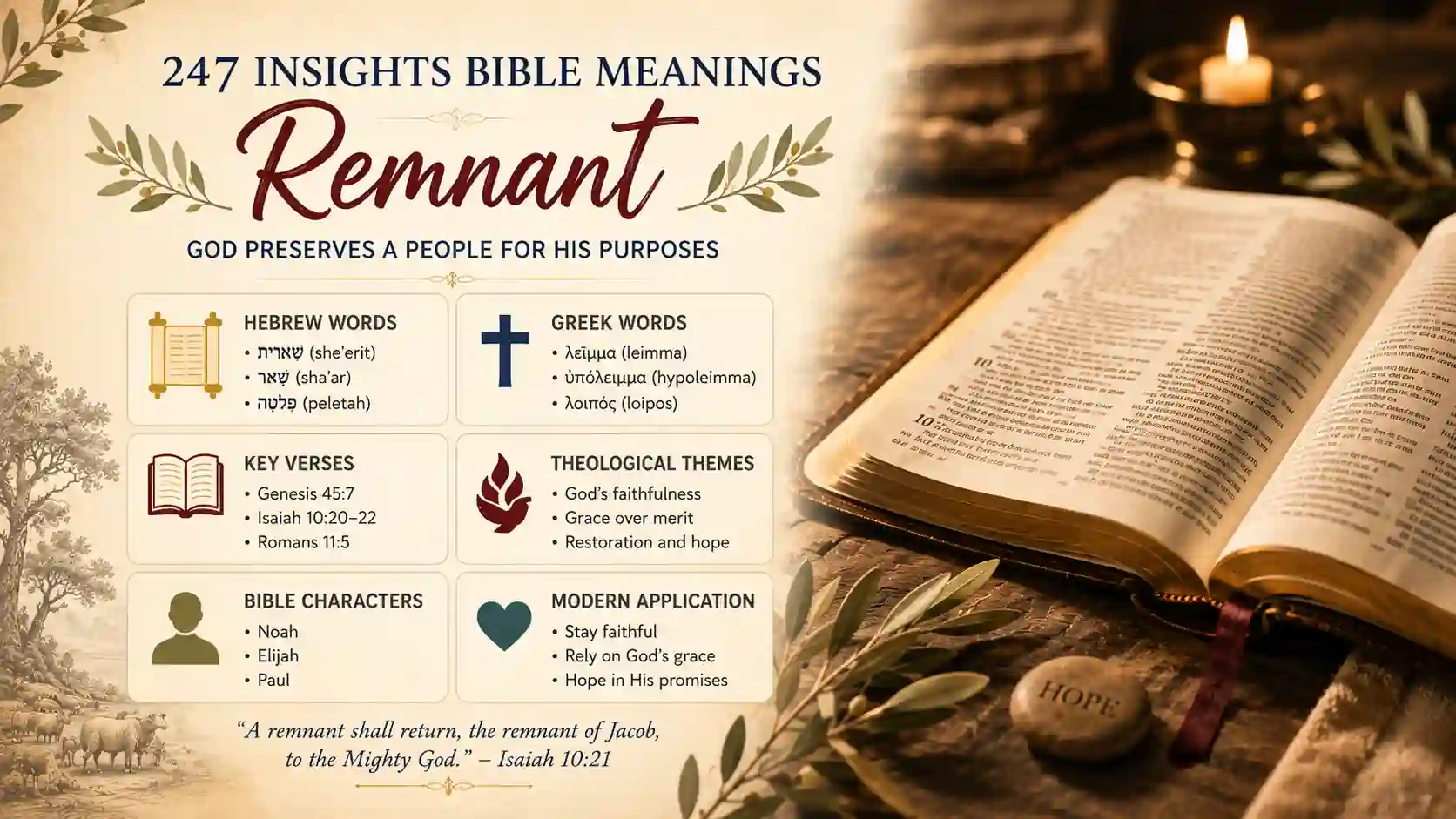
What does remnant mean in the Bible? A remnant is the surviving portion that remains after judgment, disaster, exile, apostasy, or separation. Scripture often applies the idea to people whom God preserves so that His covenant purposes continue.
The remnant theme joins divine judgment with remarkable mercy. Human unfaithfulness brings real consequences, yet God does not abandon His promises. As you follow this theme from Noah and Joseph through Isaiah, the exile, and Paul’s teaching about Israel, you discover that survival rests on God’s faithfulness and grace.
Remnant Key Scripture References
| Verse | Passage Snippet | Context |
|---|---|---|
| Genesis 45:7 | “Preserve you a posterity” | Joseph sees his position in Egypt as God’s means of preserving Jacob’s family. |
| 1 Kings 19:18 | “Seven thousand in Israel” | God assures Elijah that faithful worshipers remain despite national apostasy. |
| 2 Kings 19:30 | “The remnant that is escaped” | Jerusalem’s survivors will again take root after Assyrian aggression. |
| Ezra 9:8 | “A remnant to escape” | Returned exiles confess that restoration is an undeserved gift of grace. |
| Isaiah 10:20–22 | “A remnant shall return” | Survivors abandon false supports and rely sincerely upon the Lord. |
| Isaiah 37:31–32 | “Out of Jerusalem shall go forth” | God promises life beyond Sennacherib’s invasion and Jerusalem’s distress. |
| Jeremiah 23:3 | “The remnant of my flock” | God gathers His scattered people and restores them under faithful shepherding. |
| Micah 2:12 | “The remnant of Israel” | Scattered Israelites are pictured as a gathered and protected flock. |
| Zephaniah 3:12–13 | “The remnant of Israel” | A humble, truthful people seek refuge in the name of the Lord. |
| Romans 11:5 | “A remnant chosen by grace” | Paul explains that God has not rejected Israel or nullified His promises. |
Remnant Bible Translation Comparison
| Verse | KJV | NIV | ESV | NASB |
|---|---|---|---|---|
| Genesis 45:7 | “preserve you a posterity” | “preserve for you a remnant” | “preserve for you a remnant” | “preserve for you a remnant” |
| 2 Kings 19:30 | “remnant that is escaped” | “surviving remnant” | “surviving remnant” | “survivors that are left” |
| Ezra 9:8 | “a remnant to escape” | “a remnant” | “a remnant” | “an escaped remnant” |
| Isaiah 10:21 | “remnant shall return” | “remnant will return” | “remnant will return” | “remnant will return” |
| Jeremiah 23:3 | “remnant of my flock” | “remnant of my flock” | “remnant of my flock” | “remnant of my flock” |
| Micah 2:12 | “remnant of Israel” | “survivors of Israel” | “remnant of Israel” | “remnant of Israel” |
| Zephaniah 3:13 | “remnant of Israel” | “remnant of Israel” | “remnant of Israel” | “remnant of Israel” |
| Romans 9:27 | “a remnant shall be saved” | “remnant will be saved” | “remnant will be saved” | “remnant will be saved” |
| Romans 11:5 | “remnant according to election” | “remnant chosen by grace” | “remnant, chosen by grace” | “remnant according to grace” |
Remnant People and Characters Associated
| Person | Role | Connection |
|---|---|---|
| Noah | Flood survivor | His household survives judgment and carries human life into a renewed world. |
| Joseph | Providential deliverer | God sends him ahead to preserve a surviving community during famine. |
| Jacob | Covenant patriarch | His family is preserved in Egypt so that the covenant line continues. |
| Elijah | Prophet in Israel | He wrongly believes he stands alone until God reveals seven thousand faithful people. |
| Hezekiah | King of Judah | He witnesses God’s preservation of Jerusalem during the Assyrian crisis. |
| Isaiah | Prophet of judgment and hope | His son Shear-jashub bears the symbolic name “a remnant shall return.” |
| Jeremiah | Prophet before exile | He announces both scattering and God’s future gathering of His flock. |
| Ezra | Scribe and reformer | He describes returned Judeans as an escaped remnant receiving temporary relief. |
| Zerubbabel | Postexilic governor | He leads restored Judeans and represents renewed Davidic hope after exile. |
| Paul | Apostle to the Gentiles | He teaches that an Israelite remnant exists according to God’s gracious choice. |
Remnant Hebrew and Greek Words
| Original Word | Transliteration | Strong’s # | Literal Meaning |
|---|---|---|---|
| שָׁאַר | sha’ar | H7604 | To remain, be left, survive |
| שְׁאָר | she’ar | H7605 | Remainder, residue, remnant |
| שְׁאֵרִית | she’erit | H7611 | Remaining part, surviving portion |
| פְּלֵיטָה | peletah | H6413 | Escape, deliverance, escaped group |
| יָתַר | yathar | H3498 | To remain, be left over |
| שָׂרִיד | sarid | H8300 | Survivor, one who escapes |
| λεῖμμα | leimma | G3005 | Remainder, remnant |
| ὑπόλειμμα | hypoleimma | G5275 | That which is left behind |
| λοιπός | loipos | G3062 | Remaining, the rest |
| καταλείπω | kataleipō | G2641 | To leave behind, reserve |
The principal Hebrew terms, especially שְׁאֵרִית, describe a remaining or surviving portion, while Paul uses λεῖμμα in Romans 11:5 for a remnant formed by grace.
Remnant Related Biblical Concepts
| Concept | Connection | Supporting Verse |
|---|---|---|
| Covenant faithfulness | God preserves a people because His promises do not fail. | Leviticus 26:44–45 |
| Divine election | The remnant exists through gracious choice rather than human achievement. | Romans 11:5–6 |
| Judgment | A remnant survives when widespread rebellion brings covenant discipline. | Isaiah 10:22–23 |
| Mercy | Preservation demonstrates compassion within deserved punishment. | Micah 7:18 |
| Repentance | The returning remnant relies truthfully upon the Lord. | Isaiah 10:20–21 |
| Restoration | Survivors are gathered, planted, healed, and made fruitful again. | Jeremiah 23:3 |
| Faithfulness | God keeps witnesses who refuse idolatry and compromise. | 1 Kings 19:18 |
| Mission | Preserved people bear witness to God among nations. | Isaiah 66:19 |
| Hope | Destruction never receives the final word in God’s redemptive plan. | Zechariah 8:11–13 |
| New creation | Salvation through judgment anticipates renewed life under God’s rule. | Genesis 8:15–17 |
Remnant Historical and Cultural Context
| Aspect | Detail | Biblical Source |
|---|---|---|
| Ancient warfare | Conquering armies often killed, deported, or scattered defeated populations. | 2 Kings 17:5–6 |
| Assyrian expansion | The northern kingdom fell, while Jerusalem survived Sennacherib’s campaign. | 2 Kings 18–19 |
| Babylonian conquest | Jerusalem’s fall left survivors in Judah and deportees in Babylon. | 2 Kings 25:11–22 |
| Agricultural imagery | A surviving stump, root, or seed pictured national renewal. | Isaiah 6:13 |
| Shepherd imagery | God gathers scattered survivors as a shepherd gathers sheep. | Micah 2:12 |
| Return from exile | Persian policy permitted Judean exiles to rebuild Jerusalem and the temple. | Ezra 1:1–4 |
| Postexilic vulnerability | Returnees remained politically weak and conscious of God’s mercy. | Ezra 9:8–9 |
| Prophetic naming | Shear-jashub’s name publicly embodied Isaiah’s remnant message. | Isaiah 7:3 |
| Second Temple Israel | Jewish communities lived in Judea and throughout the wider Mediterranean world. | Acts 2:5–11 |
| First-century mission | Jewish believers in Jesus illustrated Paul’s remnant argument. | Romans 11:1–5 |
Remnant Theological Themes
| Theme | Explanation | Scripture |
|---|---|---|
| God’s sovereignty | God determines that judgment will not erase His redemptive purpose. | Isaiah 46:9–10 |
| God’s faithfulness | Israel’s failure cannot make God’s covenant word ineffective. | Romans 9:6 |
| Grace over merit | A true remnant is preserved by grace, not earned religious status. | Romans 11:5–6 |
| Holy judgment | God takes rebellion seriously and may reduce a proud multitude. | Amos 5:14–15 |
| Preserving mercy | God keeps life and hope alive even during severe discipline. | Genesis 45:7 |
| Purification | The surviving community is called away from idols and false confidence. | Isaiah 10:20 |
| Humility | Zephaniah’s remnant is poor in spirit and dependent upon God. | Zephaniah 3:12 |
| Messianic hope | Restoration is connected with righteous Davidic rule. | Jeremiah 23:3–6 |
| Corporate identity | The remnant is a community within the larger covenant people. | Romans 11:5 |
| Future restoration | Remnant promises point beyond survival toward gathering and fruitfulness. | Micah 5:7–8 |
Remnant Modern Application for Believers
| Area | Practice | Scripture |
|---|---|---|
| Faithfulness | Obey God even when surrounding culture rejects His ways. | 1 Kings 19:18 |
| Humility | Refuse to assume that spiritual endurance proves personal superiority. | Romans 11:18 |
| Grace | Credit preservation to God’s kindness rather than your moral strength. | Romans 11:5–6 |
| Repentance | Turn from false securities and rely sincerely upon the Lord. | Isaiah 10:20–21 |
| Community | Seek faithful fellowship rather than embracing spiritual isolation. | Hebrews 10:24–25 |
| Courage | Remember that God may have many faithful servants you cannot see. | 1 Kings 19:14–18 |
| Prayer | Ask God to revive and restore His people during seasons of decline. | Habakkuk 3:2 |
| Witness | Speak of God’s works so that others may know His saving power. | Isaiah 66:19 |
| Perseverance | Remain steadfast when obedience appears unnoticed or unfruitful. | Revelation 14:12 |
| Hope | Trust that discipline, exile, or loss cannot defeat God’s promises. | Jeremiah 32:37–41 |
What Does Remnant Mean in the Bible’S Covenant Story?
A biblical remnant is more than a fortunate group that happens to survive. God preserves people in faithfulness to His covenant purposes. Joseph tells his brothers that God sent him ahead to preserve שְׁאֵרִית, she’erit, upon the earth. The survival of Jacob’s family protects the line through which Israel, David, and ultimately the Messiah will come.
This does not make the remnant naturally righteous or deserving. Ezra’s prayer shows returned exiles ashamed of sin and astonished that God has granted them an escaped remnant. Their continued existence is mercy. The remnant therefore magnifies God’s patience, not human moral achievement.
שְׁאֵרִית She’erit in Isaiah’S Age of Assyrian Judgment
Isaiah’s ministry unfolded while Assyria threatened Israel and Judah. Against this setting, the name of Isaiah’s son שְׁאָר יָשׁוּב, Shear-jashub, means “a remnant shall return.” The name carries both warning and hope. Only a portion will remain, but God will not permit the covenant people to disappear.
Isaiah 10 explains the spiritual character of this returning community. The remnant will no longer lean upon the empire that struck them. They will lean upon the Holy One of Israel “in truth.” Remnant theology therefore concerns transformed dependence, not mere physical survival.
Elijah’S Seven Thousand and the Hidden Remnant
In 1 Kings 19, Elijah believes that he alone remains loyal to the Lord. God corrects him by declaring that seven thousand have not bowed to Baal. The passage comforts discouraged believers while challenging spiritual pride. God’s work may be far larger than the evidence visible from your limited position.
Paul uses Elijah’s experience in Romans 11. Just as God preserved faithful Israelites during Ahab’s reign, He had not abandoned Israel in Paul’s day. Paul himself, an Israelite who believed in Christ, was evidence that God’s promises remained active.
λεῖμμα Leimma and the Remnant Chosen by Grace
Romans 11:5 uses the Greek noun λεῖμμα, leimma, meaning a remainder or what is left. Paul describes this remnant as existing “according to the choice of grace.” His next sentence guards the meaning carefully. If preservation is by grace, it cannot rest upon works as its determining basis.
Paul’s argument should produce gratitude rather than arrogance. Gentile believers are warned not to boast over Jewish branches. The God who preserves a remnant is both kind and severe. Your proper response is humble faith, reverence, prayer, and confidence that God remains faithful to His word.
Questions About the Biblical Remnant
Is שְׁאֵרִית, she’erit, always a spiritually faithful group?
No. It can simply identify survivors, though prophetic passages often describe a purified and trusting community.
Why does Romans 9:27 say only a remnant of Israel will be saved?
Paul quotes Isaiah to show that physical descent alone does not guarantee salvation and that God’s saving word has not failed.
What is the difference between λεῖμμα, leimma, and ὑπόλειμμα, hypoleimma?
Both concern what remains, but leimma names a remainder while hypoleimma more explicitly describes what is left behind.
Does remnant theology teach that God rejected Israel?
No. Romans 11 uses the remnant as evidence that God has not rejected His people or forgotten His promises.
How should the remnant theme affect your life?
It should strengthen faithful endurance, deepen humility, and teach you to depend upon preserving grace rather than visible numbers.