
When you meet Elisha in Scripture, you meet a prophet who served quietly, boldly, and close to ordinary people. The name itself points to the God who saves, and the life behind the name shows that saving help in homes, fields, and battlefields.
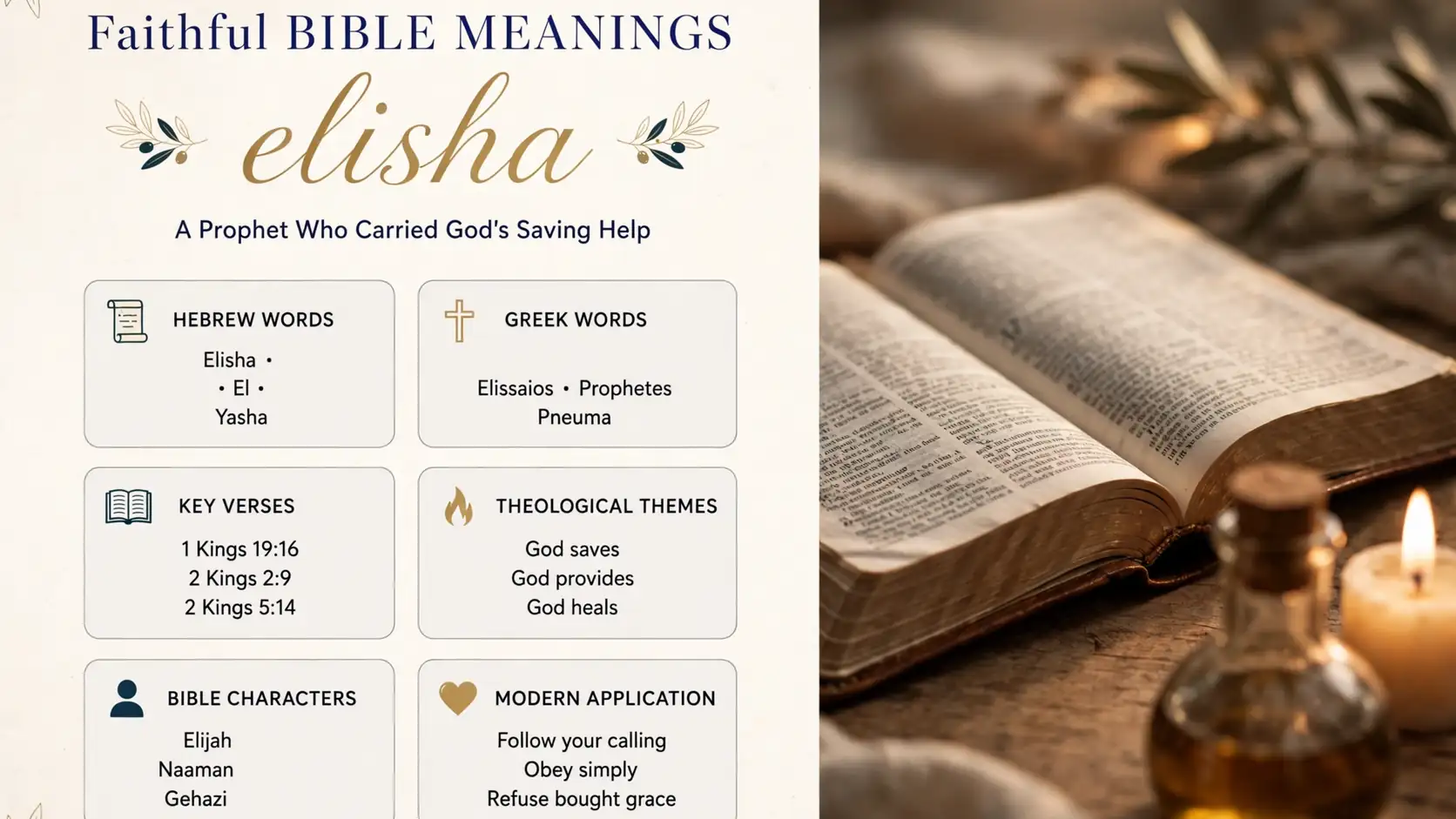
So what does elisha mean in the bible for your study today? It means God is salvation, carried by a man who followed Elijah, received a double share of his spirit, and spent his ministry healing, feeding, warning, and guiding Israel.
Key Scripture References for Elisha
| Verse | Passage Snippet | Context |
|---|---|---|
| 1 Kings 19:16 | Anoint Elisha son of Shaphat as prophet | God gives Elijah his successor at Horeb |
| 1 Kings 19:19 | Elijah throws his mantle on Elisha | Elisha leaves his plowing to follow |
| 1 Kings 19:21 | Elisha slaughters his oxen and follows | A clean break with his old work |
| 2 Kings 2:9 | Let a double portion of your spirit be mine | Elisha asks before Elijah is taken |
| 2 Kings 2:14 | Where is the Lord, the God of Elijah | Elisha parts the Jordan with the mantle |
| 2 Kings 4:3 | Borrow empty vessels from all your neighbors | The widow gathers jars for oil |
| 2 Kings 5:14 | He dipped seven times in the Jordan | Naaman is cleansed from leprosy |
| 2 Kings 6:17 | Open his eyes that he may see | The servant sees fiery horses and chariots |
Bible Translation Comparison for Elisha
| Verse | KJV | NIV | ESV | NASB |
|---|---|---|---|---|
| 1 Kings 19:16 | Elisha the son of Shaphat shalt thou anoint | Anoint Elisha son of Shaphat | Anoint Elisha the son of Shaphat | Anoint Elisha the son of Shaphat |
| 2 Kings 2:9 | A double portion of thy spirit be upon me | Let me inherit a double portion of your spirit | Let there be a double portion of your spirit upon me | Please let a double portion of your spirit be upon me |
| 2 Kings 2:14 | Where is the LORD God of Elijah | Where now is the LORD, the God of Elijah | Where is the LORD, the God of Elijah | Where is the LORD, the God of Elijah |
| 2 Kings 4:7 | Sell the oil, and pay thy debt | Sell the oil and pay your debts | Sell the oil and pay your debts | Sell the oil and pay your debt |
| 2 Kings 5:14 | His flesh came again like a child | His flesh was restored like that of a young boy | His flesh was restored like the flesh of a little child | His flesh was restored like the flesh of a little child |
| 2 Kings 6:17 | LORD, open his eyes, that he may see | Open his eyes, LORD, so that he may see | O LORD, please open his eyes that he may see | Please, LORD, open his eyes so that he may see |
| Luke 4:27 | Many lepers were in Israel in the time of Eliseus | There were many in Israel with leprosy in the time of Elisha | Many lepers were in Israel in the time of the prophet Elisha | Many lepers were in Israel in the time of Elisha the prophet |
| 2 Kings 4:35 | The child sneezed seven times | The child sneezed seven times | The child sneezed seven times | The child sneezed seven times |
People and Characters Associated with Elisha
| Person | Role | Connection |
|---|---|---|
| Elijah | Prophet and mentor | Calls Elisha and passes on the mantle |
| Shaphat | Father of Elisha | Elisha is named as his son at Abel Meholah |
| The widow | Poor debtor in Israel | Elisha multiplies her oil to save her sons |
| The Shunammite woman | Wealthy host | Elisha promises her a son and later raises him |
| Naaman | Syrian army commander | Elisha sends him to wash in the Jordan |
| Gehazi | Servant of Elisha | His greed brings leprosy on himself |
| The king of Israel | Ruler in Samaria | Elisha warns him of Aramean raids |
| Joash | King of Israel | Elisha blesses his arrows before his death |
Original Hebrew and Greek Words for Elisha
| Original Word | Transliteration | Strong’s # | Literal Meaning |
|---|---|---|---|
| אֱלִישָׁע | Elisha | H477 | God is salvation |
| אֵל | El | H410 | God, mighty one |
| יָשַׁע | Yasha | H3467 | To save, to deliver |
| נָבִיא | Navi | H5030 | Prophet, spokesperson |
| אַדֶּרֶת | Adderet | H155 | Mantle, cloak |
| Ἐλισσαῖος | Elissaios | G1666 | Elisha, Greek form of the name |
| προφήτης | Prophetes | G4396 | Prophet, one who speaks forth |
| πνεῦμα | Pneuma | G4151 | Spirit, wind, breath |
Related Biblical Concepts for Elisha
| Concept | Connection | Supporting Verse |
|---|---|---|
| Succession | Elisha carries on the work of Elijah | 2 Kings 2:15 |
| Double portion | A firstborn share of prophetic spirit | 2 Kings 2:9 |
| Healing | God cleanses Naaman through a simple act | 2 Kings 5:14 |
| Provision | Oil fills every vessel the widow gathers | 2 Kings 4:6 |
| Resurrection | A dead boy and a dead man live again | 2 Kings 4:35 |
| Sight | The servant sees the army of fire | 2 Kings 6:17 |
| Mercy to enemies | Captured soldiers are fed and sent home | 2 Kings 6:22 |
| Judgment | Greed and idolatry still meet consequences | 2 Kings 5:27 |
Historical and Cultural Context for Elisha
| Aspect | Detail | Biblical Source |
|---|---|---|
| Time | Ninth century before Christ, divided kingdom | 1 Kings 19:16 |
| Place | Abel Meholah, Gilgal, Bethel, Jericho, Samaria | 1 Kings 19:16 |
| Kings | Ahab, Jehoram, Jehu, Jehoahaz, Joash | 2 Kings 3:11 |
| Enemy | Aram, based at Damascus, raids Israel | 2 Kings 6:8 |
| Baal worship | Elijah and Elisha confront Baal devotion | 1 Kings 19:18 |
| Prophetic schools | Groups of prophets live at several towns | 2 Kings 2:3 |
| Farming life | Elisha plows with twelve yoke of oxen | 1 Kings 19:19 |
| Debt slavery | A widow fears her sons will be taken | 2 Kings 4:1 |
Theological Themes for Elisha
| Theme | Explanation | Scripture |
|---|---|---|
| God saves | The name Elisha declares salvation belongs to God | 1 Kings 19:16 |
| God provides | Small supplies become enough in faithful hands | 2 Kings 4:7 |
| God heals | Cleansing comes by obedience, not by payment | 2 Kings 5:14 |
| God sees | The unseen host outnumbers the visible army | 2 Kings 6:17 |
| God raises the dead | Life returns at the word and touch of God | 2 Kings 4:35 |
| Grace reaches outsiders | Naaman, a Syrian, finds cleansing in Israel | 2 Kings 5:15 |
| Sin bears fruit | Gehazi takes a gift and takes leprosy too | 2 Kings 5:27 |
| Faithful succession | God’s work continues after one servant dies | 2 Kings 2:15 |
Modern Application for Believers from Elisha
| Area | Practice | Scripture |
|---|---|---|
| Calling | Leave lesser work when God calls you clearly | 1 Kings 19:21 |
| Mentoring | Learn closely from faithful servants before you | 2 Kings 2:9 |
| Generosity | Use what you have, even a jar of oil | 2 Kings 4:2 |
| Hospitality | Welcome God’s servants into your home | 2 Kings 4:10 |
| Obedience | Do the simple, humbling thing God asks | 2 Kings 5:14 |
| Prayer | Ask God to open eyes in fearful times | 2 Kings 6:17 |
| Mercy | Feed enemies rather than repay their raids | 2 Kings 6:22 |
| Integrity | Refuse gifts that trade on God’s free grace | 2 Kings 5:16 |
Elisha and the Mantle of Elijah
Elisha first appears as a farmer, not as a court prophet. He is plowing when Elijah casts his mantle over him. The gesture names him as successor, and Elisha answers with a feast and a clean break from his farm.
The mantle returns at the Jordan when Elijah is taken up. Elisha strikes the water and asks where the Lord, the God of Elijah, is now. The river parts, and the prophets at Jericho recognize Elijah’s spirit on Elisha. His ministry begins where his mentor’s ended.
What Does Elisha Mean in the Bible for the Name Itself
The name Elisha joins El, God, with a form of the verb to save. It can be read as God is salvation, or my God is salvation. That meaning fits a prophet whose deeds so often bring rescue to the lowly, the indebted, the sick, and the besieged. He does not save by his own power, and he never takes payment for what God gives freely.
Luke keeps the name alive in the New Testament when Jesus names Elisha in the synagogue at Nazareth. Jesus recalls that many lepers lived in Israel in the time of Elisha, yet only Naaman the Syrian was cleansed. The point stings his hearers, because grace reaches beyond expected borders.
Elisha and the God Who Works in Ordinary Homes
Many of Elisha’s miracles happen in kitchens and bedrooms rather than on mountaintops. A widow pours oil until every borrowed jar is full. A Shunammite woman loses her son and finds him alive again. A pot of stew is made safe, an axe head floats, and a starving city hears food will be cheap by tomorrow.
These stories show a God who cares about debts, meals, tools, and children. Elisha also moves in war, blinding an army and advising kings, yet he never turns his gift into revenge. When captured soldiers stand helpless in Samaria, he tells the king to feed them and send them home.
Elisha and the End of a Long Ministry
Elisha serves through several kings and dies in old age under Joash. On his deathbed he still speaks to the king about arrows and victory. His last act in the text is not even his own, for a dead man thrown into his grave revives at his bones.
That closing scene sums up the whole story. God worked through Elisha in life, and his memory carried life even after death. For your study, Elisha invites you to trust the God who saves in small rooms and in national crises, and to pass on what you received.
Frequently Asked Questions About Elisha
Does the name Elisha really mean God is salvation?
Yes, the Hebrew name joins El, God, with a form of yasha, to save, so it reads as God is salvation.
Why did Elisha ask for a double portion of Elijah’s spirit?
He asked for the firstborn share of a prophet’s inheritance, so he could carry on Elijah’s work with full authority.
Is the Greek form Elissaios the same person as the Hebrew Elisha?
Yes, Elissaios in Luke 4:27 is the Greek form of the same prophet from 2 Kings.
Why did Elisha refuse Naaman’s gifts after healing him?
He refused payment to show that God’s cleansing was free grace, not a service bought with silver and garments.
Does Elisha’s story teach that miracles replace ordinary obedience?
No, his miracles often follow simple obedience, like washing seven times, gathering jars, or feeding enemies.