
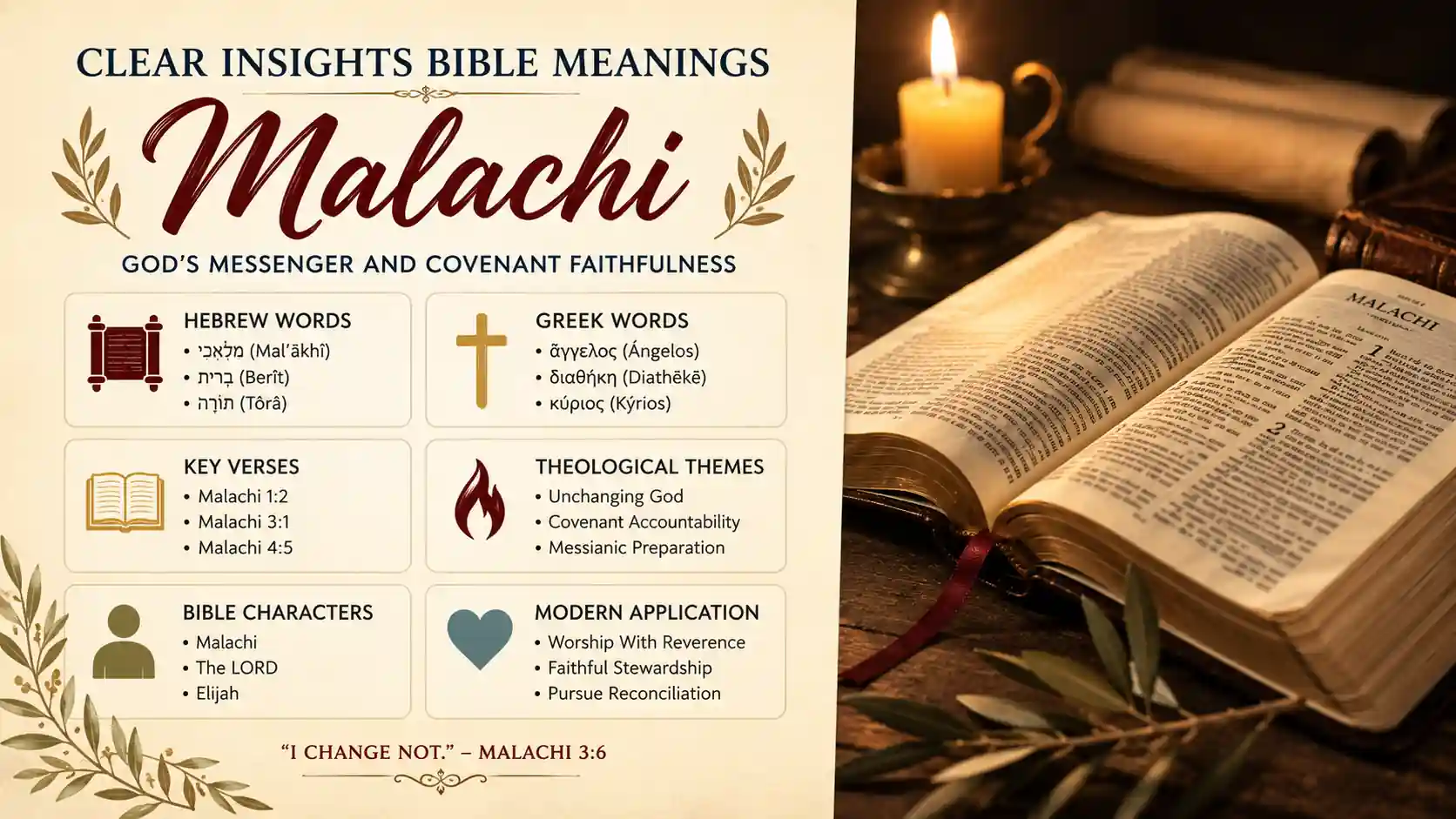
What does Malachi mean in the Bible? The name Malachi comes from the Hebrew מַלְאָכִי, Malʾākhî, meaning “my messenger.” It identifies the prophetic voice through whom God addressed Judah after the exile, when the temple had been rebuilt but spiritual devotion had grown weak.
As you study Malachi, you encounter more than a definition of a name. You hear the Lord confronting careless worship, corrupt leadership, broken covenants, social injustice, and religious cynicism while promising purification, covenant faithfulness, and the coming messenger who would prepare the way for the Lord.
Key Malachi Scripture References
| Verse | Passage Snippet | Context |
|---|---|---|
| Malachi 1:1 | “The burden of the word” | Opening prophetic announcement to Israel |
| Malachi 1:2 | “I have loved you” | God answers doubts about His covenant love |
| Malachi 1:6 | “Where is mine honour?” | Priests are confronted for dishonoring God |
| Malachi 1:11 | “My name shall be great” | Pure worship among the nations is foretold |
| Malachi 2:7 | “Messenger of the LORD” | Priests should preserve and teach knowledge |
| Malachi 2:10 | “Hath not one God created us?” | Covenant betrayal damages the whole community |
| Malachi 3:1 | “I will send my messenger” | A forerunner prepares the Lord’s way |
| Malachi 3:6 | “I change not” | Israel’s survival rests on God’s constancy |
| Malachi 3:10 | “Bring ye all the tithes” | The people are called to renewed faithfulness |
| Malachi 4:5 | “Elijah the prophet” | Elijah’s ministry precedes the day of the Lord |
Malachi Bible Translation Comparison
| Verse | KJV | NIV | ESV | NASB |
|---|---|---|---|---|
| Malachi 1:1 | “by Malachi” | “through Malachi” | “by Malachi” | “through Malachi” |
| Malachi 1:2 | “I have loved you” | “I have loved you” | “I have loved you” | “I have loved you” |
| Malachi 1:6 | “despiseth my name” | “show contempt” | “despise my name” | “despise My name” |
| Malachi 2:7 | “messenger of the LORD” | “messenger of the LORD” | “messenger of the LORD” | “messenger of the LORD” |
| Malachi 3:1 | “my messenger” | “my messenger” | “my messenger” | “My messenger” |
| Malachi 3:6 | “I change not” | “I the LORD do not change” | “I the LORD do not change” | “I, the LORD, do not change” |
| Malachi 3:10 | “all the tithes” | “the whole tithe” | “the full tithe” | “the whole tithe” |
| Malachi 3:16 | “book of remembrance” | “scroll of remembrance” | “book of remembrance” | “book of remembrance” |
| Malachi 4:2 | “Sun of righteousness” | “sun of righteousness” | “sun of righteousness” | “sun of righteousness” |
| Malachi 4:5 | “Elijah the prophet” | “the prophet Elijah” | “Elijah the prophet” | “Elijah the prophet” |
People and Characters Associated with Malachi
| Person | Role | Connection |
|---|---|---|
| Malachi | Postexilic prophet | Delivered God’s covenant accusations and promises |
| The LORD | Covenant God of Israel | Speaks throughout nearly the entire book |
| Jacob | Patriarch of Israel | Represents the people God chose and loved |
| Esau | Jacob’s brother | Represents Edom under divine judgment |
| Levi | Tribal ancestor of priests | His covenant models faithful priestly service |
| Corrupt priests | Temple leaders | Offered polluted sacrifices and taught carelessly |
| Judah’s husbands | Covenant offenders | Acted faithlessly toward wives and God |
| Moses | Lawgiver | His Torah is remembered in Malachi 4:4 |
| Elijah | Prophet and reformer | Promised before the great day of the Lord |
| John the Baptist | New Testament forerunner | Fulfills the messenger pattern of Malachi 3:1 |
Original Hebrew and Greek Words in Malachi
| Original Word | Transliteration | Strong’s # | Literal Meaning |
|---|---|---|---|
| מַלְאָכִי | Malʾākhî | H4401 | My messenger |
| מַלְאָךְ | malʾākh | H4397 | Messenger, angel |
| יְהוָה | YHWH | H3068 | The LORD, covenant name |
| בְּרִית | berît | H1285 | Covenant |
| תּוֹרָה | tôrâ | H8451 | Instruction, law |
| מַעֲשֵׂר | maʿăśēr | H4643 | Tenth part, tithe |
| ἄγγελος | angelos | G32 | Messenger, angel |
| διαθήκη | diathēkē | G1242 | Covenant, testament |
| Ἠλίας | Ēlias | G2243 | Elijah |
| κύριος | kyrios | G2962 | Lord, master |
Related Malachi Biblical Concepts
| Concept | Connection | Supporting Verse |
|---|---|---|
| Covenant love | God’s election is grounded in faithful love | Malachi 1:2 |
| Holy worship | God rejects polluted and careless offerings | Malachi 1:7 |
| Reverence | God’s name deserves fear and honor | Malachi 1:14 |
| Priestly instruction | Spiritual leaders must guard true knowledge | Malachi 2:7 |
| Marriage covenant | Marital betrayal is covenant unfaithfulness | Malachi 2:14 |
| Divine justice | God will judge sorcery, oppression, and fraud | Malachi 3:5 |
| Repentance | Returning to God precedes restored fellowship | Malachi 3:7 |
| Stewardship | Tithes reveal trust and covenant responsibility | Malachi 3:10 |
| Remembrance | God recognizes those who fear His name | Malachi 3:16 |
| Day of the Lord | Final judgment separates wicked and righteous | Malachi 4:1 |
Historical and Cultural Context of Malachi
| Aspect | Detail | Biblical Source |
|---|---|---|
| Historical era | Persian-period Judah after the exile | Malachi 1:1 |
| Temple setting | Sacrifices had resumed in Jerusalem | Malachi 1:7 |
| Spiritual condition | Worship continued without wholehearted reverence | Malachi 1:6 |
| Priesthood | Priests accepted defective animals | Malachi 1:8 |
| Agriculture | Crops suffered from pests and poor yield | Malachi 3:11 |
| Economy | Tithes and offerings were being withheld | Malachi 3:8 |
| Family life | Divorce and intermarriage threatened covenant identity | Malachi 2:11-16 |
| Public justice | Laborers, widows, and foreigners faced oppression | Malachi 3:5 |
| Prophetic method | Disputations answer the people’s objections | Malachi 1:2 |
| Future expectation | A messenger and the Lord’s coming are promised | Malachi 3:1 |
Theological Themes in Malachi
| Theme | Explanation | Scripture |
|---|---|---|
| Unchanging God | God’s nature and covenant purpose remain dependable | Malachi 3:6 |
| Electing love | Israel’s story begins with God’s gracious choice | Malachi 1:2-3 |
| Holiness of God | God refuses worship that treats Him as common | Malachi 1:10 |
| Universal kingship | God’s name will be honored among all nations | Malachi 1:11 |
| Covenant accountability | Privilege brings responsibility before God | Malachi 2:4 |
| Purification | The coming Lord refines His servants | Malachi 3:2-3 |
| Righteous judgment | God distinguishes faithful people from evildoers | Malachi 3:18 |
| Messianic preparation | A messenger prepares for the Lord’s arrival | Malachi 3:1 |
| Remnant faithfulness | God treasures those who fear and remember Him | Malachi 3:16-17 |
| Restoration | Elijah’s mission turns hearts toward reconciliation | Malachi 4:6 |
Modern Application from Malachi for Believers
| Area | Practice | Scripture |
|---|---|---|
| Worship | Give God your best rather than leftovers | Malachi 1:8 |
| Leadership | Teach truth with integrity and reverence | Malachi 2:6-7 |
| Marriage | Honor promises made before God | Malachi 2:14 |
| Repentance | Return honestly when God exposes sin | Malachi 3:7 |
| Finances | Practice generous and faithful stewardship | Malachi 3:10 |
| Justice | Protect workers, widows, orphans, and foreigners | Malachi 3:5 |
| Speech | Refuse cynical words about serving God | Malachi 3:13-14 |
| Fellowship | Encourage believers to fear the Lord together | Malachi 3:16 |
| Hope | Await God’s justice without becoming bitter | Malachi 4:1-2 |
| Family | Pursue reconciliation across generations | Malachi 4:6 |
מַלְאָכִי And the Meaning of Malachi’S Name
The Hebrew name מַלְאָכִי, Malʾākhî, is commonly understood as “my messenger.” It is closely related to מַלְאָךְ, malʾākh, the ordinary Hebrew word for a messenger. Depending on context, malʾākh may describe a human envoy, a prophetic representative, or an angelic servant sent by God.
Scholars have discussed whether Malachi is the prophet’s personal name or a descriptive title. Malachi 1:1 presents it as the designation of the person through whom the oracle came. Even if the name carries a vocational emphasis, the text gives you no solid reason to identify the prophet with Ezra or another known figure.
What Does Malachi Mean in the Bible’S Postexilic Setting?
Malachi ministered in Judah after the Babylonian exile and after temple worship had been restored. The people possessed an altar, priests, sacrifices, and the Torah, yet their spiritual weariness showed that outward religious structures could not produce inward covenant faithfulness.
The book likely reflects conditions similar to those confronted by Ezra and Nehemiah. Priestly negligence, mixed marriages, divorce, economic injustice, and neglect of contributions all appear in that broader period. Malachi speaks into disappointment because the restored community had not yet experienced the fullness of prophetic hope.
בְּרִית In Malachi and the Seriousness of Covenant Faithfulness
The Hebrew word בְּרִית, berît, means “covenant.” Malachi refers to God’s covenant with Levi, the marriage covenant, and the coming “messenger of the covenant.” These references show that faithfulness to God cannot be separated from truthful teaching, honorable worship, marital loyalty, and just treatment of neighbors.
Malachi’s warnings are severe because covenant sin misrepresents God’s character. A priest who corrupts instruction, a husband who betrays his wife, or an employer who exploits a worker does more than break a private rule. Such behavior denies the faithful Lord whom Israel was called to represent.
The Messenger of Malachi 3 and the Coming Day of the Lord
Malachi 3:1 contains a deliberate messenger pattern. God first announces “my messenger,” who prepares the way. Then “the Lord” comes to His temple, followed by the mysterious “messenger of the covenant.” The New Testament applies the preparatory language to John the Baptist, whose ministry called Israel to repentance before Jesus appeared publicly.
The prophecy includes comfort and warning. The Lord’s coming brings purification like a refiner’s fire and cleansing like a launderer’s soap. Malachi therefore prepares you to understand Christ not only as a gentle comforter, but also as the holy Lord who exposes sin, purifies worship, judges evil, and preserves a faithful people.
Questions Bible Students Ask About Malachi
Does מַלְאָכִי mean that Malachi was an angel?
No. The name means “my messenger,” but the book presents Malachi as the human bearer of a prophetic oracle.
Why do some readers question whether Malachi was the prophet’s personal name?
Because מַלְאָכִי can function descriptively, yet Malachi 1:1 naturally uses it as the prophet’s identifying designation.
Who is “my messenger” in Malachi 3:1?
The New Testament identifies the preparatory messenger pattern with John the Baptist, who prepared the way for Jesus.
Is the “Sun of righteousness” in Malachi 4:2 directly a title for Christ?
The image first promises healing and vindication from God, though Christians have long recognized its fitting fulfillment in Christ.
Does Malachi 3:10 promise that every faithful giver will become wealthy?
No. It addresses Israel’s covenant obligations and God’s care, not a universal guarantee of personal financial riches.