
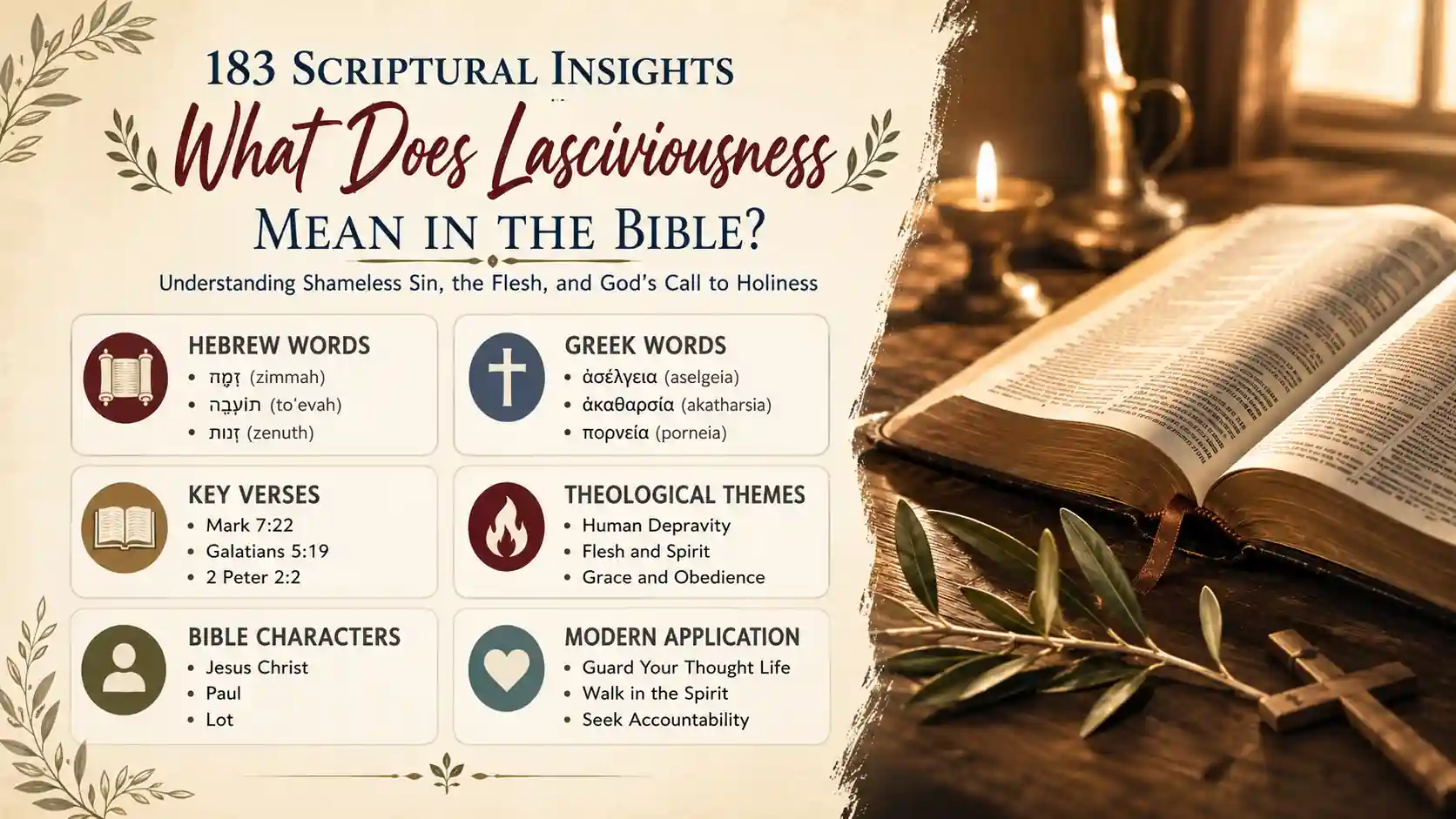
What does lasciviousness mean in the Bible? In Scripture, the word describes shameless, uncontrolled behavior that rejects God’s moral boundaries. It often includes sexual immorality, but its meaning is broader than sexual desire alone. Lasciviousness is appetite without restraint, sin practiced openly, and conduct that no longer feels shame before God or neighbor.
Your study should therefore examine not only outward actions but also the hardened heart beneath them. Scripture contrasts lasciviousness with repentance, holiness, self-control, love, and life under the direction of the Holy Spirit.
Lasciviousness Key Scripture References
| Verse | Passage Snippet | Context |
|---|---|---|
| Mark 7:22 | “Lasciviousness” comes from within | Jesus identifies heart-born defilement |
| Romans 13:13 | Not in “chambering and wantonness” | Believers must walk honorably |
| 2 Corinthians 12:21 | Uncleanness, fornication, lasciviousness | Paul fears continued Corinthian sin |
| Galatians 5:19 | A manifest work of the flesh | Contrasted with the Spirit’s fruit |
| Ephesians 4:19 | “Given themselves over” to it | Gentile hardness produces moral excess |
| 1 Peter 4:3 | Former life of lasciviousness | Converts leave pagan behavior behind |
| 2 Peter 2:2 | Many follow destructive sensuality | False teachers disgrace the truth |
| 2 Peter 2:7 | Lot was distressed by lawless conduct | Sodom illustrates public corruption |
| 2 Peter 2:18 | Fleshly desires entice the unstable | False teachers exploit new believers |
| Jude 4 | Grace turned into lasciviousness | Deceivers use grace to excuse sin |
Lasciviousness Bible Translation Comparison
| Verse | KJV | NIV | ESV | NASB |
|---|---|---|---|---|
| Mark 7:22 | Lasciviousness | Lewdness | Sensuality | Sensuality |
| Romans 13:13 | Wantonness | Sexual immorality | Sensuality | Sexual promiscuity |
| 2 Corinthians 12:21 | Lasciviousness | Debauchery | Sensuality | Indecent behavior |
| Galatians 5:19 | Lasciviousness | Debauchery | Sensuality | Indecent behavior |
| Ephesians 4:19 | Lasciviousness | Sensuality | Sensuality | Indecent behavior |
| 1 Peter 4:3 | Lasciviousness | Debauchery | Sensuality | Indecent behavior |
| 2 Peter 2:2 | Pernicious ways | Depraved conduct | Sensuality | Shameful ways |
| 2 Peter 2:7 | Filthy conversation | Depraved conduct | Sensual conduct | Sensual conduct |
| 2 Peter 2:18 | Wantonness | Lustful desires | Sensual passions | Sensuality |
| Jude 4 | Lasciviousness | License for immorality | Sensuality | Indecent behavior |
People and Characters Associated with Lasciviousness
| Person | Role | Connection |
|---|---|---|
| Jesus Christ | Teacher and Lord | Traces lasciviousness to the heart |
| Paul | Apostle to the Gentiles | Calls it a work of the flesh |
| Peter | Apostle and letter writer | Warns against sensual false teachers |
| Jude | Servant of Jesus Christ | Condemns abuse of divine grace |
| Lot | Resident of Sodom | Grieved by shameless lawlessness |
| Corinthian offenders | Church members needing repentance | Continued in impurity and sensuality |
| Ephesian Gentiles | Picture of the former pagan life | Surrendered themselves to excess |
| False teachers | Corrupt religious influencers | Enticed others through fleshly passions |
| Sodom’s inhabitants | Example of public wickedness | Practiced defiant, lawless conduct |
| Gentile converts | Redeemed believers | Called to abandon their former lifestyle |
Lasciviousness Original Hebrew and Greek Words
| Original Word | Transliteration | Strong’s # | Literal Meaning |
|---|---|---|---|
| ἀσέλγεια | aselgeia | G766 | Sensuality, shameless excess |
| ἀκαθαρσία | akatharsia | G167 | Uncleanness, moral impurity |
| πορνεία | porneia | G4202 | Sexual immorality |
| ἐπιθυμία | epithymia | G1939 | Strong craving or lust |
| πλεονεξία | pleonexia | G4124 | Greed, desire for more |
| זִמָּה | zimmah | H2154 | Wicked scheme or lewdness |
| תּוֹעֵבָה | toʿevah | H8441 | Detestable or abominable act |
| זְנוּת | zenuth | H2183 | Harlotry or unfaithfulness |
| טָמֵא | tame | H2930 | To become unclean |
| נָאַף | naʾaph | H5003 | To commit adultery |
Lasciviousness and Related Biblical Concepts
| Concept | Connection | Supporting Verse |
|---|---|---|
| Sexual immorality | Common expression of unrestrained desire | Galatians 5:19 |
| Moral uncleanness | Lasciviousness defiles conduct | Ephesians 4:19 |
| Hardness of heart | Insensitivity permits shameless sin | Ephesians 4:18–19 |
| Greed | Appetite seeks continual satisfaction | Ephesians 4:19 |
| Drunkenness | Intoxication weakens restraint | 1 Peter 4:3 |
| Revelry | Public excess encourages corruption | Romans 13:13 |
| False teaching | Error can legitimize sensual behavior | Jude 4 |
| Lawlessness | God’s boundaries are openly rejected | 2 Peter 2:7 |
| Self-control | Spirit-produced restraint opposes excess | Galatians 5:22–23 |
| Holiness | God calls believers away from impurity | 1 Thessalonians 4:7 |
Lasciviousness Historical and Cultural Context
| Aspect | Detail | Biblical Source |
|---|---|---|
| Greco-Roman cities | Sexual excess was publicly visible | Romans 13:13 |
| Pagan worship | Idolatry could accompany drunken feasts | 1 Peter 4:3 |
| Banquet culture | Revelry encouraged intoxication and lust | Romans 13:13 |
| Corinth | The church faced persistent impurity | 2 Corinthians 12:21 |
| Ephesus | Converts left hardened Gentile practices | Ephesians 4:17–24 |
| Asia Minor | False teachers targeted Christian communities | 2 Peter 2 |
| Sodom | Lawlessness became socially entrenched | 2 Peter 2:6–8 |
| Honor and shame | ἀσέλγεια implied loss of moral shame | Mark 7:22 |
| Household ethics | Believers were to live visibly honorable lives | 1 Peter 2:12 |
| Early church discipline | Unrepentant immorality required correction | 1 Corinthians 5 |
Lasciviousness Theological Themes
| Theme | Explanation | Scripture |
|---|---|---|
| Human depravity | Evil behavior proceeds from the heart | Mark 7:21–23 |
| Flesh and Spirit | Lasciviousness belongs to fallen desire | Galatians 5:16–19 |
| Repentance | Past sensuality must be abandoned | 2 Corinthians 12:21 |
| Sanctification | God renews conduct and understanding | Ephesians 4:22–24 |
| Grace and obedience | Grace never authorizes immorality | Jude 4 |
| Kingdom inheritance | Persistent fleshly living brings warning | Galatians 5:21 |
| Christian witness | Sensual sin dishonors the way of truth | 2 Peter 2:2 |
| Divine judgment | God judges proud, unrepentant excess | 2 Peter 2:6 |
| Spiritual freedom | Freedom serves love, not the flesh | Galatians 5:13 |
| Union with Christ | Believers put on Christ rather than lust | Romans 13:14 |
Lasciviousness Modern Application for Believers
| Area | Practice | Scripture |
|---|---|---|
| Thought life | Reject fantasies that cultivate impurity | Philippians 4:8 |
| Entertainment | Refuse content that celebrates shamelessness | Ephesians 5:11 |
| Dating | Treat another person with holiness and honor | 1 Thessalonians 4:3–5 |
| Marriage | Practice fidelity and mutual honor | Hebrews 13:4 |
| Clothing | Choose modesty without pride or provocation | 1 Timothy 2:9–10 |
| Speech | Avoid crude and corrupt conversation | Ephesians 5:4 |
| Digital habits | Remove repeated sources of temptation | Matthew 5:29–30 |
| Accountability | Confess sin and seek faithful support | James 5:16 |
| Church teaching | Reject messages that excuse immorality | Jude 3–4 |
| Spiritual growth | Walk by the Spirit in daily choices | Galatians 5:16 |
What Does Lasciviousness Mean in the Bible Through ἀσέλγεια?
The principal New Testament word is ἀσέλγεια, transliterated aselgeia and numbered G766 in Strong’s Concordance. It describes licentiousness, sensuality, shameless conduct, and unrestrained indulgence. The emphasis is not merely on experiencing temptation but on yielding to appetite without respect for God’s authority or another person’s dignity.
This explains why modern translations use several English terms. “Sensuality” emphasizes domination by bodily appetite, “debauchery” suggests ruinous excess, and “indecent behavior” highlights conduct that violates moral boundaries. The older word “lasciviousness” carries all these ideas when understood in its biblical setting.
Jesus Locates ἀσέλγεια within the Human Heart
In Mark 7:20–23, Jesus teaches that lasciviousness proceeds “from within, out of the heart.” His point confronts any attempt to treat the sin as merely a product of clothing, culture, opportunity, or another person’s influence. External circumstances may tempt you, but sinful consent arises within the moral center of the person.
This teaching also protects your study from reducing lasciviousness to outward appearance. Scripture is concerned with intentions, desires, decisions, and actions. A person can appear respectable while secretly nurturing corrupt cravings, just as another person may be unfairly judged by human traditions rather than God’s revealed standard.
Paul Contrasts Lasciviousness with the Spirit’S Fruit
Galatians 5 places ἀσέλγεια among the works of the flesh. “Flesh” in this context means fallen human nature acting independently of God, not the physical body as though the body were inherently evil. Lasciviousness reveals what happens when desire refuses the loving government of the Holy Spirit.
Paul’s answer is not mere willpower. You are commanded to walk by the Spirit, belong to Christ, and crucify the flesh with its passions and desires. The Spirit forms love, faithfulness, gentleness, and self-control, qualities that directly oppose using people for gratification or treating freedom as permission to sin.
Ephesians 4 adds another sobering dimension. People who become “past feeling” give themselves over to sensuality with greediness. Repeated sin can dull moral sensitivity, making yesterday’s shame tomorrow’s habit. Renewal begins as you learn Christ, put away the former manner of life, and receive a renewed mind.
Jude’S Warning Against Turning Grace into Lasciviousness
Jude 4 addresses teachers who turned God’s grace into lasciviousness. Their error was theological as well as behavioral. They treated mercy as permission to reject Christ’s lordship, separating forgiveness from repentance and salvation from a transformed life.
Biblical grace does not mean that sin is harmless. Grace pardons the guilty, trains believers to renounce ungodliness, and restores those who repent. You do not overcome lasciviousness by hiding from God, but by bringing sin into his light, trusting Christ’s cleansing, and accepting the Spirit’s call to obedient change.
Peter gives a similar warning about teachers who enticed others through sensual passions. Their conduct harmed both vulnerable people and the reputation of the gospel. Sound doctrine must therefore be measured not only by eloquence but also by its view of Christ, holiness, accountability, and the treatment of others.
Questions About Lasciviousness in Scripture
Is ἀσέλγεια limited to sexual sin?
No. It often includes sexual misconduct, but it more broadly describes shameless, unrestrained, and defiant excess.
Why does the KJV say “lasciviousness” while the NIV says “debauchery”?
Both translate ἀσέλγεια, with the KJV preserving an older term and the NIV emphasizing corrupt, excessive behavior.
Does Galatians 5:19 teach that one failure permanently excludes you from God’s kingdom?
Paul warns against an unrepentant pattern ruled by the flesh, not a repentant believer’s isolated failure and return to Christ.
How does the Hebrew word זִמָּה relate to lasciviousness?
זִמָּה, zimmah, describes a wicked plan or lewd purpose and supplies an Old Testament parallel to deliberate moral corruption.
How can you resist lasciviousness without becoming legalistic?
Walk by the Spirit, receive God’s boundaries as loving wisdom, practice accountability, and pursue holiness from faith rather than self-righteousness.