
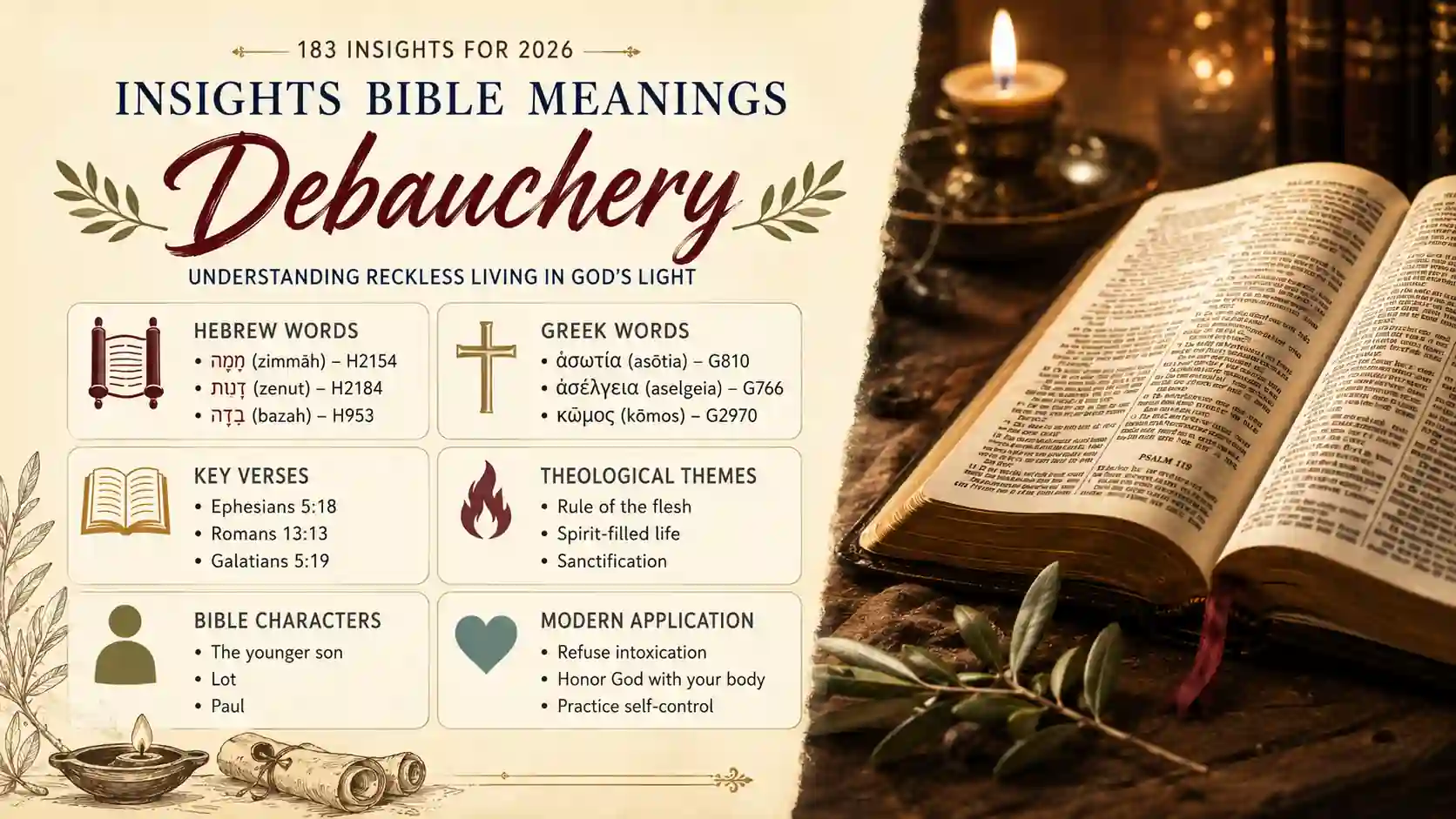
What does debauchery mean in the Bible? Scripture uses the term for a life of reckless excess that rejects God’s moral boundaries. It can include drunkenness, sexual immorality, shameless sensuality, wild partying, and other conduct ruled by appetite rather than wisdom.
The biblical idea is broader than one isolated failure. Debauchery describes wasteful, uncontrolled living that resists restraint and dishonors the body, other people, and God. Your study must therefore consider several Hebrew and Greek words, especially ἀσωτία, asōtia, and ἀσέλγεια, aselgeia.
Debauchery Key Scripture References
| Verse | Passage Snippet | Context |
|---|---|---|
| Ephesians 5:18 | “Do not get drunk on wine” | Drunkenness leads to debauchery |
| Romans 13:13 | “Not in sensuality and debauchery” | Believers walk as children of day |
| Galatians 5:19 | “Impurity and sensuality” | Works produced by fallen flesh |
| 1 Peter 4:3 | “Drunkenness, orgies, drinking parties” | Former Gentile manner of life |
| 1 Peter 4:4 | “Flood of debauchery” | Unbelievers resent Christian separation |
| Mark 7:22 | “Sensuality, envy, slander” | Defilement comes from the heart |
| 2 Peter 2:7 | “Sensual conduct of the wicked” | Lot distressed by lawless behavior |
| 2 Peter 2:18 | “Sensual passions of the flesh” | False teachers entice unstable people |
| Jude 4 | “Grace into sensuality” | False teachers misuse Christian liberty |
| Luke 15:13 | “Reckless living” | The younger son wastes his inheritance |
Debauchery Bible Translation Comparison
| Verse | KJV | NIV | ESV | NASB |
|---|---|---|---|---|
| Ephesians 5:18 | excess | debauchery | debauchery | dissipation |
| Romans 13:13 | wantonness | debauchery | sensuality | promiscuity |
| Galatians 5:19 | lasciviousness | debauchery | sensuality | indecent behavior |
| 1 Peter 4:3 | lasciviousness | debauchery | sensuality | indecent behavior |
| 1 Peter 4:4 | excess of riot | flood of debauchery | flood of debauchery | excessive dissipation |
| Mark 7:22 | lasciviousness | lewdness | sensuality | indecent behavior |
| 2 Peter 2:7 | filthy conversation | depraved conduct | sensual conduct | indecent behavior |
| 2 Peter 2:18 | lusts of the flesh | lustful desires | sensual passions | fleshly desires |
| Jude 4 | lasciviousness | license for immorality | sensuality | indecent behavior |
| Luke 15:13 | riotous living | wild living | reckless living | wild living |
Debauchery People and Characters Associated
| Person | Role | Connection |
|---|---|---|
| The younger son | Lost son in Jesus’ parable | Squandered wealth through reckless living |
| Paul | Apostle to the Gentiles | Warned churches against drunken excess |
| Peter | Apostle and pastor | Addressed converts leaving pagan revelry |
| Lot | Resident of Sodom | Distressed by shameless lawlessness |
| Noah | Patriarch after the flood | Drunkenness brought exposure and shame |
| Israelites at Sinai | Covenant nation | Feasted and rose up for corrupt play |
| Belshazzar | Babylonian king | Profaned sacred vessels during a feast |
| Herod Antipas | Galilean ruler | Rash banquet oath led to murder |
| Corinthian offender | Church member | Practiced public sexual immorality |
| False teachers | Corrupt church infiltrators | Used grace to excuse sensual conduct |
Debauchery Original Hebrew and Greek Words
| Original Word | Transliteration | Strong’s # | Literal Meaning |
|---|---|---|---|
| ἀσωτία | asōtia | G810 | Wastefulness, dissipation |
| ἀσώτως | asōtōs | G811 | Recklessly, wastefully |
| ἀσέλγεια | aselgeia | G766 | Sensuality, shameless excess |
| κῶμος | kōmos | G2970 | Revelry, carousing |
| μέθη | methē | G3178 | Drunkenness |
| πορνεία | porneia | G4202 | Sexual immorality |
| ἀκαθαρσία | akatharsia | G167 | Moral impurity |
| ἐπιθυμία | epithymia | G1939 | Strong desire, lust |
| זִמָּה | zimmāh | H2154 | Lewdness, wicked scheme |
| זְנוּת | zenut | H2184 | Harlotry, unfaithfulness |
Debauchery Related Biblical Concepts
| Concept | Connection | Supporting Verse |
|---|---|---|
| Drunkenness | Weakens judgment and self-control | Ephesians 5:18 |
| Sensuality | Pursues desire without shame | Galatians 5:19 |
| Sexual immorality | Misuses God’s gift of sexuality | 1 Corinthians 6:18 |
| Revelry | Turns celebration into disorder | Romans 13:13 |
| Wastefulness | Squanders entrusted gifts | Luke 15:13 |
| Idolatry | Makes appetite a ruling master | Philippians 3:19 |
| Impurity | Corrupts thought and conduct | Ephesians 4:19 |
| Lawlessness | Rejects God’s righteous boundaries | 2 Peter 2:7 |
| Self-control | Opposes uncontrolled indulgence | Galatians 5:23 |
| Sobriety | Keeps the believer spiritually alert | 1 Peter 5:8 |
Debauchery Historical and Cultural Context
| Aspect | Detail | Biblical Source |
|---|---|---|
| Greco-Roman banquets | Heavy drinking could accompany elite feasts | Romans 13:13 |
| Pagan worship | Some gatherings included sensual excess | 1 Peter 4:3 |
| Drinking parties | Social identity formed around intoxication | 1 Peter 4:3 |
| Nighttime revelry | Carousing was associated with darkness | Romans 13:12–13 |
| Symposium culture | Wine gatherings encouraged entertainment and debate | Ephesians 5:18 |
| Roman patronage | Banquets displayed wealth and social rank | 1 Corinthians 11:21 |
| Corinthian immorality | The church faced its city’s sexual permissiveness | 1 Corinthians 6:9–18 |
| Sodom’s corruption | Lawlessness became socially established | 2 Peter 2:6–8 |
| Babylonian feasting | Sacred objects were mocked during drunken celebration | Daniel 5:1–4 |
| Covenant festivals | Worship could be corrupted by idolatrous excess | Exodus 32:6 |
Debauchery Theological Themes
| Theme | Explanation | Scripture |
|---|---|---|
| Rule of the flesh | Fallen desire seeks mastery over conduct | Galatians 5:16–21 |
| Spirit-filled life | The Spirit replaces intoxication’s control | Ephesians 5:18 |
| Human dignity | The body belongs to the Lord | 1 Corinthians 6:13 |
| Sanctification | Grace trains believers to reject passions | Titus 2:11–12 |
| Repentance | Former patterns need not define believers | 1 Peter 4:3 |
| Christian freedom | Liberty must not become license | Jude 4 |
| Kingdom inheritance | Persistent rebellion contradicts kingdom life | Galatians 5:21 |
| Inner defilement | Sinful excess begins within the heart | Mark 7:20–23 |
| Stewardship | God’s gifts must not be squandered | Luke 15:13 |
| Watchfulness | Sobriety prepares believers for faithful service | 1 Peter 5:8 |
Debauchery Modern Application for Believers
| Area | Practice | Scripture |
|---|---|---|
| Alcohol | Refuse intoxication and dependence | Ephesians 5:18 |
| Entertainment | Reject content that celebrates shamelessness | Ephesians 5:11 |
| Sexual conduct | Honor God with your body | 1 Corinthians 6:20 |
| Social gatherings | Practice restraint and consideration | Romans 13:13 |
| Spending | Avoid reckless consumption | Luke 15:13 |
| Private habits | Bring hidden conduct into God’s light | John 3:21 |
| Friendships | Choose companions who encourage wisdom | 1 Corinthians 15:33 |
| Thought life | Direct your mind toward what is pure | Philippians 4:8 |
| Church discipline | Restore serious offenders with humility | Galatians 6:1 |
| Spiritual growth | Cultivate Spirit-given self-control | Galatians 5:22–23 |
What Does Debauchery Mean in the Bible Through ἀσωτία?
The Greek noun ἀσωτία, asōtia, appears in Ephesians 5:18 and 1 Peter 4:4. It means dissipation, wastefulness, or reckless living. The word describes behavior that consumes what is valuable without producing anything worthy. A person ruled by asōtia wastes strength, money, time, relationships, and moral clarity.
This meaning explains its connection with drunkenness. Paul does not teach merely that excessive wine produces unpleasant consequences. He contrasts two controlling powers. Wine can master the mind and lead toward wasteful disorder, but the Holy Spirit forms worship, gratitude, wisdom, and mutual submission.
ἀσέλγεια And the Shameless Character of Debauchery
The Greek word ἀσέλγεια, aselgeia, emphasizes unrestrained and shameless conduct. English translations render it as sensuality, lewdness, licentiousness, indecency, or debauchery. The precise English term varies because aselgeia describes an attitude as well as particular actions.
This is why Jesus includes aselgeia among the evils proceeding from the human heart in Mark 7:22. Debauchery is not only pressure from an immoral culture. Its deeper source is a heart that resents restraint and treats desire as an unquestionable authority.
What Does Debauchery Mean in the Bible’S Covenant Story?
The Old Testament seldom uses the English word “debauchery,” yet it repeatedly condemns the reality. זִמָּה, zimmāh, can describe calculated wickedness, lewdness, or an outrageous act. Israel’s law treated sexual corruption and idolatrous excess as violations of covenant holiness, not merely private lifestyle choices.
The golden calf episode reveals this covenant dimension. Israel combined feasting with idolatry while Moses received God’s commands. Their disorder was serious because a redeemed people behaved as though they belonged to another master. Debauchery contradicts the identity and calling God gives his people.
From Reckless Living to Spirit-Given Self-Control
The younger son in Luke 15 illustrates the wastefulness associated with debauchery. He demands his inheritance, leaves his father’s house, and disperses his resources through ἀσώτως, asōtōs, living. His outward ruin exposes the inward tragedy of seeking freedom apart from the father.
Yet Scripture’s message is not limited to condemnation. The son returns and receives mercy. Likewise, Paul reminds believers that some had once lived in serious sin but were washed, sanctified, and justified. Grace does not rename debauchery as freedom. Grace forgives sinners and teaches them a new manner of life.
Questions About Debauchery in the Bible
Why does Ephesians 5:18 connect drunkenness with ἀσωτία, asōtia?
Because intoxication can surrender sound judgment and lead to wasteful, disorderly living rather than Spirit-directed worship.
Are ἀσωτία, asōtia, and ἀσέλγεια, aselgeia, identical?
No. Asōtia stresses reckless dissipation, while aselgeia stresses shameless, unrestrained sensuality, though their meanings overlap.
Why do translations use “debauchery,” “sensuality,” “lewdness,” and “dissipation” differently?
Each translation highlights a different aspect of broad Greek terms involving excess, moral unrestraint, wastefulness, and public indecency.
Does Romans 13:13 condemn every celebration or social gathering?
No. Paul condemns carousing, drunkenness, sexual sin, and conduct belonging to moral darkness, not joyful fellowship practiced with holiness.
Can a believer who practiced debauchery receive forgiveness?
Yes. Through repentance and faith in Christ, sinners can be washed and transformed, then learn self-control through the Holy Spirit.