
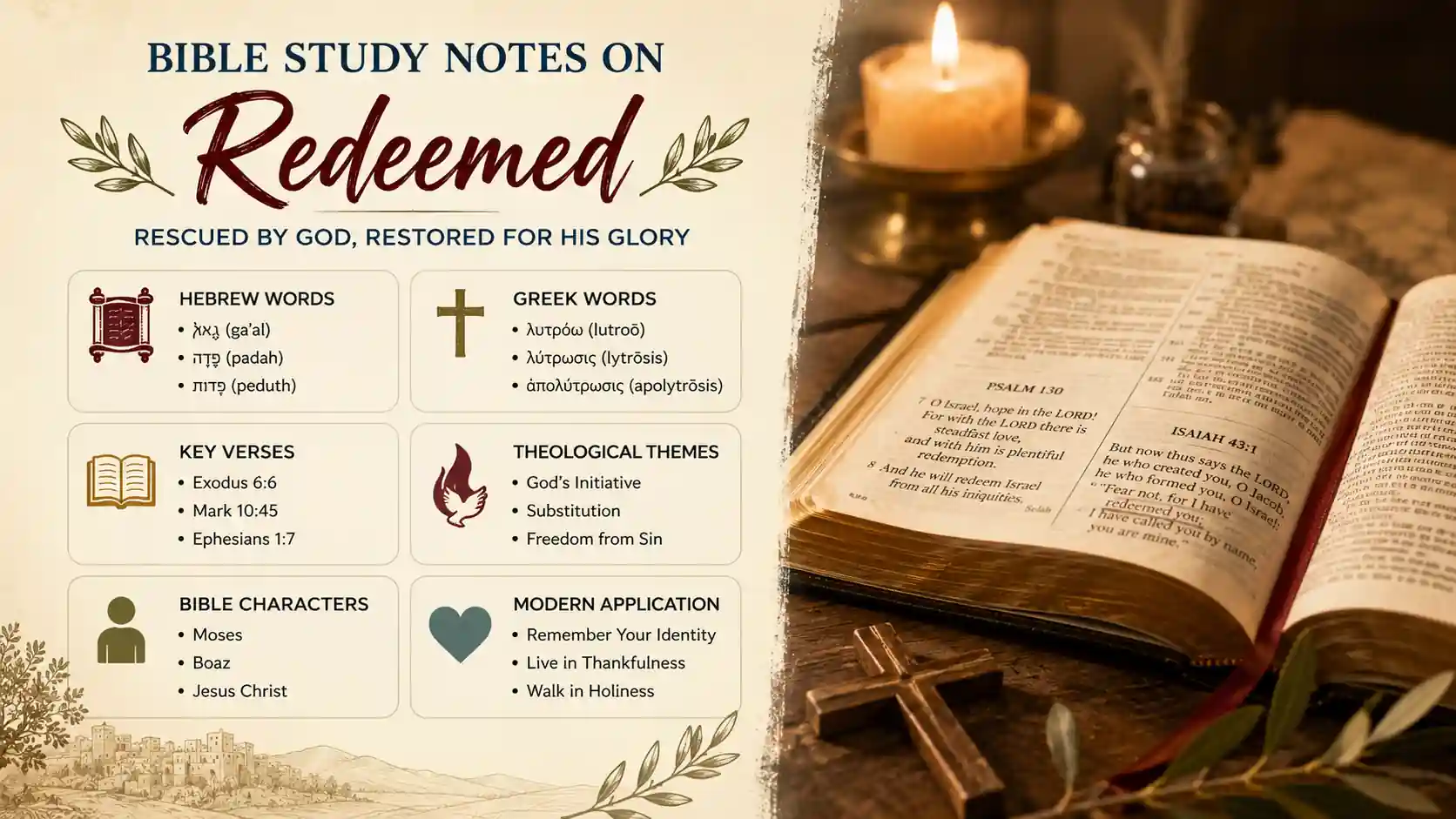
What does redeemed mean in the Bible? To be redeemed is to be rescued from bondage, loss, guilt, or judgment through the action of another who possesses both the right and the power to deliver. Scripture uses the language of family restoration, liberation from slavery, payment of a ransom, and recovery of forfeited property.
In the Old Testament, God redeems Israel and relatives redeem endangered family members. In the New Testament, Jesus gives himself to free sinners from sin, condemnation, and lawlessness, bringing them into God’s covenant people.
Redeemed Key Scripture References
| Verse | Passage Snippet | Context |
|---|---|---|
| Exodus 6:6 | “I will redeem you” | God promises deliverance from Egypt |
| Leviticus 25:25 | “his redeemer shall come” | A kinsman recovers family property |
| Ruth 4:4 | “redeem it” | Boaz discusses Naomi’s land |
| Psalm 130:8 | “redeem Israel” | Hope for release from iniquity |
| Isaiah 43:1 | “I have redeemed you” | God claims Israel as his own |
| Mark 10:45 | “a ransom for many” | Jesus explains his sacrificial mission |
| Galatians 3:13 | “redeemed us from the curse” | Christ bears covenant judgment |
| Ephesians 1:7 | “redemption through his blood” | Forgiveness rests in Christ |
| Titus 2:14 | “redeem us from all lawlessness” | Grace creates a purified people |
| 1 Peter 1:18–19 | “redeemed…with precious blood” | Christ frees believers from empty living |
Redeemed Bible Translation Comparison
| Verse | KJV | NIV | ESV | NASB |
|---|---|---|---|---|
| Exodus 6:6 | “redeem you” | “redeem you” | “redeem you” | “redeem you” |
| Psalm 130:8 | “redeem Israel” | “redeem Israel” | “redeem Israel” | “redeem Israel” |
| Isaiah 43:1 | “redeemed thee” | “redeemed you” | “redeemed you” | “redeemed you” |
| Galatians 3:13 | “redeemed us” | “redeemed us” | “redeemed us” | “redeemed us” |
| Ephesians 1:7 | “we have redemption” | “we have redemption” | “we have redemption” | “we have redemption” |
| Titus 2:14 | “redeem us” | “redeem us” | “redeem us” | “redeem us” |
| 1 Peter 1:18 | “redeemed” | “redeemed” | “ransomed” | “redeemed” |
| Revelation 5:9 | “redeemed us to God” | “purchased for God” | “ransomed people for God” | “purchased for God” |
Redeemed People and Characters Associated
| Person | Role | Connection |
|---|---|---|
| Yahweh | Israel’s divine Redeemer | Rescues Israel from slavery and exile |
| Moses | Deliverance leader | Announces God’s redemption from Egypt |
| Naomi | Impoverished widow | Needs family property and security restored |
| Ruth | Moabite widow | Receives protection through a kinsman-redeemer |
| Boaz | Kinsman-redeemer | Restores land and preserves a family line |
| Job | Suffering worshiper | Confesses that his Redeemer lives |
| David | King and psalmist | Praises God for redeeming life and soul |
| Jesus Christ | Ransom and Redeemer | Gives his life to liberate sinners |
| Paul | Apostle and theologian | Explains redemption through Christ’s blood |
| Believers | Redeemed people | Belong to God and await bodily redemption |
Redeemed Original Hebrew and Greek Words
| Original Word | Transliteration | Strong’s # | Literal Meaning |
|---|---|---|---|
| גָּאַל | ga’al | H1350 | Redeem as a near relative |
| גְּאֻלָּה | ge’ullah | H1353 | Redemption or right of recovery |
| פָּדָה | padah | H6299 | Ransom or release |
| פְּדוּת | peduth | H6304 | Redemption or deliverance |
| פִּדְיוֹם | pidyom | H6306 | Ransom price |
| כֹּפֶר | kopher | H3724 | Ransom or covering payment |
| λυτρόω | lutroō | G3084 | Release by paying a ransom |
| λύτρωσις | lytrōsis | G3085 | Ransoming or liberation |
| ἀπολύτρωσις | apolytrōsis | G629 | Release through ransom |
| ἐξαγοράζω | exagorazō | G1805 | Buy out from obligation |
Redeemed Related Biblical Concepts
| Concept | Connection | Supporting Verse |
|---|---|---|
| Ransom | A price secures release | Mark 10:45 |
| Exodus | God frees an enslaved people | Exodus 6:6 |
| Forgiveness | Redemption includes canceled sins | Ephesians 1:7 |
| Atonement | Sacrifice addresses guilt before God | Romans 3:24–25 |
| Adoption | The redeemed receive family standing | Galatians 4:5 |
| Covenant | God rescues people to belong to him | Exodus 6:7 |
| Kinsman-redeemer | A relative restores family losses | Ruth 4:9–10 |
| New creation | Redemption reaches the body and cosmos | Romans 8:23 |
| Holiness | Christ redeems people from lawlessness | Titus 2:14 |
| Inheritance | Redemption guarantees God’s promised future | Ephesians 1:13–14 |
Redeemed Historical and Cultural Context
| Aspect | Detail | Biblical Source |
|---|---|---|
| Egyptian slavery | Israel labored under Pharaoh’s oppression | Exodus 1:13–14 |
| Divine kingship | God defeats Egypt and claims Israel | Exodus 15:13 |
| Family land | Inherited property remained within the clan | Leviticus 25:23–25 |
| Debt servitude | An impoverished Israelite could be bought back | Leviticus 25:47–49 |
| Firstborn redemption | A substitute payment acknowledged God’s claim | Numbers 18:15–16 |
| Blood sacrifice | Life was given in relation to guilt | Leviticus 17:11 |
| Roman slave markets | Purchase language suggested changed ownership | 1 Corinthians 6:20 |
| Exile | Return from Babylon resembled a second exodus | Isaiah 52:3–12 |
| Patronage | Benefactors could purchase another’s freedom | Galatians 4:4–5 |
| Marriage and lineage | Boaz preserves Mahlon’s family name | Ruth 4:10 |
Redeemed Theological Themes
| Theme | Explanation | Scripture |
|---|---|---|
| God’s initiative | Redemption begins with divine compassion | Exodus 3:7–8 |
| God’s ownership | The redeemed become God’s treasured people | Exodus 19:5 |
| Substitution | Christ gives his life in place of many | Mark 10:45 |
| Sacrificial blood | Christ’s death secures forgiveness | Ephesians 1:7 |
| Freedom from sin | Redemption breaks sin’s ruling claim | Romans 6:6–7 |
| Freedom from curse | Christ bears the law’s condemnation | Galatians 3:13 |
| Purification | Grace forms a people eager for good works | Titus 2:14 |
| Victory | Redemption defeats hostile spiritual powers | Colossians 1:13–14 |
| Already and not yet | Souls are redeemed while bodies await renewal | Romans 8:23 |
| Worship | The redeemed praise the slain Lamb | Revelation 5:9 |
Redeemed Modern Application for Believers
| Area | Practice | Scripture |
|---|---|---|
| Identity | Remember that you belong to God | Isaiah 43:1 |
| Gratitude | Thank Christ for the cost of your freedom | 1 Peter 1:18–19 |
| Repentance | Turn from the lawlessness Christ opposed | Titus 2:14 |
| Worship | Praise the Lamb who purchased a people | Revelation 5:9 |
| Stewardship | Honor God with your body and choices | 1 Corinthians 6:19–20 |
| Hope | Await the redemption of your body | Romans 8:23 |
| Mercy | Help restore those facing loss | Ruth 4:9–10 |
| Justice | Resist systems that exploit the vulnerable | Exodus 3:7–8 |
| Community | Receive fellow believers as God’s people | Galatians 3:28–29 |
| Witness | Proclaim God’s saving acts | 1 Peter 2:9 |
What Does Redeemed Mean in the Bible Through גָּאַל And λυτρόω?
The Hebrew verb גָּאַל, ga’al, often describes redemption performed by a qualified relative. The גֹּאֵל, go’el, did not offer distant sympathy. He entered a family crisis to recover property, preserve a name, defend the vulnerable, or release a relative from servitude.
The Greek verb λυτρόω, lutroō, emphasizes liberation obtained through ransom. When the New Testament applies this language to Christ, it presents salvation as a costly release. You are not merely encouraged to improve yourself. You are freed through the self-giving work of Jesus.
The Exodus Pattern and the Redeemer of Israel
Exodus gives Scripture one of its foundational pictures of redemption. Israel could not negotiate its own freedom from Pharaoh. God heard the people’s groaning, remembered his covenant, judged their oppressors, and brought them out “with an outstretched arm” in Exodus 6:6.
This rescue created a new relationship. God redeemed Israel so that Israel would be his people and he would be their God. Biblical redemption therefore means more than escape from misery. It is liberation for covenant belonging, worship, obedience, and life in God’s presence.
The prophets later used Exodus language when promising deliverance from exile. Isaiah calls the Lord Israel’s Redeemer and portrays the return from Babylon as another mighty act of salvation. The God who rescued from Egypt remained faithful when his people suffered displacement and judgment.
Boaz the גֹּאֵל and the Cost of Covenant Rescue
The book of Ruth gives redemption a human face. Naomi returns to Bethlehem grieving, impoverished, and without an obvious heir. Boaz becomes a willing גֹּאֵל, go’el, but he acts according to covenant law rather than private emotion.
Boaz publicly accepts the cost of acquiring the family property and marrying Ruth. His action protects vulnerable women, preserves Mahlon’s name, and restores Naomi’s future. Redemption in Ruth is legal, relational, economic, and deeply compassionate.
Boaz is not a complete picture of Christ in every detail, yet his conduct helps you understand the character of redemptive love. A redeemer has the necessary standing, accepts personal cost, and acts faithfully for someone unable to restore what has been lost.
Christ’S Blood, ἀπολύτρωσις, and the Freedom of God’S People
The New Testament centers redemption in the death of Jesus. Ephesians 1:7 declares that believers have ἀπολύτρωσις, apolytrōsis, through Christ’s blood, identified with the forgiveness of trespasses. The price is not money, moral effort, or religious achievement. It is Christ’s sacrificial life.
Scripture does not suggest that Satan receives Christ’s blood as a commercial payment. Ransom language explains costly liberation, while sacrificial and covenant language explains how Christ deals with guilt before God. His death satisfies divine justice, displays divine love, and releases sinners from condemnation.
Redemption also changes your present allegiance. Titus 2:14 says Christ gave himself to redeem a people from lawlessness and purify them for good works. Grace does not free you to return comfortably to slavery. It frees you to live as one who belongs to the Redeemer.
Yet redemption is not fully experienced in the present age. Romans 8:23 says believers await the redemption of their bodies. Your forgiveness is secure in Christ, but you still long for resurrection, complete freedom from corruption, and the renewal of creation under God’s reign.
Questions About What Redeemed Means in the Bible
What is the difference between גָּאַל, ga’al, and פָּדָה, padah?
Ga’al stresses redemption by a qualified relative, while padah more broadly describes release through ransom or divine rescue.
Why does the ESV say “ransomed” in 1 Peter 1:18 when other translations say “redeemed”?
Both render λυτρόω, lutroō, which describes being released through the payment of a costly ransom.
Does Revelation 5:9 say Christ redeemed “us” or purchased “people” for God?
The KJV follows manuscripts containing “us,” while many modern translations follow evidence supporting people purchased from every nation.
From whom did Jesus redeem believers?
Christ redeems believers from sin, guilt, condemnation, lawlessness, death, and the curse, bringing them under God’s gracious rule.
How should being redeemed affect your daily life?
You should live with gratitude, holiness, hope, and mercy because Christ purchased your freedom and made you his own.