
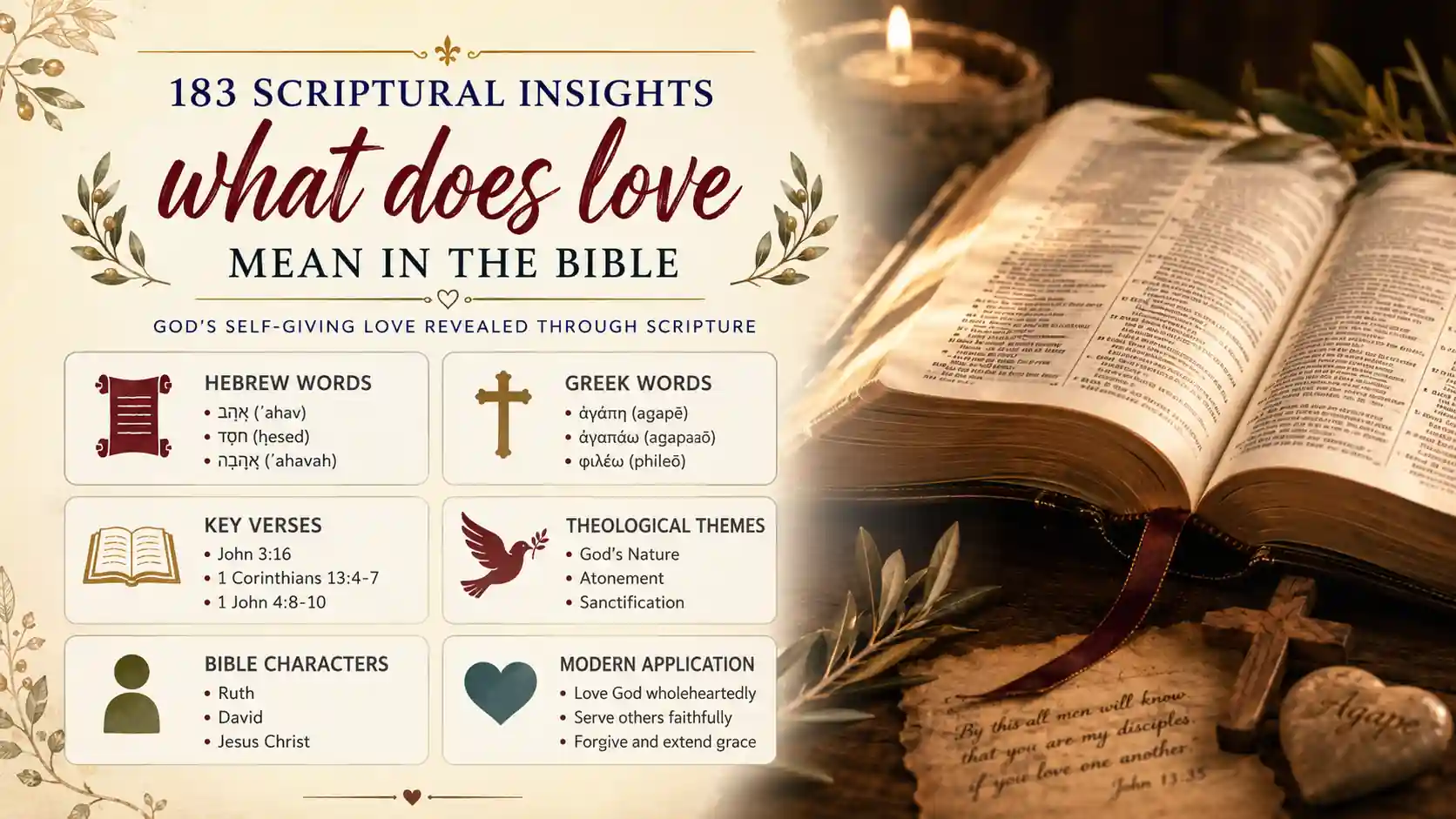
What does love mean in the Bible? Scripture presents love as far more than affection, attraction, or emotional warmth. Biblical love begins in God’s character, appears through His covenant faithfulness, and reaches its clearest expression in Jesus Christ. It is loyal, holy, truthful, merciful, and willing to sacrifice for another’s good.
As you study love throughout Scripture, you encounter several Hebrew and Greek words that illuminate its meaning. Together, they show that biblical love involves the heart, the will, faithful action, moral commitment, and enduring relationship.
Love in Key Scripture References
| Verse | Passage Snippet | Context |
|---|---|---|
| Deuteronomy 6:5 | Love the Lord wholeheartedly | Israel’s covenant response |
| Leviticus 19:18 | Love your neighbor as yourself | Holiness within community |
| Psalm 136:1 | His steadfast love endures | Worship of the covenant God |
| Matthew 5:44 | Love your enemies | Kingdom righteousness |
| Matthew 22:37-39 | Love God and neighbor | Greatest commandments |
| John 3:16 | God loved the world | The giving of the Son |
| John 13:34 | Love as Christ loved | New covenant discipleship |
| Romans 5:8 | Christ died for sinners | Love demonstrated at the cross |
| 1 Corinthians 13:4-7 | Love is patient and kind | Correction of Corinthian pride |
| 1 John 4:8-10 | God is love | God as love’s source |
Love in Bible Translation Comparison
| Verse | KJV | NIV | ESV | NASB |
|---|---|---|---|---|
| Psalm 136:1 | mercy endureth for ever | love endures forever | steadfast love endures | lovingkindness everlasting |
| Micah 6:8 | love mercy | love mercy | love kindness | love kindness |
| John 3:16 | so loved the world | so loved the world | so loved the world | so loved the world |
| John 13:34 | love one another | love one another | love one another | love one another |
| Romans 5:8 | commendeth his love | demonstrates his love | shows his love | demonstrates his love |
| 1 Corinthians 13:4 | charity suffereth long | love is patient | love is patient | love is patient |
| Colossians 3:14 | put on charity | put on love | put on love | put on love |
| 1 John 4:19 | he first loved us | he first loved us | he first loved us | he first loved us |
Love Through People and Characters
| Person | Role | Connection |
|---|---|---|
| Abraham | Covenant patriarch | Loved Isaac yet obeyed God |
| Ruth | Moabite widow | Showed loyal love to Naomi |
| Jonathan | Son of Saul | Loved David with covenant loyalty |
| David | King and psalmist | Celebrated God’s steadfast love |
| Hosea | Prophet | Embodied faithful love toward Gomer |
| Mary of Bethany | Disciple | Honored Jesus sacrificially |
| Good Samaritan | Parable character | Practiced neighbor love |
| Jesus Christ | Son of God | Revealed self-giving divine love |
| Paul | Apostle | Explained love’s supremacy |
| John | Apostle | Taught that God is love |
Love in Original Hebrew and Greek Words
| Original Word | Transliteration | Strong’s # | Literal Meaning |
|---|---|---|---|
| אָהַב | ʾahav | H157 | To love or desire |
| אַהֲבָה | ʾahavah | H160 | Love or affection |
| חֶסֶד | ḥesed | H2617 | Loyal kindness |
| דּוֹד | dod | H1730 | Beloved or love |
| רַעְיָה | raʿyah | H7474 | Beloved companion |
| ἀγαπάω | agapaō | G25 | To love devotedly |
| ἀγάπη | agapē | G26 | Self-giving love |
| φιλέω | phileō | G5368 | To love affectionately |
| φιλία | philia | G5373 | Friendship |
| φιλόστοργος | philostorgos | G5387 | Tender family affection |
Love and Related Biblical Concepts
| Concept | Connection | Supporting Verse |
|---|---|---|
| Covenant | Love remains loyal to promises | Deuteronomy 7:9 |
| Obedience | Love responds to God’s commands | John 14:15 |
| Grace | Love gives what is undeserved | Ephesians 2:4-5 |
| Mercy | Love acts compassionately | Luke 10:33-37 |
| Sacrifice | Love gives itself for others | Ephesians 5:2 |
| Truth | Love rejects falsehood | 1 Corinthians 13:6 |
| Forgiveness | Love refuses revenge | Colossians 3:13-14 |
| Holiness | Love seeks another’s true good | Romans 13:9-10 |
| Fellowship | Love binds believers together | 1 John 4:12 |
| Justice | Love protects the vulnerable | Isaiah 1:17 |
Love in Historical and Cultural Context
| Aspect | Detail | Biblical Source |
|---|---|---|
| Ancient covenants | Loyalty bound parties together | Genesis 21:27 |
| Israel’s election | God loved Israel by sovereign choice | Deuteronomy 7:7-8 |
| Kinship duties | Families protected vulnerable relatives | Ruth 2:20 |
| Patronage culture | Gifts often created social obligations | Luke 6:32-35 |
| Roman hierarchy | Status divided households and society | Galatians 3:28 |
| Corinthian rivalry | Gifts became sources of pride | 1 Corinthians 12-13 |
| Jewish neighbor ethics | Neighbor love came from Torah | Leviticus 19:18 |
| Enemy relations | Jesus rejected retaliatory hatred | Matthew 5:43-48 |
| Crucifixion | The cross displayed costly shame-bearing | Philippians 2:8 |
| Early churches | Shared care testified to discipleship | Acts 2:44-47 |
Love and Its Theological Themes
| Theme | Explanation | Scripture |
|---|---|---|
| God’s nature | Love belongs eternally to God | 1 John 4:8 |
| Divine initiative | God loves before people respond | 1 John 4:19 |
| Election | God freely sets covenant affection | Deuteronomy 7:7-8 |
| Incarnation | God’s love appears in His Son | 1 John 4:9 |
| Atonement | Christ dies for undeserving sinners | Romans 5:8 |
| New birth | God enables believers to love | 1 John 4:7 |
| Sanctification | Love matures through the Spirit | Galatians 5:22 |
| Church unity | Love binds diverse believers | Colossians 3:14 |
| Moral fulfillment | Love fulfills God’s law | Romans 13:8-10 |
| Eternal hope | Love continues beyond present gifts | 1 Corinthians 13:13 |
Love in Modern Application for Believers
| Area | Practice | Scripture |
|---|---|---|
| Worship | Love God with your whole life | Mark 12:30 |
| Marriage | Serve with covenant faithfulness | Ephesians 5:25 |
| Family | Show patient, tender affection | Romans 12:10 |
| Church | Bear burdens without rivalry | Galatians 6:2 |
| Conflict | Speak truth without cruelty | Ephesians 4:15 |
| Forgiveness | Release personal vengeance | Romans 12:19 |
| Community | Meet practical needs | 1 John 3:17-18 |
| Enemies | Pray and pursue their good | Matthew 5:44 |
| Work | Act for others’ benefit | 1 Corinthians 10:24 |
| Witness | Make Christ visible through love | John 13:35 |
אַהֲבָה ʾAhavah Joins Affection with Covenant Loyalty
The Hebrew verb אָהַב, ʾahav, and noun אַהֲבָה, ʾahavah, describe genuine attachment, desire, affection, and commitment. They can describe God’s love for His people, Israel’s love for God, parental love, friendship, marriage, and even disordered desire. Context determines whether that love is faithful or corrupt.
In Deuteronomy, love for God is never reduced to a private emotion. You are commanded to love Him with all your heart, soul, and strength. This love is expressed through remembrance, worship, obedience, and the teaching of His words to the next generation.
The Old Testament also speaks often of חֶסֶד, ḥesed, a rich term associated with mercy, kindness, loyalty, and covenant faithfulness. Although ḥesed is not interchangeable with every occurrence of “love,” it reveals how divine love behaves. God keeps His promises, forgives repentant people, and remains faithful to His covenant purposes.
Ruth’s devotion to Naomi illustrates this loyal quality. She leaves her homeland, embraces Naomi’s people, and places herself under Israel’s God. Her love is visible through costly faithfulness, just as God’s ḥesed is recognized through His faithful deeds.
What Does Love Mean in the Bible Through ἀγάπη Agapē?
The Greek noun ἀγάπη, agapē, and verb ἀγαπάω, agapaō, dominate many New Testament teachings about love. The terms can describe love directed toward God, neighbors, fellow believers, enemies, and even sinful things. The moral character of the love depends on its object and its conformity to God’s will.
New Testament agapē is therefore not a magical term that always means divine or unconditional love. Its meaning becomes distinctly Christian when Scripture fills it with the character and action of God. Jesus defines its pattern by laying down His life, serving His disciples, and obeying the Father.
John 3:16 connects God’s love with the giving of His unique Son. Romans 5:8 connects it with Christ’s death for sinners. First John 4 teaches that love begins not in humanity’s search for God but in God’s initiative toward guilty people who could never earn His favor.
When Jesus commands His disciples to love one another as He loved them, the words “as I have loved you” establish the standard. Christian love takes the shape of the cross. It gives, serves, endures, forgives, and seeks another person’s lasting good.
Jesus Unites Love for God, Neighbor, and Enemy
When asked about the greatest commandment, Jesus joins Deuteronomy 6:5 with Leviticus 19:18. Love for God and love for neighbor cannot be separated. Your treatment of another person reveals whether your claimed devotion to God is truthful.
The parable of the Good Samaritan shows that a neighbor is not merely someone from your own community. Neighbor love crosses ethnic, religious, and social barriers. It notices suffering, moves with compassion, accepts inconvenience, and provides practical care without demanding repayment.
Jesus presses the command even further by teaching you to love your enemies and pray for those who persecute you. He does not call evil good or remove the need for justice. He forbids personal hatred and commands conduct that reflects the Father’s generosity.
Enemy love seeks repentance, restoration, and ultimate good rather than revenge. It may include truthful confrontation, wise boundaries, or an appeal to lawful authority. Biblical love is never permission for abuse, manipulation, or continued participation in another person’s sin.
The Cross and Resurrection Define Christian Love
First Corinthians 13 is often read at weddings, but Paul originally addressed a divided church competing over spiritual gifts and public recognition. His description of love confronts pride. Love is patient and kind because it does not make personal honor its controlling goal.
The statement that love “bears all things” does not require you to conceal crimes or remain exposed to violence. Paul’s next statement says love rejoices with the truth. Love protects people from evil while refusing resentment, vanity, and delight in another person’s failure.
At the cross, Jesus demonstrates that holiness and love are not opposites. God does not ignore sin. Christ bears judgment and provides reconciliation. Divine love is merciful because it addresses guilt rather than pretending guilt is harmless.
The resurrection confirms that self-giving love is not defeat. Because Christ lives, believers can love with hope. Your acts of faithfulness may appear unnoticed, but love offered in Christ’s name belongs to the life of God’s coming kingdom.
Questions Bible Students Ask About Love
Does ἀγάπη agapē always mean God’s unconditional love?
No. Context determines its moral quality, while Christ’s sacrifice supplies its highest biblical pattern.
How are אַהֲבָה ʾahavah and חֶסֶד ḥesed different?
ʾAhavah commonly expresses love or affection, while ḥesed especially emphasizes loyal kindness and covenant faithfulness.
Why does the KJV use “charity” in 1 Corinthians 13?
“Charity” once carried the broader sense of Christian love, though modern English usually reserves it for benevolent giving.
Does loving an enemy mean trusting an abusive person?
No. You may pursue someone’s good while establishing boundaries, seeking protection, and refusing to enable evil.
How can you grow in biblical love when affection is absent?
Begin with prayerful obedience, truthful speech, patient service, forgiveness, and dependence on the Holy Spirit.