
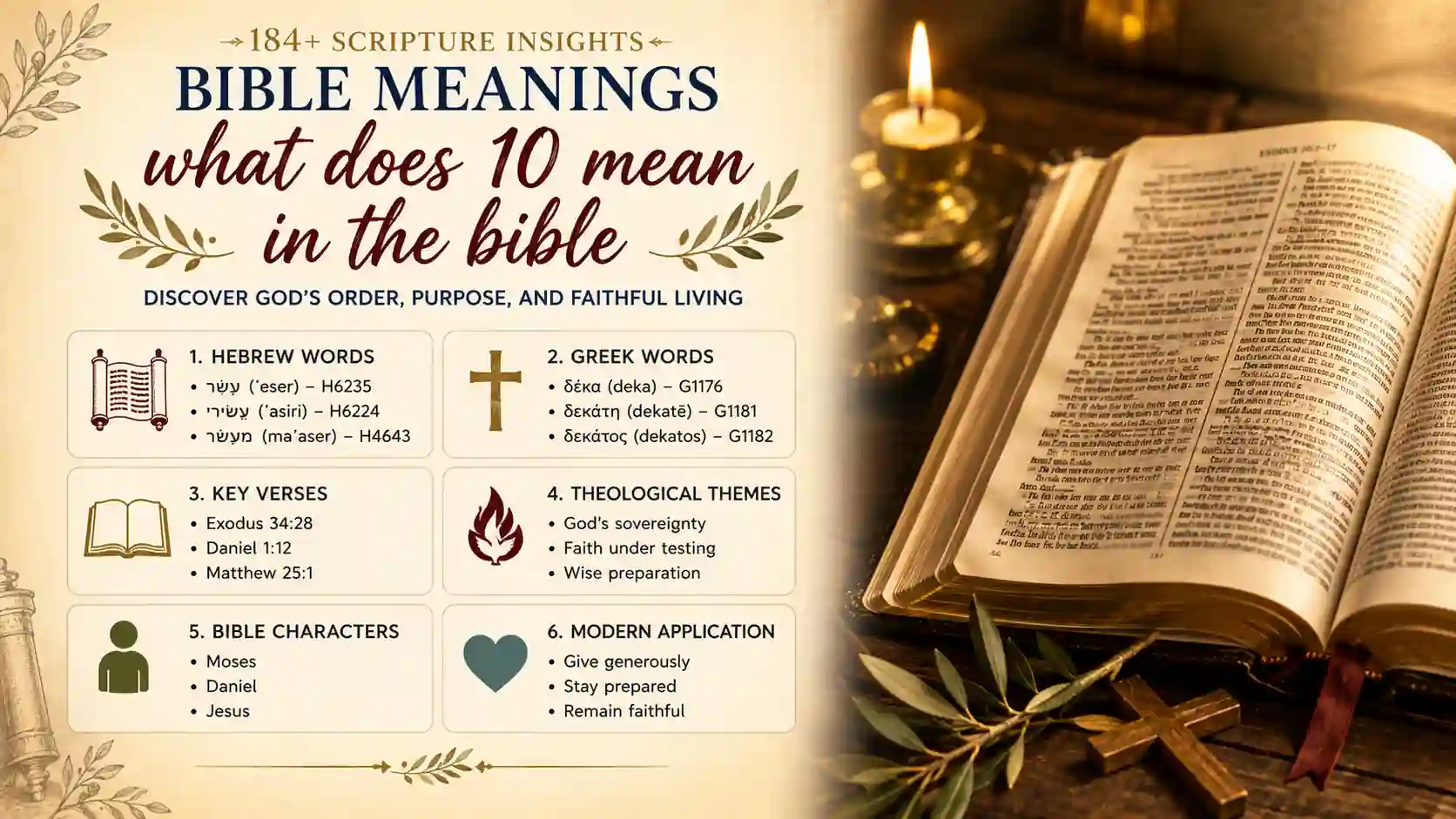
What does 10 mean in the Bible? Scripture often uses ten in settings involving divine order, covenant responsibility, testing, judgment, and completeness within a defined human sphere. The number appears in the Ten Commandments, ten plagues, tithes, prophetic visions, parables, and carefully structured genealogies.
Yet the Bible never gives a universal rule declaring that ten always has one symbolic meaning. Your study should begin with each passage’s historical and literary context. Patterns matter, but the inspired message of the passage matters more than numerical speculation.
Ten in Key Scripture References
| Verse | Passage Snippet | Context |
|---|---|---|
| Exodus 7:14 to 12:30 | Ten plagues strike Egypt | God judges Egypt and frees Israel |
| Exodus 34:28 | “The ten commandments” | Covenant words given through Moses |
| Numbers 14:22 | Israel tested God ten times | Repeated rebellion in the wilderness |
| Deuteronomy 4:13 | “Ten commandments” on stone | Covenant obligations for Israel |
| Leviticus 27:30 | A tenth belongs to the Lord | Israel’s produce supports sacred worship |
| Daniel 1:12 | “Test your servants ten days” | Daniel seeks faithfulness in Babylon |
| Daniel 7:7 | A beast has ten horns | Prophetic image of political powers |
| Matthew 25:1 | Ten virgins await the bridegroom | Jesus teaches readiness for his return |
| Luke 17:12 | Jesus meets ten lepers | Mercy is given, but one returns |
| Revelation 2:10 | Tribulation for ten days | Smyrna is called to faithful endurance |
Ten in Bible Translation Comparison
| Verse | KJV | NIV | ESV | NASB |
|---|---|---|---|---|
| Exodus 34:28 | “the ten commandments” | “the Ten Commandments” | “the Ten Commandments” | “the Ten Commandments” |
| Deuteronomy 4:13 | “ten commandments” | “Ten Commandments” | “Ten Commandments” | “Ten Commandments” |
| Numbers 14:22 | “tempted me now these ten times” | “tested me these ten times” | “put me to the test” | “put Me to the test” |
| Daniel 1:12 | “prove thy servants” | “test your servants” | “test your servants” | “test your servants” |
| Daniel 7:7 | “it had ten horns” | “it had ten horns” | “it had ten horns” | “it had ten horns” |
| Matthew 25:1 | “ten virgins” | “ten virgins” | “ten virgins” | “ten virgins” |
| Luke 19:13 | “ten servants” | “ten of his servants” | “ten of his servants” | “ten of his slaves” |
| Revelation 2:10 | “tribulation ten days” | “persecution for ten days” | “tribulation for ten days” | “tribulation for ten days” |
Ten and the People Connected with It
| Person | Role | Connection |
|---|---|---|
| Moses | Covenant mediator | Receives the Ten Commandments |
| Pharaoh | King of Egypt | Resists God through the plague cycle |
| Aaron | Israel’s first high priest | Serves within the covenant order |
| Abraham | Patriarch | Gives Melchizedek a tenth |
| Jacob | Patriarch | Vows to give God a tenth |
| Daniel | Exile and prophet | Requests a ten-day food test |
| Nebuchadnezzar | Babylonian king | Finds the Hebrews ten times wiser |
| Jesus | Messiah and teacher | Uses ten in several kingdom parables |
| Ten lepers | Recipients of healing | All are cleansed, but one gives thanks |
| John | Apostle and seer | Records ten horns and ten crowns |
Ten in Original Hebrew and Greek Words
| Original Word | Transliteration | Strong’s # | Literal Meaning |
|---|---|---|---|
| עֶשֶׂר | ʿeser | H6235 | Ten |
| עָשָׂר | ʿasar | H6240 | Ten |
| עֲשָׂרָה | ʿasarah | H6235 | Ten, numbered group |
| עֲשִׂירִי | ʿasiri | H6224 | Tenth |
| מַעֲשֵׂר | maʿaser | H4643 | Tenth part, tithe |
| דָּבָר | davar | H1697 | Word, matter, command |
| δέκα | deka | G1176 | Ten |
| δέκατος | dekatos | G1182 | Tenth |
| δεκάτη | dekatē | G1181 | A tenth, tithe |
| δεκατόω | dekatoō | G1183 | To receive or pay a tenth |
Ten and Related Biblical Concepts
| Concept | Connection | Supporting Verse |
|---|---|---|
| Covenant law | Ten Words summarize Israel’s duties | Exodus 34:28 |
| Divine judgment | Ten plagues expose Egypt’s gods | Exodus 12:12 |
| Human responsibility | Commands address loyalty and conduct | Deuteronomy 5:6-21 |
| Testing | Ten days reveal Daniel’s faithfulness | Daniel 1:12-15 |
| Rebellion | Ten occasions represent persistent unbelief | Numbers 14:22 |
| Stewardship | A tenth is set apart for God | Leviticus 27:30 |
| Readiness | Ten virgins await the bridegroom | Matthew 25:1-13 |
| Accountability | Ten servants receive entrusted money | Luke 19:13 |
| Political power | Ten horns portray rulers or kingdoms | Daniel 7:24 |
| Perseverance | Ten days describe limited suffering | Revelation 2:10 |
Ten in Historical and Cultural Context
| Aspect | Detail | Biblical Source |
|---|---|---|
| Decimal counting | Groups of ten suited ordinary counting | Genesis 18:32 |
| Covenant tablets | The Ten Words were written on stone | Deuteronomy 4:13 |
| Ancient treaties | Covenant commands shaped national loyalty | Exodus 20:1-17 |
| Egyptian religion | Plagues challenged Egypt’s supposed powers | Exodus 12:12 |
| Agricultural life | Tithes came from crops and herds | Leviticus 27:30-32 |
| Levitical support | Tithes sustained those serving at worship | Numbers 18:21 |
| City administration | Ten elders could witness legal matters | Ruth 4:2 |
| Babylonian education | Daniel’s training occurred in exile | Daniel 1:3-20 |
| Wedding customs | Bridesmaids waited for the groom’s arrival | Matthew 25:1-13 |
| Roman persecution | Smyrna faced a defined season of trial | Revelation 2:10 |
Ten and Its Theological Themes
| Theme | Explanation | Scripture |
|---|---|---|
| God’s sovereignty | The Lord rules nations and rulers | Exodus 9:16 |
| Covenant holiness | God orders worship and neighborly conduct | Exodus 20:1-17 |
| Complete accountability | Every area of life belongs under God | Deuteronomy 6:1-9 |
| Judgment with purpose | Plagues reveal God and rescue his people | Exodus 7:5 |
| Faith under testing | Obedience may be proved through pressure | Daniel 1:12 |
| Grateful worship | The healed Samaritan returns to Jesus | Luke 17:15-19 |
| Wise preparation | Readiness cannot be borrowed at the last moment | Matthew 25:8-13 |
| Faithful stewardship | Servants answer for what they receive | Luke 19:15 |
| Limited tribulation | Suffering remains under divine authority | Revelation 2:10 |
| Kingdom victory | Earthly powers finally yield to Christ | Revelation 17:12-14 |
Ten in Modern Application for Believers
| Area | Practice | Scripture |
|---|---|---|
| Worship | Give God undivided loyalty | Exodus 20:3 |
| Speech | Refuse lies and damaging testimony | Exodus 20:16 |
| Family | Honor parents with respect and care | Exodus 20:12 |
| Contentment | Resist coveting another person’s life | Exodus 20:17 |
| Stewardship | Give generously and intentionally | 2 Corinthians 9:7 |
| Gratitude | Return thanks after receiving mercy | Luke 17:15-16 |
| Preparation | Maintain living faith and watchfulness | Matthew 25:13 |
| Work | Use entrusted abilities faithfully | Luke 19:16-17 |
| Testing | Choose obedience under cultural pressure | Daniel 1:8 |
| Suffering | Remain faithful when trials are intense | Revelation 2:10 |
עֲשֶׂרֶת הַדְּבָרִים And the Covenant’S Ten Words
The Old Testament calls the commandments עֲשֶׂרֶת הַדְּבָרִים, ʿaseret ha-devarim, commonly rendered “the Ten Commandments” or more literally “the Ten Words.” This wording appears in Exodus 34:28, Deuteronomy 4:13, and Deuteronomy 10:4. The Hebrew דָּבָר, davar, can describe a word, matter, declaration, or command.
These Ten Words do not function as ten magical formulas. They express Israel’s covenant allegiance to the Lord and establish foundational duties toward God and neighbor. Jesus later gathers the law’s moral direction under wholehearted love for God and genuine love for one’s neighbor.
What Does 10 Mean in the Bible’S Exodus Story?
The ten plagues form one of Scripture’s clearest patterns involving the number. Each plague confronts Pharaoh’s refusal to recognize the Lord’s authority. Together they reveal that Israel’s God rules the Nile, the land, the weather, animal life, human health, light, darkness, life, and death.
Ten here suggests an ordered and climactic series of judgments. The plagues are not random disasters. They progressively expose Egypt’s helplessness, distinguish Israel from its oppressors, and lead toward Passover and deliverance. The emphasis remains on God’s identity, justice, patience, and saving power.
δέκα In Jesus’ Parables of Readiness and Stewardship
The Greek word δέκα, deka, appears in Jesus’ teaching about ten virgins, ten servants, ten minas, and a woman possessing ten coins. In these passages, ten often creates a complete group within the story. Jesus then distinguishes people by their response to a shared opportunity or responsibility.
The ten virgins all receive invitations and all await the bridegroom, yet only five prepare wisely. Ten servants receive a commission, but their faithfulness differs. The number sets the scene, while the spiritual weight falls on vigilance, obedience, stewardship, and readiness for the King’s return.
Tithes, Tenths, and מַעֲשֵׂר in Israel’S Worship
The Hebrew noun מַעֲשֵׂר, maʿaser, means a tenth part or tithe. Abraham gave Melchizedek a tenth of the spoils, Jacob promised a tenth to God, and the Mosaic covenant regulated tithes from agricultural produce and livestock. These practices confessed that provision ultimately came from the Lord.
Christians differ over whether Israel’s precise tithe regulations directly govern the church. The New Testament clearly teaches willing, proportionate, generous, and cheerful giving. A tenth may provide a useful discipline, but generosity should flow from grace, love, worship, and concern for those in need rather than mechanical calculation.
Questions About What 10 Means in the Bible
Does עֶשֶׂר, ʿeser, always symbolize divine completeness?
No. It literally means ten, and any symbolic force must be established from the passage’s context.
Why are the commandments called עֲשֶׂרֶת הַדְּבָרִים, the Ten Words?
The phrase emphasizes God’s covenant declarations, which summarize Israel’s fundamental obligations toward God and neighbor.
Were there exactly ten plagues in Egypt?
Yes. Exodus records ten distinct judgments, culminating in the death of Egypt’s firstborn and Israel’s deliverance.
Does δεκάτη, dekatē, prove that every Christian must give exactly ten percent?
No. It means a tenth or tithe, but New Testament giving is presented primarily as willing, generous, proportionate, and cheerful.
What should you learn from the ten virgins in Matthew 25?
You should remain spiritually prepared because readiness for Christ cannot be borrowed from another person at the moment of his coming.