
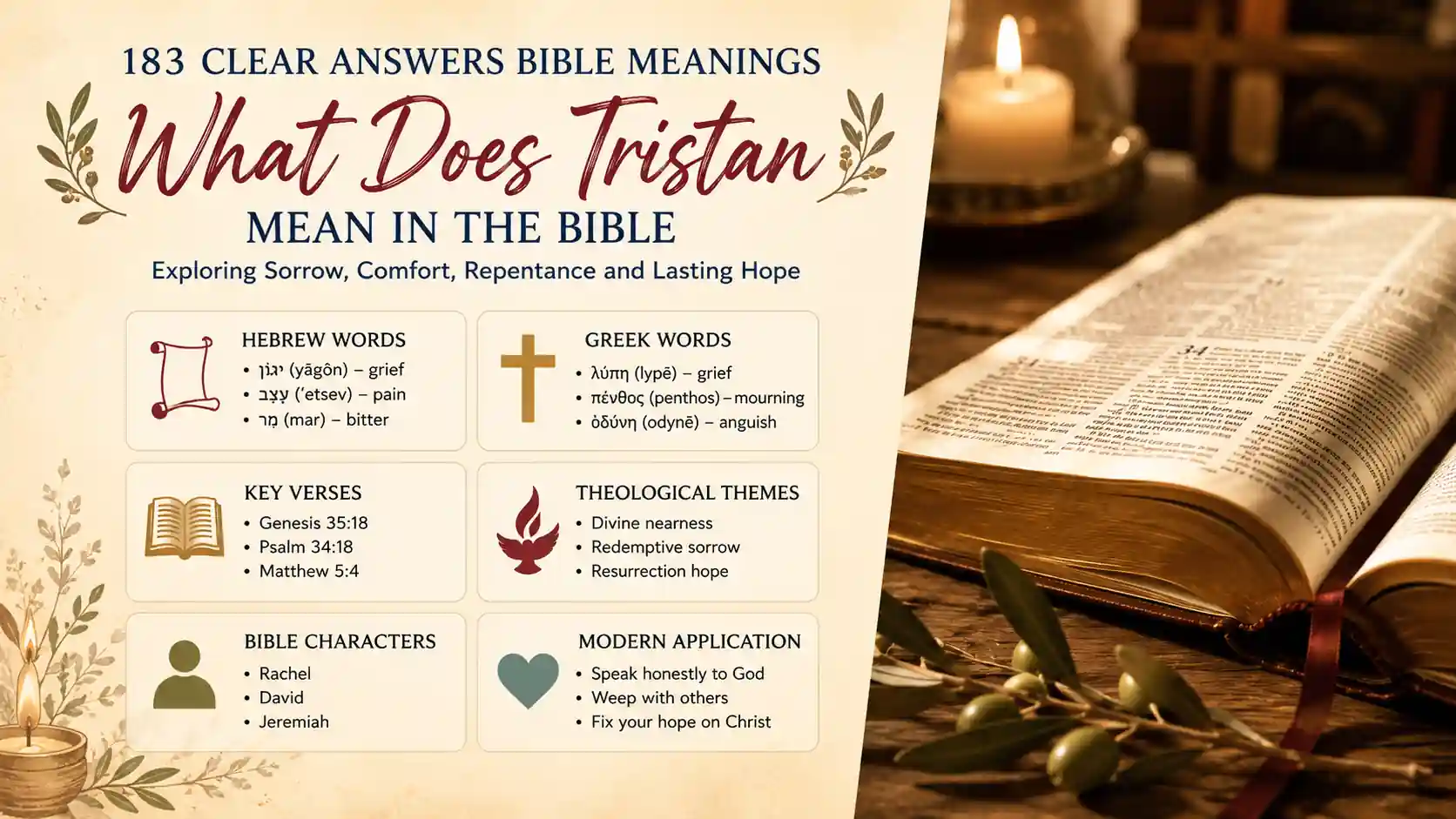
What does Tristan mean in the Bible? Strictly speaking, Tristan is not a biblical name. It does not occur in the Hebrew Old Testament, the Greek New Testament, or the ancient genealogies of Scripture. The name arose within Celtic and medieval European tradition, not the world of biblical Hebrew or Koine Greek.
Its early derivation is uncertain, though it is often connected with the Pictish or Celtic form Drustan. Through Old French usage, it became associated with triste and Latin tristis, meaning “sad” or “sorrowful.” That association provides a useful biblical study of sorrow, lament, comfort, and hope, but it is not a direct biblical definition of Tristan.
Tristan Key Scripture References
| Verse | Passage Snippet | Context |
|---|---|---|
| Genesis 35:18 | “son of my sorrow” | Rachel names Ben-oni while dying |
| 1 Samuel 1:10 | Hannah wept bitterly | Grief over childlessness |
| Psalm 30:5 | Joy comes in the morning | Sorrow is not permanent |
| Psalm 34:18 | Near the brokenhearted | God approaches the crushed |
| Psalm 42:11 | Hope in God | Faith confronts inner despair |
| Isaiah 53:3 | A man of sorrows | The suffering Servant |
| Matthew 5:4 | Mourners will be comforted | Kingdom blessing in grief |
| John 16:20 | Sorrow turned into joy | Jesus prepares the disciples |
| 2 Corinthians 7:10 | Godly sorrow brings repentance | Grief directed toward restoration |
| Revelation 21:4 | No more mourning or pain | Final renewal through God |
Tristan Bible Translation Comparison
| Verse | KJV | NIV | ESV | NASB |
|---|---|---|---|---|
| Genesis 35:18 | son of my sorrow | son of my trouble | son of my sorrow | son of my sorrow |
| Psalm 34:18 | broken heart | brokenhearted | brokenhearted | brokenhearted |
| Psalm 42:11 | cast down | downcast | cast down | in despair |
| Isaiah 53:3 | man of sorrows | man of suffering | man of sorrows | man of sorrows |
| Matthew 5:4 | they that mourn | those who mourn | those who mourn | those who mourn |
| John 16:20 | sorrow turned into joy | grief will turn to joy | sorrow will turn into joy | grief will be turned into joy |
| 2 Corinthians 7:10 | godly sorrow | godly sorrow | godly grief | sorrow according to God |
| 1 Thessalonians 4:13 | sorrow not | do not grieve | may not grieve | will not grieve |
| James 4:9 | mourn and weep | mourn and wail | mourn and weep | mourn and weep |
| Revelation 21:4 | no more sorrow | no more mourning | mourning shall be no more | no longer any mourning |
Tristan People and Characters Associated
| Person | Role | Connection |
|---|---|---|
| Rachel | Wife of Jacob | Named Ben-oni in sorrow |
| Jacob | Patriarch | Endured bereavement and fear |
| Hannah | Mother of Samuel | Prayed from deep anguish |
| Naomi | Widow of Bethlehem | Asked to be called Mara |
| David | King and psalmist | Voiced grief through lament |
| Job | Righteous sufferer | Wrestled with devastating loss |
| Jeremiah | Prophet | Wept over Judah’s rebellion |
| Jesus | Suffering Messiah | Bore sorrow and wept |
| Mary Magdalene | Disciple | Grief changed by resurrection |
| Paul | Apostle | Taught hope within grief |
Tristan Original Hebrew and Greek Words
| Original Word | Transliteration | Strong’s # | Literal Meaning |
|---|---|---|---|
| יָגוֹן | yāgôn | H3015 | grief, sorrow |
| עֶצֶב | ʿetsev | H6089 | pain, hurt, sorrow |
| תּוּגָה | tûgâ | H8424 | heaviness, grief |
| אֵבֶל | ʾēvel | H60 | mourning |
| מַר | mar | H4751 | bitter |
| λύπη | lypē | G3077 | grief, sorrow |
| λυπέω | lypeō | G3076 | to grieve |
| πένθος | penthos | G3997 | mourning, lamentation |
| πενθέω | pentheō | G3996 | to mourn |
| ὀδύνη | odynē | G3601 | anguish, consuming pain |
None of these words is the Hebrew or Greek source of Tristan. They are authentic biblical terms related to the sorrowful meaning later associated with the European name. Scripture therefore supplies theological parallels, not an inspired etymology for Tristan.
Tristan Related Biblical Concepts
| Concept | Connection | Supporting Verse |
|---|---|---|
| Lament | Honest grief before God | Psalm 13:1 |
| Mourning | Response to death or sin | Ecclesiastes 3:4 |
| Bitterness | Pain that shapes perception | Ruth 1:20 |
| Compassion | God responds to suffering | Psalm 103:13 |
| Repentance | Sorrow may lead to change | 2 Corinthians 7:10 |
| Comfort | God strengthens mourners | 2 Corinthians 1:3 |
| Hope | Faith looks beyond pain | Psalm 42:11 |
| Perseverance | Trials mature believers | James 1:3 |
| Resurrection | Death will not prevail | John 11:25 |
| Restoration | God renews ruined lives | Joel 2:25 |
Tristan Historical and Cultural Context
| Aspect | Detail | Biblical Source |
|---|---|---|
| Name origin | Tristan is European, not Semitic | Biblical name lists |
| Hebrew naming | Names often reflected circumstances | Genesis 35:18 |
| Mourning customs | Clothing could be torn | Job 1:20 |
| Sackcloth | Sign of grief or repentance | Jonah 3:5 |
| Ashes | Expressed humiliation and sorrow | Job 2:8 |
| Funeral lament | Communities mourned publicly | John 11:31 |
| Professional mourners | Musicians accompanied mourning | Matthew 9:23 |
| Covenant sorrow | Sin brought communal lament | Lamentations 1:1 |
| Messianic suffering | Isaiah described the Servant | Isaiah 53:3 |
| Christian burial hope | Grief was shaped by resurrection | 1 Thessalonians 4:13 |
Tristan Theological Themes
| Theme | Explanation | Scripture |
|---|---|---|
| Human brokenness | Sorrow entered a fallen world | Genesis 3:16 |
| Divine nearness | God stays near the crushed | Psalm 34:18 |
| Honest prayer | Lament belongs in faithful worship | Psalm 22:1 |
| Suffering Messiah | Christ entered human grief | Isaiah 53:4 |
| Compassion of Jesus | Jesus wept with mourners | John 11:35 |
| Redemptive sorrow | Grief may produce repentance | 2 Corinthians 7:10 |
| Shared burdens | Believers carry one another’s pain | Galatians 6:2 |
| Resurrection hope | Death cannot defeat Christ | 1 Corinthians 15:20 |
| Patient endurance | Trials can form character | Romans 5:3 |
| Final consolation | God will remove mourning | Revelation 21:4 |
Tristan Modern Application for Believers
| Area | Practice | Scripture |
|---|---|---|
| Personal grief | Speak honestly to God | Psalm 62:8 |
| Emotional health | Refuse to suffer alone | Galatians 6:2 |
| Prayer | Turn anguish into petition | Philippians 4:6 |
| Repentance | Let conviction produce change | 2 Corinthians 7:10 |
| Friendship | Weep with those who weep | Romans 12:15 |
| Worship | Praise while waiting for relief | Psalm 42:5 |
| Counseling | Listen before offering answers | Job 2:13 |
| Endurance | Ask God for sustaining grace | 2 Corinthians 12:9 |
| Bereavement | Grieve with resurrection hope | 1 Thessalonians 4:13 |
| Future hope | Fix your heart on renewal | Revelation 21:5 |
What Does Tristan Mean in the Bible and Why the Distinction Matters
When you ask what does Tristan mean in the Bible, the most accurate answer begins with a distinction. Tristan has no inspired Hebrew spelling, Greek form, biblical character, or Strong’s number. Assigning one would create a connection that Scripture itself does not make.
This does not make Tristan an inappropriate name for a Christian. The Bible never requires every personal name to originate in Scripture. Your concern should be whether the character, hopes, and values associated with the name are submitted to Christ.
From Drustan to Tristis without Inventing a Biblical Etymology
The older name behind Tristan is commonly associated with Celtic or Pictish forms such as Drust and Drustan. Its precise original sense remains debated. Later European speakers connected Tristan with Old French triste and Latin tristis, both associated with sadness.
That history developed centuries after the biblical period. You should therefore resist claims that Tristan directly translates a Hebrew word such as יָגוֹן, yāgôn, or a Greek word such as λύπη, lypē. Those words illuminate sorrow in Scripture, but they did not produce the name Tristan.
יָגוֹן YāGôN and λύπη Lypē in the Biblical Theology of Sorrow
The Hebrew noun יָגוֹן, yāgôn, describes grief or sorrow and appears in passages where suffering threatens to overwhelm a person. Yet biblical lament rarely treats sorrow as the believer’s final identity. The sufferer cries to God because covenant faith still expects him to hear.
The Greek noun λύπη, lypē, can describe emotional grief, painful concern, or sorrow over sin. Paul distinguishes destructive worldly sorrow from godly sorrow that produces repentance. Your pain is not automatically virtuous, but God can redirect it toward life, humility, and renewed obedience.
Ben-Oni, the Man of Sorrows, and the Name God Redeems
Rachel’s final words named her son בֶּן־אוֹנִי, Ben-oni, “son of my sorrow,” but Jacob called him Benjamin, “son of the right hand.” The event does not explain Tristan, yet it reveals a vital biblical truth. A painful beginning need not dictate a person’s permanent calling.
That pattern reaches its fullness in Jesus, the “man of sorrows” in Isaiah 53. Christ did not merely observe grief. He carried suffering, bore sin, entered death, and rose victorious. For you, sorrow can be real without becoming ultimate because the risen Lord promises final comfort.
Questions About Tristan and Biblical Meaning
Does Tristan have a Hebrew Strong’s number?
No. Tristan is not a Hebrew biblical name, so it has no Strong’s number or original Hebrew spelling.
Is Tristan a Greek name found in the New Testament?
No. The Greek New Testament does not contain Tristan, although words such as λύπη, lypē, describe sorrow.
Does Tristan literally mean “man of sorrows” like Isaiah 53:3?
No. Isaiah’s title describes the suffering Servant, while Tristan developed independently within European naming tradition.
Is יָגוֹן, yāgôn, the Hebrew translation of Tristan?
No. יָגוֹן means grief or sorrow, but it is only thematically related to the later sorrowful association of Tristan.
Can a Christian name a child Tristan?
Yes. Scripture does not forbid nonbiblical names, and parents may use Tristan while dedicating the child’s life and character to God.