
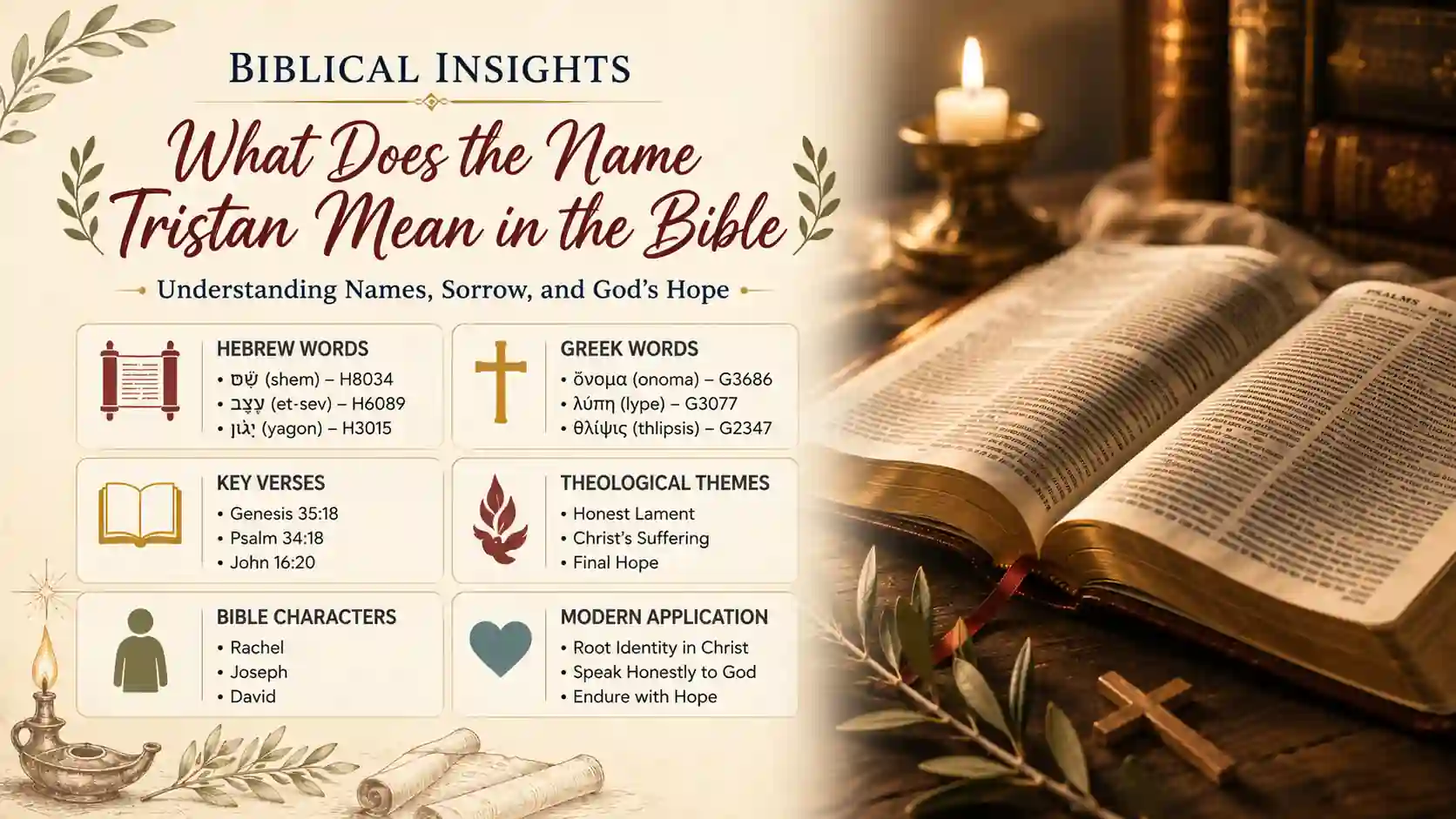
What does the name Tristan mean in the Bible? The most accurate answer is that Tristan does not appear in Scripture and has no direct Hebrew or Greek biblical equivalent. It probably developed from the old Pictish name Drustan and later became associated with the Old French word triste, meaning “sad” or “sorrowful.”
Therefore, you should not present Tristan as a biblical name or assign it a divinely inspired definition. You can, however, study biblical words and people connected with names, sorrow, courage, endurance, and God’s redemption of suffering.
Tristan Key Scripture References
| Verse | Passage Snippet | Context |
|---|---|---|
| Genesis 35:18 | “son of my sorrow” | Rachel names Benoni while dying |
| Genesis 41:51 | “made me forget” | Joseph names Manasseh after affliction |
| 1 Samuel 1:20 | “asked him of the Lord” | Hannah names Samuel after answered prayer |
| Ruth 1:20 | “Call me Mara” | Naomi describes her bitter grief |
| Psalm 30:5 | “joy cometh” | Sorrow does not have the final word |
| Psalm 34:18 | “nigh unto the brokenhearted” | God draws near to the crushed |
| Isaiah 53:3 | “man of sorrows” | The Servant bears rejection and grief |
| John 16:20 | “sorrow shall be turned” | Jesus promises joy beyond grief |
| Romans 5:3-4 | “tribulation worketh patience” | Suffering produces tested character |
| Revelation 21:4 | “no more sorrow” | God removes grief in the new creation |
Tristan Bible Translation Comparison
| Verse | KJV | NIV | ESV | NASB |
|---|---|---|---|---|
| Genesis 35:18 | son of my sorrow | son of my trouble | son of my sorrow | son of my sorrow |
| Ruth 1:20 | call me Mara | call me Mara | call me Mara | call me Mara |
| Psalm 30:5 | joy cometh | rejoicing comes | joy comes | shout of joy |
| Psalm 34:18 | broken heart | brokenhearted | brokenhearted | brokenhearted |
| Isaiah 53:3 | man of sorrows | man of suffering | man of sorrows | man of sorrows |
| John 16:20 | turned into joy | turn to joy | turn into joy | turned into joy |
| Romans 5:3 | glory in tribulations | glory in sufferings | rejoice in sufferings | celebrate in tribulation |
| James 1:3 | worketh patience | produces perseverance | produces steadfastness | produces endurance |
| 2 Corinthians 7:10 | godly sorrow | godly sorrow | godly grief | godly sorrow |
| Revelation 21:4 | neither sorrow | no mourning | neither mourning | no longer mourning |
Tristan People and Characters Associated with Biblical Themes
| Person | Role | Connection |
|---|---|---|
| Rachel | Wife of Jacob | Named Benoni through sorrow |
| Benjamin | Son of Jacob | Received a hopeful name from his father |
| Naomi | Widowed Israelite | Asked to be called Mara in bitterness |
| Ruth | Faithful Moabite | Walked with Naomi through grief |
| Hannah | Mother of Samuel | Turned anguish into prayer |
| Joseph | Son of Jacob | Endured suffering without abandoning God |
| Job | Righteous sufferer | Worshiped amid devastating loss |
| David | King and psalmist | Expressed grief, courage, and trust |
| Jeremiah | Prophet | Lamented while remaining faithful |
| Jesus Christ | Suffering Messiah | Bore sorrow and conquered death |
Tristan Original Hebrew and Greek Words
No Hebrew or Greek word is the linguistic root of Tristan. The following terms are genuine biblical words that illuminate themes commonly associated with the name.
| Original Word | Transliteration | Strong’s # | Literal Meaning |
|---|---|---|---|
| שֵׁם | shem | H8034 | name, reputation |
| עֶצֶב | etsev | H6089 | pain, sorrow |
| יָגוֹן | yagon | H3015 | grief, sorrow |
| מַר | mar | H4751 | bitter |
| נָחַם | nacham | H5162 | comfort, relent |
| ὄνομα | onoma | G3686 | name, authority |
| λύπη | lypē | G3077 | grief, sorrow |
| πένθος | penthos | G3997 | mourning |
| θλῖψις | thlipsis | G2347 | pressure, affliction |
| ὑπομονή | hypomonē | G5281 | endurance, steadfastness |
Tristan Related Biblical Concepts
| Concept | Connection | Supporting Verse |
|---|---|---|
| Naming | Names may express identity or circumstances | Genesis 35:18 |
| Renaming | God can give a new identity | Genesis 17:5 |
| Sorrow | Grief is acknowledged honestly | Psalm 13:2 |
| Lament | Pain may be brought before God | Lamentations 3:19-24 |
| Comfort | God ministers to the afflicted | 2 Corinthians 1:3-4 |
| Endurance | Trials can produce perseverance | James 1:3-4 |
| Character | Affliction can refine believers | Romans 5:3-4 |
| Hope | Suffering does not defeat faith | Romans 8:18 |
| Redemption | God can bring good from evil | Genesis 50:20 |
| Restoration | Mourning will ultimately cease | Revelation 21:4 |
Tristan Historical and Cultural Context
| Aspect | Detail | Biblical Source |
|---|---|---|
| Biblical status | Tristan is absent from Scripture | Biblical name lists |
| Language | Scripture uses Hebrew, Aramaic, and Greek | Ezra 4:7; Luke 23:38 |
| Name origins | Biblical names often reflect events | Genesis 29:32-35 |
| Family authority | Parents commonly named children | Genesis 4:25 |
| Paternal naming | Fathers could alter a given name | Genesis 35:18 |
| Prophetic names | Some names communicated judgment | Hosea 1:4-9 |
| Changed names | New names could mark new callings | Genesis 17:5 |
| Memorial names | Names preserved God’s activity | 1 Samuel 7:12 |
| Medieval origin | Tristan entered literature after biblical times | Postbiblical history |
| Christian use | A nonbiblical name may still be honorable | Romans 16:1-16 |
Tristan Theological Themes
| Theme | Explanation | Scripture |
|---|---|---|
| Divine truth | Meanings should not be invented | Proverbs 30:5-6 |
| Human identity | Your identity is deeper than a given name | Galatians 3:26 |
| God’s knowledge | God knows His people personally | Isaiah 43:1 |
| Honest lament | Faith permits sincere expressions of pain | Psalm 42:5 |
| Christ’s suffering | Jesus entered human grief fully | Isaiah 53:3-5 |
| Providence | God remains active in hardship | Genesis 50:20 |
| Perseverance | Trials can mature your faith | James 1:2-4 |
| Transformation | God renews character and thinking | Romans 12:2 |
| Adoption | Believers receive a new family identity | Romans 8:15 |
| Final hope | Sorrow ends in God’s restored creation | Revelation 21:4 |
Tristan Modern Application for Believers
| Area | Practice | Scripture |
|---|---|---|
| Bible study | Distinguish biblical fact from tradition | Acts 17:11 |
| Naming children | Choose names with prayer and wisdom | James 1:5 |
| Personal identity | Root your worth in Christ | Colossians 3:3 |
| Grief | Speak honestly to God | Psalm 62:8 |
| Anxiety | Present your requests in prayer | Philippians 4:6 |
| Endurance | Remain faithful under pressure | Hebrews 10:36 |
| Compassion | Comfort others with received comfort | 2 Corinthians 1:4 |
| Reputation | Pursue a good name through integrity | Proverbs 22:1 |
| Speech | Refuse false spiritual claims | Ephesians 4:25 |
| Hope | Look toward resurrection and restoration | 1 Peter 1:3 |
What Does the Name Tristan Mean in the Bible and Biblical Languages?
Tristan has no meaning in biblical Hebrew, Aramaic, or Koine Greek because it did not originate within the biblical world. It is not the name of an Israelite, prophet, apostle, ruler, place, tribe, or spiritual being in the canonical Scriptures.
Its probable historical ancestor is Drustan, an old Pictish or Brittonic name whose precise derivation remains uncertain. The later form Tristan was associated with Old French triste, “sad,” especially through medieval stories about Tristan and Iseult. That association is literary rather than biblical.
שֵׁם Shem and the Biblical Importance of a Name
The Hebrew noun שֵׁם, shem, Strong’s H8034, means “name,” but it can also concern reputation, remembrance, or recognized character. Proverbs 22:1 teaches that a good name is more desirable than great wealth. Scripture therefore directs your attention from an attractive label to the life represented by it.
The Greek counterpart ὄνομα, onoma, Strong’s G3686, may refer to a personal name, reputation, or authority. The New Testament’s emphasis on the name of Jesus concerns His revealed identity and sovereign authority, not the sound of particular syllables. A name becomes spiritually significant through truth, character, and relationship with God.
From Benoni’S Sorrow to Benjamin’S Hope
Genesis 35:18 offers a careful biblical parallel for studying a name popularly connected with sadness. As Rachel died, she called her newborn son Benoni, commonly understood as “son of my sorrow” or “son of my trouble.” Jacob renamed him Benjamin, traditionally understood as “son of the right hand.”
This passage does not explain Tristan, but it reveals that painful circumstances need not determine a person’s lasting identity. Rachel’s grief was real, yet Jacob chose a name expressing dignity and favored position. Likewise, sorrow may be part of your story without becoming the final definition of your life.
λύπη Lypē, θλῖψις Thlipsis, and Christian Endurance
The New Testament uses λύπη, lypē, Strong’s G3077, for grief or sorrow. It also uses θλῖψις, thlipsis, Strong’s G2347, for affliction, pressure, or tribulation. Neither word is an etymological source for Tristan, but both help you understand how Scripture addresses the experiences sometimes associated with the name.
Christian hope does not deny suffering. Romans 5:3-5 teaches that affliction can produce ὑπομονή, hypomonē, Strong’s G5281, meaning endurance or steadfastness. God can use hardship to form proven character and hope, while Revelation 21:4 promises that mourning, crying, pain, and death will not endure forever.
Questions About Tristan in Biblical Study
Is Tristan a name found anywhere in the Bible?
No. Tristan does not occur as a personal name, place, title, or translated biblical term.
Is Tristan derived from the Hebrew word שֵׁם, shem?
No. שֵׁם means “name,” but it has no linguistic connection with Tristan.
Does Tristan literally mean sorrow according to Scripture?
No. Its association with sorrow comes from Old French and medieval tradition, not from a biblical definition.
Can Genesis 35:18 be used to explain the name Tristan?
It may illustrate how Scripture treats sorrow-related names, but it does not establish Tristan’s etymology.
Can a Christian give a child the name Tristan?
Yes. Scripture does not require every Christian name to appear in the Bible, though parents should choose with wisdom and prayer.