
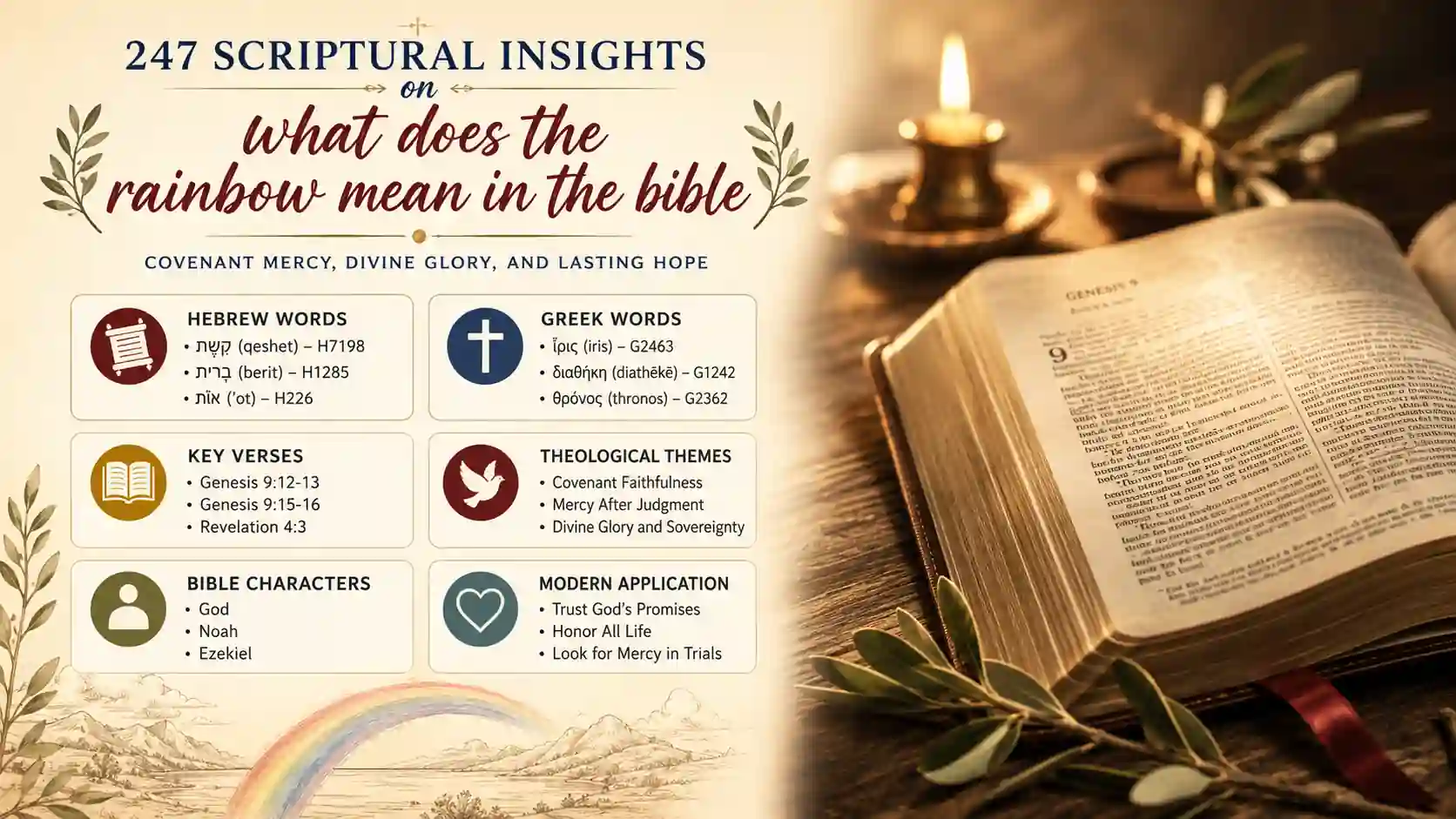
What does the rainbow mean in the Bible? Scripture first presents it as God’s covenant sign after the flood, assuring Noah, his descendants, every living creature, and the earth that waters would never again destroy all flesh. The rainbow therefore speaks of divine mercy following judgment and of God’s faithfulness to creation.
Later visions deepen that meaning. Ezekiel sees rainbowlike radiance surrounding God’s glory, while John sees a rainbow around the heavenly throne and above a mighty angel. Your study should hold these scenes together as covenant, glory, mercy, sovereignty, and hope.
Rainbow Key Scripture References
| Verse | Passage Snippet | Context |
|---|---|---|
| Genesis 8:21 | “Neither will I again smite” | God responds after Noah’s sacrifice |
| Genesis 8:22 | “Seedtime and harvest” | Creation’s rhythms will continue |
| Genesis 9:8-9 | “I establish my covenant” | God addresses Noah and his sons |
| Genesis 9:11 | “Neither shall all flesh be cut off” | No future worldwide destruction by flood |
| Genesis 9:12 | “The token of the covenant” | God appoints a visible covenant sign |
| Genesis 9:13 | “My bow in the cloud” | The rainbow signifies God’s promise |
| Genesis 9:15 | “I will remember my covenant” | God pledges faithful covenant action |
| Genesis 9:16 | “The everlasting covenant” | The promise includes every living creature |
| Ezekiel 1:28 | “The appearance of the bow” | Radiance surrounds the likeness of God’s glory |
| Revelation 4:3 | “A rainbow round about the throne” | Covenant imagery appears in heavenly worship |
Genesis gives the rainbow its foundational biblical meaning. It is not introduced as a vague symbol of optimism, but as the divinely appointed sign of a specific covenant. God promises that floodwaters will never again destroy all flesh, while the seasons and ordinary patterns of earthly life continue.
Ezekiel and Revelation do not cancel that meaning. They carry it into visions of divine glory and government. The bow that appeared after judgment in Genesis is later seen near God’s glorious presence, suggesting that mercy remains visible even when the sovereign Lord judges the world.
Rainbow Bible Translation Comparison
| Verse | KJV | NIV | ESV | NASB |
|---|---|---|---|---|
| Genesis 9:12 | “token” | “sign” | “sign” | “sign” |
| Genesis 9:13 | “my bow” | “my rainbow” | “my bow” | “My rainbow” |
| Genesis 9:14 | “bow shall be seen” | “rainbow appears” | “bow is seen” | “rainbow is seen” |
| Genesis 9:15 | “remember my covenant” | “remember my covenant” | “remember my covenant” | “remember My covenant” |
| Genesis 9:16 | “everlasting covenant” | “everlasting covenant” | “everlasting covenant” | “everlasting covenant” |
| Ezekiel 1:28 | “appearance of the bow” | “appearance of a rainbow” | “appearance of the bow” | “appearance of the rainbow” |
| Revelation 4:3 | “rainbow round about” | “rainbow shone” | “around the throne” | “rainbow around the throne” |
| Revelation 10:1 | “rainbow was upon his head” | “rainbow above his head” | “rainbow over his head” | “rainbow was upon his head” |
The most noticeable translation difference concerns קֶשֶׁת, qeshet. The KJV and ESV often retain “bow,” while the NIV and NASB commonly say “rainbow” when the atmospheric phenomenon is clearly intended. “Bow” preserves the Hebrew wordplay because the same noun can describe a weapon used in battle.
The translations agree on the central message. The phenomenon is the covenant sign appointed by God, and its later appearances surround scenes of heavenly majesty. Differences such as “upon,” “above,” or “over” do not substantially change the symbolism.
Rainbow People and Characters Associated
| Person | Role | Connection |
|---|---|---|
| God | Covenant Lord | Establishes the covenant and appoints the bow |
| Noah | Flood survivor | First human recipient of the covenant declaration |
| Noah’s sons | Covenant witnesses | Hear God’s promise with their father |
| Shem | Son of Noah | Included in the post-flood covenant community |
| Ham | Son of Noah | Included among Noah’s descendants |
| Japheth | Son of Noah | Receives the promise with his family |
| Ezekiel | Exilic prophet | Sees rainbowlike radiance around divine glory |
| John | Apostle and seer | Sees the rainbow around God’s throne |
| Throne’s Occupant | Sovereign ruler | Surrounded by emerald-like rainbow radiance |
| Mighty angel | Apocalyptic messenger | Appears with a rainbow above his head |
Noah is central because the sign follows his emergence from the ark and his offering to God. Yet Scripture carefully widens the covenant beyond one man. Noah’s family, future generations, animals, and the earth itself stand within the stated scope of God’s promise.
Ezekiel and John receive visions rather than covenant ceremonies. Their experiences connect the earthly sign with the heavenly throne. In both cases, the rainbow belongs to a revelation of God, not merely to the private spiritual experience of the prophet.
Rainbow Original Hebrew and Greek Words
| Original Word | Transliteration | Strong’s # | Literal Meaning |
|---|---|---|---|
| קֶשֶׁת | qeshet | H7198 | Bow, weapon, rainbow |
| בְּרִית | berit | H1285 | Covenant, binding agreement |
| אוֹת | ’ot | H226 | Sign, mark, token |
| עָנָן | ‘anan | H6051 | Cloud, cloud mass |
| זָכַר | zakhar | H2142 | Remember, call to mind |
| עוֹלָם | ‘olam | H5769 | Long duration, perpetuity |
| כָּבוֹד | kavod | H3519 | Glory, honor, weight |
| ἶρις | iris | G2463 | Rainbow, colored halo |
| διαθήκη | diathēkē | G1242 | Covenant, testament |
| θρόνος | thronos | G2362 | Throne, seat of authority |
The principal Hebrew term is קֶשֶׁת, qeshet, Strong’s H7198. It can mean an archer’s bow or a rainbow, with context determining the sense. This double meaning explains why some translations say “bow” in Genesis 9 while others make the atmospheric reference explicit with “rainbow.” The New Testament word is ἶρις, iris, Strong’s G2463, used in Revelation 4:3 and 10:1.
The surrounding vocabulary is equally significant. God calls the bow an אוֹת, ’ot, or sign, of his בְּרִית, berit, or covenant. When God says he will “remember,” זָכַר, zakhar, the language describes faithful covenant attention and action, not recovery from forgetfulness.
Rainbow Related Biblical Concepts
| Concept | Connection | Supporting Verse |
|---|---|---|
| Covenant | The rainbow visibly confirms God’s pledge | Genesis 9:12-13 |
| Mercy | Creation is preserved after severe judgment | Genesis 8:21 |
| Judgment | The sign appears after the flood | Genesis 7:21-23 |
| Remembrance | God promises to remember his covenant | Genesis 9:15 |
| Creation order | Seasons continue under divine providence | Genesis 8:22 |
| Common grace | The promise benefits humanity and animals | Genesis 9:9-10 |
| Divine glory | Rainbowlike radiance surrounds God’s glory | Ezekiel 1:28 |
| Sovereignty | The rainbow encircles the heavenly throne | Revelation 4:3 |
| Hope | Judgment does not nullify God’s faithfulness | Genesis 9:16 |
| Revelation | The sign helps communicate unseen realities | Revelation 10:1 |
Biblically, mercy does not mean that evil is insignificant. The flood narrative presents real judgment upon human violence and corruption. The rainbow appears afterward, showing that the God who judges also freely commits himself to preserving the world.
The sign also belongs to creation theology. God’s covenant encompasses “all flesh” and every living creature. The rainbow therefore concerns more than individual comfort. It declares God’s continuing concern for the inhabited earth and the creatures dependent upon its stability.
Rainbow Historical and Cultural Context
| Aspect | Detail | Biblical Source |
|---|---|---|
| Post-flood setting | The sign follows catastrophic judgment | Genesis 7:17-24 |
| Noah’s altar | Worship precedes the covenant declaration | Genesis 8:20 |
| Ancient weapon | A bow was used in warfare and hunting | Genesis 27:3 |
| Bow imagery | A lowered bow can suggest ended hostility | Genesis 9:13 |
| Covenant formula | God personally establishes the agreement | Genesis 9:9 |
| Universal scope | Humans, animals, and earth are included | Genesis 9:10-13 |
| Cloud setting | The sign becomes visible amid storm clouds | Genesis 9:14 |
| Exilic vision | Ezekiel sees glory in Babylonian exile | Ezekiel 1:1-3 |
| Throne vision | John sees heavenly worship and rule | Revelation 4:1-11 |
| Apocalyptic imagery | Visible symbols reveal divine realities | Revelation 10:1-7 |
In the ancient world, a bow naturally suggested military power. Because qeshet means both a weapon and the rainbow, many interpreters see the bow placed in the clouds as an image of suspended hostility. That interpretation is suggestive, though Genesis itself emphasizes the bow’s function as a covenant sign rather than explicitly explaining its direction.
The historical setting of Ezekiel is also important. He saw the likeness of God’s glory while living among exiles near the Chebar canal. The rainbowlike brightness assured displaced hearers that God’s majestic presence and covenant purposes were not confined to Jerusalem.
Rainbow Theological Themes
| Theme | Explanation | Scripture |
|---|---|---|
| Divine initiative | God establishes the covenant himself | Genesis 9:9 |
| Covenant faithfulness | God binds his promise to a visible sign | Genesis 9:12-13 |
| Mercy after judgment | Preservation follows the flood | Genesis 8:21 |
| Universal providence | God sustains humanity and animal life | Genesis 9:10 |
| Sanctity of life | Human blood matters because of God’s image | Genesis 9:5-6 |
| Patient restraint | God limits a form of worldwide judgment | Genesis 9:11 |
| Glorious holiness | Rainbowlike light accompanies divine glory | Ezekiel 1:28 |
| Royal sovereignty | The bow surrounds God’s throne | Revelation 4:3 |
| Mercy within majesty | Covenant imagery appears beside divine rule | Revelation 4:2-3 |
| Hope amid tribulation | The sign remains visible in apocalyptic judgment | Revelation 10:1 |
The Noahic covenant is initiated by God rather than negotiated between equals. No condition is attached to the promise that a flood will never again destroy all flesh. Humanity remains morally accountable, but the stability of creation rests finally upon God’s declared faithfulness.
The rainbow around the throne presents a rich theological union. God’s authority is absolute, his holiness is overwhelming, and his judgments are righteous. Yet the remembered sign of covenant mercy is not distant from his rule. It surrounds the throne from which he governs.
Rainbow Modern Application for Believers
| Area | Practice | Scripture |
|---|---|---|
| Trust | Receive the rainbow as testimony to God’s faithfulness | Genesis 9:16 |
| Worship | Praise the Creator who preserves life | Genesis 8:20-22 |
| Humility | Remember the seriousness of human sin | Genesis 6:5 |
| Gratitude | Thank God for ordinary seasons and provision | Genesis 8:22 |
| Creation care | Treat living creatures as belonging to God | Genesis 9:10 |
| Human dignity | Honor people made in God’s image | Genesis 9:6 |
| Perseverance | Look for mercy during threatening circumstances | Genesis 9:14-15 |
| Reverence | Respond to divine glory with worship | Ezekiel 1:28 |
| Hope | Trust God’s promises when judgment is discussed | Revelation 4:3 |
| Witness | Explain the sign from its biblical context | Genesis 9:12-13 |
When you see a rainbow, you may remember more than a beautiful optical event. Scripture invites you to recall the character of the God who keeps covenant, preserves creation, and displays mercy after judgment. The sign directs your attention away from human optimism and toward divine faithfulness.
Your application should also reflect the covenant’s breadth. God mentions families, future generations, animals, and the earth. Gratitude for the rainbow should encourage reverence for life, respect for every person bearing God’s image, and responsible care for the world God continues to sustain.
What Does the Rainbow Mean in the Bible within the Noahic Covenant?
The clearest answer to what does the rainbow mean in the Bible begins in Genesis 9. The rainbow is God’s chosen sign that never again will a flood destroy all flesh. It confirms an “everlasting covenant” made with Noah, his offspring, every living creature, and the earth.
The promise is specific. It does not mean that local floods, storms, suffering, or divine judgment will never occur. It means that God has pledged not to repeat the Genesis flood as a destruction of all earthly flesh by water.
קֶשֶׁת Qeshet Joins the Warrior’S Bow to the Sign in the Clouds
The Hebrew noun קֶשֶׁת, qeshet, can describe both a battle bow and the colored arc visible in clouds. This shared vocabulary gives the passage memorable force. The instrument associated with conflict becomes the sign of restraint, preservation, and covenant commitment.
You should distinguish the text’s direct teaching from a possible symbolic inference. Genesis explicitly says that the bow is the covenant sign. The popular image of God hanging up his weapon is theologically fitting, but it remains an interpretation of the wordplay rather than a separate statement in the passage.
The Rainbow Around the Throne in Ezekiel and Revelation
Ezekiel compares the radiance around the divine appearance to a rainbow seen on a rainy day. He then falls facedown before “the appearance of the likeness” of the Lord’s glory. Here the rainbow communicates splendor, transcendence, and holy majesty.
Revelation 4:3 places an emerald-like rainbow around God’s throne, while Revelation 10:1 describes a mighty angel with a rainbow above his head. These visions recall Genesis while presenting God as the sovereign ruler whose covenant faithfulness remains present during judgment.
Covenant Remembrance Does Not Mean That God Forgets
Genesis repeatedly says that God will see the bow and “remember” the covenant. In biblical covenant language, remembering usually points to purposeful attention and faithful action. God does not need a visual aid because his memory is weak.
The language graciously communicates certainty in human terms. The rainbow assures you that the preservation of creation does not depend on chance. God actively remains true to the covenant he freely established with the post-flood world.
Questions Bible Students Ask About the Rainbow
Does קֶשֶׁת, qeshet, mean a rainbow or a weapon in Genesis 9?
It can mean either, but the cloud setting identifies a rainbow while preserving an intentional association with a warrior’s bow.
Why does Genesis say that God will “remember” the covenant when he sees the rainbow?
The Hebrew זָכַר, zakhar, describes God’s faithful covenant attention and action, not forgetfulness followed by recollection.
Why do the KJV and ESV say “bow” where other translations say “rainbow”?
“Bow” reflects the broader range of qeshet, while “rainbow” states the specific natural phenomenon intended by the context.
Does the rainbow promise that God will never judge the world again?
No. It promises that floodwaters will never again destroy all flesh, while other biblical passages continue to teach divine judgment.
What does ἶρις, iris, add to the rainbow imagery in Revelation?
The Greek word identifies the rainbow or radiant halo surrounding heavenly figures, linking covenant mercy with God’s glory and sovereign rule.