
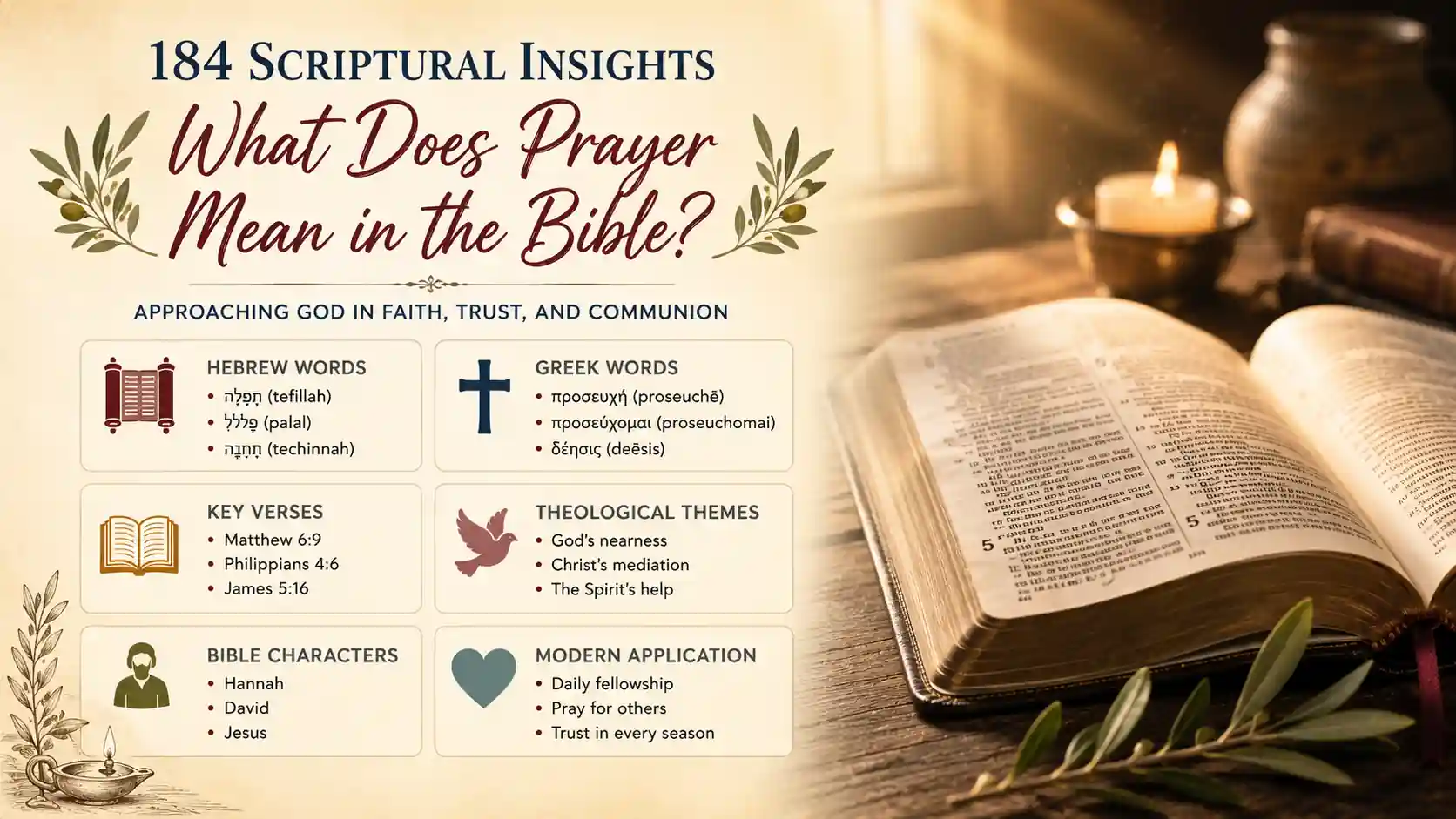
What does prayer mean in the Bible? Prayer is the reverent act of approaching God through praise, confession, thanksgiving, lament, petition, and intercession. Scripture presents it not as a religious formula but as covenant fellowship with the living God.
As you study prayer, you discover both honest human speech and gracious divine response. From Hannah’s silent anguish to Jesus’ submission in Gethsemane, biblical prayer expresses dependence, trust, repentance, worship, and alignment with God’s will.
Key Prayer Scripture References
| Verse | Passage Snippet | Context |
|---|---|---|
| Genesis 20:17 | Abraham prayed unto God | Intercession brings healing |
| 1 Samuel 1:10 | She prayed unto the Lord | Hannah pours out grief |
| 2 Chronicles 7:14 | Pray, and seek my face | Covenant repentance |
| Psalm 5:3 | In the morning will I direct | Daily dependence |
| Psalm 51:10 | Create in me a clean heart | Confession and renewal |
| Daniel 6:10 | Prayed three times a day | Faithfulness under threat |
| Matthew 6:9 | After this manner pray | Jesus teaches His disciples |
| Luke 18:1 | Always to pray | Perseverance without despair |
| Philippians 4:6 | By prayer and supplication | Anxiety answered with trust |
| James 5:16 | Effectual fervent prayer | Righteous intercession |
Prayer Bible Translation Comparison
| Verse | KJV | NIV | ESV | NASB |
|---|---|---|---|---|
| Matthew 6:9 | After this manner pray | This is how you should pray | Pray then like this | Pray, then, in this way |
| Luke 11:1 | Lord, teach us to pray | Lord, teach us to pray | Lord, teach us to pray | Lord, teach us to pray |
| Romans 8:26 | We know not what to pray | We do not know what to pray | We do not know what to pray | We do not know what to pray |
| Philippians 4:6 | By prayer and supplication | By prayer and petition | By prayer and supplication | By prayer and pleading |
| 1 Thessalonians 5:17 | Pray without ceasing | Pray continually | Pray without ceasing | Pray without ceasing |
| 1 Timothy 2:1 | Supplications, prayers, intercessions | Petitions, prayers, intercession | Supplications, prayers, intercessions | Requests, prayers, intercession |
| James 5:16 | Effectual fervent prayer | Prayer of a righteous person | Prayer of a righteous person | Prayer of a righteous person |
| 1 Peter 5:7 | Casting all your care | Cast all your anxiety | Casting all your anxieties | Having cast all your anxiety |
People and Characters Associated with Prayer
| Person | Role | Connection |
|---|---|---|
| Abraham | Patriarch | Interceded for Sodom and Abimelech |
| Moses | Covenant mediator | Pleaded for rebellious Israel |
| Hannah | Mother of Samuel | Prayed through sorrow and dedication |
| David | King and psalmist | Voiced praise, lament, and repentance |
| Solomon | Temple builder | Offered Israel’s dedication prayer |
| Elijah | Prophet | Prayed for drought, fire, and rain |
| Daniel | Exile and statesman | Maintained disciplined daily prayer |
| Jesus | Son of God | Modeled perfect communion and submission |
| Paul | Apostle | Prayed for churches and gospel growth |
| Early church | Covenant community | Prayed in unity during persecution |
Original Hebrew and Greek Prayer Words
| Original Word | Transliteration | Strong’s # | Literal Meaning |
|---|---|---|---|
| תְּפִלָּה | tefillah | H8605 | Prayer or intercession |
| פָּלַל | palal | H6419 | Pray, intervene, mediate |
| תְּחִנָּה | techinnah | H8467 | Plea for favor |
| חָנַן | chanan | H2603 | Seek or show grace |
| קָרָא | qara | H7121 | Call or cry out |
| שָׁאַל | sha’al | H7592 | Ask or inquire |
| προσευχή | proseuchē | G4335 | Prayer addressed to God |
| προσεύχομαι | proseuchomai | G4336 | To pray or worship |
| δέησις | deēsis | G1162 | Supplication arising from need |
| ἔντευξις | enteuxis | G1783 | Petition or intercession |
Related Biblical Prayer Concepts
| Concept | Connection | Supporting Verse |
|---|---|---|
| Worship | Prayer honors God’s character | Psalm 95:6 |
| Confession | Sin is acknowledged before God | Psalm 32:5 |
| Thanksgiving | Grace is received with gratitude | Colossians 4:2 |
| Lament | Suffering is spoken honestly | Psalm 13:1-2 |
| Petition | Personal needs are presented | Matthew 7:7 |
| Intercession | Needs of others are carried | 1 Timothy 2:1 |
| Repentance | The heart turns back to God | 2 Chronicles 7:14 |
| Faith | Requests rest in God’s power | Mark 11:24 |
| Forgiveness | Prayer includes reconciled relationships | Mark 11:25 |
| Watchfulness | Prayer resists spiritual carelessness | Matthew 26:41 |
Historical and Cultural Context of Prayer
| Aspect | Detail | Biblical Source |
|---|---|---|
| Temple worship | Prayer accompanied sacrifice and praise | 1 Kings 8:28-30 |
| Incense | Rising smoke pictured offered prayer | Psalm 141:2 |
| Fixed hours | Some prayed at regular daily times | Daniel 6:10 |
| Ninth hour | Temple prayer occurred in afternoon | Acts 3:1 |
| Standing | A common public prayer posture | Mark 11:25 |
| Kneeling | Expressed humility and earnestness | Luke 22:41 |
| Lifted hands | Signified appeal and holiness | 1 Timothy 2:8 |
| Fasting | Intensified repentance or seeking | Nehemiah 1:4 |
| Private rooms | Secrecy guarded sincerity | Matthew 6:6 |
| Psalms | Israel used inspired prayers in worship | Psalm 72:20 |
Theological Themes of Prayer
| Theme | Explanation | Scripture |
|---|---|---|
| God’s nearness | God welcomes those who call sincerely | Psalm 145:18 |
| Divine sovereignty | Prayer submits to God’s wise will | Matthew 6:10 |
| Christ’s mediation | Believers approach through Jesus | Hebrews 7:25 |
| The Spirit’s help | The Spirit aids human weakness | Romans 8:26 |
| Covenant relationship | God hears His redeemed people | Exodus 2:23-25 |
| Grace | Prayer approaches mercy, not merit | Hebrews 4:16 |
| Transformation | Prayer changes desires and conduct | Psalm 139:23-24 |
| Perseverance | Continued prayer expresses trust | Luke 18:1-8 |
| Corporate unity | The church seeks God together | Acts 4:24 |
| Kingdom mission | Prayer advances gospel labor | Colossians 4:3 |
Modern Prayer Application for Believers
| Area | Practice | Scripture |
|---|---|---|
| Daily fellowship | Set aside undistracted time | Mark 1:35 |
| Scripture reading | Turn biblical truth into prayer | John 15:7 |
| Anxiety | Present fears with thanksgiving | Philippians 4:6-7 |
| Decision-making | Ask for wisdom in faith | James 1:5-6 |
| Temptation | Pray for vigilance and strength | Matthew 26:41 |
| Relationships | Forgive while approaching God | Mark 11:25 |
| Church life | Pray for leaders and believers | Ephesians 6:18-19 |
| Public life | Intercede for rulers and peace | 1 Timothy 2:1-2 |
| Suffering | Lament without abandoning hope | Psalm 42:5 |
| Mission | Ask God to send gospel workers | Matthew 9:38 |
What Does Prayer Mean in the Bible Through תְּפִלָּה And προσευχή?
The Hebrew noun תְּפִלָּה, tefillah, refers to prayer, supplication, or intercession. It is related to the verb פָּלַל, palal, which can describe praying, intervening, or acting as a mediator. Biblical prayer therefore includes more than requesting benefits. It often means placing a matter before God and appealing to His covenant mercy.
This appears clearly when Solomon offers his תְּפִלָּה at the temple dedication. He asks God to hear from heaven when Israel sins, suffers defeat, experiences drought, or turns toward the temple in repentance. Prayer rests on God’s character, His promises, and His willingness to forgive those who return to Him.
The principal New Testament noun is προσευχή, proseuchē, with the related verb προσεύχομαι, proseuchomai. These words ordinarily describe prayer directed toward God. They may include praise, petition, thanksgiving, confession, or intercession, depending on the passage.
The New Testament distinguishes prayer from magical speech. Jesus warns against empty repetition and theatrical displays because prayer is communion with the Father, not a technique for controlling Him. Your Father already knows what you need, yet He invites you to ask because prayer nurtures trust, dependence, and loving fellowship.
Prayer from Israel’S Covenant Worship to the Church
Prayer in the Old Testament develops within God’s covenant relationship with Israel. Abraham intercedes, Moses pleads for the nation, Hannah pours out her soul, David sings laments, Solomon prays at the temple, and Daniel seeks God in exile. Their prayers recall God’s promises while honestly acknowledging human weakness.
The Psalms became Israel’s inspired prayer book. They teach you that faithful prayer can include joy, confusion, anger, fear, repentance, and hope. Biblical lament is not unbelief. It brings pain into God’s presence, appeals to His steadfast love, and refuses to seek refuge apart from Him.
In the New Testament, Jesus gathers up Israel’s prayer tradition and brings it to its fullest expression. He prays at His baptism, before choosing the Twelve, during His transfiguration, before raising Lazarus, at the Last Supper, in Gethsemane, and from the cross.
After Christ’s ascension, the church continues steadfastly in prayer. Believers pray before appointing leaders, during persecution, for imprisoned apostles, and before missionary work. Christian prayer is both personal and corporate because salvation joins you to God and to a praying community.
Jesus’ Pattern of Father-Centered Prayer
The Lord’s Prayer begins with God rather than human desire. “Our Father” expresses both intimacy and reverence. “Hallowed be thy name” seeks the honor of God, while “thy kingdom come” and “thy will be done” place your requests inside His redemptive purposes.
Requests for daily bread, forgiveness, and deliverance show that no part of life lies outside God’s care. You may bring physical needs, moral failures, damaged relationships, and spiritual dangers before Him. Yet every request remains governed by confidence in the Father’s wisdom.
Gethsemane reveals the deepest posture of biblical prayer. Jesus honestly asks that the cup might pass from Him, yet He submits Himself to the Father’s will. His prayer is neither detached resignation nor an effort to manipulate circumstances.
When you pray “according to his will,” you are not suppressing every strong desire. You are entrusting that desire to the God whose understanding exceeds yours. Mature prayer speaks plainly while surrendering the outcome to divine goodness.
Christ’S Mediation and the Spirit’S Help in Prayer
Christian prayer approaches the Father through the Son. Jesus is not merely an example of prayer. He is the great High Priest who gives believers access to the throne of grace. Praying in His name means approaching on the basis of His person, work, authority, and purposes.
This keeps prayer from becoming a claim of personal worthiness. You do not earn an audience through eloquence, emotional intensity, or perfect conduct. You come because Christ has reconciled you to God and continues to intercede for His people.
The Holy Spirit also helps you in weakness. Romans 8 acknowledges that believers sometimes do not know what they ought to pray. The Spirit intercedes according to God’s will even when suffering leaves your thoughts confused and your words incomplete.
Prayer can therefore remain genuine when language fails. Silence, tears, brief cries, and repeated appeals may all express dependence on God. The effectiveness of prayer rests finally in the Father who hears, the Son who mediates, and the Spirit who helps.
Prayer Questions Bible Students Often Ask
Does προσεύχομαι mean every request is guaranteed?
No. The word means to pray, while Scripture places requests under God’s will, wisdom, and kingdom purposes.
Why does Matthew 6 condemn repetition when Jesus repeated His prayer in Gethsemane?
Jesus condemns empty, manipulative babbling, not sincere repetition arising from persistent faith or deep anguish.
What is the difference between προσευχή and δέησις?
Προσευχή is a broad term for prayer, while δέησις usually emphasizes an urgent plea arising from a specific need.
Does “pray without ceasing” require constant spoken words?
No. It calls you to sustained dependence, regular communion, and readiness to turn toward God throughout life.
Why pray when God already knows what you need?
Prayer is not informing God. It is trusting Him, receiving from Him, submitting to Him, and growing in fellowship with Him.