
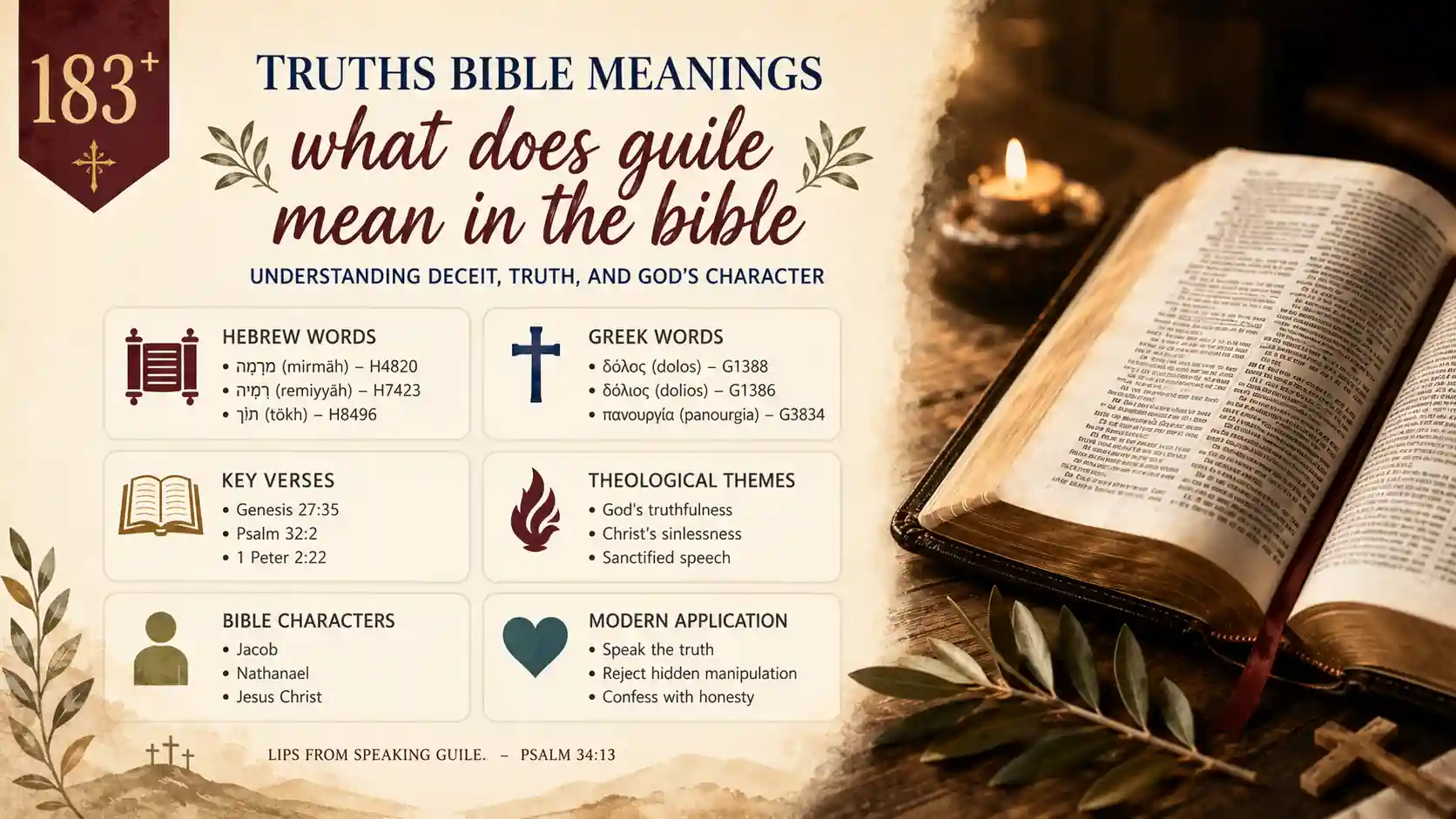
What does guile mean in the Bible? Guile is deliberate deceit expressed through cunning words, concealed motives, or manipulative conduct. Unlike an innocent mistake, guile involves presenting something false in order to mislead another person. Scripture treats it as a serious corruption of truth, trust, and covenant faithfulness.
The biblical words translated “guile” can also mean deceit, treachery, fraud, or bait used to trap someone. Your study will show that guile appears in sinful speech, dishonest commerce, political schemes, religious hypocrisy, and personal betrayal, while its complete absence is displayed in Jesus Christ.
Guile in Key Scripture References
| Verse | Passage Snippet | Context |
|---|---|---|
| Genesis 27:35 | “Came with subtilty” | Jacob obtains Esau’s blessing deceitfully |
| Psalm 32:2 | “In whose spirit there is no guile” | The forgiven person confesses honestly |
| Psalm 34:13 | “Lips from speaking guile” | Wisdom instruction about fearing God |
| Psalm 55:11 | “Deceit and guile” | David describes corruption within Jerusalem |
| Isaiah 53:9 | “Neither was any deceit in his mouth” | The Servant suffers though completely innocent |
| John 1:47 | “In whom is no guile” | Jesus commends Nathanael’s sincerity |
| 1 Peter 2:1 | “Laying aside all guile” | Christians must reject deceitful relationships |
| 1 Peter 2:22 | “Neither was guile found in his mouth” | Christ’s sinlessness fulfills Isaiah 53 |
| 1 Peter 3:10 | “His lips that they speak no guile” | Peter applies Psalm 34 to Christian conduct |
Guile in Bible Translation Comparison
| Verse | KJV | NIV | ESV | NASB |
|---|---|---|---|---|
| Genesis 27:35 | Subtilty | Deceitfully | Deceitfully | Deceitfully |
| Psalm 32:2 | Guile | Deceit | Deceit | Deceit |
| Psalm 34:13 | Guile | Lies | Deceit | Deceit |
| Psalm 55:11 | Guile | Fraud | Fraud | Deceit |
| Isaiah 53:9 | Deceit | Deceit | Deceit | Deceit |
| John 1:47 | Guile | Deceit | Deceit | Deceit |
| 2 Corinthians 12:16 | Guile | Trickery | Cunning | Deceit |
| 1 Peter 2:1 | Guile | Deceit | Deceit | Deceit |
| 1 Peter 2:22 | Guile | Deceit | Deceit | Deceit |
People and Characters Associated with Guile
| Person | Role | Connection |
|---|---|---|
| Jacob | Patriarch | Approached Isaac deceitfully for the blessing |
| Laban | Aramean household head | Deceived Jacob concerning Rachel and Leah |
| David | King and psalmist | Condemned guile and prayed for honest speech |
| Doeg | Servant of Saul | Used malicious information against David’s priests |
| Absalom | Son of David | Stole Israel’s loyalty through calculated persuasion |
| Nathanael | Disciple | Called an Israelite without guile |
| Jesus Christ | Messiah and Servant | No deceit was found in His mouth |
| Paul | Apostle | Rejected deceitful handling of God’s Word |
| Peter | Apostle | Commanded believers to put away guile |
Original Hebrew and Greek Words for Guile
| Original Word | Transliteration | Strong’s # | Literal Meaning |
|---|---|---|---|
| מִרְמָה | mirmāh | H4820 | Deceit, fraud, treachery |
| רְמִיָּה | remiyyāh | H7423 | Deceit, slackness, false dealing |
| תֹּךְ | tōkh | H8496 | Oppression, fraud, inward deceit |
| נָכַל | nākhal | H5230 | To act craftily or deceitfully |
| עָקַב | ʿāqab | H6117 | To supplant or deal insidiously |
| דόλος | dolos | G1388 | Bait, deceit, cunning |
| δόλιος | dolios | G1386 | Deceitful, treacherous |
| δολιόω | dolioō | G1387 | To deceive or use guile |
| πανουργία | panourgia | G3834 | Craftiness, unscrupulous cunning |
The principal Old Testament noun is מִרְמָה, mirmāh, Strong’s H4820, which describes deliberate deceit in speech, trade, or conduct. The principal New Testament noun is δόλος, dolos, Strong’s G1388, a word associated with bait and the cunning used to ensnare someone.
Biblical Concepts Related to Guile
| Concept | Connection | Supporting Verse |
|---|---|---|
| Falsehood | Guile intentionally distorts truth | Psalm 34:13 |
| Hypocrisy | Guile hides motives behind appearances | 1 Peter 2:1 |
| Flattery | Pleasant words may conceal a trap | Proverbs 26:28 |
| Slander | Deceitful speech damages another’s name | Psalm 109:2 |
| Fraud | Guile manipulates economic dealings | Amos 8:5 |
| Treachery | Deception violates relational trust | Jeremiah 9:4 |
| Craftiness | Intelligence is used for sinful manipulation | 2 Corinthians 4:2 |
| Confession | Honest repentance removes hidden deceit | Psalm 32:2 |
| Integrity | Truthful character opposes guile | John 1:47 |
Historical and Cultural Context of Guile
| Aspect | Detail | Biblical Source |
|---|---|---|
| Patriarchal blessing | Spoken blessings carried legal and family weight | Genesis 27 |
| Household marriage | Family heads negotiated marriage arrangements | Genesis 29 |
| City commerce | Traders could alter weights and measures | Amos 8:5 |
| Royal courts | Informants could gain power through accusation | 1 Samuel 22 |
| City gates | Public business and judgments occurred there | Amos 5:10 |
| Wisdom teaching | Parents trained children to reject deceptive speech | Proverbs 4:24 |
| Honor culture | False testimony could destroy social standing | Exodus 20:16 |
| Messianic expectation | The righteous Servant would be free from deceit | Isaiah 53:9 |
| Early churches | Converts had to abandon former social vices | 1 Peter 2:1 |
Theological Themes Revealed Through Guile
| Theme | Explanation | Scripture |
|---|---|---|
| God’s truthfulness | God cannot lie or deceive | Numbers 23:19 |
| Human corruption | Sin reaches motives, words, and actions | Romans 3:13 |
| Covenant loyalty | Deceit betrays relationships established before God | Jeremiah 9:3 |
| Divine judgment | God opposes those who practice fraud | Psalm 5:6 |
| Honest repentance | Forgiveness is joined with truthful confession | Psalm 32:2–5 |
| Christ’s sinlessness | Jesus never manipulated through false speech | 1 Peter 2:22 |
| New birth | Believers put away deceit as former conduct | 1 Peter 2:1–2 |
| Sanctified speech | Christian words should reflect God’s truth | Ephesians 4:25 |
| Final redemption | The redeemed are characterized by truthful speech | Revelation 14:5 |
Modern Application of Guile for Believers
| Area | Practice | Scripture |
|---|---|---|
| Conversation | State the truth without hidden manipulation | Ephesians 4:25 |
| Marriage | Speak honestly about needs and failures | Colossians 3:9 |
| Workplace | Give accurate reports and promises | Proverbs 12:22 |
| Business | Use fair prices, measures, and agreements | Proverbs 11:1 |
| Church | Reject flattery, gossip, and factional schemes | 1 Peter 2:1 |
| Leadership | Refuse secret pressure and misleading claims | 2 Corinthians 4:2 |
| Social media | Verify claims before sharing them | Proverbs 14:15 |
| Conflict | Address the person rather than creating a false story | Matthew 18:15 |
| Repentance | Confess both the lie and its concealed motive | Psalm 32:5 |
מִרְמָה And the Old Testament Portrait of Calculated Deceit
The Hebrew noun מִרְמָה, mirmāh, does not describe simple confusion. It refers to deceit that is fashioned with intention. A person using mirmāh knows that another conclusion will be drawn and deliberately supplies the words, appearances, or circumstances needed to produce it.
Jacob’s approach to Isaac in Genesis 27 provides a vivid narrative example. Jacob wears Esau’s clothing, covers his hands, prepares the expected food, and answers his father’s questions falsely. Isaac later says that Jacob came “deceitfully.” The account shows guile operating through a coordinated mixture of disguise, speech, and personal ambition.
Guile also appears frequently in Israel’s poetry and prophecy. The Psalms connect it with violent people, corrupt cities, false tongues, and hidden hostility. The prophets expose deceit in commercial practices, political alliances, religious claims, and neighborly relationships.
This broader setting helps you see why guile is a covenant issue. God called Israel to reflect His truthful character. When His people manipulated one another, used fraudulent measures, or concealed hatred beneath friendly words, they did more than violate social etiquette. They contradicted the character of the God whose name they carried.
What Does Guile Mean in the Bible Through δόλος?
The Greek noun δόλος, dolos, originally carried the picture of bait used to catch something. The emphasis is not merely on saying an inaccurate sentence. It is on arranging a trap, presenting an attractive appearance, or concealing the real purpose of one’s words so that another person can be exploited.
This meaning explains the New Testament’s close association between guile and hypocrisy. Hypocrisy supplies the false appearance, while guile supplies the concealed strategy. A person may sound affectionate, spiritual, generous, or concerned while secretly pursuing control, reputation, money, revenge, or influence.
Paul rejects this method in his ministry. He refuses to tamper with God’s Word or use hidden, disgraceful practices. The gospel must not be promoted through manipulation because the message of the truthful God cannot rightly be served by dishonest methods.
Peter gives the same instruction to churches experiencing social pressure. Believers must lay aside malice, guile, hypocrisy, envy, and slander. These sins form a connected pattern. Malice provides the hostile desire, guile creates the deceptive strategy, hypocrisy disguises it, envy feeds it, and slander strikes the intended target.
Nathanael and the Israelite in Whom Was No Guile
When Jesus sees Nathanael, He declares him to be truly an Israelite in whom there is no guile. The statement likely recalls Jacob, whose name and history were associated with grasping and deceptive conduct. Nathanael is not being declared sinless, but he is recognized as sincere rather than doublehearted.
Nathanael had spoken skeptically about Nazareth, yet he did not pretend to possess a faith he lacked. When confronted with evidence of Jesus’ supernatural knowledge, he responded openly. His story teaches you that honest questions are not the same as guile. God welcomes sincere inquiry, while guile protects unbelief through calculated pretense.
The contrast also carries a redemptive note. Jacob was renamed Israel, and his descendants were repeatedly called to become a people of truth. Jesus now identifies a genuine Israelite whose openness reflects what covenant faithfulness should look like.
For your own discipleship, this means that spiritual maturity is not measured by appearing certain at every moment. It is measured partly by bringing your real doubts, motives, sins, and desires into the light. Guile performs spirituality for an audience. Faith speaks truthfully before the Lord who already knows the heart.
Isaiah’S Servant and the Guileless Speech of Christ
Isaiah 53:9 declares that the suffering Servant had done no violence and that no deceit was in His mouth. Peter applies this passage directly to Jesus in 1 Peter 2:22. Christ’s freedom from guile is therefore not a minor observation about polite speech. It is part of the biblical testimony to His complete innocence.
Jesus never used false promises to gain followers. He did not disguise the cost of discipleship, flatter influential people, manipulate crowds, or adjust truth to escape suffering. Even when falsely accused, He entrusted Himself to the Father who judges justly.
This guileless obedience stands in direct contrast to human sin. Scripture says that fallen speech naturally bends toward deception. Christ, however, remained truthful under temptation, rejection, political pressure, physical abuse, and the threat of death.
His example shapes Christian ethics, but His work gives more than an example. The guileless Savior bears the sins of deceitful people and creates a community committed to truth. As you grow in Him, honesty becomes an expression of worship. You reject guile because you belong to the One whose mouth contained no deceit.
Questions About Guile in the Bible
Does מִרְמָה, mirmāh, always refer to spoken lies?
No. It can describe deceptive speech, fraudulent behavior, treachery, or an entire scheme designed to mislead.
Why does the KJV say “guile” when modern translations often say “deceit”?
“Guile” was once a familiar English term for cunning deception, while “deceit” communicates the meaning more directly to many modern readers.
Does John 1:47 teach that Nathanael was completely sinless?
No. Jesus praises Nathanael’s sincerity and lack of duplicity, not absolute moral perfection.
How does δόλος, dolos, differ from an accidental false statement?
Dolos includes intention, concealment, or strategy, while an accidental error lacks the purpose of misleading someone.
Can a truthful statement still be spoken with guile?
Yes. A person may use technically accurate words selectively or manipulatively to create a false impression.