
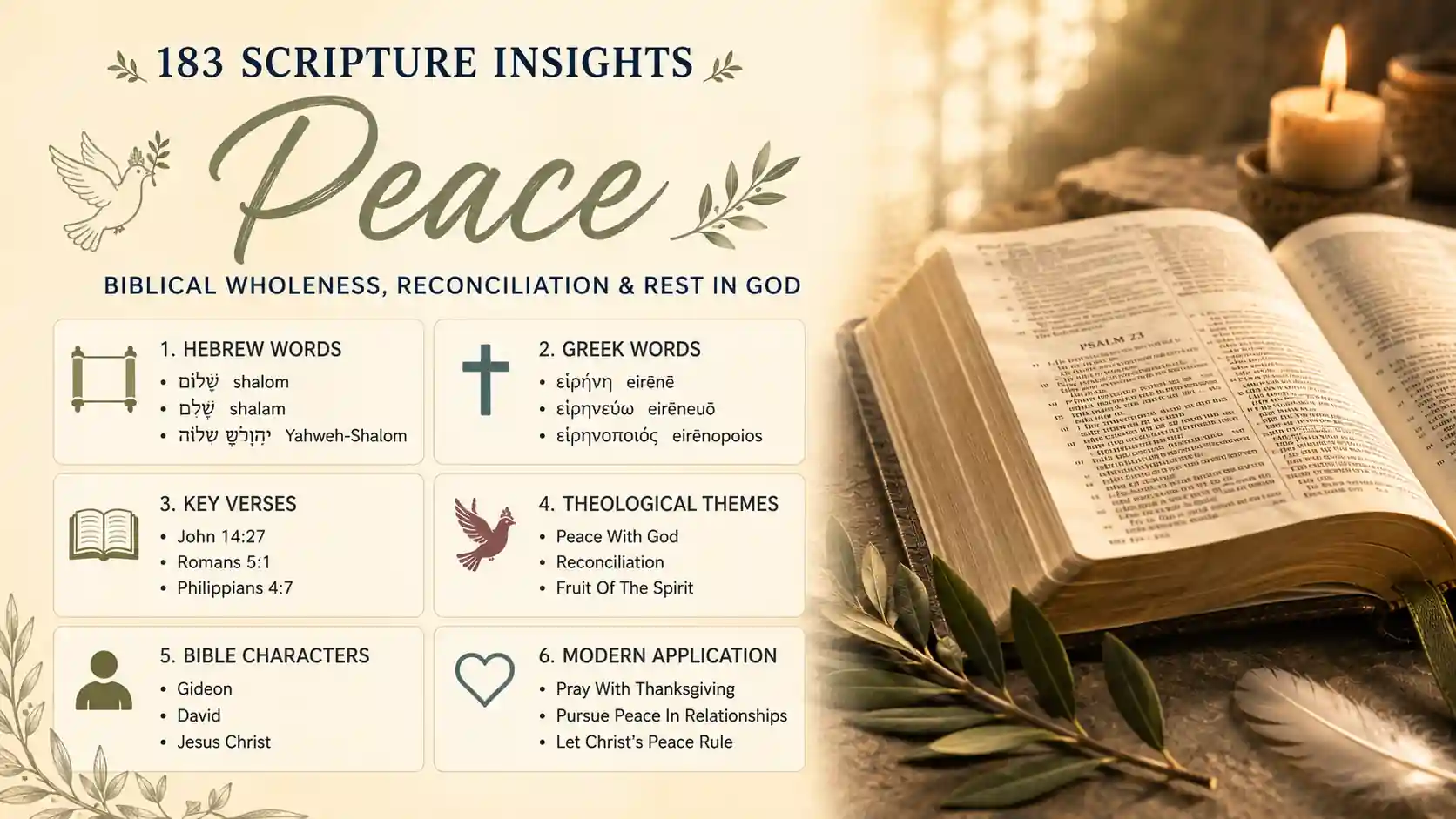
What does peace mean in the Bible? Scripture presents peace as far more than quiet circumstances or the absence of conflict. Biblical peace describes wholeness, restored relationships, covenant well-being, moral order, and the security that comes from living under God’s gracious rule.
In the Old Testament, peace is closely associated with שָׁלוֹם, shalom. In the New Testament, εἰρήνη, eirēnē, carries this rich Hebrew background forward. Your study of peace therefore begins with God, reaches its fulfillment in Jesus Christ, and shapes how you worship, endure suffering, and treat others.
Key Peace Scripture References
| Verse | Passage Snippet | Context |
|---|---|---|
| Numbers 6:24-26 | The Lord give you peace | Priestly blessing over Israel |
| Judges 6:23-24 | Peace be to you | God reassures fearful Gideon |
| Psalm 29:11 | Bless his people with peace | Divine strength produces security |
| Isaiah 9:6-7 | Prince of Peace | Messiah establishes righteous government |
| Isaiah 26:3 | Perfect peace | Trusting minds remain steadfast |
| John 14:27 | My peace I give you | Jesus comforts his disciples |
| Romans 5:1 | Peace with God | Justification ends hostility with God |
| Ephesians 2:14 | He is our peace | Christ unites Jews and Gentiles |
| Philippians 4:7 | Peace of God | God guards anxious hearts |
| Colossians 3:15 | Peace of Christ rule | Peace governs the church community |
These passages show several dimensions of biblical peace. It may describe safety, reconciliation, inner stability, social harmony, covenant blessing, or the future reign of the Messiah.
The meanings belong together because genuine peace flows from rightly ordered relationships. When God restores sinners to himself, that reconciliation begins reshaping their minds, communities, and hopes.
Peace Bible Translation Comparison
| Verse | KJV | NIV | ESV | NASB |
|---|---|---|---|---|
| Numbers 6:26 | Give thee peace | Give you peace | Give you peace | Give you peace |
| Isaiah 26:3 | Perfect peace | Perfect peace | Perfect peace | Perfect peace |
| Isaiah 53:5 | Chastisement of our peace | Punishment that brought peace | Chastisement that brought peace | Punishment for our well-being |
| Luke 2:14 | On earth peace | On earth peace | On earth peace | Peace among people |
| John 14:27 | My peace I give | My peace I give | My peace I give | My peace I give |
| Romans 5:1 | Peace with God | Peace with God | Peace with God | Peace with God |
| Ephesians 2:14 | He is our peace | He himself is our peace | He himself is our peace | He himself is our peace |
| Philippians 4:7 | Peace of God | Peace of God | Peace of God | Peace of God |
| Colossians 3:15 | Peace of God | Peace of Christ | Peace of Christ | Peace of Christ |
| James 3:18 | Fruit of righteousness | Harvest of righteousness | Harvest of righteousness | Fruit of righteousness |
Most translation differences concern wording rather than contradictory meanings. Isaiah 53:5 may refer to the discipline that secured “peace” or “well-being,” both of which reflect the breadth of shalom.
Colossians 3:15 contains a notable textual difference. Some manuscripts support “peace of God,” while many modern translations read “peace of Christ.” Either reading places the church’s shared life under peace that comes from the divine Redeemer.
People and Characters Associated with Peace
| Person | Role | Connection |
|---|---|---|
| Abraham | Patriarch | Promised a peaceful death |
| Aaron | High priest | Pronounced God’s peace upon Israel |
| Gideon | Judge | Built the altar Yahweh-Shalom |
| David | King and psalmist | Praised God as giver of peace |
| Solomon | King | His reign pictured national rest |
| Isaiah | Prophet | Announced the Prince of Peace |
| Jeremiah | Prophet | Exposed false promises of peace |
| Jesus Christ | Messiah and Lord | Gives peace and embodies peace |
| Paul | Apostle | Taught peace through justification |
| Peter | Apostle | Joined peace with righteous living |
Abraham’s promised departure “in peace” indicated a full and settled end to life. Aaron proclaimed peace as a divine blessing, while Gideon discovered peace when God met him during fear and national oppression.
The prophets also guarded the meaning of peace from distortion. Jeremiah condemned leaders who announced peace without repentance, justice, or healing. Jesus fulfilled the true prophetic hope by making peace through his sacrificial death.
Original Hebrew and Greek Words for Peace
| Original Word | Transliteration | Strong’s # | Literal Meaning |
|---|---|---|---|
| שָׁלוֹם | shalom | H7965 | Completeness, welfare, peace |
| שָׁלֵם | shalem | H8003 | Complete, safe, sound |
| שָׁלַם | shalam | H7999 | Be complete, repay, restore |
| שֶׁלֶם | shelem | H8002 | Peace offering, fellowship sacrifice |
| יְהוָה שָׁלוֹם | YHWH shalom | H3073 | The Lord is peace |
| שָׁקַט | shaqat | H8252 | Be quiet, undisturbed |
| מְנוּחָה | menuhah | H4496 | Resting place, repose |
| εἰρήνη | eirēnē | G1515 | Peace, harmony, welfare |
| εἰρηνεύω | eirēneuō | G1514 | Live or act peacefully |
| εἰρηνοποιός | eirēnopoios | G1518 | Peacemaker |
The principal Hebrew noun שָׁלוֹם, shalom, is Strong’s H7965. Its range includes completeness, soundness, welfare, safety, friendship, tranquility, and peace in covenant relationships. It is related to שָׁלַם, shalam, which can express completing, restoring, repaying, or making something whole.
The principal New Testament word is εἰρήνη, eirēnē, Strong’s G1515. In Jewish and Christian usage, it carries much of the theological depth of shalom. It can refer to ordinary peacefulness, reconciliation with God, harmony among believers, or the saving condition created by Christ.
Related Biblical Peace Concepts
| Concept | Connection | Supporting Verse |
|---|---|---|
| Righteousness | Right order produces peace | Isaiah 32:17 |
| Justice | Peace flourishes under just rule | Psalm 72:3-4 |
| Covenant | God pledges enduring well-being | Ezekiel 37:26 |
| Reconciliation | Enmity is replaced by fellowship | Romans 5:10 |
| Justification | Believers receive peace with God | Romans 5:1 |
| Rest | God provides settled security | Deuteronomy 12:10 |
| Holiness | Peace is pursued with holy living | Hebrews 12:14 |
| Unity | Christ creates one reconciled people | Ephesians 2:14-16 |
| Hope | Trust in God produces peaceful confidence | Romans 15:13 |
| Wisdom | Godly wisdom bears peaceful fruit | James 3:17-18 |
Peace and righteousness cannot be separated in biblical theology. Peace without truth becomes mere appeasement, while righteousness without reconciliation leaves relationships unrestored.
Scripture therefore connects peace with justice, holiness, wisdom, and covenant faithfulness. God’s peace does not conceal evil. It confronts sin, restores what is broken, and establishes relationships that reflect his character.
Historical and Cultural Context of Peace
| Aspect | Detail | Biblical Source |
|---|---|---|
| Hebrew greeting | Shalom expressed well-being | 1 Samuel 25:6 |
| Farewell blessing | Peace accompanied departure | Exodus 4:18 |
| Priestly blessing | Peace crowned the benediction | Numbers 6:24-26 |
| Covenant treaty | Peace could describe political agreement | Joshua 9:15 |
| Peace offering | Meal celebrated fellowship with God | Leviticus 7:11-15 |
| Royal security | Peace included safety from enemies | 1 Kings 4:24-25 |
| Prophetic warning | False prophets promised shallow peace | Jeremiah 6:14 |
| Roman setting | Imperial claims praised enforced order | Luke 2:1-14 |
| Jewish greeting | Peace marked household hospitality | Luke 10:5-6 |
| Apostolic greeting | Grace and peace opened letters | Romans 1:7 |
In ancient Israel, asking whether someone had “peace” could mean asking about that person’s health, family, safety, or general welfare. The word was broad enough to describe the condition of a person, a community, or a kingdom.
The peace offering also gave shalom a worship setting. Its shared meal celebrated communion with God. By contrast, prophetic announcements of false peace exposed the danger of using comforting religious language while ignoring covenant rebellion.
Theological Themes of Peace
| Theme | Explanation | Scripture |
|---|---|---|
| God as source | Lasting peace originates in God | Judges 6:24 |
| Messianic kingship | The Messiah governs in peace | Isaiah 9:6-7 |
| Atonement | Christ makes peace through his blood | Colossians 1:20 |
| Justification | Faith establishes peace with God | Romans 5:1 |
| Reconciliation | The cross removes hostility | Ephesians 2:14-16 |
| Holy Spirit | Peace is fruit of the Spirit | Galatians 5:22 |
| Sanctification | Peace should govern Christian conduct | Colossians 3:15 |
| Perseverance | Christ gives peace amid trouble | John 16:33 |
| Mission | The gospel announces peace | Ephesians 6:15 |
| New creation | God’s kingdom ends destructive conflict | Isaiah 11:6-9 |
The Bible first presents peace as something God possesses and gives. It is not generated merely by disciplined thought, favorable conditions, or political stability. Gideon named his altar יְהוָה שָׁלוֹם, YHWH shalom, “The Lord is peace,” after God answered his fear with assurance.
In the New Testament, this divine gift is centered in Christ. Paul does not merely say that Jesus teaches peace. He declares, “He himself is our peace,” because Christ’s cross reconciles sinners to God and creates one new people from formerly divided groups.
Modern Peace Application for Believers
| Area | Practice | Scripture |
|---|---|---|
| Prayer | Bring anxiety to God with thanksgiving | Philippians 4:6-7 |
| Thought life | Set your mind on the Spirit | Romans 8:6 |
| Relationships | Pursue what builds mutual peace | Romans 14:19 |
| Conflict | Seek truthful reconciliation | Matthew 5:23-24 |
| Speech | Reject slander and needless quarrels | 1 Peter 3:10-11 |
| Church life | Let Christ’s peace govern decisions | Colossians 3:15 |
| Suffering | Remember Christ has overcome | John 16:33 |
| Witness | Announce the gospel of peace | Ephesians 6:15 |
| Leadership | Join righteousness with peacemaking | James 3:17-18 |
| Public life | Pray for quiet and godly conditions | 1 Timothy 2:1-2 |
Biblical peace changes how you respond to anxiety, disagreement, suffering, and uncertainty. You seek God in prayer, submit your thoughts to revealed truth, and remember that circumstances do not determine your standing with him.
Peace also requires active obedience. You cannot control every conflict, but you can refuse revenge, speak truthfully, seek reconciliation, and pursue what strengthens others. Christian peacemaking is courageous love, not passive avoidance.
What Does Peace Mean in the Bible Through Shalom?
שָׁלוֹם, shalom, describes life made whole under God’s favor. It may include physical safety and outward prosperity, but it cannot be reduced to comfort or wealth. Its deepest foundation is a rightly ordered relationship with the covenant Lord.
This explains why peace and righteousness meet so often in the prophets and Psalms. When people worship faithfully, practice justice, and live securely beneath God’s rule, shalom becomes visible in communal life.
Yahweh-Shalom and Gideon’S Fearful Generation
Judges 6 places Gideon in an age without national peace. Midianite raiders had devastated Israel, and Gideon was hiding produce when the angel of the Lord commissioned him. His first need, however, was not a military plan but assurance before God.
When Gideon feared that seeing the divine messenger meant death, the Lord said, “Peace be to you. Do not fear.” Gideon then built an altar called יְהוָה שָׁלוֹם, YHWH shalom. Peace began with God’s presence and promise before circumstances changed.
EirēNē Through the Cross of Christ
The New Testament does not treat εἰρήνη, eirēnē, as sentimental calm. Romans 5 places peace with God after justification by faith. The problem being answered is humanity’s guilt and estrangement, not simply emotional discomfort.
Ephesians 2 extends this vertical reconciliation into human community. Through the cross, Christ ends hostility and forms one body from Jews and Gentiles. Peace with God creates a people who must learn to live at peace with one another.
Christ’S Peace in Trouble, Prayer, and Hope
Jesus promised peace in the upper room while preparing his disciples for his departure, persecution, and grief. His peace was not a guarantee that suffering would disappear. It was the security of belonging to him while trouble continued.
Philippians 4 likewise connects peace with prayer rather than perfect circumstances. As you present your requests with thanksgiving, God’s peace guards your heart and mind. Peace becomes a divine protection that enables faithful endurance.
Questions About Biblical Peace
Does שָׁלוֹם, shalom, simply mean the absence of war?
No. It also expresses wholeness, welfare, safety, sound relationships, and life ordered beneath God’s blessing.
What is the difference between peace with God and the peace of God?
Peace with God describes reconciliation through Christ, while the peace of God describes God-given stability that guards believers.
Why does Jesus say he brings peace when Matthew 10:34 mentions a sword?
Christ reconciles people to God, but loyalty to him also exposes unbelief and may produce division within resistant relationships.
Does Isaiah 53:5 teach emotional peace or reconciliation with God?
Its shalom language is broad, but the servant’s suffering primarily repairs the sinful estrangement that lies beneath human brokenness.
How can you pursue εἰρήνη, eirēnē, without compromising truth?
You pursue peace through truthful speech, repentance, forgiveness, justice, patience, and obedience rather than by pretending evil does not matter.