
What does lament mean in the Bible? Biblical lament is the faithful expression of grief, confusion, protest, repentance, or longing before God. Rather than hiding pain, you bring it into God’s presence through prayer, tears, song, and honest speech.
Lament is not unbelief dressed in religious language. It is wounded faith still reaching toward the Lord. Scripture gives you words for personal sorrow, national disaster, injustice, bereavement, divine discipline, and seasons when God seems silent.
Lament Key Scripture References
| Verse | Passage Snippet | Context |
|---|---|---|
| Psalm 13:1 | “How long, O Lord?” | David feels forgotten |
| Psalm 22:1 | “Why have you forsaken me?” | Suffering and divine silence |
| Psalm 42:9 | “Why have you forgotten me?” | Exile from worship |
| Job 3:3 | “Let the day perish” | Job mourns his birth |
| 2 Samuel 1:17 | David lamented | Saul and Jonathan die |
| Jeremiah 9:1 | “A fountain of tears” | Judah’s sin and ruin |
| Lamentations 1:1 | “How lonely sits the city” | Jerusalem lies desolate |
| Lamentations 3:22 | Mercies never cease | Hope within affliction |
| Habakkuk 1:2 | “How long shall I cry?” | Violence appears unanswered |
| Matthew 27:46 | “Why have you forsaken me?” | Jesus suffers on the cross |
These passages show that lament may include questioning, mourning, confession, petition, remembrance, and renewed trust. It speaks truthfully about suffering while continuing to address God.
Lament Bible Translation Comparison
| Verse | KJV | NIV | ESV | NASB |
|---|---|---|---|---|
| Psalm 13:1 | “How long wilt thou forget me” | “How long, Lord?” | “How long, O Lord?” | “How long, Lord?” |
| Psalm 22:1 | “Why hast thou forsaken me” | “Why have you forsaken me” | “Why have you forsaken me” | “Why have You forsaken me” |
| Psalm 42:9 | “Why hast thou forgotten me” | “Why have you forgotten me” | “Why have you forgotten me” | “Why have You forgotten me” |
| Job 3:3 | “Let the day perish” | “May the day of my birth perish” | “Let the day perish” | “May the day perish” |
| Jeremiah 9:1 | “A fountain of tears” | “A fountain of tears” | “A fountain of tears” | “A fountain of tears” |
| Lamentations 1:1 | “How doth the city sit solitary” | “How deserted lies the city” | “How lonely sits the city” | “How lonely sits the city” |
| Habakkuk 1:2 | “How long shall I cry” | “How long, Lord, must I call” | “How long shall I cry” | “How long, Lord, have I called” |
| Matthew 11:17 | “Ye have not lamented” | “You did not mourn” | “You did not mourn” | “You did not mourn” |
| Luke 23:27 | “Lamented him” | “Mourned and wailed for him” | “Lamenting for him” | “Mourning and grieving for Him” |
| James 4:9 | “Mourn, and weep” | “Grieve, mourn and wail” | “Mourn and weep” | “Mourn and weep” |
Translation differences often reflect the breadth of lament language. Words rendered “lament,” “mourn,” “wail,” “weep,” or “grieve” may describe overlapping expressions of sorrow, though each term can carry its own emphasis.
Lament People and Characters Associated
| Person | Role | Connection |
|---|---|---|
| Job | Righteous sufferer | Laments devastating loss |
| David | King and psalmist | Writes personal laments |
| Jeremiah | Prophet of Judah | Weeps over rebellion |
| Hannah | Mother of Samuel | Prays through bitter grief |
| Naomi | Widowed Israelite | Voices emptiness and loss |
| Asaph | Temple singer | Laments national confusion |
| Habakkuk | Prophet | Questions unchecked violence |
| Ezekiel | Exilic prophet | Composes judgment laments |
| Jesus | Messiah | Laments Jerusalem and suffers |
| Mary Magdalene | Disciple | Weeps outside the tomb |
These people do not all lament in the same manner. Hannah pours out her soul, Job curses the day of his birth, David sings, Jeremiah weeps, and Jesus cries aloud. Together they demonstrate that biblical faith does not require emotional uniformity.
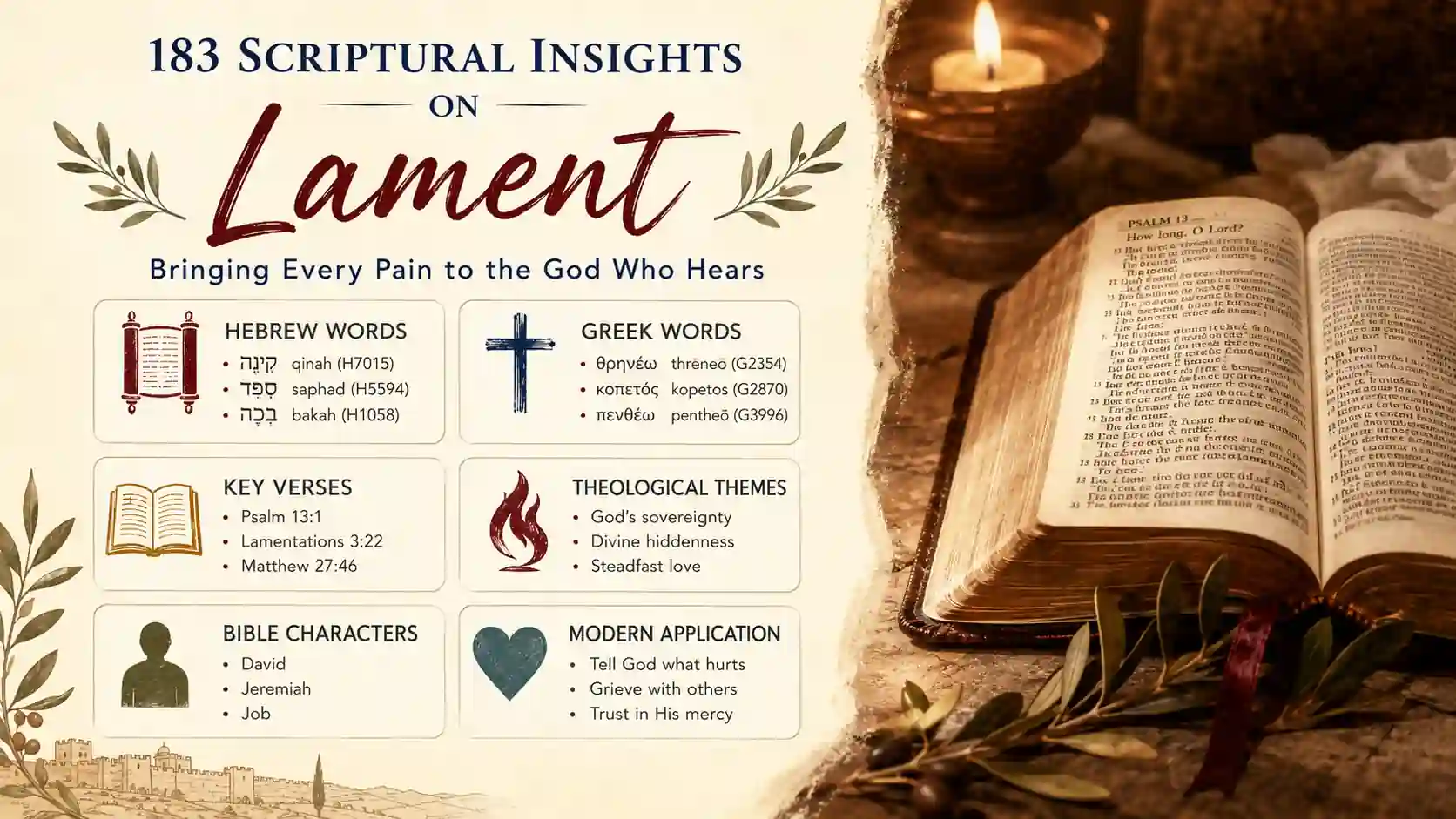
Lament Original Hebrew and Greek Words
| Original Word | Transliteration | Strong’s # | Literal Meaning |
|---|---|---|---|
| קִינָה | qinah | H7015 | Dirge or lamentation |
| סָפַד | saphad | H5594 | Mourn or lament |
| מִסְפֵּד | misped | H4553 | Mourning or wailing |
| בָּכָה | bakah | H1058 | Weep or shed tears |
| בְּכִי | bekhi | H1065 | Weeping or crying |
| נְהִי | nehi | H5092 | Wailing or lament |
| אָבַל | aval | H56 | Mourn or grieve |
| θρηνέω | thrēneō | G2354 | Lament or sing a dirge |
| κοπετός | kopetos | G2870 | Beating the breast, mourning |
| πενθέω | pentheō | G3996 | Mourn or experience grief |
The formal Hebrew noun קִינָה, qinah, often describes a composed dirge, including David’s lament for Saul and Jonathan and Ezekiel’s poetic laments over rulers and nations. The verb סָפַד, saphad, points more directly to the act of mourning, sometimes accompanied by weeping, fasting, sackcloth, or burial customs.
In the New Testament, θρηνέω, thrēneō, portrays audible lamentation or the singing of a dirge. Biblical lament therefore includes inward grief, but it is frequently voiced, embodied, communal, and shaped into prayer or poetry.
Lament Related Biblical Concepts
| Concept | Connection | Supporting Verse |
|---|---|---|
| Grief | Lament gives sorrow words | John 11:35 |
| Prayer | Pain is addressed to God | Psalm 13:3 |
| Complaint | Suffering is honestly named | Habakkuk 1:2 |
| Repentance | Sin produces godly mourning | Joel 2:12 |
| Confession | Guilt is acknowledged | Psalm 51:3 |
| Intercession | One grieves for others | Jeremiah 14:7 |
| Justice | Evil is brought before God | Psalm 10:1 |
| Remembrance | God’s character is recalled | Lamentations 3:21 |
| Hope | Mercy is awaited | Psalm 130:5 |
| Worship | Sorrow becomes sacred speech | Psalm 42:5 |
Biblical complaint is not identical to faithless grumbling. Grumbling rejects God’s wisdom and resists his ways. Lament turns toward God, names what is wrong, asks him to act, and often appeals to his covenant character.
Lament Historical and Cultural Context
| Aspect | Detail | Biblical Source |
|---|---|---|
| Funeral dirges | Songs honored the dead | 2 Samuel 1:17 |
| Professional mourners | Skilled women led wailing | Jeremiah 9:17 |
| Torn garments | Clothing expressed anguish | Job 1:20 |
| Sackcloth | Rough cloth marked sorrow | Esther 4:1 |
| Ashes and dust | Humiliation was embodied | Job 2:8 |
| Fasting | Food was withheld in grief | 2 Samuel 1:12 |
| Public weeping | Communities mourned together | Judges 20:26 |
| City lament | Ruined Jerusalem is personified | Lamentations 1:1 |
| Acrostic poetry | Grief receives ordered form | Lamentations 1 to 4 |
| Exile | Displacement fuels communal lament | Psalm 137:1 |
Many biblical laments arose within public practices rather than private reflection alone. Families and communities wept, fasted, tore garments, wore sackcloth, sat in ashes, and sang dirges. These actions made grief visible and allowed the community to bear sorrow together.
The Book of Lamentations responds to Jerusalem’s destruction by Babylon in 586 BC. Its first four poems use alphabetic structures, giving disciplined expression to national devastation. Ordered poetry does not diminish pain. It helps sufferers speak when disaster has shattered ordinary language.
Lament Theological Themes
| Theme | Explanation | Scripture |
|---|---|---|
| God’s sovereignty | Pain remains under his rule | Job 1:21 |
| Divine hiddenness | God may seem absent | Psalm 22:1 |
| Covenant appeal | Prayer recalls God’s promises | Psalm 74:20 |
| Human honesty | Suffering is not minimized | Psalm 88:3 |
| Divine justice | The oppressed ask for action | Psalm 10:15 |
| Judgment | Sin has destructive consequences | Lamentations 1:8 |
| Compassion | God hears afflicted people | Exodus 3:7 |
| Steadfast love | Mercy survives catastrophe | Lamentations 3:22 |
| Messianic suffering | Jesus bears forsakenness | Matthew 27:46 |
| Resurrection hope | Mourning will not reign forever | Revelation 21:4 |
Lament rests on a profound theological conviction. God is worth addressing even when you do not understand his actions. The lamenter assumes that God hears, governs, remembers his covenant, opposes evil, and possesses the power to save.
Some laments move quickly toward confidence, as Psalm 13 does. Others end in darkness, as Psalm 88 does. Scripture preserves both experiences, teaching you that faithful prayer is not measured by how rapidly your emotions improve.
Lament Modern Application for Believers
| Area | Practice | Scripture |
|---|---|---|
| Personal grief | Tell God what hurts | Psalm 62:8 |
| Bereavement | Mourn with hope | 1 Thessalonians 4:13 |
| Injustice | Ask God to intervene | Psalm 10:12 |
| Illness | Pray without pretending | Psalm 6:2 |
| Repentance | Grieve sin sincerely | James 4:9 |
| Church life | Weep with sufferers | Romans 12:15 |
| National crisis | Pray as a community | Psalm 80:3 |
| Spiritual dryness | Continue seeking God | Psalm 42:11 |
| Waiting | Remember past faithfulness | Psalm 77:11 |
| Future hope | Anticipate restored creation | Revelation 21:4 |
You can practice lament by addressing God directly, describing the trouble honestly, requesting help, and recalling what Scripture reveals about his character. This pattern is not a rigid formula. It is a trustworthy path for bringing your whole heart before the Lord.
Lament also guards you against shallow comfort. Before offering explanations to a sufferer, you can listen, weep, pray, and acknowledge the weight of loss. Romans 12:15 calls you to “weep with those who weep,” not to hurry them past their sorrow.
קִינָה Gives Grief a Faithful Form
The Hebrew word קִינָה, qinah, shows that lament can be thoughtfully composed. David’s song over Saul and Jonathan in 2 Samuel 1 honors the dead, describes Israel’s loss, and teaches the community how to remember. His grief is neither chaotic denial nor cold analysis.
A composed lament allows pain to be repeated, shared, and preserved. When your own words fail, biblical laments can carry your prayer. You may borrow the language of David, Asaph, Job, Jeremiah, or the exiles until you can speak again.
What Does Lament Mean in the Bible’S Covenant Story?
Israel’s laments frequently appeal to covenant history. The worshiper remembers the exodus, God’s promises, his dwelling in Zion, and his past acts of deliverance. The question is not merely, “Why am I hurting?” It is also, “Lord, how does this suffering relate to who you have revealed yourself to be?”
This appeal is an act of faith. You are asking God to act consistently with his name, mercy, justice, and promises. Even questions such as “How long?” assume that evil has a limit and that the covenant Lord can bring the waiting to an end.
Jesus Carries Lament into the Heart of Redemption
Jesus lamented over Jerusalem because its people resisted the peace God offered. At Lazarus’s tomb, he wept in the presence of death. On the cross, he prayed the opening words of Psalm 22, entering the scriptural language of abandonment and suffering.
His lament reveals that sorrow is not foreign to holiness. Through his death and resurrection, lament is placed within a larger hope. Christians still grieve, but they grieve before the risen Christ, trusting that death, injustice, and tears will not have the final word.
From “How Long?” to Remembered Mercy
Lamentations 3 turns when the sufferer calls God’s steadfast love to mind. Circumstances have not yet changed, and Jerusalem remains devastated. Hope arises because the lamenter remembers the Lord’s mercies, compassion, and faithfulness amid the ruins.
This movement does not require you to deny your anguish. Biblical hope can stand inside grief rather than replacing it. You may confess both realities at once, saying that your soul is deeply troubled and that God remains your portion.
Questions Bible Students Ask About Lament
Is קִינָה, qinah, simply another word for sadness?
No. It usually describes an expressed or composed dirge, not merely an inward feeling.
Why does Psalm 88 end without a clear statement of hope?
Its dark ending shows that faithful prayer may continue even when relief and emotional resolution have not arrived.
Does asking “How long?” reveal a lack of faith?
Not necessarily. In biblical lament, the question often expresses faith that God can act and that suffering should not continue forever.
How is θρηνέω, thrēneō, different from silent grief?
The word commonly emphasizes audible mourning, wailing, or the public singing of a dirge.
Can you lament and still trust God at the same time?
Yes. Biblical lament is often the language of trust under pressure, bringing unresolved pain directly to the God whose mercy you still seek.