
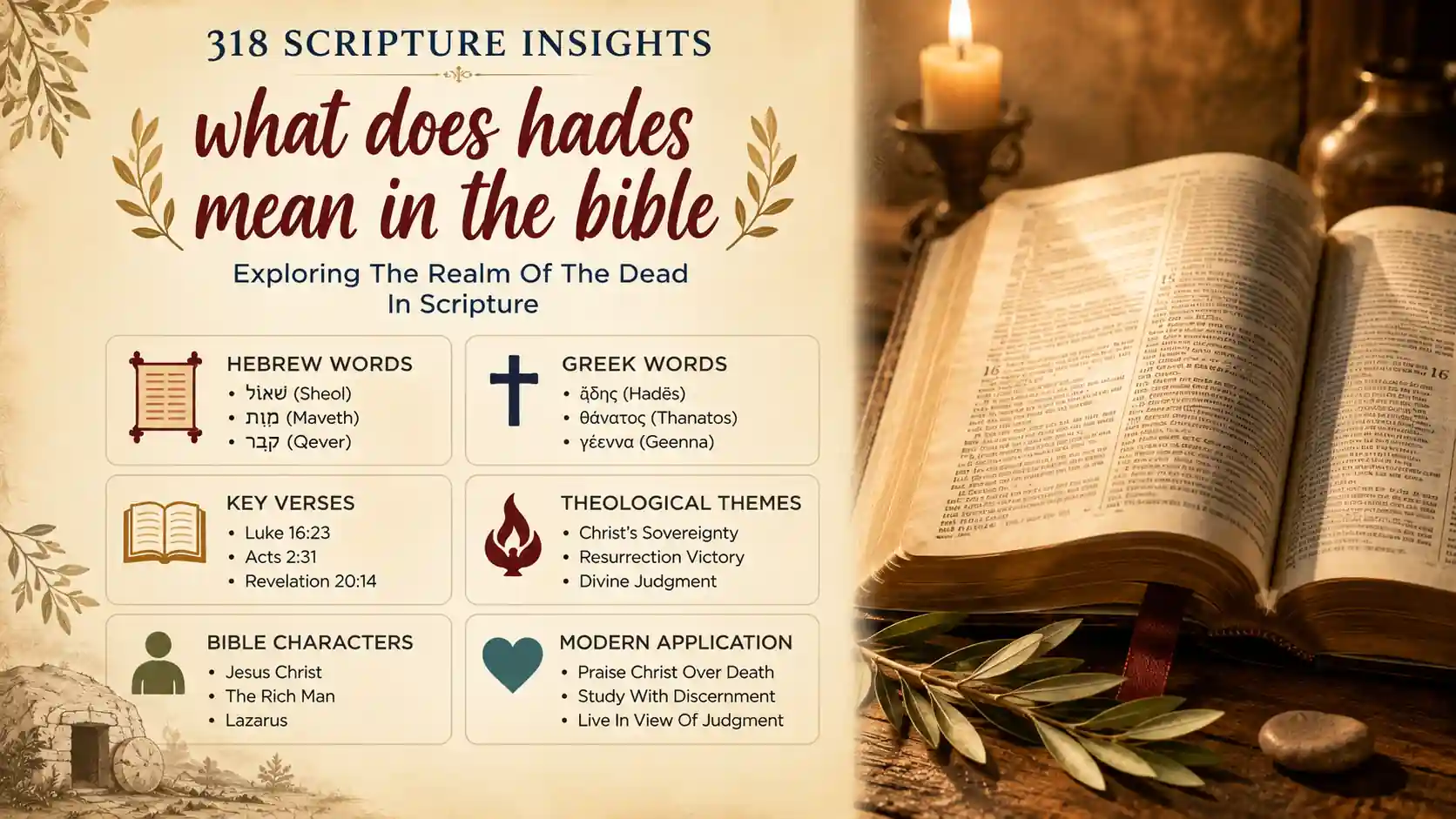
What does Hades mean in the Bible? The Greek word ᾅδης, hadēs, usually refers to the realm of the dead, the unseen destination associated with death before the final resurrection and judgment. Its meaning is related to the Hebrew concept of שְׁאוֹל, sheol, though individual passages emphasize different aspects of that realm.
As you study Hades, you must distinguish it from the grave, Gehenna, and the lake of fire. Scripture presents Hades as temporary, subject to Christ’s authority, and ultimately destined for destruction.
Hades Key Scripture References
| Verse | Passage Snippet | Context |
|---|---|---|
| Matthew 11:23 | Capernaum brought down to Hades | Jesus warns an unrepentant city |
| Matthew 16:18 | Gates of Hades will not prevail | Christ promises to build His church |
| Luke 10:15 | Capernaum brought down to Hades | Pride is answered by humiliation |
| Luke 16:23 | The rich man is in Hades | Jesus portrays anguish after death |
| Acts 2:27 | Not abandoned to Hades | Peter applies Psalm 16 to Jesus |
| Acts 2:31 | Christ was not left in Hades | Resurrection fulfills David’s prophecy |
| Revelation 1:18 | Keys of Death and Hades | The risen Jesus declares His authority |
| Revelation 6:8 | Hades follows Death | The fourth horseman brings judgment |
| Revelation 20:13 | Hades gives up the dead | The dead appear before final judgment |
| Revelation 20:14 | Hades cast into the lake of fire | Death’s realm is permanently abolished |
These ten New Testament occurrences show Hades in warnings, resurrection preaching, apocalyptic judgment, and Christ’s victory over death.
Hades Bible Translation Comparison
| Verse | KJV | NIV | ESV | NASB |
|---|---|---|---|---|
| Matthew 11:23 | hell | Hades | Hades | Hades |
| Matthew 16:18 | gates of hell | gates of Hades | gates of hell | gates of Hades |
| Luke 10:15 | hell | Hades | Hades | Hades |
| Luke 16:23 | hell | Hades | Hades | Hades |
| Acts 2:27 | hell | realm of the dead | Hades | Hades |
| Acts 2:31 | hell | realm of the dead | Hades | Hades |
| Revelation 1:18 | hell | Hades | Hades | Hades |
| Revelation 6:8 | Hell | Hades | Hades | Hades |
| Revelation 20:13 | hell | Hades | Hades | Hades |
| Revelation 20:14 | hell | Hades | Hades | Hades |
The KJV commonly uses “hell,” while many modern translations preserve “Hades” or use “the realm of the dead.” This difference matters because English “hell” can suggest final punishment, while Revelation 20:14 distinguishes Hades from the lake of fire.
Hades People and Characters Associated
| Person | Role | Connection |
|---|---|---|
| Jesus Christ | Risen Lord | Possesses the keys of Hades |
| Peter | Apostle and preacher | Proclaims Christ was not abandoned there |
| David | King and psalmist | Prophetically speaks of resurrection |
| The rich man | Figure in Jesus’ account | Experiences anguish in Hades |
| Lazarus | Poor man in Jesus’ account | Receives comfort after death |
| Abraham | Patriarch | Speaks to the rich man across a chasm |
| Capernaum’s residents | Witnesses of Jesus’ works | Warned of descent to Hades |
| Death | Personified enemy | Paired with Hades in Revelation |
| The fourth rider | Agent of judgment | Named Death, followed by Hades |
| The final Judge | Enthroned divine ruler | Summons the dead from Hades |
These people and figures reveal that Hades is not an abstract philosophical idea. It appears within Jesus’ teaching, apostolic preaching, Israel’s hope, and John’s vision of final judgment.
Hades Original Hebrew and Greek Words
| Original Word | Transliteration | Strong’s # | Literal Meaning |
|---|---|---|---|
| ᾅδης | hadēs | G86 | Hades, unseen realm of the dead |
| שְׁאוֹל | sheol | H7585 | Sheol, underworld, realm of the dead |
| θάνατος | thanatos | G2288 | Death |
| מָוֶת | maveth | H4194 | Death |
| קֶבֶר | qever | H6913 | Grave, burial place |
| בּוֹר | bor | H953 | Pit, cistern, dungeon |
| γέεννα | geenna | G1067 | Gehenna, place of punishment |
| ἄβυσσος | abyssos | G12 | Abyss, bottomless depth |
| ταρταρόω | tartaroō | G5020 | To confine in Tartarus |
| ψυχή | psychē | G5590 | Soul, life, self |
The noun ᾅδης, hadēs, is Strong’s G86, while שְׁאוֹל, sheol, is Strong’s H7585. Greek translations of the Old Testament frequently used hadēs for sheol, creating an important bridge between the Testaments.
Hades Related Biblical Concepts
| Concept | Connection | Supporting Verse |
|---|---|---|
| Sheol | Old Testament realm of the dead | Psalm 16:10 |
| Death | Frequently paired with Hades | Revelation 1:18 |
| Resurrection | Releases people from death’s power | Acts 2:31 |
| The grave | Physical burial, unlike the broader realm | John 11:17 |
| Gehenna | Image of final divine punishment | Matthew 10:28 |
| Lake of fire | Final destination of Death and Hades | Revelation 20:14 |
| Final judgment | Hades releases its dead for judgment | Revelation 20:13 |
| Abraham’s side | Place of comfort in Jesus’ account | Luke 16:22 |
| Great chasm | Fixed separation after death | Luke 16:26 |
| Keys | Symbol of Christ’s sovereign authority | Revelation 1:18 |
These concepts should not be collapsed into one definition. A grave is a burial place, Hades is the realm associated with the dead, and the lake of fire appears after the final judgment.
Hades Historical and Cultural Context
| Aspect | Detail | Biblical Source |
|---|---|---|
| Hebrew background | Sheol described the destination of the dead | Genesis 37:35 |
| Greek translation | Hadēs often represented Hebrew sheol | Psalm 16:10, LXX |
| Ancient geography | The dead were pictured as going downward | Numbers 16:30 |
| City gates | Gates symbolized a city’s defensive strength | Matthew 16:18 |
| Burial customs | Bodies were placed in tombs or caves | John 19:41 |
| Royal imagery | Kings could be brought down to Sheol | Isaiah 14:9 |
| Wisdom literature | Sheol is never satisfied | Proverbs 27:20 |
| Jewish hope | God could redeem a person from Sheol | Psalm 49:15 |
| Apostolic preaching | Psalm 16 was read as messianic prophecy | Acts 2:25-32 |
| Apocalyptic imagery | Death and Hades become personified powers | Revelation 6:8 |
The Septuagint, the ancient Greek translation of the Hebrew Scriptures, helped shape the vocabulary available to New Testament writers. Its use of hadēs for sheol explains why Acts 2 can quote Psalm 16 while speaking of Hades.
Hades Theological Themes
| Theme | Explanation | Scripture |
|---|---|---|
| Christ’s sovereignty | Jesus controls access to Death and Hades | Revelation 1:18 |
| Resurrection victory | Christ was not held by death’s realm | Acts 2:24-31 |
| Human mortality | Every person faces death apart from Christ’s return | Hebrews 9:27 |
| Divine judgment | Hades gives up the dead before judgment | Revelation 20:13 |
| Temporary existence | Hades itself reaches an appointed end | Revelation 20:14 |
| Church endurance | Death cannot defeat Christ’s gathered people | Matthew 16:18 |
| Moral accountability | Earthly choices possess eternal seriousness | Luke 16:19-31 |
| Reversal of status | Pride and privilege do not guarantee divine favor | Luke 16:25 |
| Prophetic fulfillment | David’s words anticipate the Messiah | Acts 2:30-31 |
| Final restoration | Death is removed from God’s renewed creation | Revelation 21:4 |
Hades belongs to the Bible’s larger story of creation, fall, redemption, resurrection, judgment, and renewal. It is real within that story, but it is never presented as equal to God or beyond Christ’s power.
Hades Modern Application for Believers
| Area | Practice | Scripture |
|---|---|---|
| Bible study | Distinguish Hades, Gehenna, and the grave | Revelation 20:14 |
| Worship | Praise Christ as Lord over death | Revelation 1:18 |
| Hope | Rest in the promise of resurrection | John 11:25 |
| Evangelism | Speak honestly about judgment and grace | Acts 17:30-31 |
| Humility | Respond to the light God has given | Matthew 11:23 |
| Compassion | Notice suffering people like Lazarus | Luke 16:20 |
| Repentance | Do not presume upon privilege | Luke 10:15 |
| Grief | Mourn with confidence in Christ | 1 Thessalonians 4:13 |
| Courage | Trust that death cannot defeat the church | Matthew 16:18 |
| Holiness | Live in view of final accountability | 2 Corinthians 5:10 |
Your study of Hades should produce neither morbid fascination nor careless speculation. It should deepen your confidence in Christ, awaken sober reflection about judgment, and strengthen compassionate witness.
What Does Hades Mean in the Bible’S Greek Vocabulary?
The Greek noun ᾅδης, hadēs, means Hades or the realm of the dead. The word was familiar in the Greek-speaking world, but the New Testament uses it within the Bible’s own account of creation, sin, death, resurrection, and judgment rather than simply adopting pagan mythology.
In several passages, Hades describes the condition or realm to which the dead descend. It can express humiliation, as in the warnings against Capernaum, or the power of death, as in Christ’s promise that the gates of Hades will not overcome His church.
How שְׁאוֹל Sheol Illuminates Hades
The Hebrew שְׁאוֹל, sheol, appears throughout the Old Testament for the realm of the dead. Jacob expects to go there mourning, Job speaks of hiding there, the psalmists cry for deliverance from it, and the prophets use it to portray the downfall of proud nations.
Sheol is broader than a single physical grave because Scripture can distinguish it from a person’s tomb. Yet Old Testament descriptions vary according to genre. Poetry often uses Sheol as a vivid image of death, silence, weakness, darkness, or separation from ordinary life.
What Does Hades Mean in the Bible After Christ’S Resurrection?
Acts 2 gives the clearest Christ-centered interpretation. Peter quotes Psalm 16 and explains that David foresaw the Messiah’s resurrection. Jesus was not abandoned to Hades, and His body did not undergo the corruption expected in ordinary death.
This does not mean Hades successfully imprisoned Christ until He escaped. Peter’s point is that death could not hold Him. The Father raised Him, fulfilling Scripture and publicly identifying Jesus as both Lord and Messiah.
The Keys of Death and Hades in Revelation
In Revelation 1:18, the risen Christ declares that He holds the keys of Death and Hades. Keys represent rightful authority. Neither death nor the realm of the dead acts independently of the Lord who died, rose, and now lives forever.
Revelation 20 provides the final perspective. Death and Hades release the dead for judgment, then both are thrown into the lake of fire. Hades is therefore not the final state. It is a temporary enemy that disappears when God’s judgment is complete and death is abolished.
Frequently Asked Questions About Hades
Are ᾅδης, hadēs, and שְׁאוֹל, sheol, exactly identical?
They substantially overlap as terms for the realm of the dead, though each passage’s language, covenant setting, and literary genre must guide your interpretation.
Why does the KJV call Hades “hell” in Acts 2:27?
Older English usage allowed “hell” to refer broadly to the unseen realm, while many modern translations preserve “Hades” to avoid suggesting the final lake of fire.
Does Luke 16:23 prove that everyone in Hades experiences torment?
The verse clearly portrays the rich man in anguish, but the account also portrays Lazarus in comfort, so its details should not be reduced to one condition for every dead person.
What are the gates of Hades in Matthew 16:18?
They symbolize the power or stronghold of death, which cannot prevent Christ from building and preserving His church.
Why is Hades thrown into the lake of fire in Revelation 20:14?
Because Hades is temporary, it is abolished after releasing the dead for judgment, marking the final defeat of death itself.