
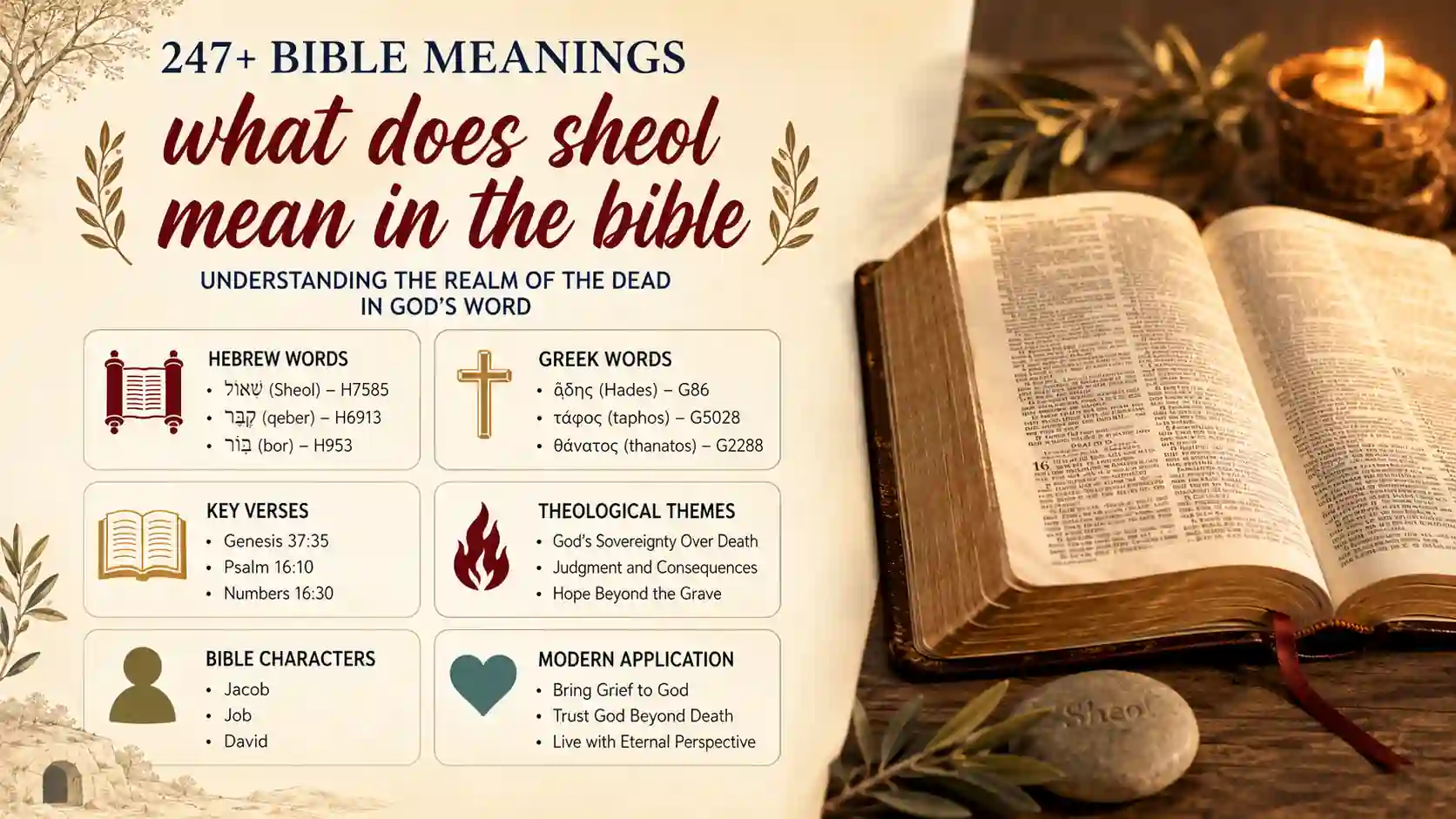
What does sheol mean in the Bible? In your study, שְׁאוֹל (Sheol) names the realm of the dead, the shadowed place to which human life descends after death. It is not merely a grave dug in soil, though it can be closely associated with burial, dust, silence, and decay.
Sheol appears most often in poetry, lament, wisdom, and prophetic warning. The Bible uses it to speak honestly about mortality, divine judgment, human sorrow, and the hope that God’s covenant love reaches beyond death.
Sheol Key Scripture References
| Verse | Passage Snippet | Context |
|---|---|---|
| Genesis 37:35 | Jacob says he will go down to Sheol | Grief over Joseph |
| Numbers 16:30 | Rebels go down alive into Sheol | Judgment on Korah |
| 1 Samuel 2:6 | The Lord brings down to Sheol | Hannah’s prayer |
| Job 7:9 | One who goes to Sheol does not come up | Job’s lament |
| Psalm 16:10 | You will not abandon my soul to Sheol | Davidic hope |
| Psalm 49:15 | God will ransom my soul from Sheol | Trust beyond death |
| Psalm 88:3 | My life draws near to Sheol | Deep suffering |
| Proverbs 9:18 | Her guests are in depths of Sheol | Folly’s danger |
| Isaiah 14:9 | Sheol beneath is stirred up | Taunt over Babylon |
| Hosea 13:14 | Shall I ransom them from Sheol? | Judgment and hope |
Sheol Bible Translation Comparison
| Verse | KJV | NIV | ESV | NASB |
|---|---|---|---|---|
| Genesis 37:35 | grave | grave | Sheol | Sheol |
| Numbers 16:30 | pit | realm of the dead | Sheol | Sheol |
| 1 Samuel 2:6 | grave | realm of the dead | Sheol | Sheol |
| Job 7:9 | grave | realm of the dead | Sheol | Sheol |
| Psalm 16:10 | hell | realm of the dead | Sheol | Sheol |
| Psalm 49:15 | grave | realm of the dead | Sheol | Sheol |
| Psalm 88:3 | grave | realm of the dead | Sheol | Sheol |
| Proverbs 15:11 | hell | Death | Sheol | Sheol |
| Isaiah 14:9 | hell | realm of the dead | Sheol | Sheol |
Sheol People & Characters Associated
| Person | Role | Connection |
|---|---|---|
| Jacob | Patriarch | Expected sorrowful descent to Sheol |
| Joseph | Beloved son | His presumed death caused Jacob’s lament |
| Korah | Rebel Levite | Went down alive in judgment |
| Dathan | Rebel leader | Swallowed in Sheol judgment scene |
| Abiram | Rebel leader | Judged with Korah’s company |
| Hannah | Mother of Samuel | Confessed God’s power over Sheol |
| Job | Suffering righteous man | Longed for Sheol as hidden rest |
| David | King and psalmist | Hoped God would not abandon him there |
| Jonah | Prophet | Prayed from “belly of Sheol” imagery |
| Hezekiah | King of Judah | Spoke of Sheol in near-death prayer |
Sheol Original Hebrew & Greek Words
| Original Word | Transliteration | Strong’s # | Literal Meaning |
|---|---|---|---|
| שְׁאוֹל | Sheol | H7585 | Underworld, realm of dead |
| קֶבֶר | qeber | H6913 | Grave, burial place |
| בּוֹר | bor | H953 | Pit, cistern, dungeon |
| שַׁחַת | shachath | H7845 | Pit, destruction |
| אֲבַדּוֹן | Abaddon | H11 | Destruction |
| מָוֶת | maveth | H4194 | Death |
| ᾅδης | Hades | G86 | Unseen realm of dead |
| γέεννα | Gehenna | G1067 | Valley of Hinnom, judgment |
| τάφος | taphos | G5028 | Tomb, grave |
| θάνατος | thanatos | G2288 | Death |
Sheol Related Biblical Concepts
| Concept | Connection | Supporting Verse |
|---|---|---|
| Death | Sheol receives the dead | Psalm 89:48 |
| Dust | Mortality frames descent | Genesis 3:19 |
| Grave | Burial overlaps imagery | Genesis 37:35 |
| Pit | Poetic parallel to Sheol | Psalm 30:3 |
| Silence | Praise ceases in death’s realm | Psalm 6:5 |
| Darkness | Sheol described as gloom | Job 10:21 |
| Abaddon | Paired with Sheol | Proverbs 15:11 |
| Ransom | God rescues from Sheol | Psalm 49:15 |
| Resurrection | Later hope answers Sheol | Daniel 12:2 |
| Judgment | The wicked are sent there | Psalm 9:17 |
Sheol Historical & Cultural Context
| Aspect | Detail | Biblical Source |
|---|---|---|
| Ancient burial | Family tombs shaped death language | Genesis 49:29 |
| Descent language | People “go down” to Sheol | Genesis 37:35 |
| Covenant grief | Patriarchs mourned with Sheol terms | Genesis 42:38 |
| Wilderness judgment | Earth opening signified divine wrath | Numbers 16:33 |
| Royal taunt | Dead kings pictured in Sheol | Isaiah 14:9 |
| Wisdom warning | Folly’s path leads downward | Proverbs 5:5 |
| Lament prayer | Sufferers speak from near Sheol | Psalm 88:3 |
| Temple worship | Death threatens public praise | Psalm 30:9 |
| Prophetic hope | God can ransom from Sheol | Hosea 13:14 |
| Greek rendering | Septuagint often uses ᾅδης | Acts 2:27 |
Sheol Theological Themes
| Theme | Explanation | Scripture |
|---|---|---|
| God’s sovereignty | The Lord rules life and death | 1 Samuel 2:6 |
| Human mortality | No person escapes death | Psalm 89:48 |
| Judgment | Rebellion descends under God’s wrath | Numbers 16:30 |
| Lament | The faithful speak honestly about death | Psalm 88:3 |
| Hope | God does not abandon His holy one | Psalm 16:10 |
| Redemption | God can ransom from Sheol | Psalm 49:15 |
| Wisdom | Sin’s path ends in death | Proverbs 7:27 |
| Presence of God | Sheol is not beyond His sight | Psalm 139:8 |
| Messianic fulfillment | Peter applies Psalm 16 to Christ | Acts 2:27 |
| Final defeat | Death and Hades are judged | Revelation 20:14 |
Sheol Modern Application for Believers
| Area | Practice | Scripture |
|---|---|---|
| Grief | Bring sorrow before God | Genesis 37:35 |
| Prayer | Cry out from deep distress | Psalm 88:1 |
| Worship | Praise God for rescue | Psalm 30:3 |
| Wisdom | Refuse paths that lead downward | Proverbs 5:5 |
| Mortality | Number your days wisely | Psalm 90:12 |
| Hope | Trust God beyond death | Psalm 49:15 |
| Courage | Remember death is not sovereign | 1 Samuel 2:6 |
| Christology | Read Psalm 16 through resurrection | Acts 2:31 |
| Repentance | Take judgment seriously | Numbers 16:30 |
| Comfort | God’s presence reaches every depth | Psalm 139:8 |
שְׁאוֹל Sheol as the Bible’S Shadowed Realm of the Dead
The Hebrew word שְׁאוֹל (Sheol, Strong’s H7585) does not begin as a technical word for the final lake of fire. In many Old Testament passages, it names the realm of the dead, the place beneath human life where strength, speech, plans, and earthly praise fade into silence.
This is why translations differ. Older English versions often used “grave,” “pit,” or “hell,” depending on context. Modern translations often keep “Sheol” because no single English word carries the whole range. Sheol can touch burial, judgment, sorrow, death’s power, and the unseen realm at once.
What Does Sheol Mean in the Bible When Jacob, Job, and David Speak?
Jacob’s use of Sheol in Genesis 37:35 is deeply personal. He believes Joseph is dead, and he says he will go down to Sheol mourning. Here Sheol is not first a doctrine chart. It is the vocabulary of a father whose grief feels as deep as death itself.
Job uses Sheol differently but just as honestly. In Job 14:13, he asks that God would hide him in Sheol until wrath passes. Job is not romanticizing death. He is voicing the pain of a righteous sufferer who longs for relief while still believing God can remember him.
Sheol, the Pit, and God’S Judgment in Torah and the Prophets
Numbers 16 gives one of the most severe Sheol passages in Scripture. Korah, Dathan, and Abiram rebel against the Lord’s appointed order, and the earth opens beneath them. Their descent alive into Sheol shows judgment as public, covenantal, and terrifying.
The prophets also use Sheol to humble proud powers. Isaiah 14 pictures Sheol stirred up to meet the fallen king of Babylon. The scene reverses earthly glory. Thrones, armies, and royal boasts cannot protect a ruler when God brings arrogance down to the realm of the dead.
From Sheol to ᾅδης Hades in the New Testament Witness
The Greek Old Testament often renders Sheol with ᾅδης (Hades, Strong’s G86), the unseen realm of the dead. This matters in Acts 2, where Peter quotes Psalm 16:10 and applies it to Jesus. Christ was not abandoned to Hades, and His flesh did not see corruption.
The New Testament does not erase the Old Testament’s language. It brings it into the light of resurrection. Death is still an enemy, and Hades is still a dreadful realm, but Christ’s resurrection announces that death’s gates do not have the final word over God’s Messiah or His people.
Sheol and Christian Hope without Flattening the Old Testament
A careful Bible student should not force every Sheol passage to mean exactly the same thing. In poetry, Sheol may emphasize darkness or silence. In wisdom literature, it may warn against sin’s downward road. In prophecy, it may portray the collapse of arrogant kingdoms.
Yet the whole canon gives you a clear direction. God sees Sheol, rules over Sheol, rescues from Sheol, and in Christ triumphs over death and Hades. The believer’s hope is not vague survival. It is confidence that the Lord who raises the dead is faithful beyond the grave.
Questions Bible Students Ask About Sheol
Is שְׁאוֹל Sheol the same as hell?
Not exactly. Sheol usually means the realm of the dead, while final judgment is more directly linked with Gehenna and the lake of fire.
Why does Psalm 16:10 say God will not abandon His holy one to Sheol?
In its fullest New Testament reading, Peter says it points to Jesus’ resurrection, where Christ was not left in Hades.
Why do some translations say “grave,” “pit,” “hell,” or “realm of the dead”?
Sheol overlaps with death, burial, judgment, and the unseen realm, so translators choose terms by context.
Did righteous people like Jacob and Job expect to go to Sheol?
Yes, they used Sheol language for death, but they also trusted that God could remember, ransom, and restore.
How should Sheol shape your faith today?
It teaches you to face death honestly, reject sin’s downward path, and rest your hope in the risen Christ.