
What does sloth mean in the Bible? Scripture presents sloth as more than occasional tiredness or a desire for proper rest. It is a settled unwillingness to act wisely, fulfill responsibilities, receive correction, persevere in faith, or serve God with wholehearted devotion.
Biblical sloth can affect your work, relationships, spiritual growth, and stewardship. Proverbs pictures its practical consequences, while Jesus and the apostles expose its deeper spiritual danger. Your study reveals that God opposes negligent living but graciously calls you into diligent, Spirit-empowered faithfulness.
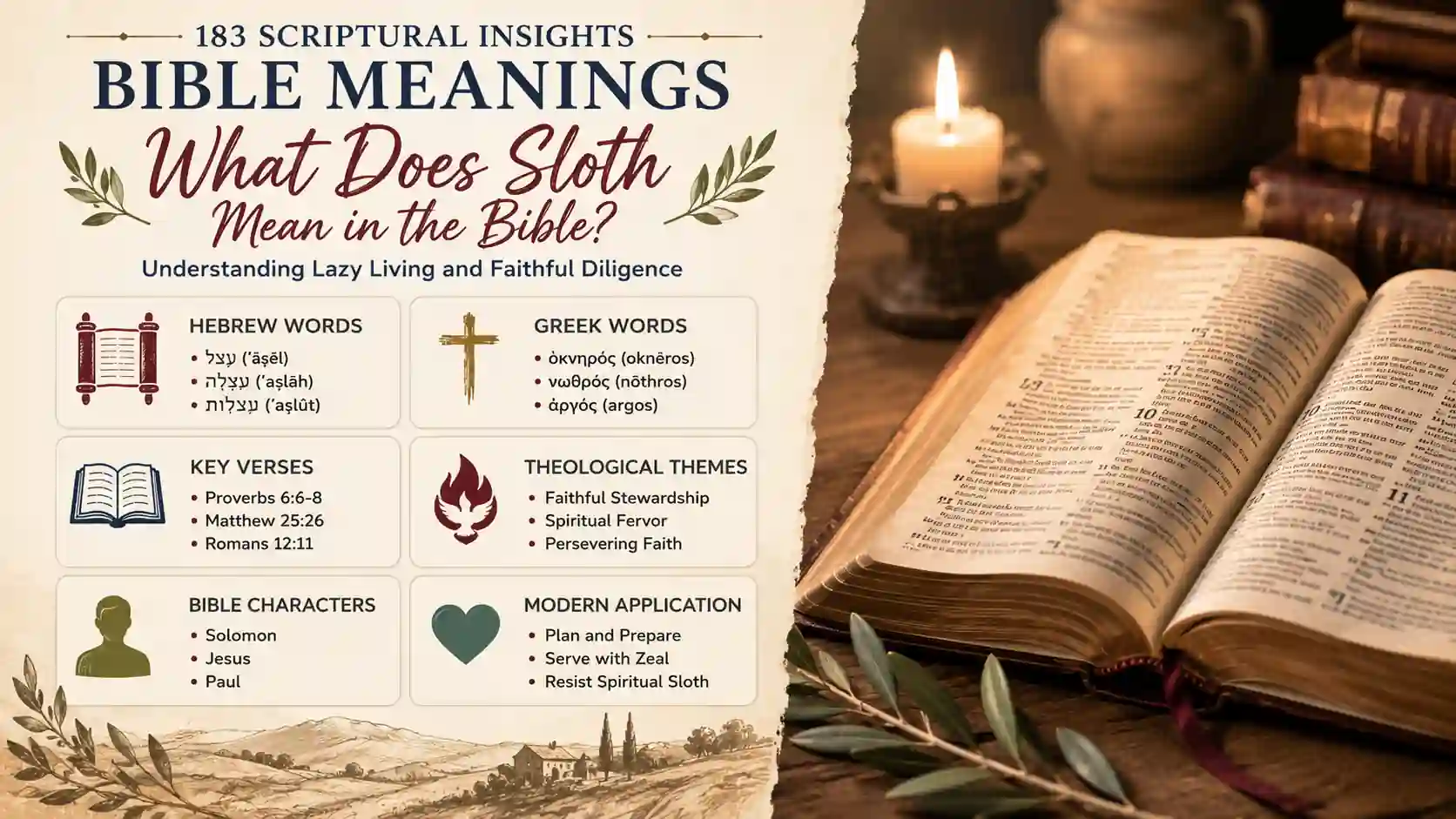
Sloth Key Scripture References
| Verse | Passage Snippet | Context |
|---|---|---|
| Proverbs 6:6-8 | Consider the ant | Wisdom learned from diligent preparation |
| Proverbs 6:9-11 | How long will you sleep? | Excessive ease leads toward poverty |
| Proverbs 10:4 | A slack hand causes poverty | Work habits carry real consequences |
| Proverbs 13:4 | The sluggard craves nothing gained | Desire without action remains empty |
| Proverbs 19:15 | Slothfulness casts into deep sleep | Laziness produces hunger and insensibility |
| Proverbs 20:4 | The sluggard does not plow | Neglected seasons bring an empty harvest |
| Proverbs 24:30-34 | The field was overgrown | Neglect slowly destroys useful property |
| Proverbs 26:13-16 | A lion is in the road | Excuses protect the sluggard from action |
| Matthew 25:26 | Wicked and slothful servant | Jesus condemns fearful, negligent stewardship |
| Romans 12:11 | Not slothful in business | Christian zeal should remain spiritually fervent |
Sloth Bible Translation Comparison
| Verse | KJV | NIV | ESV | NASB |
|---|---|---|---|---|
| Proverbs 6:6 | Thou sluggard | You sluggard | O sluggard | You lazy one |
| Proverbs 10:4 | Slack hand | Lazy hands | Slack hand | Negligent hand |
| Proverbs 12:24 | The slothful | Laziness | The slothful | The lazy hand |
| Proverbs 13:4 | Soul of the sluggard | A sluggard’s appetite | Soul of the sluggard | Soul of the lazy one |
| Proverbs 18:9 | Slothful in his work | Slack in his work | Slack in his work | Lazy in his work |
| Proverbs 19:15 | Slothfulness | Laziness | Slothfulness | Laziness |
| Matthew 25:26 | Slothful servant | Lazy servant | Slothful servant | Lazy slave |
| Romans 12:11 | Slothful in business | Lacking in zeal | Slothful in zeal | Lagging behind in diligence |
| Hebrews 6:12 | Be not slothful | Do not become lazy | Not be sluggish | Not be sluggish |
Sloth People and Characters Associated
| Person | Role | Connection |
|---|---|---|
| Solomon | Israelite king and wisdom teacher | Preserved many warnings against sloth |
| The sluggard | Recurring Proverbs character | Embodies excuses, delay, and self-deception |
| The ant | Wisdom illustration | Prepares food without external supervision |
| Neglected field owner | Observed landholder | His overgrown field reveals passive ruin |
| Proverbs 31 woman | Diligent household steward | Rejects the bread of idleness |
| Jesus | Teacher and Lord | Condemns negligent stewardship in parables |
| Wicked servant | Parable character | Buries his entrusted talent through fear |
| Paul | Apostle to the Gentiles | Commands diligence, labor, and fervent service |
| Thessalonian idlers | Disorderly church members | Refuse work while interfering with others |
Sloth Original Hebrew and Greek Words
| Original Word | Transliteration | Strong’s # | Literal Meaning |
|---|---|---|---|
| עָצַל | ʿāṣal | H6101 | To be sluggish or indolent |
| עָצֵל | ʿāṣēl | H6102 | Sluggard or lazy person |
| עַצְלָה | ʿaṣlāh | H6103 | Slothfulness or indolence |
| עַצְלוּת | ʿaṣlût | H6104 | Idleness or laziness |
| ὀκνέω | okneō | G3635 | To hesitate or shrink back |
| ὀκνηρός | oknēros | G3636 | Hesitant, lazy, or troublesome |
| νωθρός | nōthros | G3576 | Sluggish, dull, or slow |
| ἀργός | argos | G692 | Idle, inactive, or unproductive |
| ἀτακτέω | atakteō | G812 | To behave disorderly or irresponsibly |
Sloth Related Biblical Concepts
| Concept | Connection | Supporting Verse |
|---|---|---|
| Diligence | The direct moral contrast to sloth | Proverbs 12:24 |
| Wisdom | Recognizes seasons and acts appropriately | Proverbs 10:5 |
| Stewardship | Uses entrusted gifts faithfully | Matthew 25:14-30 |
| Poverty | Often follows habitual neglect | Proverbs 6:10-11 |
| Hunger | Exposes the cost of refusing work | Proverbs 19:15 |
| Self-deception | Makes the sluggard seem wise to himself | Proverbs 26:16 |
| Disorder | Idleness can disrupt church life | 2 Thessalonians 3:11 |
| Perseverance | Prevents spiritual sluggishness | Hebrews 6:11-12 |
| Zeal | Marks fervent service to the Lord | Romans 12:11 |
Sloth Historical and Cultural Context
| Aspect | Detail | Biblical Source |
|---|---|---|
| Agricultural seasons | Plowing and harvest required timely labor | Proverbs 20:4 |
| Subsistence economy | Neglect could threaten household survival | Proverbs 10:4-5 |
| Vineyard care | Walls and crops needed continual attention | Proverbs 24:30-31 |
| Household production | Food and clothing required organized work | Proverbs 31:13-27 |
| City marketplaces | Laborers waited to be hired for daily work | Matthew 20:1-7 |
| Entrusted wealth | Servants managed property for absent masters | Matthew 25:14-30 |
| Artisan labor | Paul supported ministry through manual work | Acts 18:3 |
| Church relief | Aid required careful standards and accountability | 1 Timothy 5:9-16 |
| Patronage problems | Some depended unnecessarily upon others | 2 Thessalonians 3:6-12 |
Sloth Theological Themes
| Theme | Explanation | Scripture |
|---|---|---|
| Creation vocation | Human beings were created to cultivate and keep | Genesis 2:15 |
| Fallen labor | Sin makes work painful but not meaningless | Genesis 3:17-19 |
| Wisdom and order | Diligence reflects God’s ordered creation | Proverbs 6:6-8 |
| Moral responsibility | Neglect can become destructive wrongdoing | Proverbs 18:9 |
| Faithful stewardship | God expects responsible use of entrusted gifts | Matthew 25:21 |
| Spiritual fervor | Service should be energized by the Spirit | Romans 12:11 |
| Brotherly responsibility | Believers should not exploit communal generosity | 2 Thessalonians 3:10 |
| Persevering faith | Hope must be accompanied by patient endurance | Hebrews 6:11-12 |
| Grace-enabled labor | Divine grace strengthens faithful effort | 1 Corinthians 15:10 |
Sloth Modern Application for Believers
| Area | Practice | Scripture |
|---|---|---|
| Daily work | Complete responsibilities honestly and carefully | Colossians 3:23 |
| Time | Recognize seasons and act without needless delay | Ecclesiastes 3:1 |
| Planning | Prepare before foreseeable needs become crises | Proverbs 6:6-8 |
| Home | Attend responsibly to household obligations | Proverbs 31:27 |
| Church | Use your gifts rather than remaining passive | Romans 12:6-11 |
| Finances | Earn honestly and share with those in need | Ephesians 4:28 |
| Spiritual study | Resist becoming dull in hearing | Hebrews 5:11 |
| Service | Do good without surrendering to weariness | Galatians 6:9 |
| Accountability | Accept correction instead of defending excuses | Proverbs 26:16 |
עָצֵל And the Proverbs Portrait of Sloth
The Hebrew noun עָצֵל, ʿāṣēl, describes the sluggard who repeatedly refuses appropriate action. Proverbs does not portray this person as lacking desires. The sluggard wants food, comfort, success, and security, but will not consistently perform the work connected with those goals.
This distinction helps you recognize biblical sloth. It is not simply inactivity, because prayer, sleep, Sabbath observance, and physical recovery may all involve stillness. Sloth is culpable inactivity, delay, or negligence when wisdom, love, duty, or obedience requires action.
Proverbs often exposes the sluggard through humorous exaggeration. He fears an imaginary lion outside, turns on his bed like a door on its hinges, and finds it exhausting to lift food to his mouth. These images uncover the absurdity of excuses that seem reasonable only to the person making them.
The most serious feature appears in Proverbs 26:16. The sluggard considers himself wiser than seven people who can answer sensibly. Sloth therefore resists correction. Your greatest danger may not be unfinished work, but the pride that invents explanations for why faithful action is unnecessary.
What Does Sloth Mean in the Bible’S Wisdom Literature?
In Israel’s wisdom literature, sloth violates the moral order woven into creation. The ant gathers during summer because wisdom responds to reality. The sluggard ignores seasons, opportunities, consequences, and ordinary patterns through which God provides food.
Proverbs 24:30-34 presents sloth as gradual deterioration. Thorns spread, nettles cover the ground, and the stone wall collapses. No dramatic act destroys the vineyard. Repeated inattention allows disorder to advance until useful land becomes unproductive.
This passage applies beyond employment. A neglected friendship, prayer life, ministry responsibility, household, or moral weakness can deteriorate in the same quiet manner. Biblical wisdom calls you to notice small breaches before they become collapsed walls.
The text does not teach that every poor person is lazy. Proverbs also condemns oppression, dishonest gain, and exploitation of the vulnerable. Its warnings address poverty caused by avoidable neglect, not suffering produced by injustice, illness, disaster, disability, or circumstances beyond personal control.
ὀκνηρός And Slothful Stewardship in Jesus’ Teaching
In Matthew 25:26, the master calls the servant πονηρός and ὀκνηρός, meaning wicked and slothful. The Greek adjective ὀκνηρός, oknēros, can describe someone hesitant, shrinking, or unwilling to exert effort. The servant receives a genuine trust but buries it rather than serving his master’s interests.
His failure is not measured against the other servants’ amounts. Each servant is accountable for what was actually entrusted to him. This protects you from confusing diligence with comparison. Faithfulness means obediently using your opportunities, abilities, possessions, and responsibilities, however modest they appear.
The servant claims that fear caused his inactivity, yet the master exposes the inconsistency of his reasoning. Even under the servant’s distorted view, some responsible action would have followed. Fear becomes an excuse that conceals his unwillingness to act.
Jesus therefore connects sloth with unfaithful stewardship. Grace does not make obedience optional, and waiting for Christ does not mean passive withdrawal. Faithful disciples remain watchful, merciful, fruitful, and responsible while awaiting their Lord’s return.
Romans 12 and Hebrews 6 Transform Sloth into Spiritual Urgency
Romans 12:11 commands believers not to be ὀκνηρός, oknēros, in zeal but to be fervent in spirit while serving the Lord. Paul is not praising frantic activity or restless ambition. He calls for warm, sustained devotion expressed through concrete service within Christ’s body.
Christian diligence grows from God’s mercy described earlier in Romans. You do not labor to purchase salvation. You offer yourself because mercy has already claimed you, renewed your mind, and placed you among believers whose differing gifts serve one another.
Hebrews 6:12 uses νωθρός, nōthros, for spiritual sluggishness. The surrounding appeal concerns earnestness, assurance, faith, patience, and inherited promises. Spiritual sloth appears when believers become slow to hear, careless about growth, or unwilling to persevere under pressure.
The gospel’s answer is neither shame-driven busyness nor self-salvation through effort. God supplies grace, hope, gifts, and the Holy Spirit, while calling you to active trust. Biblical diligence is dependent obedience, sustained by divine power and directed toward love.
Questions About Sloth in the Bible
Does עָצֵל, ʿāṣēl, refer to every person who rests?
No. It describes habitual indolence, while Scripture also honors sleep, Sabbath rest, bodily limits, and restoration.
Why does the KJV say “slothful in business” in Romans 12:11?
“Business” formerly carried the sense of diligence or earnest effort, so the verse concerns zeal in serving the Lord.
Is the servant in Matthew 25 condemned merely for earning no profit?
No. His lack of return reveals a deeper refusal to trust, obey, and responsibly use what his master entrusted.
How is νωθρός, nōthros, in Hebrews 6 different from ordinary laziness?
It describes spiritual dullness or sluggishness that threatens perseverance in faith, hope, and patient obedience.
Can a hardworking person still struggle with biblical sloth?
Yes. You may remain professionally busy while neglecting prayer, relationships, repentance, generosity, church service, or another duty God has given you.