
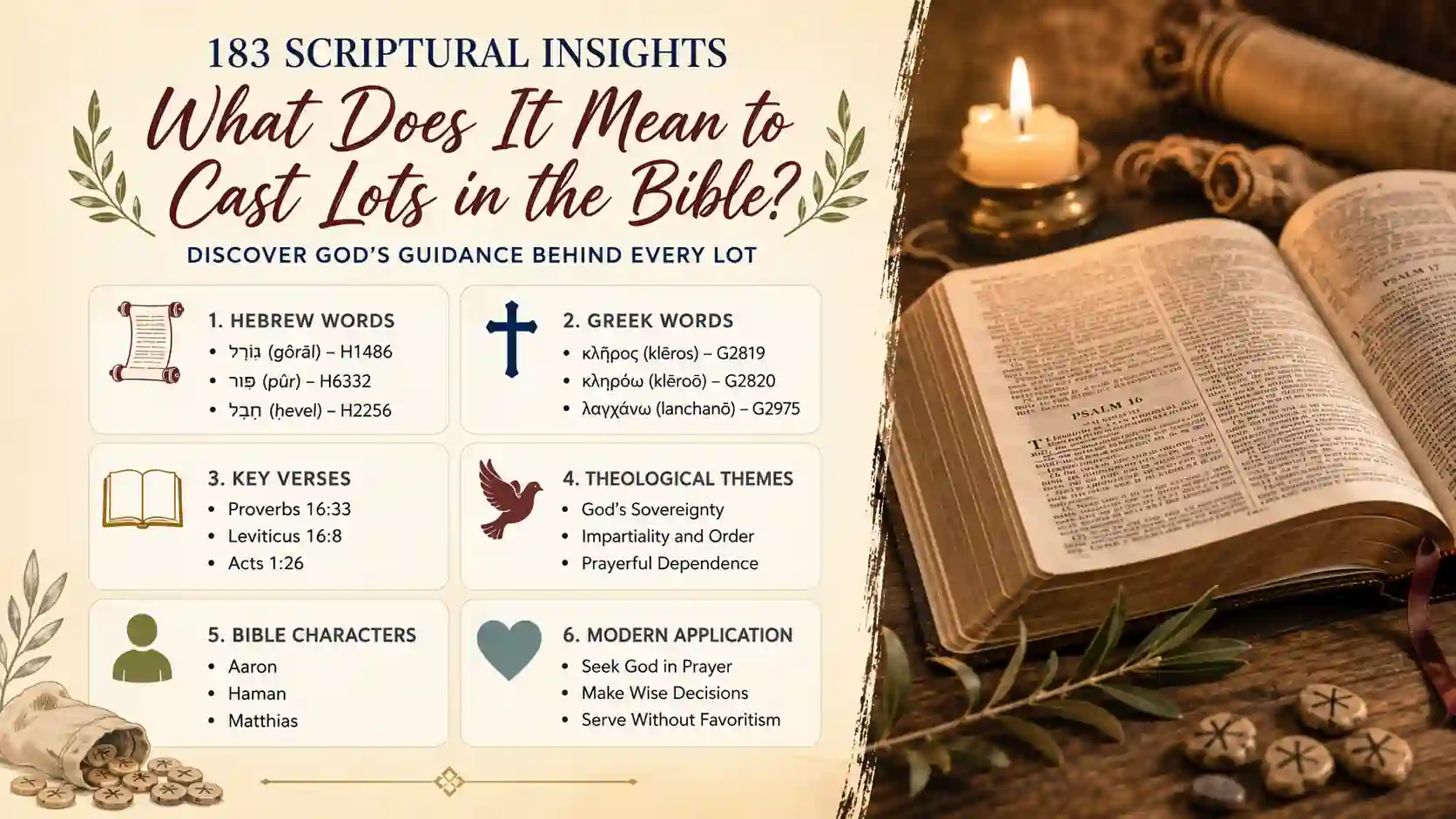
What does it mean to cast lots in the Bible? In Scripture, casting lots was an ancient method of making selections, distributing responsibilities, identifying persons, or settling contested matters. Participants used marked stones, pieces of wood, or similar objects whose resulting arrangement indicated the decision.
The Bible does not present every use of lots as equally faithful. Some were commanded by God, some occurred within prayerful covenant worship, and others belonged to pagan divination or human cruelty. Your study must therefore consider who cast the lots, why they did so, and whether God authorized the occasion.
Key Cast Lots Scripture References
| Verse | Passage Snippet | Context |
|---|---|---|
| Leviticus 16:8 | Aaron cast lots over two goats | One goat was designated for the Lord and the other for removal on the Day of Atonement. |
| Numbers 26:55 | The land was divided by lot | Tribal inheritance combined proportional distribution with a divinely governed lot. |
| Joshua 18:10 | Joshua cast lots before the Lord | Seven remaining tribes received their territories at the sanctuary in Shiloh. |
| 1 Samuel 14:41-42 | Jonathan was taken by lot | Saul sought to identify who had violated his rash military oath. |
| 1 Chronicles 24:5 | Priestly divisions were assigned by lot | Aaron’s descendants received an orderly rotation of sanctuary service. |
| Esther 3:7 | Haman cast Pur | A pagan lot selected the date for his planned destruction of the Jews. |
| Proverbs 16:33 | Every decision is from the Lord | Wisdom literature affirms God’s sovereignty over an apparently random result. |
| Jonah 1:7 | The lot fell on Jonah | Sailors used lots to identify the person connected with the violent storm. |
| Matthew 27:35 | Soldiers cast lots for His garments | Roman soldiers divided Jesus’ clothing, fulfilling the pattern of Psalm 22:18. |
| Acts 1:26 | The lot fell to Matthias | The disciples prayerfully selected an apostolic witness before Pentecost. |
Cast Lots Bible Translation Comparison
| Verse | KJV | NIV | ESV | NASB |
|---|---|---|---|---|
| Leviticus 16:8 | “cast lots upon” | “cast lots for” | “cast lots over” | “cast lots for” |
| Numbers 26:55 | “divided by lot” | “distributed by lot” | “divided by lot” | “apportioned by lot” |
| Joshua 18:10 | “cast lots for them” | “cast lots for them” | “cast lots for them” | “cast lots for them” |
| Proverbs 16:33 | “cast into the lap” | “cast into the lap” | “cast into the lap” | “cast into the lap” |
| Jonah 1:7 | “let us cast lots” | “let us cast lots” | “let us cast lots” | “let us cast lots” |
| Matthew 27:35 | “casting lots” | “casting lots” | “casting lots” | “casting lots” |
| John 19:24 | “cast lots for it” | “decide by lot” | “cast lots for it” | “cast lots for it” |
| Acts 1:26 | “gave forth their lots” | “cast lots” | “cast lots” | “drew lots” |
People and Characters Associated with Casting Lots
| Person | Role | Connection |
|---|---|---|
| Aaron | Israel’s high priest | Cast lots over the two goats during the Day of Atonement ritual. |
| Moses | Covenant mediator | Delivered God’s instructions for distributing Canaan by lot. |
| Joshua | Israel’s leader | Cast lots before the Lord to assign tribal territories at Shiloh. |
| Eleazar | High priest | Helped oversee Israel’s inheritance distribution according to the Lord’s command. |
| Saul | Israel’s first king | Used a sacred inquiry involving lots after imposing a reckless oath. |
| Jonathan | Saul’s son | Was identified by lot as the person who had unknowingly broken Saul’s command. |
| David | King and worship organizer | Arranged Levitical, priestly, musical, and gatekeeping service through lots. |
| Haman | Persian official | Cast Pur to choose a favorable date for his genocidal decree. |
| Jonah | Reluctant prophet | Was identified by the sailors’ lot as connected with the storm. |
| Matthias | Disciple and apostolic witness | Was chosen by lot to take Judas Iscariot’s vacant ministry position. |
Original Hebrew and Greek Words for Cast Lots
| Original Word | Transliteration | Strong’s # | Literal Meaning |
|---|---|---|---|
| גּוֹרָל | gôrāl | H1486 | Lot, pebble, allotted portion, destiny |
| פּוּר | pûr | H6332 | Lot used for determining a date |
| חֶבֶל | ḥevel | H2256 | Cord, measured portion, inheritance |
| יָדָה | yādâ | H3034 | To throw or cast |
| κλῆρος | klēros | G2819 | Lot, assigned share, inheritance |
| κληρόω | klēroō | G2820 | To assign or receive by lot |
| λαγχάνω | lanchanō | G2975 | To obtain or be chosen by lot |
| βάλλω | ballō | G906 | To throw, cast, or place |
Related Biblical Concepts Connected with Lots
| Concept | Connection | Supporting Verse |
|---|---|---|
| Divine sovereignty | God governs outcomes that appear random to human observers. | Proverbs 16:33 |
| Covenant inheritance | Lots assigned portions of the promised land to Israel’s tribes. | Numbers 26:55 |
| Atonement | Lots distinguished the two goats used in Israel’s annual purification rite. | Leviticus 16:8 |
| Sacred service | Priests and Levites received duties without favoritism through lots. | 1 Chronicles 24:5 |
| Impartial judgment | A lot could settle disputes when rival claims threatened peace. | Proverbs 18:18 |
| Identification of guilt | Lots sometimes exposed a person associated with covenant disobedience. | 1 Samuel 14:42 |
| Providence | Haman’s Pur became part of the story of God’s reversal and deliverance. | Esther 9:24-26 |
| Fulfilled Scripture | Soldiers cast lots for Christ’s clothing as Psalm 22 anticipated. | John 19:24 |
| Apostolic office | Matthias received Judas’s place after corporate prayer and qualification. | Acts 1:21-26 |
| Inheritance in Christ | The lot metaphor developed into language for a spiritual share or portion. | Colossians 1:12 |
Historical and Cultural Context of Casting Lots
| Aspect | Detail | Biblical Source |
|---|---|---|
| Physical objects | Lots were likely marked stones, shards, sticks, or similar small objects. | Proverbs 16:33 |
| The lap | A garment fold could hold lots before they were shaken or drawn. | Proverbs 16:33 |
| Sanctuary setting | Authorized lots were sometimes cast before the Lord at a holy place. | Joshua 18:6 |
| Land measurement | Surveyed territory was assigned after boundaries and tribal needs were considered. | Joshua 18:4-10 |
| Priestly equality | Lots distributed service among priestly houses without preference for status. | 1 Chronicles 24:5 |
| Maritime custom | Ancient sailors used lots during crisis to identify perceived responsibility. | Jonah 1:7 |
| Persian divination | Haman cast Pur repeatedly to choose an auspicious month and day. | Esther 3:7 |
| Roman military practice | Executioners divided a condemned person’s clothing among themselves. | John 19:23-24 |
| Dispute resolution | Accepted lots could prevent powerful opponents from prolonging conflict. | Proverbs 18:18 |
| Community selection | The Jerusalem believers used prayer, qualifications, and a final lot. | Acts 1:23-26 |
Theological Themes Revealed Through Lots
| Theme | Explanation | Scripture |
|---|---|---|
| God’s kingship | Chance does not operate outside the Creator’s authority. | Proverbs 16:33 |
| Human limitation | People sometimes needed a decision they could not reach by observation alone. | Acts 1:24 |
| Reverent submission | Faithful participants accepted the outcome as belonging to God. | Joshua 18:10 |
| Ordered worship | Lots assigned recurring duties within Israel’s priesthood and temple ministry. | 1 Chronicles 25:8 |
| Impartiality | A properly used lot could restrain privilege, rivalry, and manipulation. | 1 Chronicles 24:5 |
| Judgment | Lots could reveal guilt, though surrounding human leadership might remain flawed. | 1 Samuel 14:41-45 |
| Redemption | Haman’s lot could not defeat God’s covenant preservation of His people. | Esther 9:24-26 |
| Messianic suffering | Hostile soldiers unknowingly participated in the scriptural pattern concerning Jesus. | Psalm 22:18 |
| Prayerful dependence | The disciples asked the Lord, who knows every heart, to reveal His choice. | Acts 1:24 |
| Gracious inheritance | The language of a lot became a picture of the portion God gives His people. | Acts 26:18 |
Modern Application of Biblical Lots for Believers
| Area | Practice | Scripture |
|---|---|---|
| Decision-making | Begin with Scripture, prayer, wisdom, and truthful information rather than randomness. | James 1:5 |
| God’s sovereignty | Trust that no circumstance escapes God’s knowledge or governing care. | Proverbs 16:33 |
| Church leadership | Examine character and biblical qualifications before considering any selection method. | Acts 1:21-24 |
| Conflict | Seek fair procedures that reduce manipulation and personal favoritism. | Proverbs 18:18 |
| Stewardship | Assign responsibilities transparently and without partiality. | 1 Chronicles 24:5 |
| Guidance | Avoid using random signs as a substitute for spiritual maturity and obedience. | Romans 12:2 |
| Prayer | Confess dependence on the Lord, who knows motives and hearts. | Acts 1:24 |
| Providence | Recognize that human schemes cannot overturn God’s redemptive purpose. | Esther 9:24-26 |
| Christ’s suffering | See the casting of lots at the cross within the larger witness of Scripture. | John 19:23-24 |
| Spiritual inheritance | Give thanks for the portion believers receive among God’s holy people. | Colossians 1:12 |
גּוֹרָל GôRāL Joined a Physical Lot with an Assigned Portion
The principal Hebrew noun is גּוֹרָל, gôrāl, Strong’s H1486. It can name the physical object used in casting, the procedure itself, or the portion assigned by the result. This range explains why “lot” and “inheritance” are closely connected in passages about Canaan.
The expression “cast lots” therefore means more than throwing objects aimlessly. In authorized settings, the action submitted an unresolved distribution or selection to a result the community agreed to receive. Proverbs 16:33 gives the central theological interpretation. The lot enters the lap, but its judgment belongs to the Lord.
What Does It Mean to Cast Lots in the Bible’S Covenant Life?
Under the Mosaic covenant, God specifically commanded certain uses of lots. Leviticus 16 required Aaron to distinguish the sacrificial goat from the living goat. Numbers and Joshua required Israel’s land to be apportioned by lot, joining God’s promise of inheritance with an impartial public procedure.
Lots also organized priestly and Levitical service. First Chronicles records their use among priests, musicians, and gatekeepers. These were not casual games of chance. They protected order and fairness within responsibilities that belonged to Israel’s covenant worship.
From Haman’S Pur to the Soldiers’ κλῆρος
Not every biblical lot was an act of faithful worship. Haman cast פּוּר, pûr, Strong’s H6332, while seeking a favorable date for destroying the Jewish people. His divinatory plan became the background for Purim, a feast whose name remembers the very lot God’s providence overturned.
Roman soldiers also cast κλῆρος, klēros, for Jesus’ clothing. They were motivated by material gain, not reverence. Yet their action corresponded to Psalm 22:18. Scripture can therefore describe a sinful or pagan use of lots while still showing that God’s redemptive purpose remains sovereign.
Matthias, Pentecost, and Christian Guidance
Acts 1:26 records the final explicit casting of lots in the biblical narrative. The disciples did not begin with chance. They identified qualified witnesses, presented two men, prayed to the Lord who knows every heart, and then cast lots. Matthias was numbered with the eleven apostles.
The event occurred before the Spirit’s outpouring at Pentecost in Acts 2, but Scripture never directly says that Pentecost abolished lots. Still, the New Testament gives believers no command to use them routinely. Christian guidance normally comes through Scripture, prayer, Spirit-formed wisdom, mature counsel, providence, and obedience rather than attempts to produce revelation through random outcomes.
Questions Bible Students Ask About Casting Lots
Does גּוֹרָל, gôrāl, always refer to a physical pebble?
No. It can describe the object, the procedure, an assigned portion, or a person’s resulting destiny and inheritance.
Was the scapegoat chosen by chance in Leviticus 16:8?
The physical result was unpredictable to Aaron, but the rite was commanded by God and performed before Him.
Why does the NIV say “cast lots” while the NASB says “drew lots” in Acts 1:26?
The translations describe the same selection process with different English wording for giving or drawing the lots.
Does Proverbs 16:33 command believers to cast lots for personal decisions?
No. It teaches God’s sovereignty over the outcome, but it does not establish lot-casting as the ordinary Christian method of guidance.
Is casting lots the same as gambling?
Not necessarily. Biblical lots often assigned duties or settled claims, while gambling normally risks possessions for private gain.