
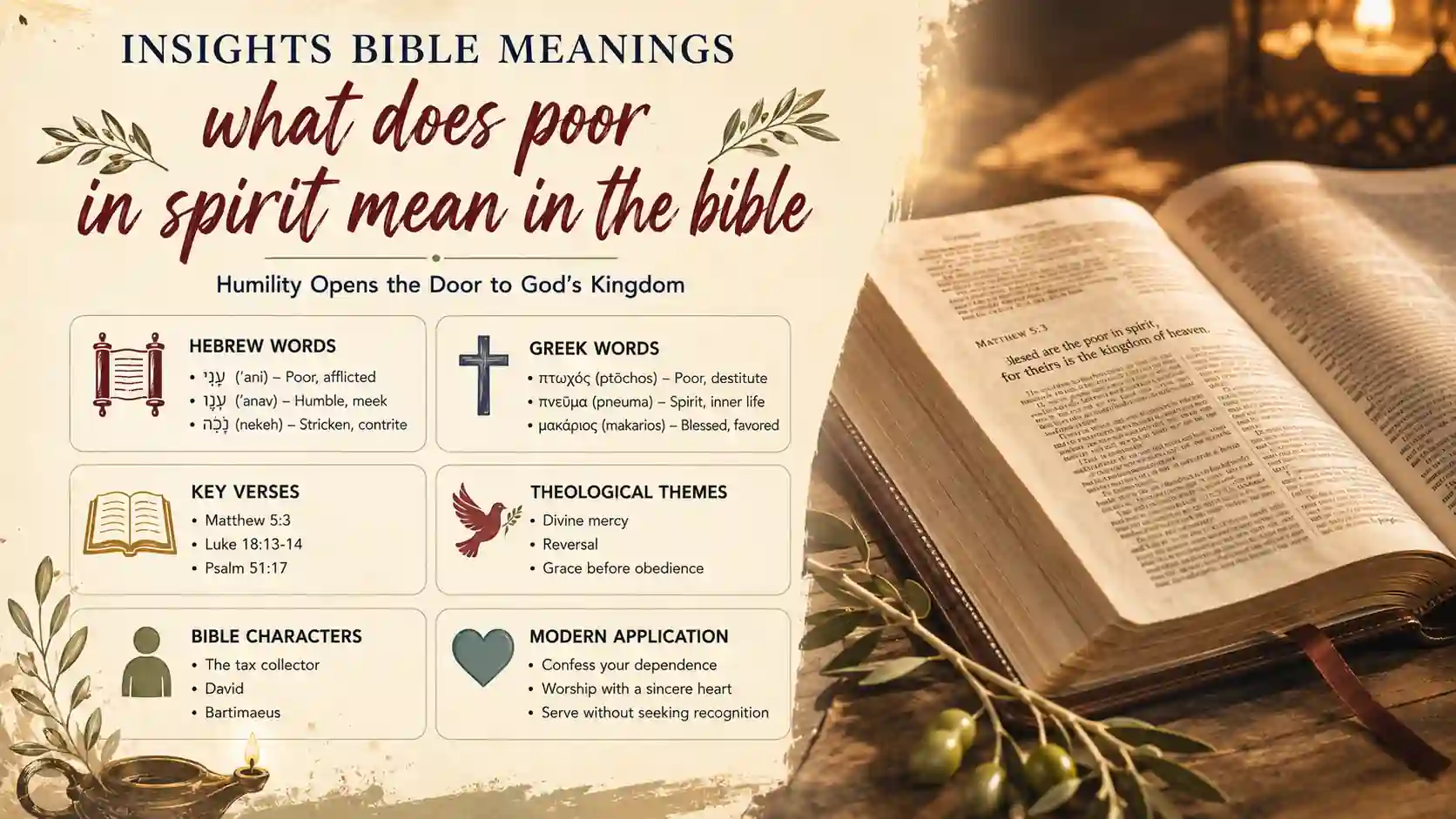
What does poor in spirit mean in the Bible? Jesus uses this striking expression in the first Beatitude, declaring that the kingdom of heaven belongs to people who recognize their spiritual poverty. His words do not praise weak character, material deprivation, or low self-esteem.
Instead, being poor in spirit means approaching God without claims of personal merit. You acknowledge your sin, dependence, and need for divine mercy. This humble posture appears throughout Scripture, from Israel’s worship and prophetic writings to Jesus’ teaching about repentance, grace, and life in God’s kingdom.
Key Scripture References About the Poor in Spirit
| Verse | Passage Snippet | Context |
|---|---|---|
| Matthew 5:3 | “Blessed are the poor in spirit” | First Beatitude in Jesus’ kingdom sermon |
| Luke 6:20 | “Blessed are you who are poor” | Luke emphasizes poor disciples awaiting God’s kingdom |
| Isaiah 66:2 | “Humble and contrite in spirit” | God favors those who tremble at his word |
| Isaiah 61:1 | “Good news to the poor” | The anointed servant announces restoration |
| Psalm 34:18 | “Saves those who are crushed in spirit” | The Lord draws near to broken worshipers |
| Psalm 51:17 | “A broken and contrite heart” | David confesses sin and seeks mercy |
| Psalm 40:17 | “I am poor and needy” | The psalmist depends upon God’s care |
| Proverbs 29:23 | “The humble in spirit will retain honor” | Humility contrasts with self-exalting pride |
| Luke 18:13-14 | “God, be merciful to me, a sinner” | The repentant tax collector is justified |
| Revelation 3:17 | “You are wretched, pitiable, poor” | Laodicea fails to recognize spiritual need |
Bible Translation Comparison for Poor in Spirit Passages
| Verse | KJV | NIV | ESV | NASB |
|---|---|---|---|---|
| Matthew 5:3 | “Poor in spirit” | “Poor in spirit” | “Poor in spirit” | “Poor in spirit” |
| Luke 6:20 | “Ye poor” | “You who are poor” | “You who are poor” | “You who are poor” |
| Isaiah 66:2 | “Poor and of a contrite spirit” | “Humble and contrite in spirit” | “Humble and contrite in spirit” | “Humble and contrite of spirit” |
| Psalm 34:18 | “Contrite spirit” | “Crushed in spirit” | “Crushed in spirit” | “Crushed in spirit” |
| Psalm 51:17 | “Broken spirit” | “Broken spirit” | “Broken spirit” | “Broken spirit” |
| Psalm 40:17 | “Poor and needy” | “Poor and needy” | “Poor and needy” | “Afflicted and needy” |
| Proverbs 16:19 | “Humble spirit” | “Lowly in spirit” | “Lowly spirit” | “Lowly in spirit” |
| Proverbs 29:23 | “Humble in spirit” | “Lowly in spirit” | “Lowly in spirit” | “Humble in spirit” |
People Associated with Being Poor in Spirit
| Person | Role | Connection |
|---|---|---|
| Jesus | Messiah and teacher | Announces blessing for the poor in spirit |
| David | King and psalmist | Offers God a broken and contrite heart |
| Isaiah | Prophet | Describes the humble person God regards |
| The tax collector | Repentant worshiper | Confesses sin without claiming merit |
| The sinful woman | Forgiven disciple | Approaches Jesus with tears and humility |
| Bartimaeus | Blind beggar | Cries persistently for messianic mercy |
| The Canaanite woman | Gentile petitioner | Depends entirely upon Jesus’ compassion |
| Mary | Mother of Jesus | Rejoices that God exalts the humble |
| Paul | Apostle | Rejects confidence in human credentials |
| Laodicean believers | Self-satisfied church | Mistake spiritual poverty for spiritual wealth |
Original Hebrew and Greek Words for Poor in Spirit
| Original Word | Transliteration | Strong’s # | Literal Meaning |
|---|---|---|---|
| πτωχός | ptōchos | G4434 | Poor, destitute, dependent beggar |
| πνεῦμα | pneuma | G4151 | Spirit, breath, inner disposition |
| μακάριος | makarios | G3107 | Blessed, favored, flourishing |
| βασιλεία | basileia | G932 | Kingdom, reign, royal rule |
| עָנִי | ʿani | H6041 | Poor, afflicted, oppressed |
| עָנָו | ʿanav | H6035 | Humble, meek, afflicted |
| רוּחַ | ruach | H7307 | Spirit, breath, inner life |
| נָכֵה | nekeh | H5223 | Stricken, contrite, smitten |
| דַּכָּא | dakka | H1793 | Crushed, broken, contrite |
| שָׁפָל | shaphal | H8217 | Low, humble, brought down |
Biblical Concepts Related to the Poor in Spirit
| Concept | Connection | Supporting Verse |
|---|---|---|
| Humility | Refuses confidence in personal merit | Proverbs 29:23 |
| Repentance | Honestly acknowledges guilt before God | Luke 18:13 |
| Grace | Receives what cannot be earned | Ephesians 2:8-9 |
| Dependence | Looks to God for every spiritual need | Psalm 40:17 |
| Contrition | Grieves sin without hiding it | Psalm 51:17 |
| Faith | Trusts God rather than self-sufficiency | Philippians 3:9 |
| Kingdom citizenship | Receives God’s reign as a gift | Matthew 5:3 |
| Spiritual hunger | Desires righteousness only God supplies | Matthew 5:6 |
| Childlike trust | Enters the kingdom receptively | Mark 10:15 |
| Divine exaltation | God raises those who humble themselves | Luke 14:11 |
Historical and Cultural Context of the Poor in Spirit
| Aspect | Detail | Biblical Source |
|---|---|---|
| Mountain setting | Jesus teaches seated as an authoritative rabbi | Matthew 5:1-2 |
| Jewish audience | Disciples hear language shaped by Israel’s Scriptures | Matthew 5:17 |
| Roman occupation | Many listeners experience taxation and oppression | Matthew 22:17 |
| Honor culture | Public status often determines social worth | Luke 14:7-11 |
| Begging poverty | πτωχός can describe total dependence on others | Luke 16:20 |
| Prophetic tradition | God defends the afflicted and humble | Isaiah 57:15 |
| Wisdom tradition | Pride brings disgrace and humiliation | Proverbs 16:18-19 |
| Temple worship | Contrite hearts matter more than outward sacrifice | Psalm 51:16-17 |
| Messianic hope | The anointed one brings good news to the poor | Isaiah 61:1 |
| Kingdom expectation | Israel awaits God’s saving and righteous reign | Daniel 7:27 |
Theological Themes within Poor in Spirit Teaching
| Theme | Explanation | Scripture |
|---|---|---|
| Human insufficiency | No sinner can establish righteousness before God | Romans 3:23 |
| Divine mercy | God receives those who plead for compassion | Luke 18:13-14 |
| Grace before obedience | Kingdom life begins with receiving, not achieving | Matthew 5:3 |
| Reversal | God exalts the humble and lowers the proud | Luke 1:52 |
| Present kingdom | “Theirs is” describes a present possession | Matthew 5:3 |
| Future fulfillment | Kingdom blessings await complete realization | Matthew 5:12 |
| Christ’s sufficiency | Spiritual riches are found in Christ | 2 Corinthians 8:9 |
| True worship | God welcomes broken and truthful hearts | Psalm 51:17 |
| Repentant faith | Genuine faith abandons self-justification | Philippians 3:7-9 |
| Spirit-formed humility | God produces a humble disposition in believers | Galatians 5:22-23 |
Modern Application for Believers Who Are Poor in Spirit
| Area | Practice | Scripture |
|---|---|---|
| Prayer | Confess your dependence before making requests | Luke 11:3-4 |
| Confession | Name sin honestly and receive forgiveness | 1 John 1:9 |
| Bible study | Tremble at God’s word rather than mastering it proudly | Isaiah 66:2 |
| Worship | Bring a sincere heart instead of religious performance | Psalm 51:17 |
| Relationships | Consider others without seeking superiority | Philippians 2:3 |
| Service | Help quietly without demanding recognition | Matthew 6:3-4 |
| Suffering | Call upon God instead of pretending strength | 2 Corinthians 12:9 |
| Success | Credit God for gifts, opportunities, and fruit | 1 Corinthians 4:7 |
| Correction | Receive biblical rebuke with teachability | Proverbs 9:9 |
| Daily faith | Ask Christ to supply what you lack | John 15:5 |
What πτωχός Reveals About Spiritual Dependence
The Greek adjective πτωχός, ptōchos, commonly describes someone deeply poor or dependent upon the generosity of others. In Matthew 5:3, Jesus joins this word to τῷ πνεύματι, tō pneumati, meaning “in spirit.” The phrase points to your inward posture before God rather than merely your financial condition.
A poor-in-spirit person knows that spiritual life cannot be purchased, inherited, or produced through determination. You come before God like a beggar with empty hands. Yet this poverty is blessed because those empty hands are ready to receive the kingdom as God’s gracious gift.
What Does Poor in Spirit Mean in the Bible’S Prophetic Tradition?
Jesus’ Beatitude grows from Israel’s Scriptures. Isaiah 66:2 describes the person God regards as עָנִי, ʿani, humble or afflicted, and נְכֵה־רוּחַ, nekeh-ruach, contrite in spirit. Such a person trembles at God’s word because divine holiness has exposed human smallness and sin.
Isaiah 61:1 also announces good news for the עֲנָוִים, ʿanavim, the poor, meek, or afflicted. Jesus stands within this prophetic hope. He announces that God’s reign has drawn near to people who possess no status, achievement, or righteousness with which to bargain.
The Kingdom Promise Hidden in the First Beatitude
The wording of Matthew 5:3 is precise. Jesus does not say that the kingdom might eventually belong to the poor in spirit. He says, “theirs is the kingdom of heaven.” The present tense identifies them as people already welcomed beneath God’s saving rule, even while they await its full revelation.
This promise establishes the pattern for the remaining Beatitudes. Spiritual poverty leads to mourning over sin, meekness before God, and hunger for righteousness. These qualities are not separate achievements. They describe the unfolding character of someone whose hope rests in God’s grace.
Poor in Spirit Is Not Low Self-Worth
Being poor in spirit does not require you to deny your dignity as a person created in God’s image. Nor does it mean remaining passive under abuse, refusing responsibility, or speaking falsely about your abilities. Biblical humility is truthfulness before God, not contempt for yourself.
You may recognize genuine gifts while admitting that every gift comes from God. You may act courageously while depending upon divine strength. Poverty of spirit removes boasting, but it does not remove faithful action. It frees you to serve because your identity no longer depends upon appearing spiritually impressive.
Questions About What Poor in Spirit Means in the Bible
Does πτωχός mean financially poor or spiritually helpless in Matthew 5:3?
The added phrase τῷ πνεύματι directs Matthew’s saying toward inward dependence, though Scripture still commands concern for people experiencing material poverty.
Why does Luke 6:20 say “poor” while Matthew 5:3 says “poor in spirit”?
Luke stresses the real poverty of Jesus’ disciples, while Matthew clarifies the humble spiritual posture that characterizes kingdom recipients.
Is being poor in spirit the same as having low self-esteem?
No. It means recognizing your need for God without denying the worth, responsibilities, or gifts God has given you.
How are Isaiah’s עָנִי and Matthew’s πτωχός connected?
Both words belong to a biblical pattern in which afflicted, humble, and dependent people look to God as their defender and source of salvation.
How can you practice being poor in spirit without becoming passive?
Act faithfully, pray dependently, confess quickly, receive correction, and credit God rather than yourself for every good result.