
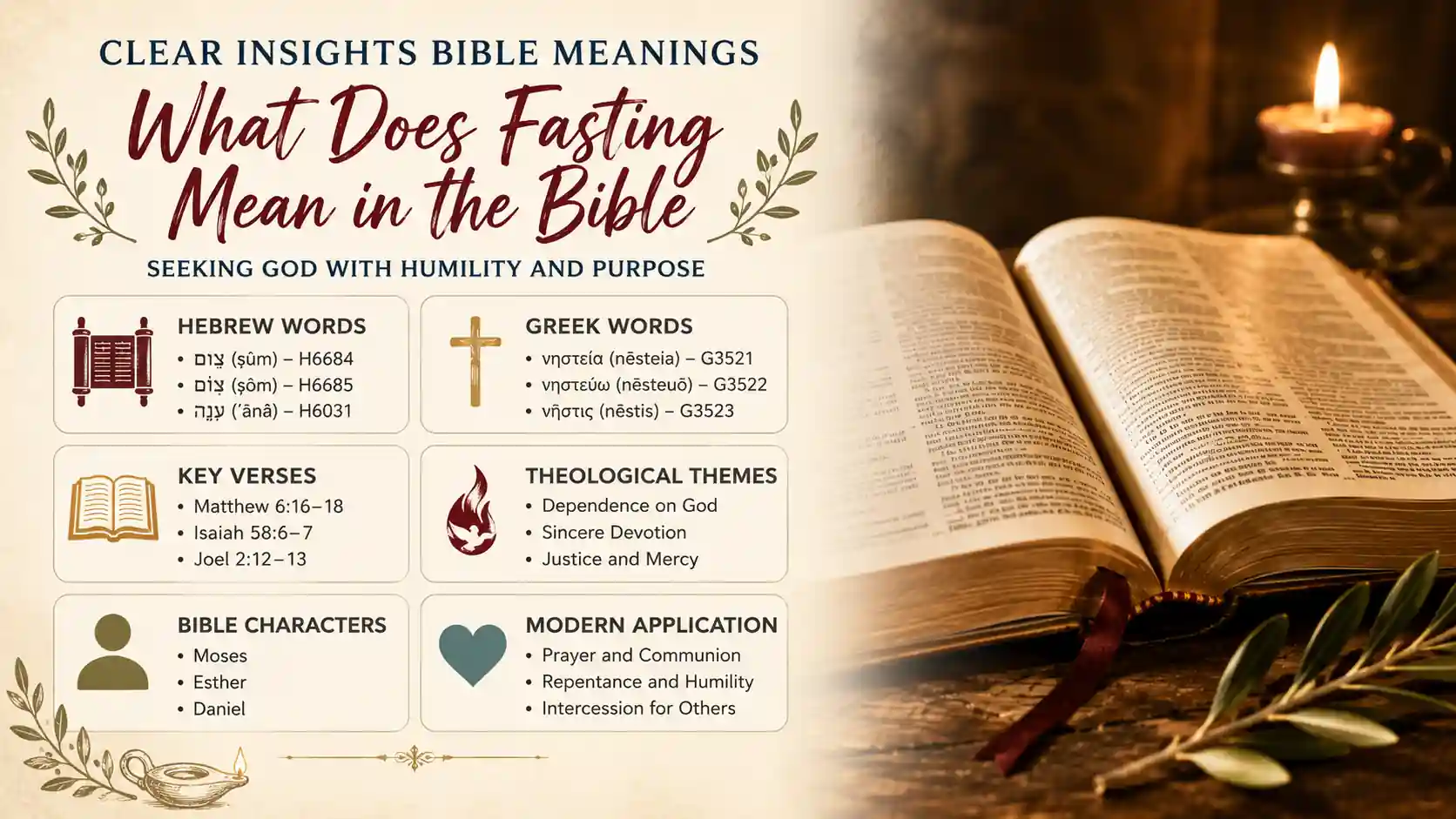
What does fasting mean in the Bible? At its simplest, biblical fasting is the voluntary abstinence from food, and sometimes drink, for a limited period in order to seek God with focused humility. Scripture joins fasting with prayer, repentance, mourning, worship, intercession, and dependence on divine guidance.
Yet fasting is never presented as spiritual hunger striking a bargain with God. Your empty stomach does not earn grace. Rather, bodily hunger gives visible expression to a heart that recognizes its need for God, submits to his will, and turns from sin toward faithful obedience.
Key Scripture References About Fasting
| Verse | Passage Snippet | Context |
|---|---|---|
| Leviticus 16:29-31 | “Afflict your souls” | Israel humbles itself on the Day of Atonement |
| Judges 20:26 | Israel fasted that day | National grief after military defeat |
| 1 Samuel 7:6 | They fasted and confessed | Israel repents at Mizpah |
| Ezra 8:21-23 | A fast beside the river | Exiles seek protection for their journey |
| Esther 4:16 | Fast for me three days | Jews intercede during a deadly crisis |
| Isaiah 58:6-7 | “The fast that I choose” | God connects fasting with justice and mercy |
| Joel 2:12-13 | Return with fasting | Judah is called to wholehearted repentance |
| Matthew 6:16-18 | “When you fast” | Jesus condemns public religious display |
| Acts 13:2-3 | Worshiping and fasting | The church commissions Barnabas and Saul |
| Acts 14:23 | Prayer with fasting | Elders are appointed in local churches |
Bible Translation Comparison for Fasting
| Verse | KJV | NIV | ESV | NASB |
|---|---|---|---|---|
| Ezra 8:21 | “proclaimed a fast” | “proclaimed a fast” | “proclaimed a fast” | “proclaimed a fast” |
| Psalm 35:13 | “humbled my soul” | “humbled myself” | “afflicted myself” | “humbled my soul” |
| Isaiah 58:6 | “fast that I have chosen” | “fasting I have chosen” | “fast that I choose” | “fast which I choose” |
| Joel 2:12 | “with fasting” | “with fasting” | “with fasting” | “with fasting” |
| Matthew 6:16 | “when ye fast” | “when you fast” | “when you fast” | “whenever you fast” |
| Matthew 9:15 | “then shall they fast” | “then they will fast” | “then they will fast” | “then they will fast” |
| Luke 2:37 | “fastings and prayers” | “fasting and praying” | “fasting and prayer” | “fasts and prayers” |
| Acts 13:2 | “ministered” | “worshiping” | “worshiping” | “serving” |
People and Characters Associated with Fasting
| Person | Role | Connection |
|---|---|---|
| Moses | Covenant mediator | Fasted forty days while receiving God’s words |
| Hannah | Grieving mother | Wept and refused food in deep distress |
| David | King and psalmist | Fasted while pleading for his sick child |
| Jehoshaphat | King of Judah | Proclaimed a national fast during invasion |
| Ezra | Priest and scribe | Led a fast for protection and safe travel |
| Esther | Jewish queen | Requested corporate fasting before approaching the king |
| Daniel | Exilic prophet | Practiced mourning and restricted food |
| Anna | Temple worshiper | Served God through prayers and fastings |
| Jesus | Messiah and Son | Fasted forty days before public ministry |
| Paul and Barnabas | Missionary leaders | Served within churches that prayed and fasted |
Original Hebrew and Greek Words for Fasting
| Original Word | Transliteration | Strong’s # | Literal Meaning |
|---|---|---|---|
| צוּם | ṣûm, tsum | H6684 | To fast or abstain from food |
| צוֹם | ṣôm, tsom | H6685 | A fast or time of fasting |
| עָנָה | ʿānâ | H6031 | To humble or afflict |
| נֶפֶשׁ | nephesh | H5315 | Soul, life, or whole person |
| νηστεία | nēsteia | G3521 | Fasting or abstinence from food |
| νηστεύω | nēsteuō | G3522 | To fast |
| νῆστις | nēstis | G3523 | Without eating or hungry |
| ἀσιτία | asitia | G776 | Abstinence or lack of food |
The Hebrew verb צוּם, ṣûm, names the act of fasting, while צוֹם, ṣôm, names a fast. The Greek noun νηστεία, nēsteia, may describe religious fasting or, in certain contexts, involuntary hunger. Its related verb νηστεύω, nēsteuō, means to abstain from food.
Related Biblical Concepts Connected with Fasting
| Concept | Connection | Supporting Verse |
|---|---|---|
| Prayer | Fasting concentrates petition before God | Ezra 8:23 |
| Repentance | Abstinence expresses sorrow over sin | 1 Samuel 7:6 |
| Humility | Physical weakness acknowledges dependence | Psalm 35:13 |
| Mourning | Refusal of food accompanies grief | 2 Samuel 1:12 |
| Confession | Fasting may accompany admission of guilt | Nehemiah 9:1-3 |
| Intercession | Communities fast for endangered people | Esther 4:16 |
| Worship | Fasting helps direct attention toward God | Luke 2:37 |
| Guidance | Churches fast while discerning ministry | Acts 13:2 |
| Justice | True fasting requires merciful conduct | Isaiah 58:6-7 |
| Hope | Disciples fast while awaiting the Bridegroom | Matthew 9:15 |
Historical and Cultural Context of Fasting
| Aspect | Detail | Biblical Source |
|---|---|---|
| Day of Atonement | Israel was commanded to humble itself | Leviticus 16:29-31 |
| Public crisis | Leaders proclaimed communal fasts | 2 Chronicles 20:3 |
| War and defeat | Fasting expressed grief and dependence | Judges 20:26 |
| National repentance | People gathered in sackcloth | Nehemiah 9:1 |
| Royal emergency | Esther requested a three-day fast | Esther 4:16 |
| Prophetic warning | Joel summoned elders and citizens | Joel 1:14 |
| Second Temple practice | Pharisees fasted twice weekly | Luke 18:12 |
| Temple devotion | Anna joined fasting with prayer | Luke 2:37 |
| Early church mission | Leaders fasted before commissioning | Acts 13:3 |
| Ancient travel season | “The Fast” marked autumn danger | Acts 27:9 |
Theological Themes Revealed Through Fasting
| Theme | Explanation | Scripture |
|---|---|---|
| Dependence | Human weakness points toward God’s sustaining power | Deuteronomy 8:3 |
| Repentance | Genuine fasting accompanies a returning heart | Joel 2:12-13 |
| Sincerity | God rejects fasting performed for human praise | Matthew 6:16-18 |
| Mercy | Religious abstinence cannot replace care for neighbors | Isaiah 58:6-7 |
| Covenant humility | Israel humbled itself before the holy God | Leviticus 16:29 |
| Divine freedom | Fasting petitions God but never controls him | 2 Samuel 12:15-23 |
| Christ’s presence | The Bridegroom determines fasting’s meaning | Mark 2:19-20 |
| Spiritual worship | Fasting may accompany service to God | Acts 13:2 |
| Mission | Prayerful abstinence precedes sending and leadership | Acts 14:23 |
| Future longing | Christian fasting expresses desire for Christ | Matthew 9:15 |
Modern Application of Fasting for Believers
| Area | Practice | Scripture |
|---|---|---|
| Motive | Seek the Father rather than admiration | Matthew 6:17-18 |
| Prayer | Use mealtimes for focused communion with God | Ezra 8:23 |
| Repentance | Confess specific sins honestly | Joel 2:12-13 |
| Discernment | Seek wisdom without demanding a sign | Acts 13:2-3 |
| Intercession | Pray for people facing danger or suffering | Esther 4:16 |
| Generosity | Give saved resources to someone in need | Isaiah 58:7 |
| Reconciliation | Release resentment and oppressive behavior | Isaiah 58:6 |
| Worship | Let hunger remind you of dependence on God | Matthew 4:4 |
| Privacy | Avoid advertising your sacrifice | Matthew 6:16 |
| Wisdom | Consider health, responsibility, and personal limits | 1 Corinthians 6:19-20 |
What Does Fasting Mean in the Bible According To צוּם?
The Hebrew verb צוּם, ṣûm, describes abstaining from food. Biblical narratives show that this abstinence was usually temporary and purposeful. People fasted when grieving, confessing sin, seeking protection, pleading for mercy, or facing decisions beyond their strength.
Fasting therefore involved the body in the soul’s appeal to God. Hunger became a physical confession that ordinary resources were insufficient. Still, Scripture places no magical power in the missed meals themselves. God listens according to his mercy and wisdom, not because a person has accumulated spiritual credit.
Isaiah 58 and the Fast God Chooses
Isaiah 58 addresses worshipers who fasted while continuing to quarrel, exploit workers, and neglect the vulnerable. They wondered why God had not responded. Through Isaiah, God exposed the contradiction between public devotion and unjust behavior.
The chosen fast included freeing the oppressed, feeding the hungry, sheltering the poor, and caring for one’s own family. Isaiah was not abolishing abstinence from food. He was declaring that genuine self-denial must produce obedient love. A fast directed toward God cannot remain indifferent to people made in God’s image.
Jesus, νηστεύω, and Hidden Devotion
In Matthew 6, Jesus says, “When you fast,” indicating that his hearers already understood the practice. His concern is not whether fasting occurs but why and how it occurs. Hypocrites altered their appearance so observers would recognize their sacrifice and praise their spirituality.
Jesus tells you to wash your face and anoint your head, maintaining an ordinary appearance. The Father who sees in secret becomes the center of the discipline. Biblical fasting is not a performance of misery. It is quiet devotion that turns attention away from reputation and toward God.
The Bridegroom and Christian Fasting
When critics asked why Jesus’ disciples did not fast like other religious groups, Jesus compared himself to a bridegroom at a wedding. His presence made that moment a time for joy. He then said the bridegroom would be taken away, and his disciples would fast.
Christian fasting is therefore shaped by both joy and longing. Christ has come, accomplished redemption, risen from death, and given the Spirit. Yet believers still await his visible return. Your fasting can express hunger for deeper fellowship with Christ, greater holiness, and the completion of his kingdom.
Questions Bible Students Ask About Fasting
Does צוּם, ṣûm, always mean giving up all food and water?
No. It ordinarily concerns food, while passages such as Esther 4:16 explicitly mention abstaining from both food and drink.
Why does Psalm 35:13 connect fasting with humbling or afflicting the soul?
The language presents fasting as embodied humility in which the whole person bows before God in prayer.
Does Acts 27:9 use νηστεία, nēsteia, for ordinary private fasting?
No. “The Fast” most naturally refers to the annual Day of Atonement, which also helped indicate the dangerous autumn sailing season.
Are “prayer and fasting” original in Matthew 17:21 and Mark 9:29?
The manuscript evidence differs. Many modern translations omit Matthew 17:21, while Mark 9:29 may read either “prayer” or “prayer and fasting.”
Can you practice biblical fasting by giving up entertainment instead of food?
Giving up entertainment may be useful self-denial, but the biblical words for fasting normally refer specifically to abstinence from food.