
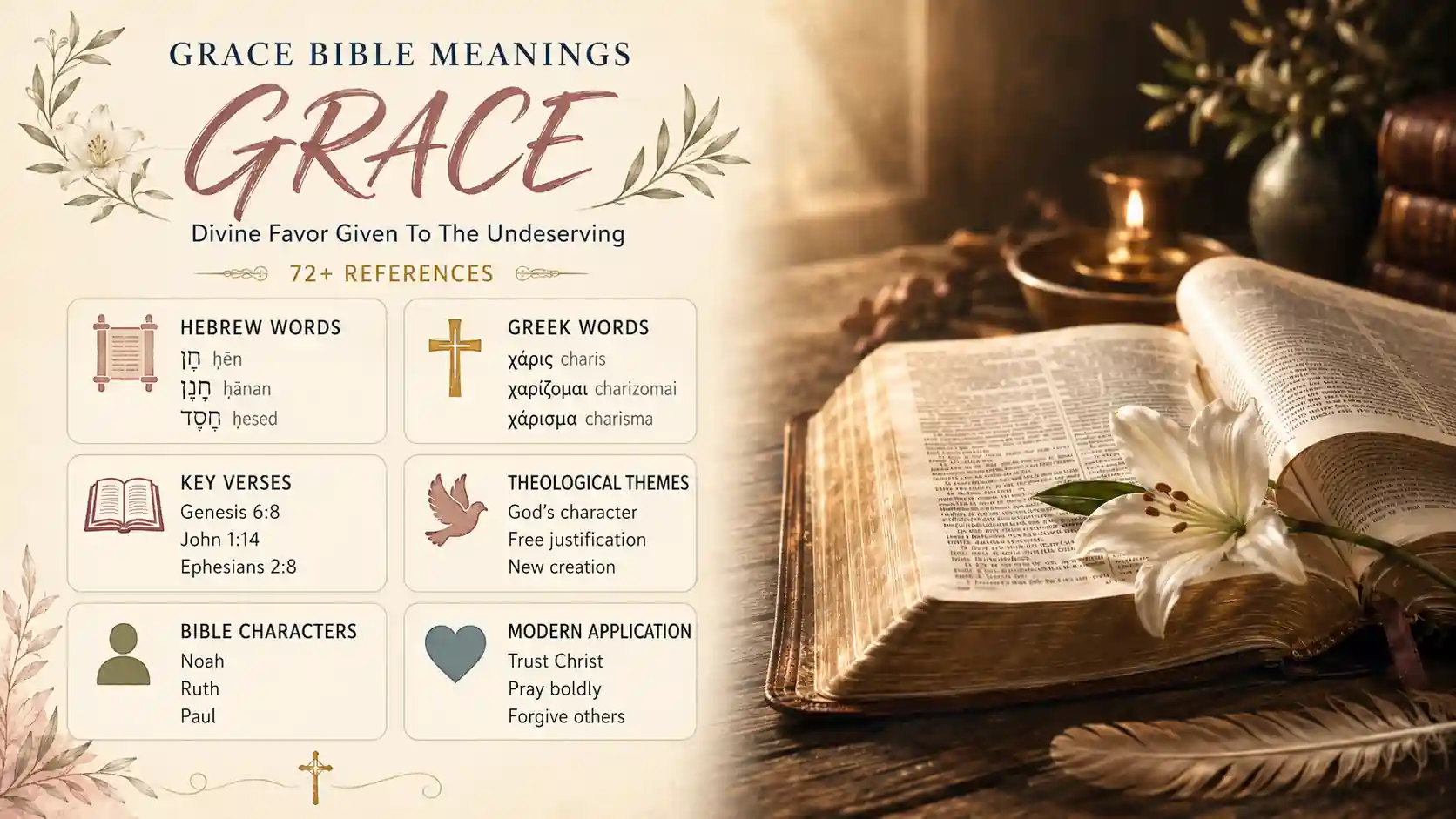
What does grace mean in the Bible is a question that reaches into the heart of God’s self-revelation. Grace is not merely kindness, pardon, or spiritual favor. It is God’s generous action toward the undeserving, flowing from His covenant love and fulfilled in Jesus Christ.
In your study, you will see grace in Hebrew mercy, Greek gift language, Israel’s story, Christ’s cross, and the Spirit’s transforming work in believers.
Grace Key Scripture References
| Verse | Passage Snippet | Context |
|---|---|---|
| Genesis 6:8 | Noah found grace | Judgment and rescue |
| Exodus 34:6 | Gracious and merciful | God’s covenant name |
| Ruth 2:10 | Found favor | Boaz shows kindness |
| Psalm 84:11 | Gives grace and glory | Worship and trust |
| Luke 1:30 | Found favor with God | Mary’s calling |
| John 1:14 | Full of grace and truth | Word made flesh |
| Acts 15:11 | Saved through grace | Gentile inclusion |
| Romans 3:24 | Justified freely | Redemption in Christ |
| Ephesians 2:8 | By grace saved | Faith and salvation |
Grace Bible Translation Comparison
| Verse | KJV | NIV | ESV | NASB |
|---|---|---|---|---|
| Genesis 6:8 | grace | favor | favor | favor |
| Exodus 34:6 | gracious | gracious | gracious | gracious |
| Ruth 2:10 | grace | favor | favor | favor |
| Psalm 84:11 | grace | favor | favor | grace |
| Luke 1:30 | favour | favor | favor | favor |
| John 1:14 | grace | grace | grace | grace |
| Acts 15:11 | grace | grace | grace | grace |
| Romans 3:24 | grace | grace | grace | grace |
| Ephesians 2:8 | grace | grace | grace | grace |
Grace People & Characters Associated
| Person | Role | Connection |
|---|---|---|
| Noah | Righteous survivor | Receives grace before flood |
| Moses | Covenant mediator | Hears God’s gracious name |
| Ruth | Moabite widow | Finds favor in Israel |
| Boaz | Kinsman redeemer | Extends generous favor |
| David | King and psalmist | Depends on mercy |
| Mary | Mother of Jesus | Favored by God |
| Jesus Christ | Son of God | Embodies grace and truth |
| Paul | Apostle | Proclaims grace to nations |
| Titus | Pastoral coworker | Receives grace teaching |
Grace Original Hebrew & Greek Words
| Original Word | Transliteration | Strong’s # | Literal Meaning |
|---|---|---|---|
| חֵן | ḥēn | H2580 | favor, grace |
| חָנַן | ḥānan | H2603 | show favor |
| חַנּוּן | ḥannûn | H2587 | gracious |
| חֶסֶד | ḥesed | H2617 | loyal love |
| רַחֲמִים | raḥămîm | H7356 | compassion |
| χάρις | charis | G5485 | grace, favor |
| χαρίζομαι | charizomai | G5483 | freely give, forgive |
| χάρισμα | charisma | G5486 | gracious gift |
| κεχαριτωμένη | kecharitōmenē | G5487 form | highly favored |
Grace Related Biblical Concepts
| Concept | Connection | Supporting Verse |
|---|---|---|
| Mercy | Grace meets misery | Exodus 34:6 |
| Covenant love | Grace stays faithful | Psalm 136:1 |
| Election | Grace chooses freely | Romans 11:5 |
| Justification | Grace declares righteous | Romans 3:24 |
| Redemption | Grace buys freedom | Ephesians 1:7 |
| Faith | Grace received humbly | Ephesians 2:8 |
| Gift | Grace cannot be earned | Romans 6:23 |
| Forgiveness | Grace releases debt | Colossians 2:13 |
| Sanctification | Grace trains holiness | Titus 2:11-12 |
Grace Historical & Cultural Context
| Aspect | Detail | Biblical Source |
|---|---|---|
| Ancient favor | Superior helps inferior | Genesis 33:8 |
| Covenant name | God reveals character | Exodus 34:6 |
| Patron language | Gift creates gratitude | Romans 12:6 |
| Honor and shame | Grace lifts the lowly | Luke 1:52 |
| Temple worship | Mercy sought through sacrifice | Leviticus 16 |
| Exile hope | Favor after judgment | Isaiah 54:8 |
| Greco-Roman world | χάρις meant gift-favor | Luke 6:32 |
| Apostolic mission | Grace welcomes Gentiles | Acts 15:11 |
| Household teaching | Grace reshapes conduct | Titus 2:11 |
Grace Theological Themes
| Theme | Explanation | Scripture |
|---|---|---|
| God’s character | Grace belongs to His name | Exodus 34:6 |
| Human need | Sinners lack merit | Romans 3:23 |
| Christ’s fullness | Grace comes through Him | John 1:17 |
| Free justification | Righteousness is gift | Romans 3:24 |
| Union with Christ | Grace reigns through Jesus | Romans 5:21 |
| New creation | Grace makes servants | 1 Corinthians 15:10 |
| Spiritual gifts | Ministry flows from grace | Romans 12:6 |
| Endurance | Grace strengthens weakness | 2 Corinthians 12:9 |
| Final hope | Grace awaits revelation | 1 Peter 1:13 |
Grace Modern Application for Believers
| Area | Practice | Scripture |
|---|---|---|
| Salvation | Trust Christ, not merit | Ephesians 2:8 |
| Prayer | Approach God boldly | Hebrews 4:16 |
| Repentance | Return without hiding | Romans 2:4 |
| Humility | Refuse boasting | 1 Corinthians 4:7 |
| Forgiveness | Release others | Ephesians 4:32 |
| Service | Use gifts faithfully | 1 Peter 4:10 |
| Suffering | Lean on sufficient grace | 2 Corinthians 12:9 |
| Speech | Speak with grace | Colossians 4:6 |
| Growth | Train in godliness | Titus 2:12 |
חֵן ḤēN and χάρις Charis Show Grace as Favor Freely Given
In the Old Testament, חֵן, ḥēn, often describes favor found in someone’s eyes. Noah found grace before the flood, not because humanity was healthy, but because God chose to preserve life through judgment. Ruth used the same favor language when Boaz welcomed her as a foreign widow.
The New Testament word χάρις, charis, deepens that pattern around Christ. John says the Word became flesh, full of grace and truth, and Paul says sinners are justified freely by grace through redemption in Jesus. Grace is personal, costly, and saving.
What Does Grace Mean in the Bible When Exodus 34 Reveals God’S Name
Exodus 34 is one of Scripture’s great grace passages because God declares Himself חַנּוּן, ḥannûn, gracious, after Israel’s golden calf sin. The setting matters. Grace appears not in a calm classroom, but beside broken covenant tablets and the need for intercession.
This does not make grace soft toward evil. God forgives iniquity, transgression, and sin, yet He remains just. Biblical grace is holy generosity. It restores the guilty without pretending guilt is harmless, and it prepares the way for atonement fulfilled in Christ.
Grace in Paul’S Gospel Means Gift, Not Wage
Romans 3 and Ephesians 2 teach that grace overturns human boasting. If salvation were a wage, the worker could claim credit. Paul calls it a gift so that faith receives what pride could never produce. You do not climb into grace. You are brought into it.
Yet grace is never permission to remain unchanged. In Titus 2, the grace of God trains believers to renounce ungodliness. The same grace that pardons sin also schools the heart, forms holy desires, and makes obedience grateful rather than self-saving.
Grace Becomes Visible in Weakness, Gifts, and Daily Life
Second Corinthians 12 shows grace meeting Paul in weakness. The Lord does not remove every thorn, but says His grace is sufficient. That means grace is not only the gate into salvation. It is also the strength by which believers endure when power feels absent.
Grace also becomes visible through service. Romans 12 and 1 Peter 4 connect grace with gifts given for the body. Whatever ability you have is stewardship, not status. Your study of grace should make you worship more deeply, forgive more freely, and serve more humbly.
Grace FAQ
Does χάρις charis always mean saving grace?
No, χάρις can mean favor, thanks, gift, or saving grace depending on context.
Why does Genesis 6:8 use חֵן ḥēn for Noah before the law?
It shows that God’s favor precedes Sinai and rests on divine mercy, not human bargaining.
Is חֶסֶד ḥesed the same as grace?
Not exactly, since ḥesed stresses loyal covenant love, while grace stresses free favor, but they often overlap.
How can Romans 6:1 reject sin if salvation is by grace?
Paul teaches that grace unites believers to Christ, so grace frees from sin rather than excusing it.
Why do translations say favor in Luke 1:30 instead of grace?
Because χάρις there describes God’s gracious favor toward Mary for her appointed role.**